Luminary’s new architecture, purpose-built to solve Physics AI’s most elusive problem
The attention mechanism behind today’s AI boom was published in 2017, yet it took years to reach the products people use every day. The numerical methods behind modern engineering simulation, too, took decades to travel from journal to workflow. The hardest gap to close isn’t awareness, tooling, or inertia. It’s the one between academic promise and industrial reality.
Today, scientific machine learning (SciML) is overflowing with innovation, and new releases show great promise in papers and LinkedIn headlines. Yet, that early excitement dissolves under the weight of real problems when they reach customer hands. At Luminary, we work at the frontier of physics-informed machine learning research while tackling some of the hardest, most ambitious problems with our customers. That unique combination has taught us what it takes to build models that are intentionally designed for real industrial use, not just to win a benchmark or a headline.
Doing that well takes an entire stack, not a single breakthrough. In a recent blog post, we laid out the essential elements of an automated Physics AI factory. The model architecture is one of the most consequential layers of that stack, driving much of the accuracy and generalizability a model can reach, and it’s an area we push on constantly.
As part of that initiative, today, we’re proud to announce Luminary-SMART, our proprietary, clean-room implementation of the SMART architecture. On our comprehensive internal benchmarking suite built on Luminary’s leading SHIFT datasets, it outperforms every architecture we have tested it against, including DoMINO, GeoTransolver, and others, across a wide range of physics and flow conditions.
The Quiet Work Behind Luminary-SMART
Luminary-SMART’s origins lie less in any single architecture than in a problem, one we spent years tackling through quiet work alongside our research partners and customers. That work began with NVIDIA’s DoMINO architecture, a leading open-source Physics AI architecture from PhysicsNeMo that Luminary was deeply involved in testing, advancing, and deploying with customers. Unlike the graph and convolutional neural networks that came before it, DoMINO could handle arbitrarily complex shapes, adapt to geometries of different sizes, and run orders of magnitude faster than a conventional solver, with results good enough to be useful. That combination is what first caught industry’s attention, and what moved Physics AI from a research curiosity into a serious candidate for industrial-scale applications.
We pushed DoMINO to and beyond its limits alongside our customers, learning where it excelled and where it broke down. That work kicked off SHIFT, Luminary’s collection of Large Physics Models built for the most demanding engineering applications. SHIFT-SUV and SHIFT-Wing, developed with Honda and Otto Aerospace respectively, each took us deeper into a customer’s domain while extending what DoMINO could do. That virtuous cycle of testing and architectural iteration let us dive deeper into Physics AI, from SHIFT-CCA (combat aircraft aerodynamics) to SHIFT-Pump (turbo-machinery/internal flows) and SHIFT-Submarine (hydrodynamic flows), at a pace and scale unmatched in industry or academia, each release further widening the capabilities of DoMINO and moving us closer toward general foundation-scale models.
That head start on real problems, and the invaluable institutional knowledge that came with it, paid dividends when NVIDIA’s GeoTransolver arrived, promising a step change in performance. We were the first to make it available to customers, and took it immediately into the most demanding problem spaces, like the supersonic flows of SHIFT-Missile, and entirely new fields of physics: SHIFT-Crash (structural and transient simulation) and SHIFT-Battery (conjugate heat transfer). That level of performance and speed is something neither open source users nor pure research teams can match. But, that same work also brought us face to face with a deeper problem, one that can make even an incomplete model look far better than it really is.
What Makes Luminary-SMART Different
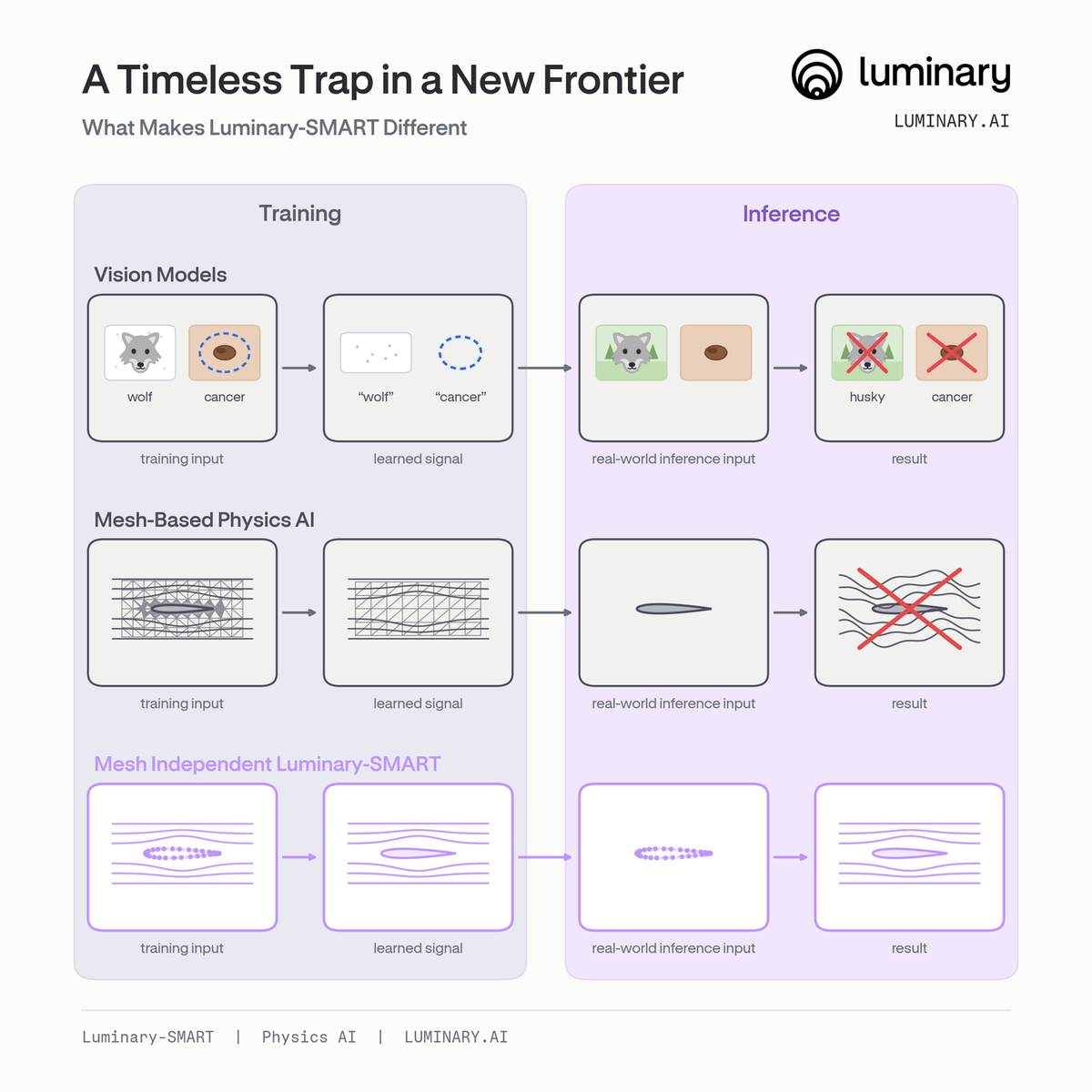
One of the oldest problems in machine learning is also one of the hardest to catch, and to fix: a model can look brilliant on every test you give it and still have learned the wrong thing entirely.
The canonical cautionary tale in deep learning is of a skin-cancer detector that turned out to be keying on the surgical ink doctors draw around suspicious moles: put the same surgical marks on a healthy mole and the model would call it cancer. Another famous example could tell huskies from wolves with high accuracy, until someone realized the model had really just learned to spot snow in the background of wolf images. The training metrics on those models looked great, right up until the shortcut went away. Working closely with our customers, we ran into Physics AI’s own versions of exactly this problem, and one of the most significant shortcuts we identified is the mesh that accompanies each simulation in the training dataset.
Most Physics AI models are trained on high-fidelity simulation data that live on detailed meshes spanning tens or hundreds of millions of cells. These meshes are often adaptively refined where the physics is the hardest, with cells packed tightly around the features that drive the results, like boundary layers, shocks, and wakes. That makes the mesh a “cheat sheet” for where the important physics lives, and a model trained on that data can quietly grow dependent on it, learning to read the mesh rather than the underlying physics. And, because validation test data is also served with the same detailed meshes, everything looks great in training: the evaluation metrics are high, the error is low, and the model looks finished and ready to deploy.
The real test comes later, when the model meets the real world. At inference, that detailed mesh isn’t there: a customer just uploads a raw geometry file, and a model that relied on the mesh as its “cheat sheet” has nothing left to lean on. The accuracy that looked so strong in training falls apart in the same way the skin-cancer and husky-wolf detectors did: it learned the wrong signal, and that signal isn’t available outside of training. It’s a significant reason why so many models that look so impressive in papers end up disappointing once they’re actually deployed.
And this isn’t really a failure of capability. GeoTransolver, for one, is a powerful architecture. The transformer at its core can learn an enormous amount, and we’ve pushed it hard on our custom GeoTransolver. But that learning power only helps if it’s pointed at the right thing. A mesh-based model spends much of it on the mesh, mastering every detail of the meshes it’s trained on, while almost none of that turns into real physical insight. It’s a bit like becoming an expert at spotting snow, or surgical ink: extraordinary at the shortcut, but no closer to the actual task.
Luminary-SMART is built to learn the underlying physics, and getting there took a structural change to capture the physical signal itself, not the mesh around it. Instead of consuming a mesh, Luminary-SMART reads the raw geometry as a cloud of surface points. An encoder distills that point cloud into a compact set of learned geometry tokens, re-sampling different points at every layer so it never leans on any one set of points. Inference does the same thing. It samples points off the raw geometry, builds geometry tokens the same way, then queries them at any location where you want a prediction. Because the query points don’t depend on one another, it can resolve the field at any resolution, from a coarse preview to millions of points. The result is a model that isn’t thrown off by a tessellation it has never seen: a different mesh or a raw file all look the same to it. And since none of its capacity goes to memorizing meshes, it can learn the underlying physics.
The Two Foundations Behind Luminary-SMART
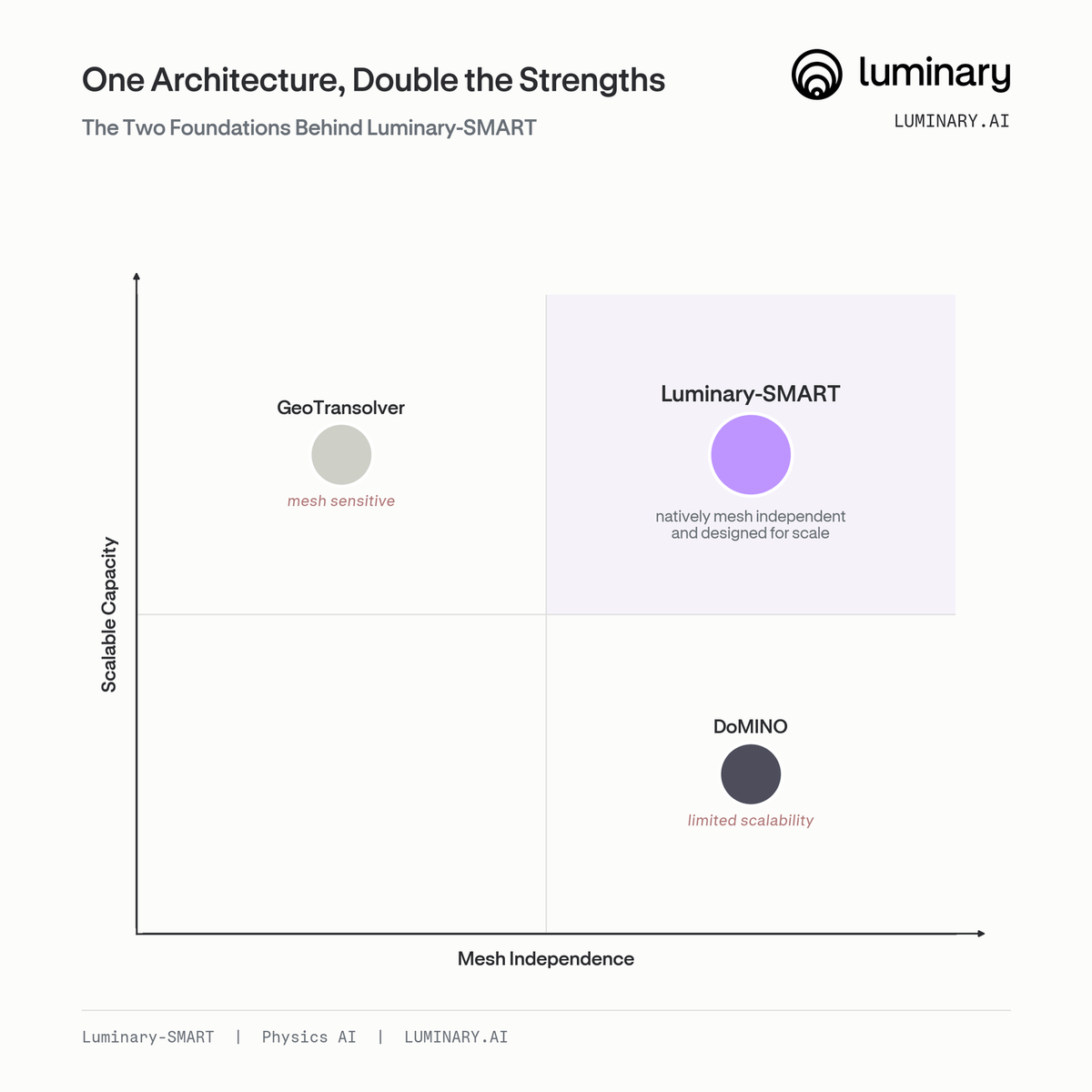
To learn the physics instead of the mesh, Luminary-SMART draws on two strengths we spent years developing in our earlier work: mesh independence, which we honed on DoMINO, and scalability, which we refined on GeoTransolver. DoMINO, like Luminary-SMART, operates on a point cloud rather than a mesh, which already gave it a basic form of mesh independence. Seeing its potential to learn independent of the mesh, we pushed it further with sharper point sampling, generalization across flow conditions, stronger accuracy in the hardest flow regimes, and a production-level foundation, among other improvements.
Enhancing DoMINO for Robust Mesh Independence
| Capability | Open Source DoMINO | Luminary-DoMINO |
|---|---|---|
| Foundation | Research point-cloud neural operator | Production hardened on Luminary’s training and serving platform: KServe inference, geometry encoding cache |
| Hardest flow regimes (high-speed, separated) | Struggles off the shelf | Log-scaled targets and retuned sampling for adaptively refined meshes to keep predictions accurate |
| Generalizing across conditions | Limited | Global parameter encodings natively built in |
| Geometry encoding | Single-scale SDF | Multi-scale SDF encoding and retuned ball query neighborhoods for fine and far field detail |
| Production readiness | Research codebase | Fine-tuning, uncertainty quantification, and out-of-distribution detection built in, plus VPC, on-prem, and ITAR-compliant deployments |
GeoTransolver brought a complementary strength. With a transformer at its core, it was made for massive scale. Building on what we learned from our SHIFT and customer work, we leaned into its capacity to learn with our own architectural changes, unlocking up to 10x gains in accuracy.
Redeveloping GeoTransolver for Massively Scaled Learning
| Capability | Open Source GeoTransolver | Luminary-GeoTransolver |
|---|---|---|
| Multi-scale geometry understanding | Two scales only | 4 spatial scales plus a region-of-interest filter: fine surface detail and far-field context, focused where it matters |
| Generalizing across operating conditions | One model per condition | Native global parameter conditioning (FiLM and related) |
| Accuracy on integrated quantities | Per-point fields only, no direct force/moment | A dedicated force/moment head and area-weighted integral loss, trained on the quantities engineers design to |
| Model capacity & training | Limiting baseline capacity | 5× layers, 4× slices, training with the Muon optimizer |
| Production readiness | Research codebase | Served, versioned, and scaled on Luminary’s platform, including VPC, on-prem, and ITAR-compliant deployments |
Even after all that work, each model still carried the other’s weakness. DoMINO, for all our tuning, could never scale the way a transformer-native architecture like GeoTransolver can. And GeoTransolver, despite our work on its mesh sensitivity, never matched DoMINO’s robust mesh independence. So rather than continuing to retrofit either one, we turned to an architecture built to deliver both at once: SMART. Luminary-SMART is our proprietary, clean-room implementation of it, taken forward with the best practices we developed across DoMINO and GeoTransolver. Mesh independence and scalable capacity are native to the architecture, which is why Luminary-SMART wins on both fronts. As our results below show, it beats DoMINO on mesh independence, and it beats GeoTransolver on accuracy at a smaller scale. Neither architecture before it did both.
Bridging SMART from Research to Production
| Capability | SMART (research paper) | Luminary-SMART |
|---|---|---|
| Multiphysics breadth | Has only been demonstrated on external aerodynamics | Supports multiple physics disciplines including external and internal aerodynamics, conjugate heat transfer, structural analysis, and more |
| Model confidence | Little to no model confidence functionality | Comprehensive model confidence suite including out of distribution detection and uncertainty quantification |
| Data consumption | No integrated ingestion or dataset management | Vertically integrated with Luminary’s data lake: train on synthetic, external-solver, and experimental data in one place |
| Production-grade engineering | Research grade implementation | Enterprise level implementation with Luminary best practices, including a 60% throughput gain in training over baseline clean room implementation |
| Enterprise deployment | Public code. No managed, compliant, or air-gapped path | SaaS, VPC, and on-prem/air-gapped deployment, including an ITAR-compliant edition |
| Commercial use | Released under the PolyForm Noncommercial License 1.0.0 | Available for commercial use as part of Luminary’s platform |
Benchmarking Luminary-SMART
A benchmark is only as good as the problems it represents. Because we work on real customer problems every day, we built the SHIFT datasets to explore the difficult problem spaces encountered in industry, from subsonic to supersonic, and from structural analysis to heat transfer. Aggregated into our internal benchmark suite, they span both public and internal datasets, and for this release we’re sharing how Luminary-SMART performed across a representative set of them.
We’ll also show where today’s benchmarking falls short, and how Luminary-SMART pulls ahead on what actually matters to end users. One note on the baselines: every comparison below is against Luminary’s own enhanced DoMINO and GeoTransolver, labeled Luminary-DoMINO and Luminary-GeoTransolver, not the stock open source versions. These variants already outperform vanilla open source, so the gaps only widen against the versions most teams actually run.
Model Training Metrics
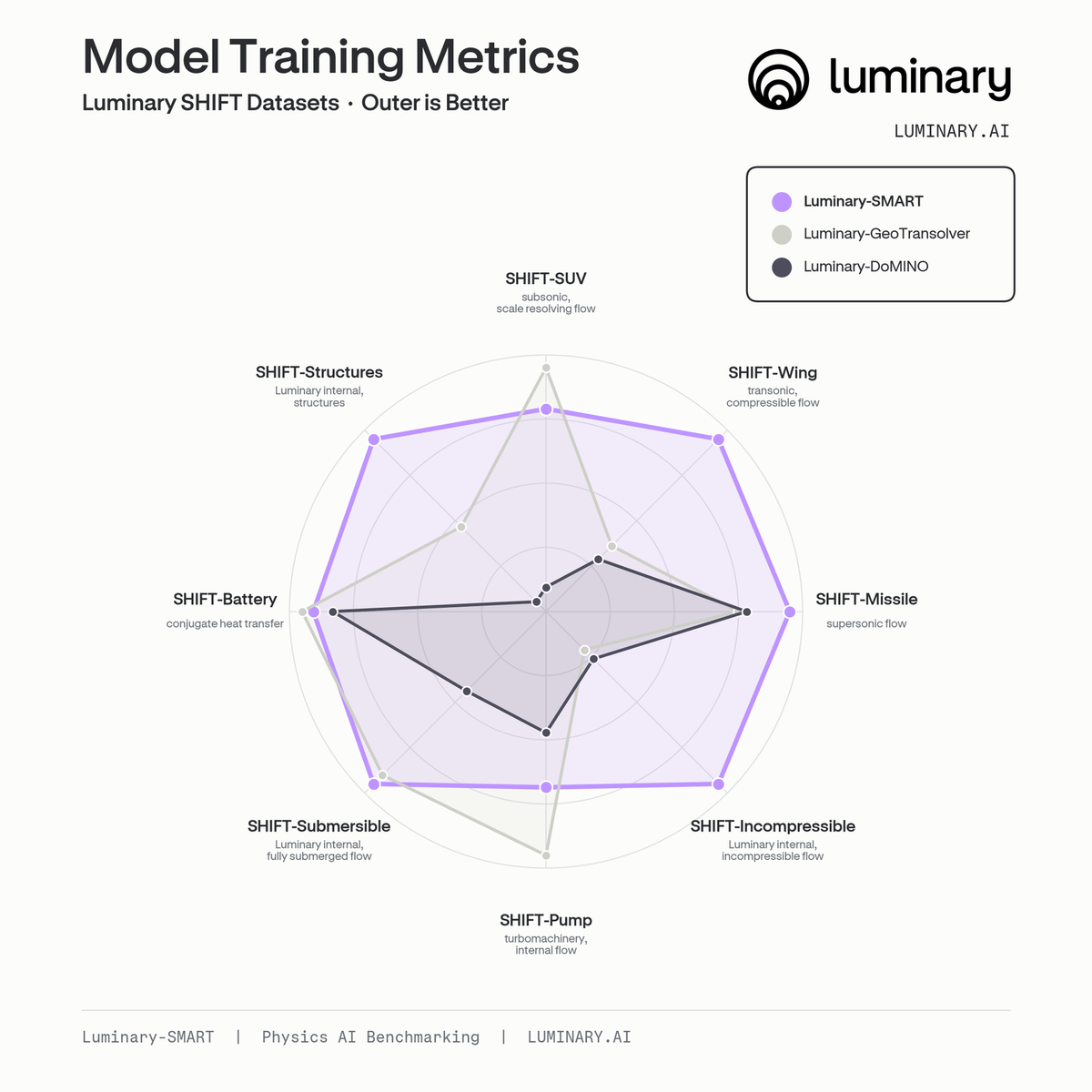
Training metrics like R² and relative L2 error are the usual way to judge model quality in machine learning, and most of the time they point in the right direction. But as we’ve noted, a lot gets lost between the lines. Luminary-SMART leads on 5 of the 8 SHIFT datasets, with Luminary-GeoTransolver taking the other 3. At face value, that reads as Luminary-SMART ahead more often than not, with Luminary-GeoTransolver holding its own on the rest. A solid result, but not yet the full story.
Quantities of Interest
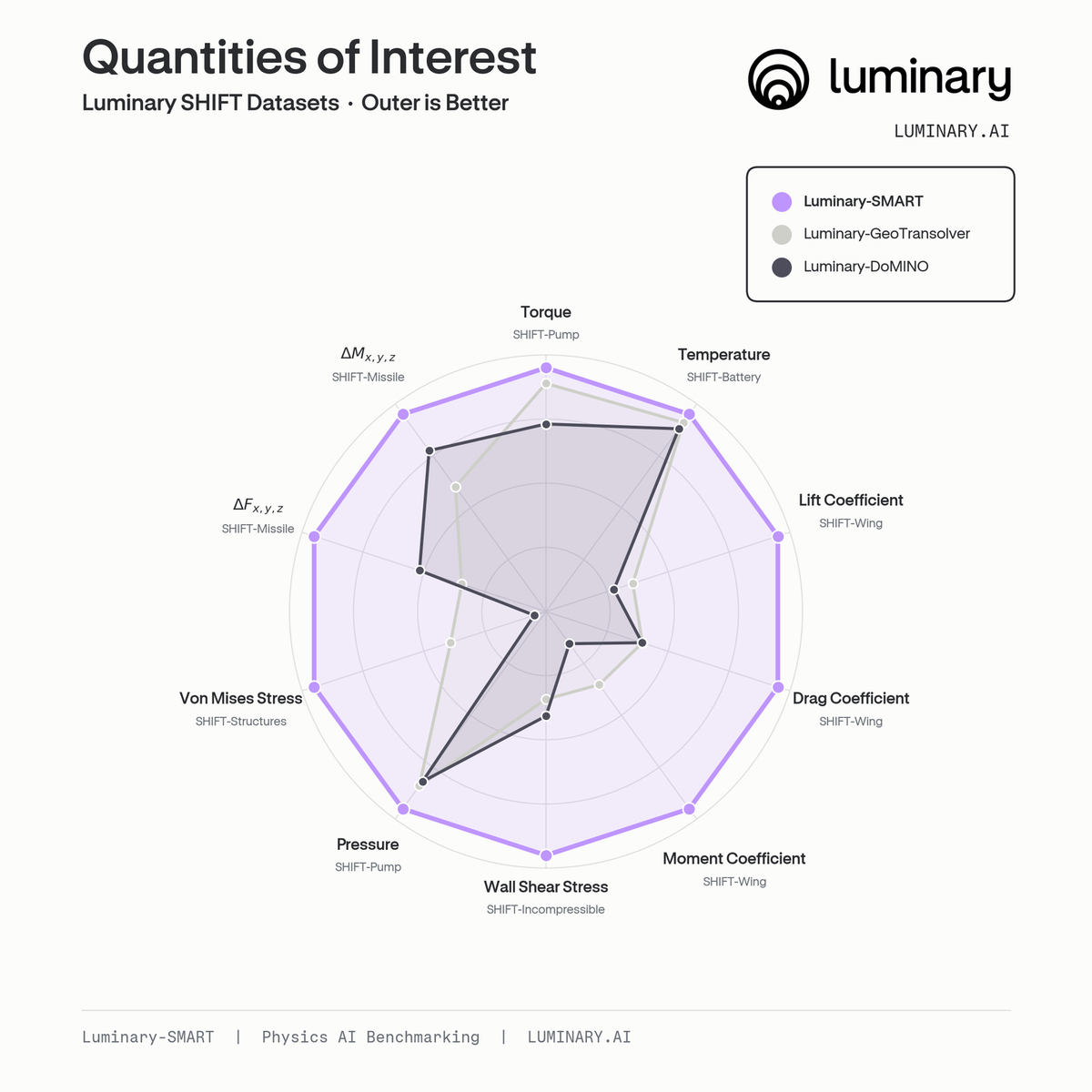
However, when we look at the quantities of interest, the fields and integrated results engineers actually design to, the picture changes. Across 10 quantities of interest, Luminary-SMART dominates, and Luminary-DoMINO, which trailed on the training metrics, pulls right up alongside Luminary-GeoTransolver. So, why the large gap between the training metrics and what actually matters at inference?
Mesh Dependence at Inference
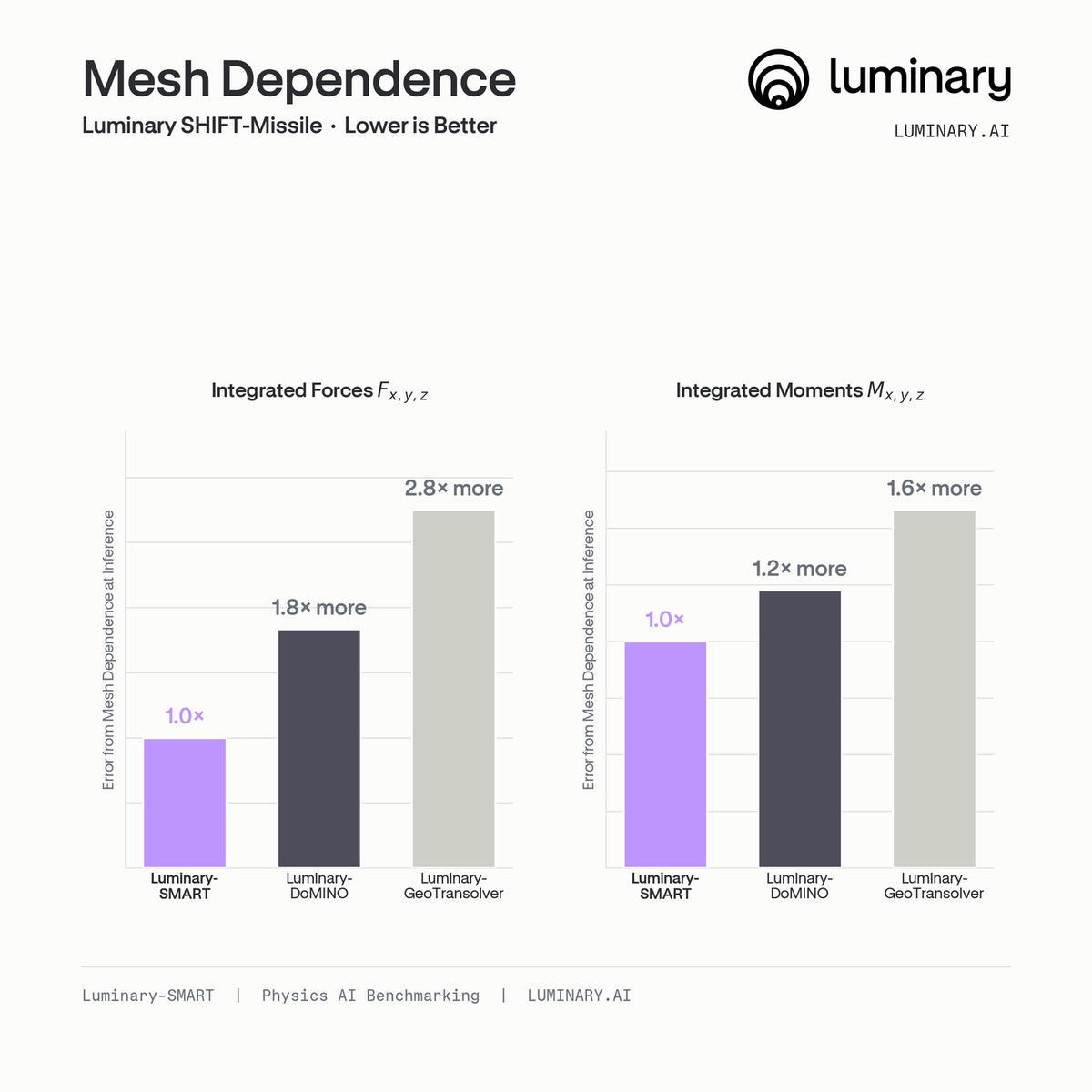
The reason comes down to mesh dependence. In training, the models learn and are tested on high-fidelity simulations and their corresponding meshes. But, strong training metrics can be misleading and push teams to deploy models that look ready but aren’t. The reason is straightforward: at inference those meshes are gone. A customer just feeds in a raw geometry, like an STL file. And because every training metric looked excellent, the breakdown is baffling on both sides: neither the customer nor the model provider has a clear reason why a model that scored so well suddenly falls apart. It’s the same silent failure that made the skin-cancer and husky-wolf detectors so hard to catch.
We can measure this directly. We take the same geometries each model was trained on, strip the mesh, and feed them back at inference as raw geometry files, then look at how far the predictions move. The less they move, the less the model was leaning on the mesh to begin with. On the supersonic SHIFT-Missile dataset, the predictions from Luminary-GeoTransolver shift 2.8× more than Luminary-SMART’s on the integrated forces, and 1.6× more on the integrated moments. And that’s the easy case: change the geometry tessellation, resolution, or hand it a different file encoding like an .STEP, .x_t, or another CAD format, and the gap only widens.
This is the mismatch we keep coming back to. The model training numbers reported in papers look great, but the gap shows up at inference when deployed to customers. Moreover, when a paper is comparing an R² of 99.98 against 99.95, that difference is already close to meaningless, and it matters even less once you realize the metric is measuring the wrong thing altogether.
Inference Speed
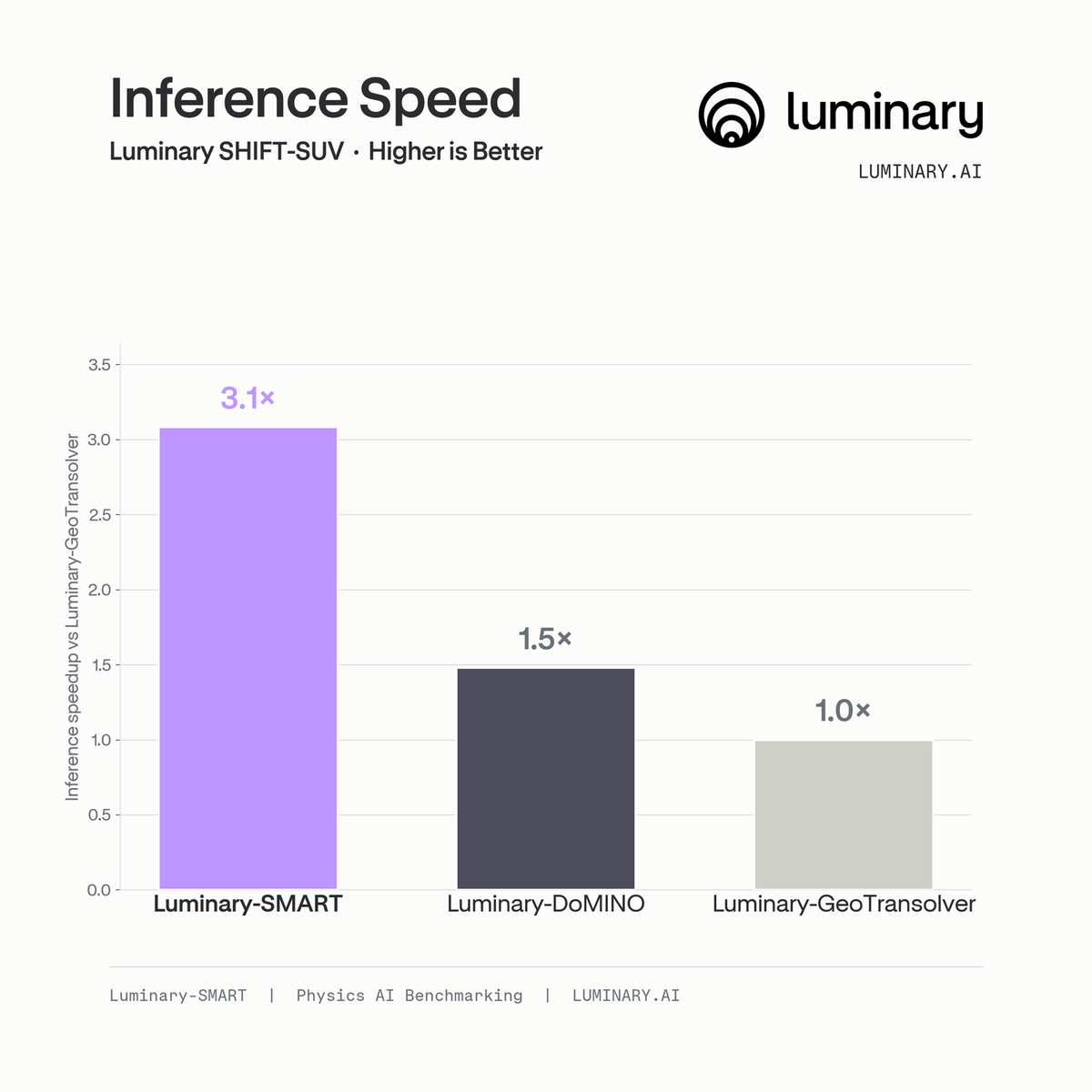
In addition to its leading results in prediction accuracy and mesh independence, Luminary-SMART also outperforms at inference speed. On SHIFT-SUV, Luminary-SMART runs inference up to 3.1× faster than Luminary-GeoTransolver on the same modest hardware. Much of that comes from its design choice: because Luminary-SMART spends its capacity on the physics rather than the mesh, it does more with a smaller, leaner model. That advantage compounds for anything that needs many inferences calls, like building an aerodynamic database, and for low-latency uses like in-flight monitors, motor controls, and other real-time, in-the-loop applications.
Training Time
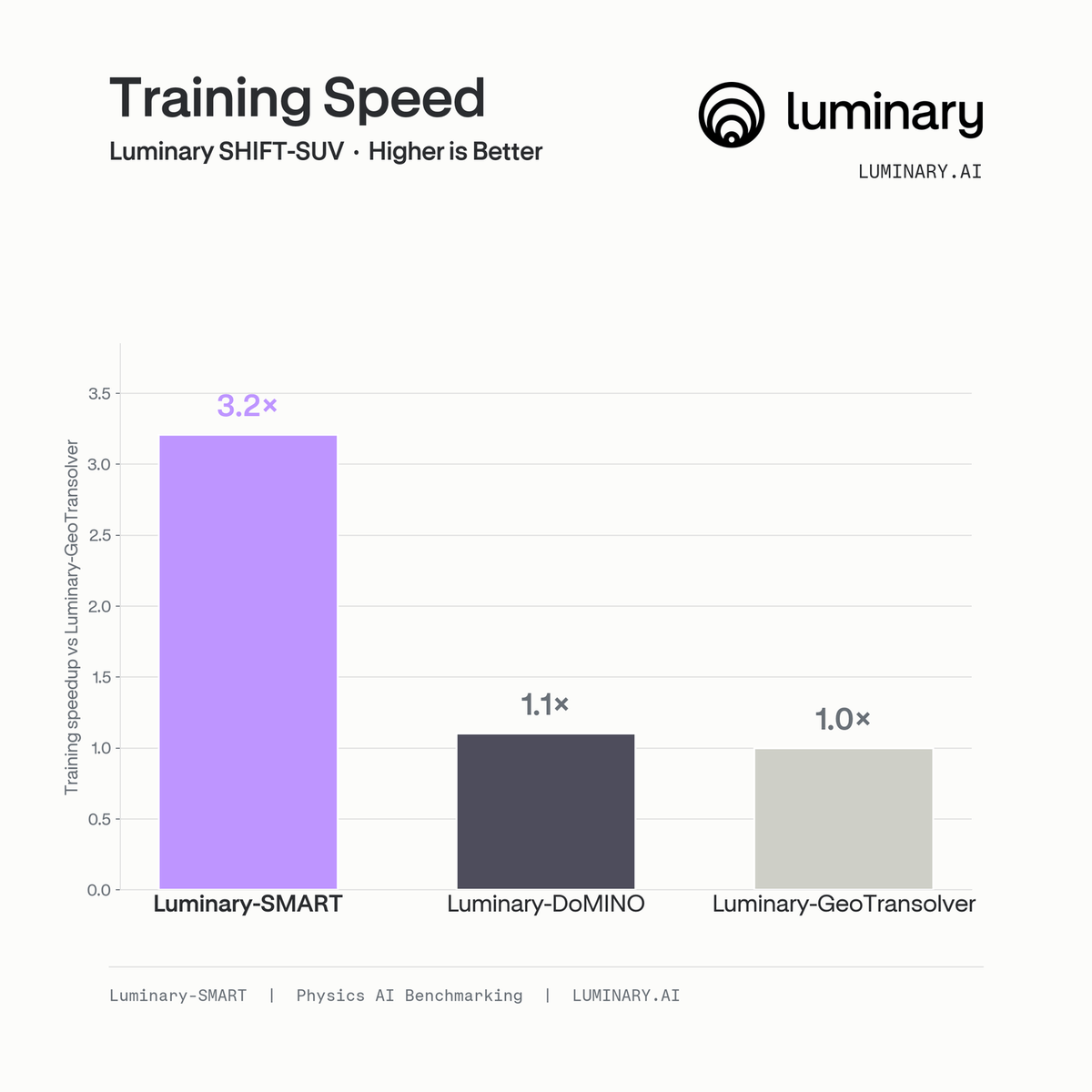
Last is training time. On SHIFT-SUV, Luminary-SMART trains up to 3.2× faster than Luminary-GeoTransolver on the same modest hardware, finishing in just a few GPU hours. That speed lets model iteration, fine-tuning, and transfer learning all fit inside already unrelenting engineering cycles, putting accurate results in engineers’ hands sooner than ever before.
The Path Forward
Just over a year ago, we released our first Physics AI models, SHIFT-SUV and SHIFT-Wing, to explore the bounds of what’s possible with today’s technology. In the year since, we’ve built a deep and growing library of datasets, shipped leading models across some of the most challenging physics and flow regimes, and solved real problems for our customers.
Much of this comes from compounding interest: we push frontier Physics AI research, break it on increasingly challenging applications with our customers, refine it with new datasets, then do it all again. Luminary-SMART has already been in customers’ hands for months now, and we’ve been learning faster than ever where it breaks down and where it shines. It’s one of a number of architectures we’ve brought to the market, and we’re already experimenting with others. Backed by some of the most comprehensive datasets in the world, each release compounds into the next.
Curious to learn what it can do for you? Talk to our team today to see what Luminary-SMART can do for your hardest problems.