Physics AI is the use of neural networks, usually trained on a library of simulation results, to predict fields and engineering quantities in seconds, where the solver run behind each training case may take hours. These networks are the latest generation of surrogate model, a lineage that starts with response surfaces in 1951. Each generation was sized to the engineering question of its time: a few design variables mapped to a few scalar outputs, then full fields for one geometry family, then fields over arbitrary geometry.
A Large Physics Model (LPM) is a neural network trained on simulation data spanning many geometry families, physical regimes and operating conditions, and applied across that range without retraining from scratch. LPMs are built to scale with data: adding simulations to the training library widens the range a single model covers, and in published pickup-truck results, validation loss fell along a power law as the training set grew from 100 to 613 simulations (SHIFT-Truck). The architectures that make this possible took shape between 2019 and 2024.
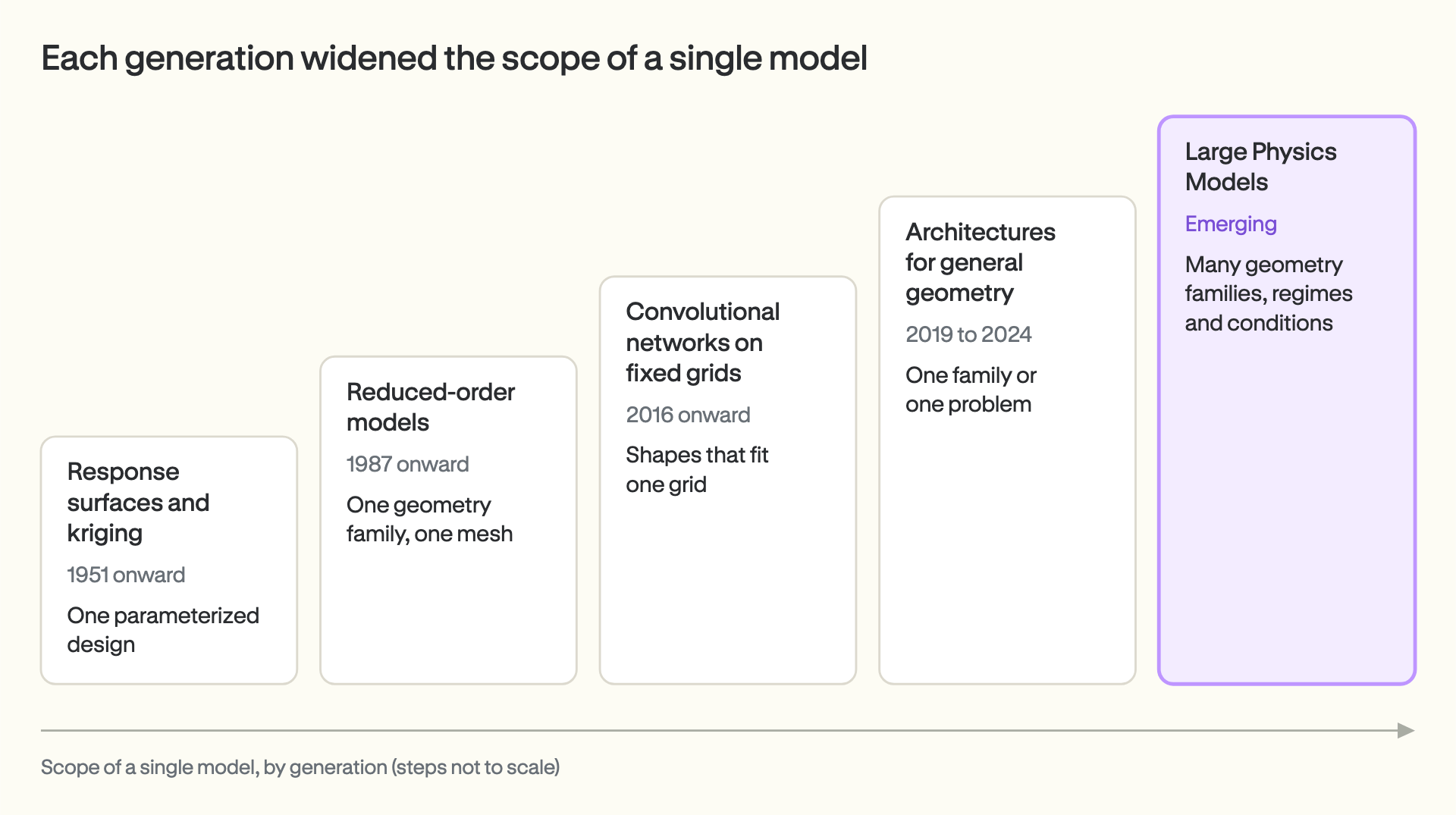
Earlier surrogates, sized to smaller questions
Response surfaces (Box and Wilson, 1951) and kriging (Sacks et al., 1989) fit a smooth function to a few dozen solver runs, mapping a handful of design parameters to scalar outputs such as drag or peak stress. They suit a single parameterized design study, and a new geometry family needs a new model.
Reduced-order models built on proper orthogonal decomposition (Sirovich, 1987) moved from scalars to full fields, predicting a solution as a weighted sum of modes extracted from earlier runs. Those modes belong to one mesh and one geometry family.
Convolutional neural networks (Guo, Li and Iorio, 2016) brought deep learning in by treating geometry as an image on a regular grid, which lets the shape change. A uniform 3D grid fine enough for industrial geometry is expensive to store and train on, which kept these models to simpler shapes.
Each of these methods ties a model to one design space, defined by a parameterization, a mesh or a grid. A new geometry family, a finer mesh or a different flow regime means generating new training data and fitting a new model, and the simulations behind one model do not carry over to the next. Large Physics Models address that limitation with one model trained across many design spaces, whose range grows with its training data and whose weights can start the model for a new design class. That approach requires architectures that accept any mesh, handle millions of points and learn efficiently from expensive simulation data.
Pieces that Large Physics Models combine
Four architecture families published between 2019 and 2024 supply those capabilities, and Large Physics Models combine ideas from them in different ways.
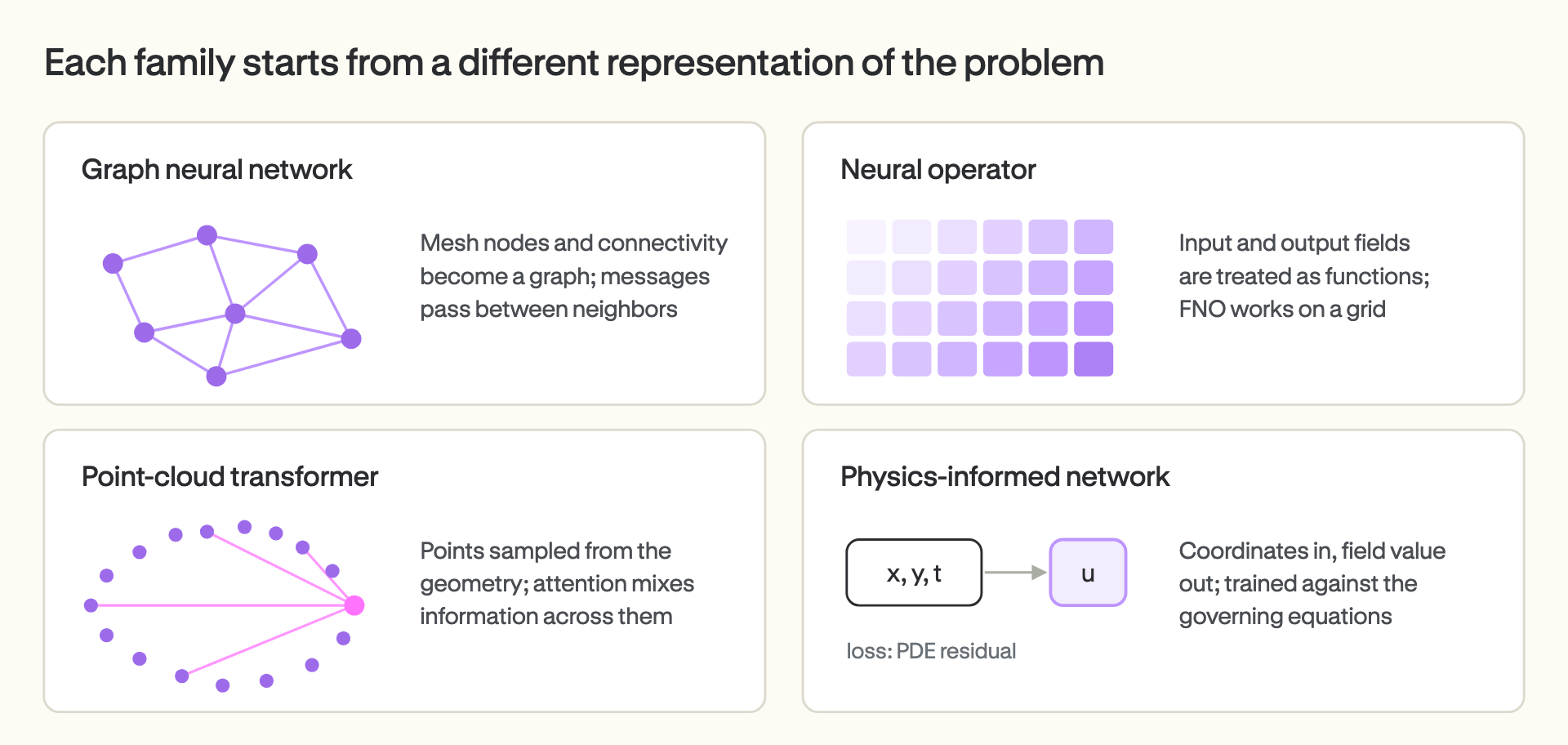
- Scale, from transformers. Point-cloud transformers such as Transolver (Wu et al., 2024) predict fields at points sampled from the geometry and use attention to share information across the whole domain. Grouping the points into a much smaller set of learned tokens makes the cost of attention grow linearly with the number of points rather than with its square.
- Data efficiency, from physics-informed training. Physics-informed neural networks (Raissi et al., 2019) add the residual of the governing equations to the training loss. Added to a data-driven model, the same term penalizes predictions that violate the equations, which can reduce how much simulation data the model needs.
- Mappings between functions, from neural operators. FNO (Li et al., 2021), DeepONet (Lu et al., 2021) and GINO (Li et al., 2023) learn a map from input fields to output fields, so the learned map is not tied to one discretization of the domain. GINO extends the approach to irregular 3D geometry.
- Local detail, from graph neural networks. MeshGraphNets (Pfaff et al., 2021) pass information between neighboring nodes on the simulation mesh, which suits local interactions such as flow around a sharp edge.
Large Physics Models
Any of these families can sit inside a Large Physics Model. What makes a model an LPM is its training data and its range: libraries of thousands of high-fidelity simulations, such as the more than 1,000 DES simulations behind SHIFT-SUV and the more than 3,000 RANS simulations behind SHIFT-Wing, and predictions across the geometry families, regimes and conditions that the library spans.
A response surface answers one question about one design. An LPM is expected to answer many questions about many designs: a new shape, a new operating condition, a different regime within its training range. Its training distribution sets the envelope, and a high-fidelity solve remains the check near the edge of that envelope and for final design decisions.
The transformer (Vaswani et al., 2017), the architecture behind large language models (LLMs), is the current frontier for LPM architectures, and it shows what applying an architecture to physics takes. The transformer was built for sequences of text tokens, and an LLM learns from trillions of them. Simulation data arrives as continuous fields on irregular meshes with millions of points, and each training case costs hours of compute. An engineering workflow also needs the same design to return the same prediction on every run, where an LLM samples its output from a probability distribution. Each of these differences calls for its own innovation in how the architecture is built and trained.
Where the architectures go next: Physics AI DevDay
Those innovations are an active research area, with directions that range from mesh-independent transformers to joint-embedding predictive architectures (JEPA), which predict in a learned latent space instead of reconstructing every field value. Physics AI DevDay is a chance to hear from the Physics AI researchers at Luminary who work on these questions, in technical deep dives, a guided hands-on workshop and an open AMA.
- When: Nov 17, 2026, 9:00 AM to 2:30 PM PT, with the hands-on workshop from 1:00 to 2:30 PM PT