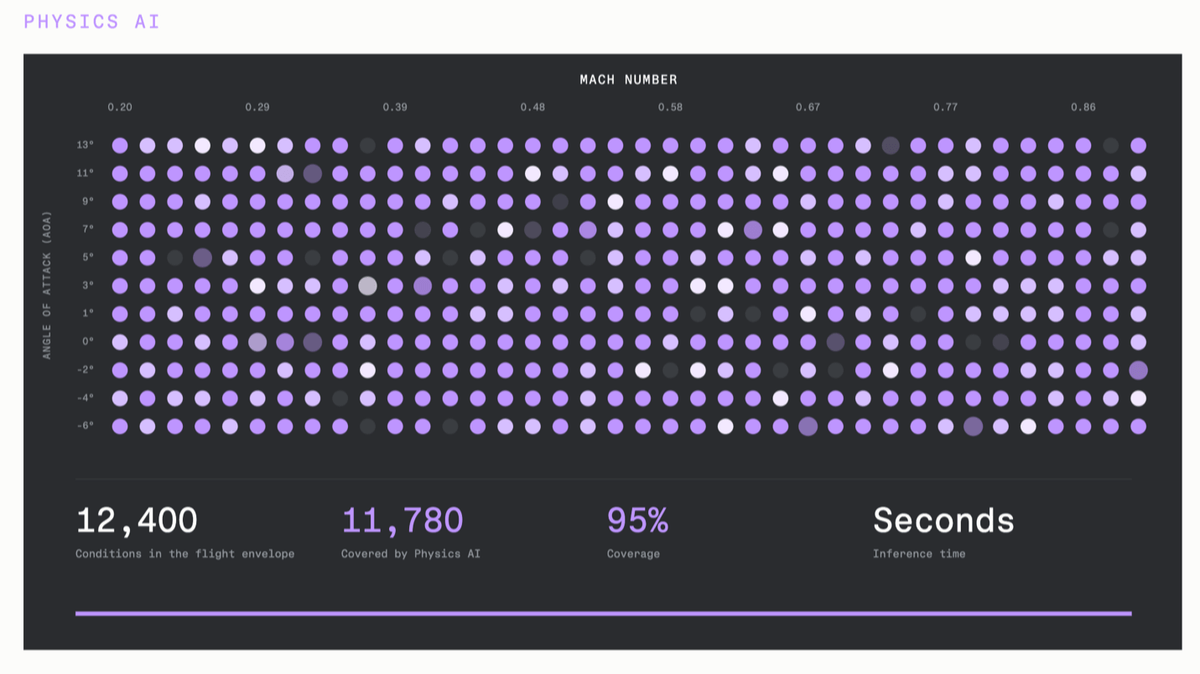
For the last twenty years, engineering software evolved incrementally. Simulation got faster. Hardware got more powerful. But confirming that a design actually works under real-world conditions still meant the same slow, expensive workflow: manual geometry cleanup, meshing, solver setup, and specialized expertise, no matter how much compute you threw at it. That era is ending. Physics AI is shifting verification from a workflow built around running simulations to one built around predicting outcomes directly. As that shift accelerates, the organizations that succeed won’t just have the best model. They’ll have a platform that continuously produces better ones.
That shift didn’t appear out of nowhere. The last time engineering verification changed this much was the transition from physical wind tunnels and prototypes to high-fidelity simulation, which lowered cost, raised agility, and made CPU-based physics solvers the default way to evaluate a design before building it. Since then, the primary focus has been on improving the same basic simulation loop: better meshes, faster solvers, bigger clusters.
Two new waves are breaking that loop. GPU-native solvers have emerged as an important shift in engineering computing, taking advantage of massively parallel architectures to run simulations over 100 times faster than CPU-based solvers, dramatically compressing the verification loop. Separately, the transformer-based wave reshaping enterprise software has been leveraged to predict the physics that impact engineered systems. By the end of Q1 2026, neural operators that generalize beyond interpolation, span multiple types of physics, obey scaling laws, and deliver very high accuracy had entered customer conversations. Together, the two waves point to the same inflection: verification is moving from something engineers accomplish with simulation to something a model predicts.
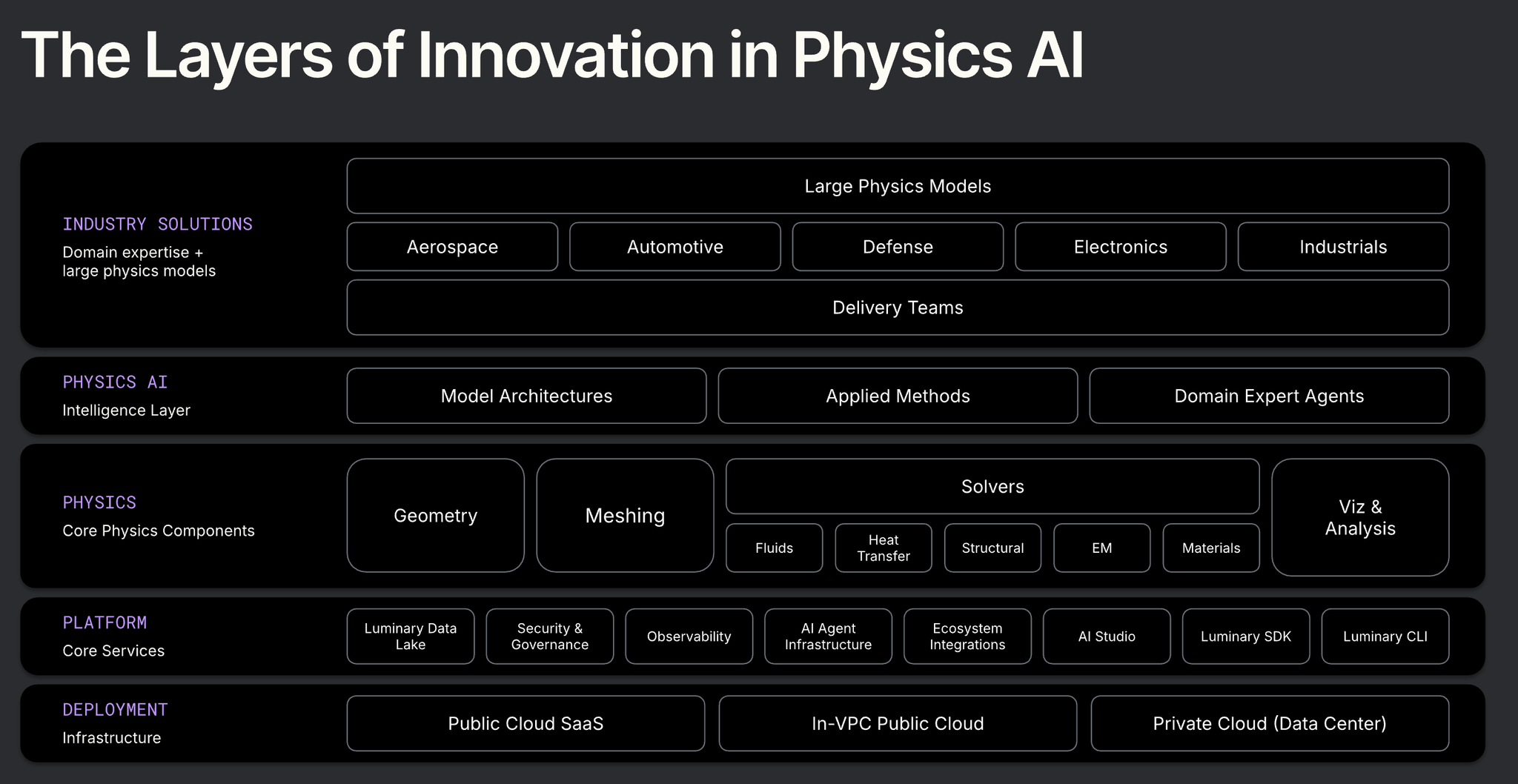
That inflection resembles an earlier one in enterprise software: the shift from single-purpose analytics tools to integrated data platforms. In both cases, value compounds for whoever accumulates the most usable data, since every dataset either trains new models or makes existing ones more accurate. That pattern is repeating in physics AI. Early in the cycle, the distinction that matters isn’t which model wins a given benchmark, but which technology stack is best positioned to turn simulation, test, and operational data into steadily improving predictions across a product line. Point solutions can excel at specific tasks, but integrated platforms are better positioned to compound and improve over time. What follows is a breakdown of Luminary’s Physics AI stack, layer by layer, and why each layer matters.
Deployment Infrastructure

Engineering design spans everything from a dishwasher to a reusable rocket, so a Physics AI platform has to meet customers wherever their workloads run: air-gapped, inside an enterprise’s own cloud, or hosted as SaaS for prototyping without heavy infrastructure investment. That deployment choice often determines whether the platform is adoptable at all.
Platform

The platform layer is what a CIO thinks of as providing peace of mind. It centers on a data lake with rich metadata, since experimental and simulation data are both valuable for training future models and grounding existing ones. Around that lake sit the standard enterprise requirements: security, governance, observability, and integration into the tools where engineering design actually happens. Increasingly it also has to support agent infrastructure, since letting long-running agents make decisions autonomously is no longer optional for a serious AI platform. The goal is to keep engineering data governed in one place and under customer control.
The Physics Layer

If the first two layers determine whether a platform can be adopted, this is where architectural decisions begin to matter most. It must support design optimization by sweeping shape families from a single base geometry, automate away manual, time-consuming meshing, and provide engineers with visualization tools purpose-built for synthetic data and inference results, rather than forcing analysis off-platform.
At the center sits a suite of GPU-native solvers, the source of the data every Physics AI model depends on. Solvers that scale horizontally and deliver highly accurate simulations are foundational to a modern Physics AI Stack. Coverage across fluid dynamics, acoustics, thermal, electromagnetics, and structural mechanics is what separates a complete platform from a single-physics point solution.
The Physics AI Layer

This is the layer that separates a traditional machine learning platform from a Physics AI company. The model architecture, whether based on neural operators, transformers, or something newer, directly shapes whether a customer can hit target accuracy and scale, so the stack needs to absorb new architectures as the field moves.
Just as important is model confidence: returning uncertainty alongside a prediction, flagging where a model is least certain, and catching out-of-distribution inputs before they produce a confident-looking wrong answer. Those uncertain regions are exactly where targeted retraining pays off, which is why owning the solver layer matters so much. It remains one of the most active research areas in Physics AI and the hinge on which autonomous improvement relies.
Coordinating experts across physics domains, aerodynamics, structures, thermal, has always been one of engineering’s biggest bottlenecks. Domain-expert agents that learn continuously, handling both the repetitive work and increasingly supporting sophisticated engineering tasks, are starting to change that.
Domain-Specific Large Physics Models

Crashworthiness illustrates the pattern. NHTSA publishes a crash database specifically to support engineering analysis of crash testing. A Physics AI model that draws on that data, generates synthetic data across a large population of vehicles, and combines the two into one broad model can make evaluating a new vehicle’s crashworthiness nearly trivial, since the model already covers a design space large enough to include it.
Crash is only one example. The same pattern, domain-specific models across aerospace, automotive, defense, and electronics thermal management, are the natural starting points for solving real customer problems, and will increasingly drive adoption.
Delivery Teams
None of this deploys itself. Turning a Physics AI stack into working engineering solutions still requires people with deep physics and industry expertise embedded alongside customers, at least until organizations build that capacity themselves.
The Continuous Learning Advantage of Physics AI
The basic economic case for a Physics AI model is straightforward: it replaces simulation runs that are slow and expensive in time, cost, and expertise with a model trained on enough real and synthetic data to match or exceed simulation accuracy while providing predictions in seconds, at near zero marginal cost. The larger opportunity is a continuous learning system that keeps improving those models over time, so every engineering project becomes an investment in the next one. When that happens, model predictions can then be leveraged at scale to engineer better products in a fraction of the time.
Turning that promise into a reliable, repeatable system is why the stack needs a continuous learning architecture built as an integrated whole rather than assembled from parts. The loop runs like this: solvers generate high-fidelity synthetic data, that data combines with real-world data to train models in the Physics AI layer, and those models return predictions with confidence scores. Where confidence is low or an input falls out of distribution, domain-expert agents commission new solver runs to fill the gap, improving the next generation of models. Those same agents automatically decide what to simulate, what to retrain, and when a model is trustworthy enough to put in front of an engineer. Over time, every engineering program contributes to the next, and the system becomes more accurate, more trusted, and more valuable with each iteration.
Every layer is load-bearing in that loop. The stack is only as strong as its weakest layer because each component plays a role in helping the system learn and improve over time. Remove the infrastructure layer and you cannot deploy where customers actually work. Remove the platform and you lose the data and governance the loop runs on. Remove high-quality, native solvers and the confidence signal has nothing to act on, so the models stop improving. At Luminary, this is the heart of our argument: in Physics AI, durable advantage lives in the system that keeps turning out better models, generation after generation, not in any single model.