
– PT
Physics AI
DevDay 2026
Use arrow keys to move the diffusion effect. Press Escape to clear it. The first DevDay dedicated to Physics AI. Explore the latest breakthroughs in Physics AI through a keynote, technical deep dives, and a hands-on workshop.
RegisterFeaturing
Physics.
Encoded in AI.
The platform for engineering teams building and operating Physics AI at scale.
Adopted by teams pushing engineering forward.





Luminary enables engineers to encode physics into AI, transforming how physical systems are designed, built, and operated. Teams can move faster, explore more possibilities, and make better decisions across the product lifecycle.

Physics AI is the next level of complexity in AI, and Northrop Grumman is bringing this technology to our design engineers to dramatically speed up hardware development.
Han Park, VP, AI Integration, Northrop Grumman Space Systems

The Physics AI solution built with the Luminary Cloud SHIFT-SUV foundation model and Blender integration provides immediate insights into vehicle performance that designers and engineers need.
Fong Loon Pan, Principal Aero Design Lead, Honda

By running our proprietary flight sciences on their platform, we're accelerating innovation and developing next-generation Physics-AI models across our design process.
Obi Ndu, Chief Information & Digital Officer, Otto Aviation
Physics AI is reshaping engineering.
Physical Verification in Real Time
In design or in live operation, verify how a system behaves in milliseconds instead of hours or days, with accuracy validated against high-fidelity simulation and physical test.
Explore More, Settle Less
Traditional simulation is too slow and costly to cover the full design space, so teams settle early. Explore far more of it at near-zero marginal cost and ship designs that perform better and fail less.
A Compounding Advantage
Encode your engineering expertise and physical data, including live operational data, into reusable models. Each program makes the models more accurate, and each model makes the next program faster.
From Data to Prediction
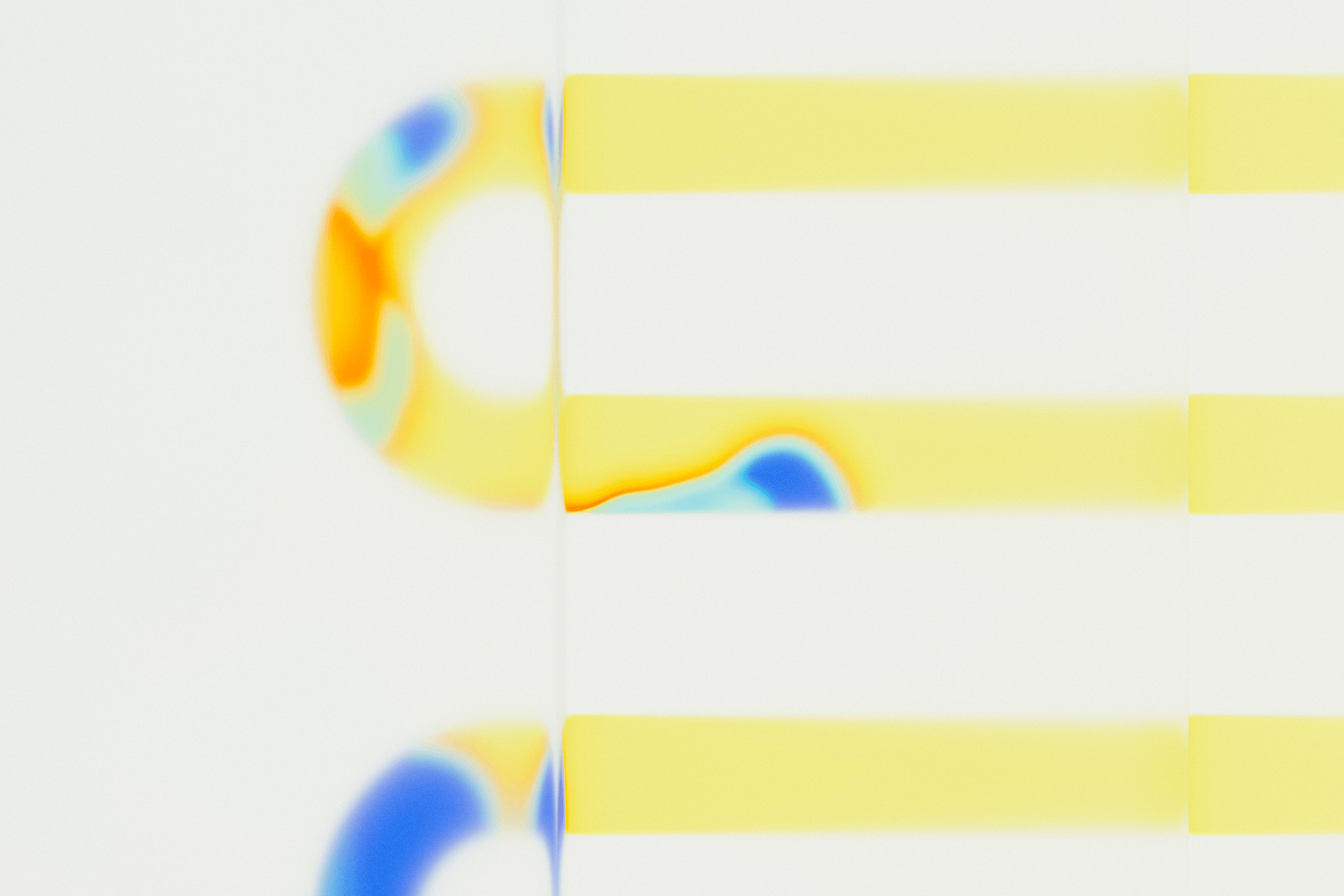
Trained on simulation, test, and operational data, Large Physics Models learn how designs flow, deform, heat, and move, then predict the behavior of a new design in less than a second.
Generate and Unify Data
Generate simulation, test, and operational data and curate into a unified dataset.
Train and Validate Models
Train models that encode the underlying physics of real systems, grounded in real-world data.
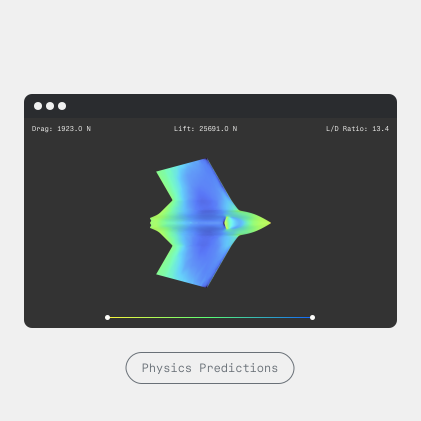
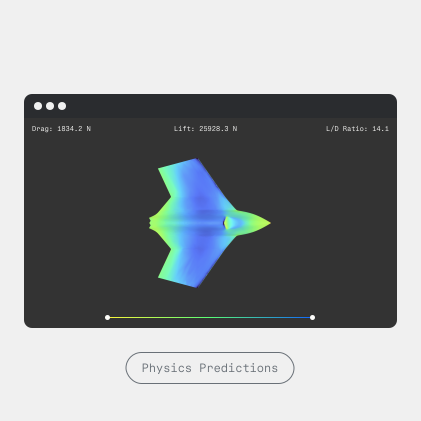
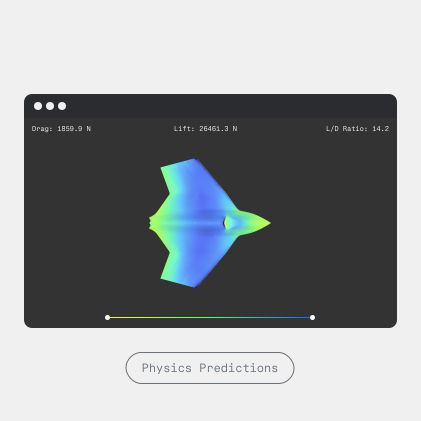
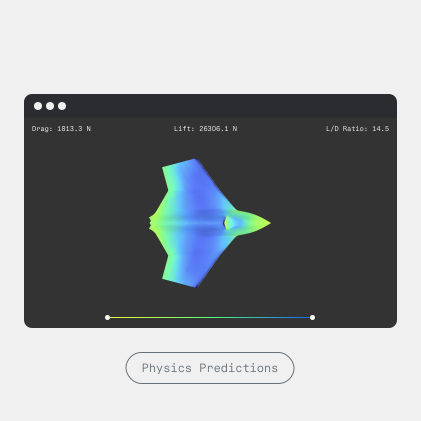
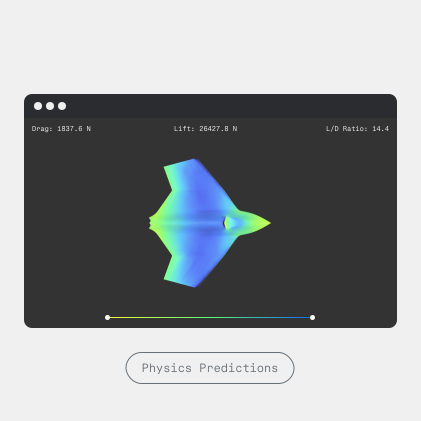
Rapidly Predict Physics
Rapidly generate accurate predictions of full physical fields to enable novel, high-impact applications.
Operating Physics AI in Production
Luminary's Physics AI Factory
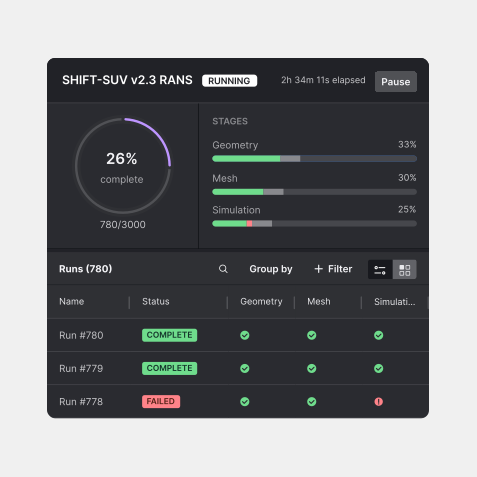
Comprehensive support for test, operational, and simulation data spanning structural, fluids, thermal, and electromagnetics.
Luminary's Physics AI Factory
Luminary connects data, model development, validation, deployment, and continuous retraining in one platform, giving teams a single system for operationalizing Physics AI.
Teams can train and validate models using state-of-the-art architectures, with evaluation, regression testing, and defined usage boundaries built into the development process.
APIs, SDKs, and Luminary's AI Assistant make it easier to embed Physics AI into the engineering tools and pipelines teams already use.
End-to-end traceability and model registry help teams understand what each model predicts, what data it used, what changed across releases, and where it is approved to run.
Built for high-stakes engineering environments.

Latest News
View newsroomLuminary-SMART: The New State of the Art Model Architecture for Large Physics Models
07.28.2026Why the Physics AI Technology Stack Matters More Than the Model
07.20.2026Why Physics AI Models Need to Be Anchored to Reality
06.03.2026The Work, and the People Who Do It
05.28.2026Luminary Launches SHIFT-Crash, the First Physics AI Model for Full-Vehicle Crash Prediction
04.14.2026Jeff Bezos plans to invest $100 billion to bring AI to factories. Here's what it means for jobs
03.24.2026Luminary Adopts NVIDIA GeoTransolver AI Model Architecture, Unlocking Up to 10x Greater Accuracy in Physics AI
03.16.2026Experience Physics AI.
Explore real world applications with live Physics AI predictions.