Pickup-truck aerodynamics directly affects fuel consumption and electric range. At highway speeds, aerodynamic drag accounts for roughly two-thirds of a light-duty vehicle’s tractive energy. Pickups have a frontal area of 3.0–3.5 m², compared with roughly 2.2 m² for a sedan. The aerodynamic penalty affects both combustion and battery-electric platforms.
Conventional vehicle programs take roughly 40–50 months from market research to start of production. Iteration between the design studio and the computational fluid dynamics (CFD) team accounts for a substantial part of that schedule. New entrants develop vehicles in roughly half that time, prompting established manufacturers to shorten their cycles. High-fidelity CFD can resolve truck aerodynamics. The challenge is delivering that feedback while designers can still change the geometry.
Where the design loop breaks
Early in a vehicle program, designers have considerable freedom to change the geometry. Changes are relatively inexpensive, but aerodynamic data is limited. More data becomes available as the program progresses. By then, surfaces may be frozen, tooling committed, and changes constrained by other systems.
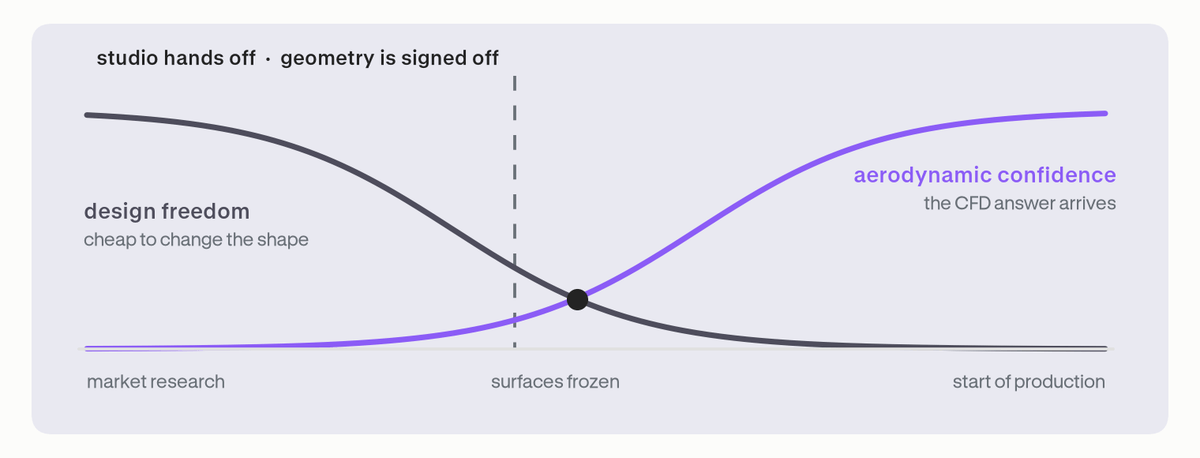
Figure 1. Design freedom and aerodynamic confidence across a vehicle program. The schematic places their intersection after the studio has signed off the geometry.
Design studios often generate geometry faster than CFD teams can evaluate it. Aerodynamic feedback can therefore arrive after a shape has been approved. Engineers identify problems, and designers revise geometry that was settled months earlier. This rework can continue for much of a year and gradually compromise the original design intent.
For pickups, several features that strongly affect drag are also central to styling. These include bed length, cab proportions, roof height, front-fascia clearance, and the presence of a bed cover. Designers adjust these features for many reasons beyond aerodynamics. They need aerodynamic feedback before those decisions become difficult to reverse.
Physics AI as an exploration engine
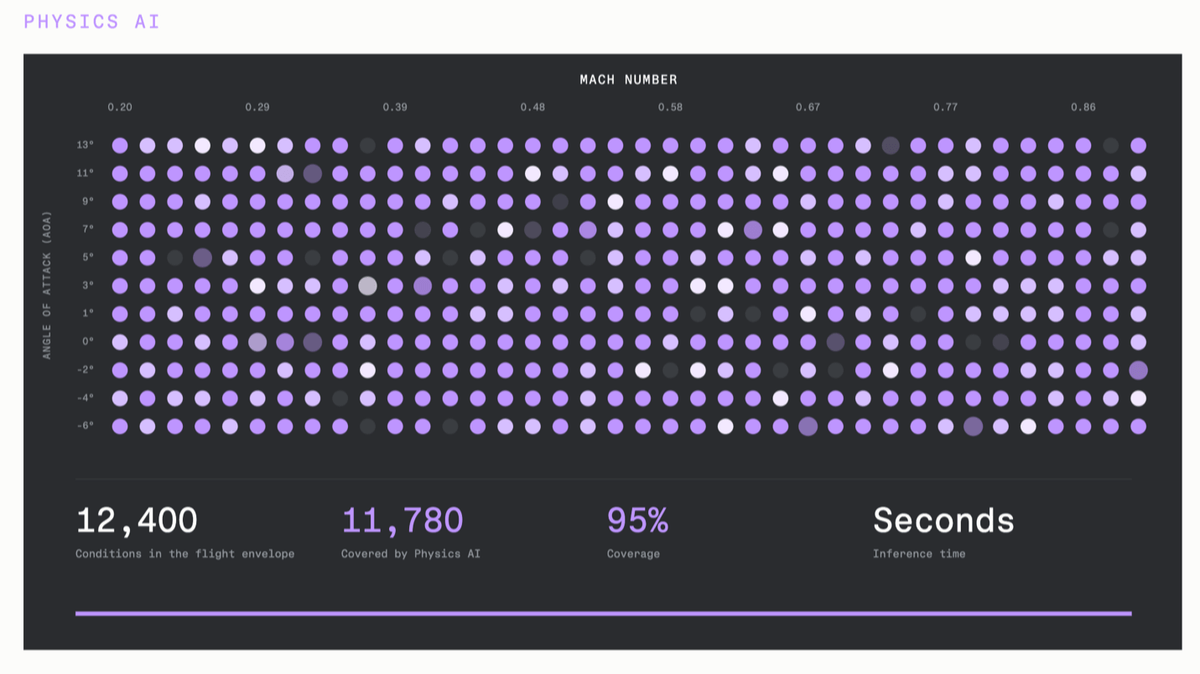
Physics AI uses high-fidelity simulations as training data. Once trained, a model predicts aerodynamic outputs for new geometries in seconds. The initial simulation cost is spread across many subsequent evaluations. High-fidelity CFD can then be used to evaluate selected candidates and provide data for model updates.
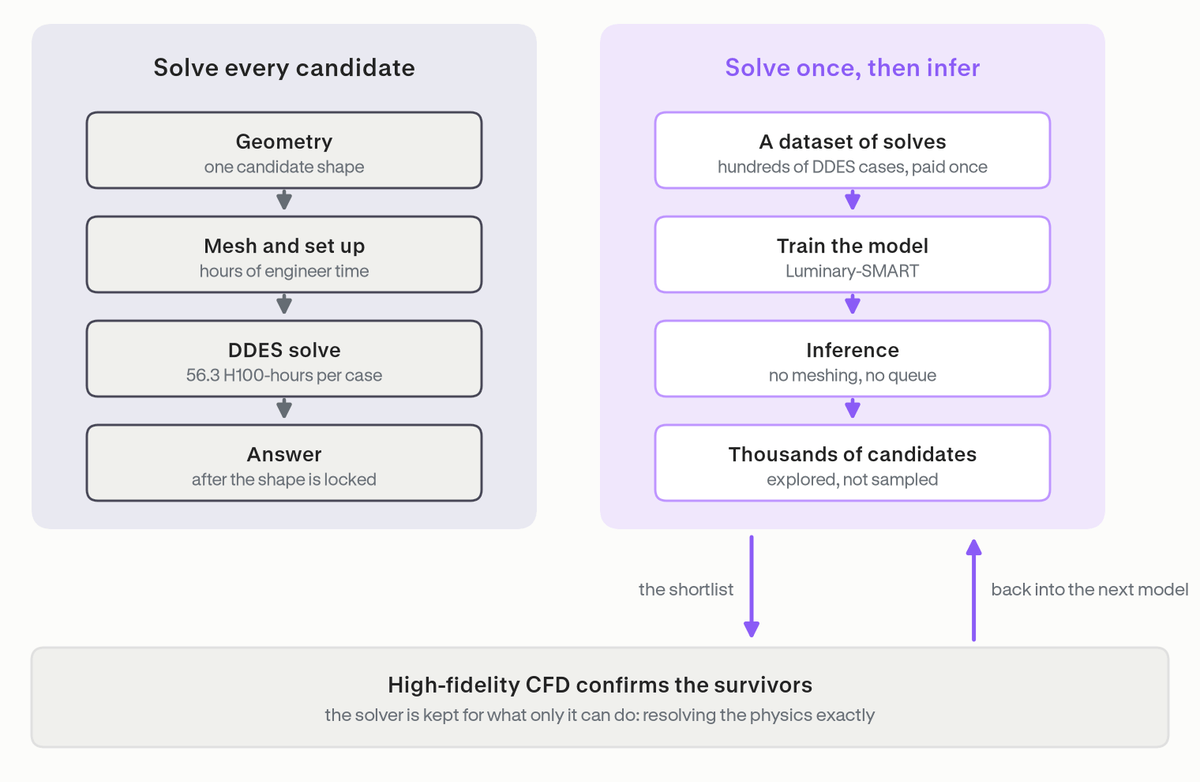
Figure 2. CFD evaluation of every candidate compared with surrogate-based exploration. In the surrogate workflow, CFD validates selected candidates and supplies data for subsequent model updates.
Luminary has already applied this approach to automotive design. SHIFT-SUV was released as an open-source Large Physics Model (LPM) in April 2025. As described in Introducing Luminary SHIFT Models, it runs inside Blender and provides aerodynamic feedback within the designer’s authoring tool. General Motors has also reported reducing an aerodynamic drag evaluation loop from about two weeks to minutes using in-house Physics AI. SHIFT-Truck extends this approach to pickup-truck aerodynamics.
A Large Physics Model for pickup trucks
We are introducing SHIFT-Truck, a Large Physics Model for pickup-truck aerodynamics. An LPM learns from solver output and predicts results for a new geometry without running another simulation. SHIFT-Truck predicts time-averaged surface pressure and wall shear stress from geometry alone. Aerodynamic forces are obtained by integrating those fields over the surface.
The training data comes from Delayed Detached Eddy Simulations (DDES) of a parameterized Generic Truck Utility (GTU). GTU is a published, non-proprietary reference geometry for pickup and SUV aerodynamics. It gives the community a shared reference model, in the same spirit as DrivAer.
A pickup has several interacting separated-flow regions. These include the tailgate wake, open-bed recirculation, A-pillar and mirror vortices, and wheel and wheelhouse wakes. Its blunt, complex underbody adds further interactions. These flows are difficult to represent faithfully with steady methods, so every training case uses scale-resolving simulation.
We used SA-DDES on a 122-million-cell mesh with second-order spatial discretization. Time integration used implicit BDF2 with Δt = CTU/500, where CTU denotes a convective time unit. The simulations included rotating wheels and five translating belts. Results were averaged over roughly 36 CTU. Each case required 56.3 H100-hours.
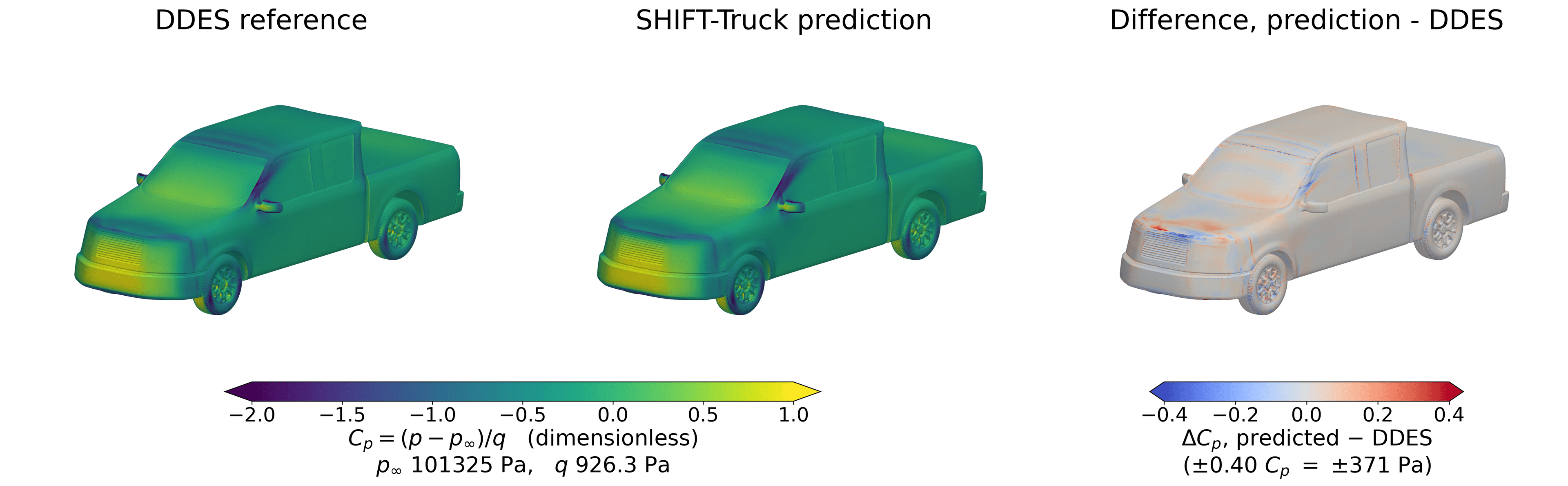
Figure 3. DDES surface pressure, the SHIFT-Truck prediction, and their signed difference for a representative pickup variant.
Before model training, we validated the CFD setup against published experimental and CFD data for two part-removal increments. That comparison is documented in Luminary’s verification and validation manual.
We created a deformation cage in Blender to generate variants from a single base mesh. The design space contains 17 parameters. Fifteen are continuous and control the front end, cab and greenhouse, bed, and stance. Two are discrete and switch the bed cover and air dam on or off.
We sampled the continuous parameters with a Sobol sequence to generate 250 morphed geometries. Each geometry was simulated with all four combinations of bed-cover and air-dam settings. This produced approximately 1,000 design points.
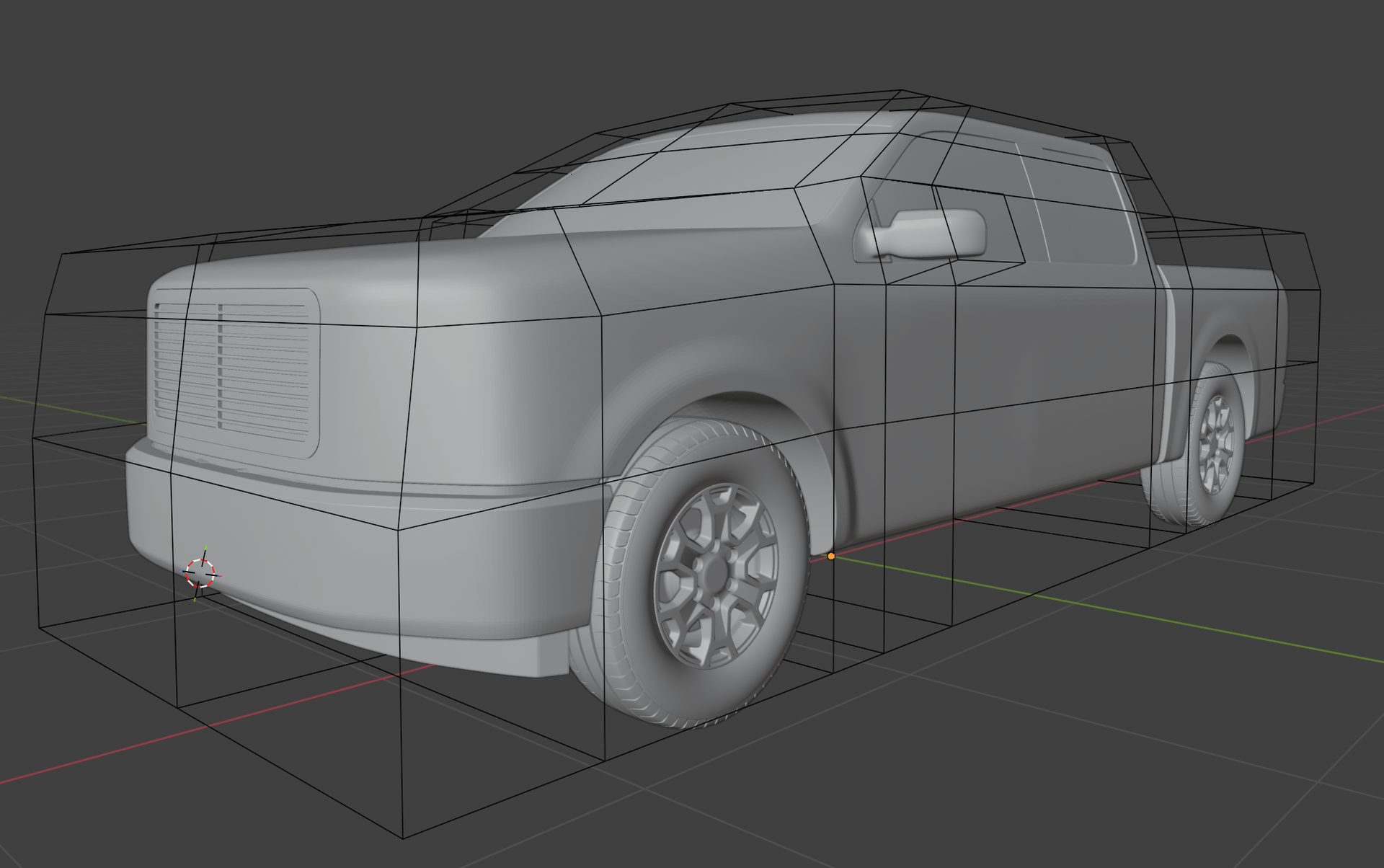
Figure 4. The Blender deformation cage used to generate training geometries. Moving its control boxes changes the shape of the base mesh.
SHIFT-Truck uses Luminary-SMART, our mesh-independent architecture for Large Physics Models. We trained the model from scratch on 613 cases and evaluated it on a fixed 57-case set. Against the DDES reference, it achieved a median drag-coefficient error of 3.8 counts and a mean absolute error of 5.5 counts. The corresponding R² was 0.96. Here, one count is defined as 0.001 in Cd.
For context, removing the side mirrors changes drag by 10.6 counts. The median prediction error is about one-third of that change.
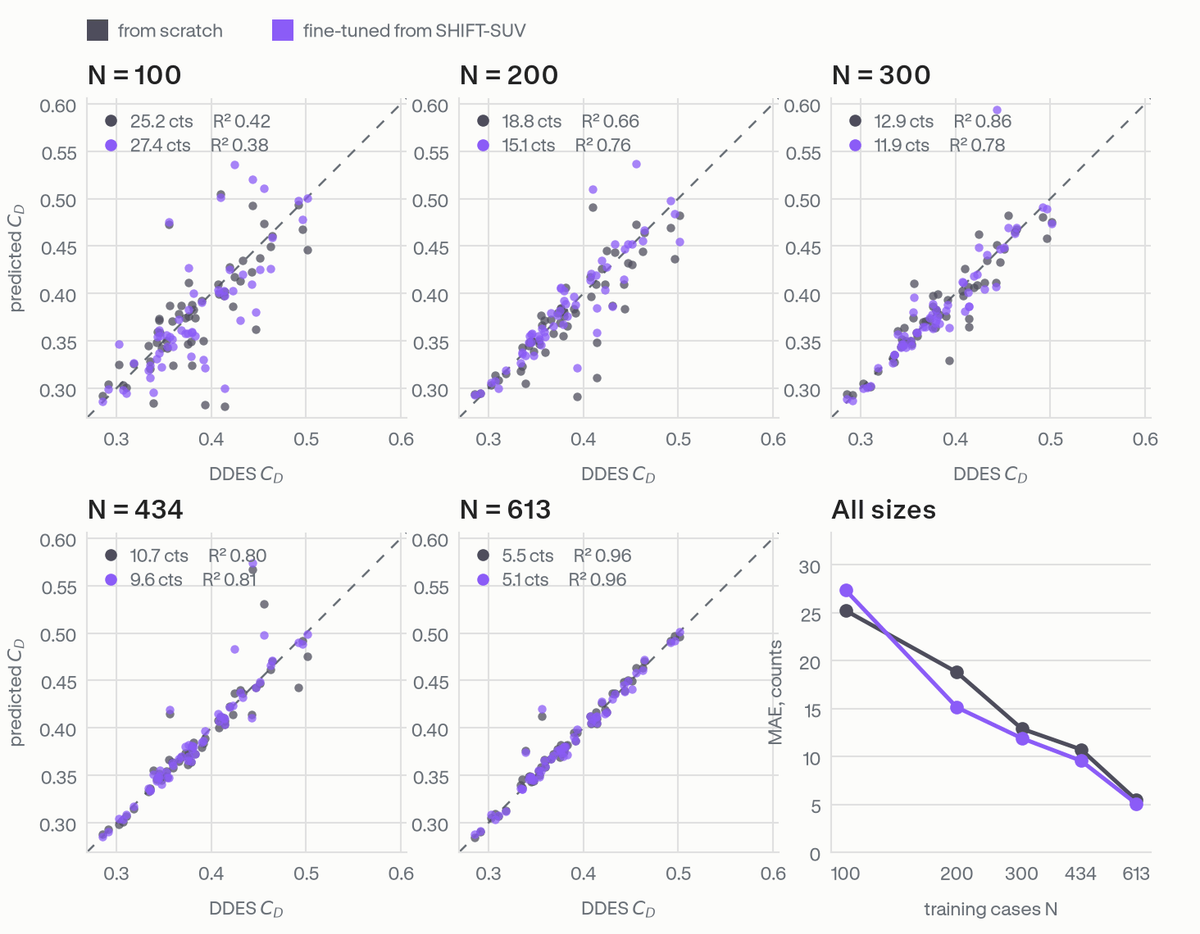
Figure 5. Predicted versus DDES drag coefficient across the fixed 57-case evaluation set. Each panel compares models trained from scratch with models fine-tuned from SHIFT-SUV at a given training-set size. The final panel shows mean absolute error versus training-set size.
The model predicts surface fields rather than only an integrated force. Engineers can therefore inspect the pressure and shear distributions that contribute to the predicted drag. This provides more information for evaluating a design than a single drag coefficient.
What this enables in practice
SHIFT-Truck makes aerodynamic feedback available earlier in a truck program, when designers still have freedom to change the geometry.
Video. Representative geometries from the SHIFT-Truck training design space, shown from a fixed camera position.
Aerodynamic feedback during styling. Within the designer’s authoring tool, the model returns forces and surface pressure for the geometry being edited. Designers can assess the aerodynamic effects of styling changes before surfaces are frozen.
Design-space optimization. Searching a 17-parameter design space can require thousands of evaluations. At 56.3 H100-hours per case, 2,000 DDES evaluations would require more than 110,000 H100-hours. Running the same evaluations through model inference is about 3,000 times faster. High-fidelity CFD can then validate the selected candidates.
Model updates from new simulations. Predictions for shapes outside the training envelope require further evaluation. Luminary’s Physics AI factory flags these shapes for high-fidelity simulation. The results are fed back into training to extend the model’s coverage.
Transfer across vehicle classes. A pretrained LPM can provide the initial weights for a model of another vehicle class. In our tests, initializing SHIFT-Truck from SHIFT-SUV improved surface-field predictions at every dataset size. The next section describes that comparison.
SHIFT-Truck supports early design exploration. High-fidelity simulation remains part of the workflow to verify the designs selected for further development.
What we learned building it
We also tested whether a released LPM could provide a useful initialization for a different vehicle class.
SHIFT-SUV was trained on morphed variants of AeroSUV, an open-access reference geometry unrelated to the GTU truck. This comparison therefore tests transfer across vehicle categories, rather than between variants of one parameterization. The two datasets were also generated at different freestream velocities, 38.9 m/s for the truck and 31.3 m/s for the SUV.
We used truck datasets containing 100, 200, 300, 434, and 613 cases. For each dataset size, we trained one model from random initialization and fine-tuned another from SHIFT-SUV. All ten models ran for 1,000 epochs under otherwise identical conditions. We evaluated them on the same held-out set.
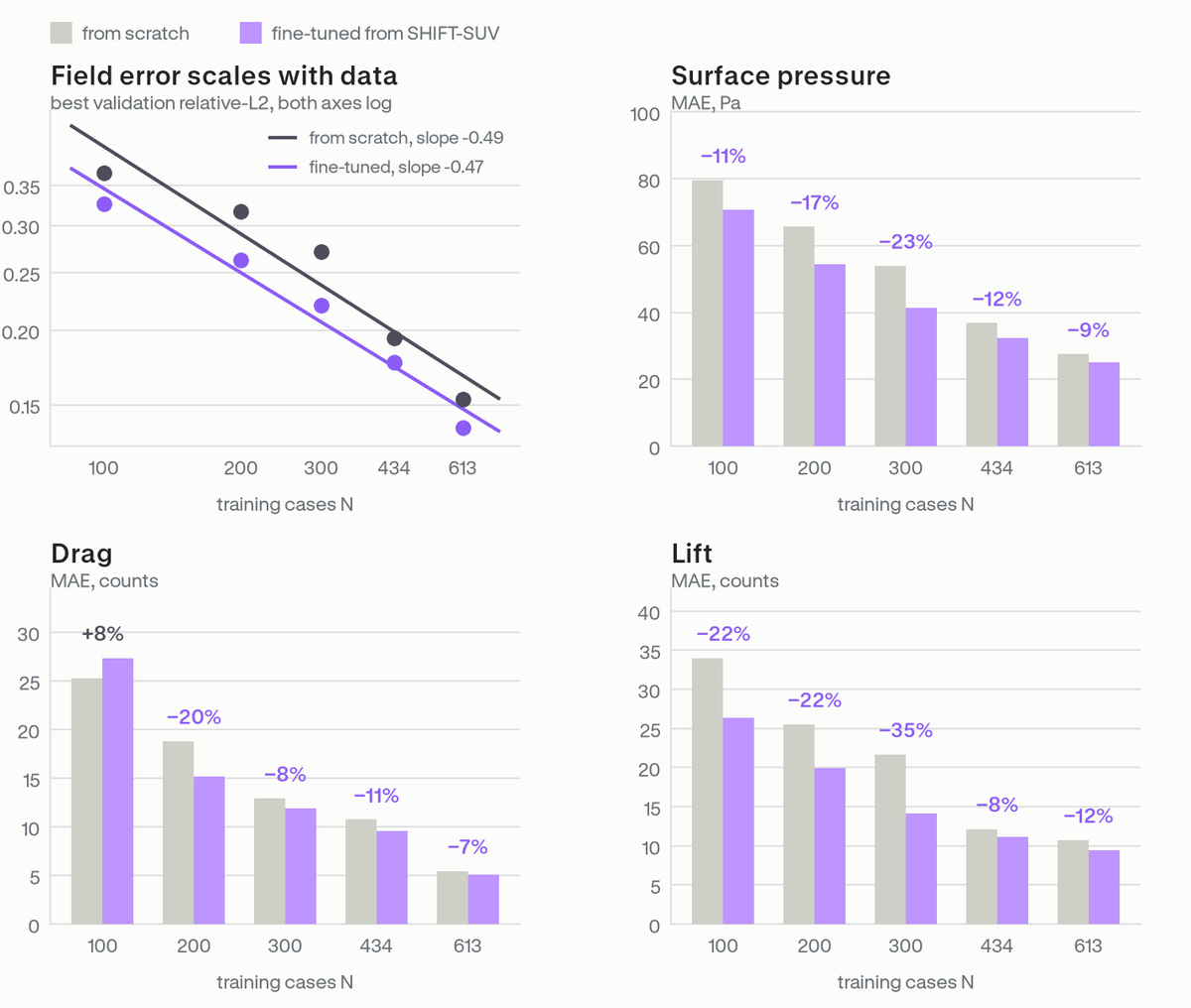
Figure 6. Best validation loss versus training-set size, along with surface-pressure, drag, and lift errors. The plots compare training from scratch with fine-tuning from SHIFT-SUV. All models were trained for 1,000 epochs. Lower values indicate better performance.
Fine-tuning improved surface-field predictions at every tested dataset size. Surface-pressure error decreased by 9–23%, and lift error decreased by 8–35%. Every fine-tuned model also reached a lower best validation loss than its from-scratch counterpart.
Both approaches showed similar scaling with dataset size, with log-log slopes near −0.5. The fine-tuned curve remained below the from-scratch curve throughout the tested range. The benefit of pretrained weights therefore persisted as more truck data became available.
Drag error decreased by 7–20% at dataset sizes of 200 cases or more. The 100-case comparison was the exception. At that size, the model trained from scratch had slightly lower drag error. The fine-tuned model still performed better on every field metric.
Drag depends on the balance of large opposing pressure contributions. Errors in those contributions may help explain the result at 100 cases, where training data is most limited.
For teams developing models on proprietary geometry, these results support testing a released SHIFT checkpoint as an alternative to random initialization. In this study, the benefit persisted across the tested dataset sizes, rather than disappearing as the dataset grew.
Looking ahead
SHIFT-Truck brings aerodynamic prediction into early pickup-truck design. It supports rapid comparisons across a parameterized geometry family and provides surface fields for engineering review. High-fidelity CFD remains part of the process, both to validate selected designs and to extend the training data.
Try the SHIFT-Truck demo. Open-source SHIFT datasets are available on the Luminary Hugging Face page.