Every vehicle program faces the same basic constraint: the physics that matter most arrive too late to shape the decisions that matter most.
Crashworthiness is one of the clearest examples. It is among the most consequential requirements in automotive development, but full-vehicle crash analysis is still too slow and expensive to inform early design work at the level engineers need. By the time detailed crash simulation is used in earnest, many of the geometric and structural choices that most influence crash performance are already difficult to change. That mismatch has shaped automotive development for decades.
The result is a familiar workflow. Engineering teams move quickly in the early stages with simplified models and limited physical visibility, then rely on high-fidelity crash simulation later, when design freedom is narrower and iteration is more costly. A single detailed crash simulation can take many hours on HPC infrastructure, which means full-vehicle crash physics often acts as a late-stage gate rather than an early-stage design input.
SHIFT-Crash is Luminary’s latest step toward changing that: a Physics AI model for full-vehicle frontal crashworthiness prediction that produces time-dependent, full-field outputs fast enough to support earlier and more frequent engineering evaluation.
Why crash is such a hard domain for Physics AI
Crash is one of the hardest problems in engineering analysis to address with machine learning surrogates. It is highly nonlinear, strongly transient, and spatially heterogeneous. During a frontal impact, different parts of the vehicle experience fundamentally different behaviors at the same time. The front structure may undergo severe plastic deformation and collapse. The cabin may experience more limited motion and load transfer. Other regions may remain relatively unchanged. Contact, buckling, yielding, and structural interaction all matter, and they evolve rapidly across time.
It is not enough to predict whether a design is broadly better or worse. To be useful in engineering workflows, a model has to capture how the event unfolds across the vehicle and over time, in a form that supports real design decisions. Prior work in this area has often focused on narrower representations, smaller datasets, or more limited output sets than what automotive crash workflows ultimately require.
That is what makes crash such an important proving ground for Physics AI. If models can become useful here, they can influence one of the most compute-intensive and decision-critical parts of vehicle development.
What SHIFT-Crash predicts
SHIFT-Crash predicts full-field crash response for complete vehicle geometries undergoing frontal impact. Given an initial mesh and a set of design conditions, the model predicts nodal displacement through time as well as Von Mises stress across the full crash event.
That distinction matters. Scalar outputs can be useful, but full-field predictions are much closer to the way engineers reason about structural behavior. Displacement tells part of the story. Stress fields provide a more decision-relevant view of load transfer, structural response, and where design changes are likely to have the most impact.
From those full-field predictions, engineers can derive the quantities of interest that drive practical crash decisions, including peak deceleration, peak firewall intrusion, and delta-V. These are not treated as isolated regression targets. They are calculated from the predicted fields in the same way they would be derived from conventional simulation output. Because the QOIs are derived rather than directly regressed, they serve as an independent check on whether the underlying field predictions are physically sound.
Side-by-side comparison of ground truth vs. SHIFT-Crash prediction showing deformation field at 120 ms for a test case
Building a crash dataset for Physics AI
SHIFT-Crash was trained on a large crash dataset built from a validated public full-vehicle finite element model under a standard frontal impact protocol. The dataset spans meaningful geometric and structural variation across the vehicle and was sampled for broad coverage of the design space. In total, it contains approximately 5,000 simulations, each capturing the crash event over multiple timesteps.
This scale matters because crash is not a problem where a small dataset is likely to be enough. The model must learn how deformation patterns, load paths, and crash severity evolve across a range of design conditions, while preserving enough physical structure for derived engineering metrics to remain trustworthy. High-quality training data is foundational to that effort.
A geometry-aware model for transient structural response
SHIFT-Crash is built on the GeoTransolver architecture within the NVIDIA PhysicsNeMo framework. GeoTransolver uses Geometry-Aware Learned Embedding (GALE) attention to partition the input point cloud into learned slices that specialize during training. Rather than predicting the crash event step by step in an autoregressive rollout, the model learns to map from the initial condition to a queried crash state directly. In a highly nonlinear transient regime like crash, that design improves stability and avoids the error accumulation that can degrade sequential prediction methods.
One of the more interesting findings during development was the way the model learned to organize the vehicle into regions associated with distinct crash behaviors. Areas with limited deformation were treated differently from crush zones and other structurally distinct subsystems. That learned organization does not replace engineering interpretation, but it provides evidence that the model is capturing structured physical behavior rather than producing visually plausible deformation patterns. The visualization of learned slices, especially around the crush zone and rigid-body-like subsystems, supports that interpretation.
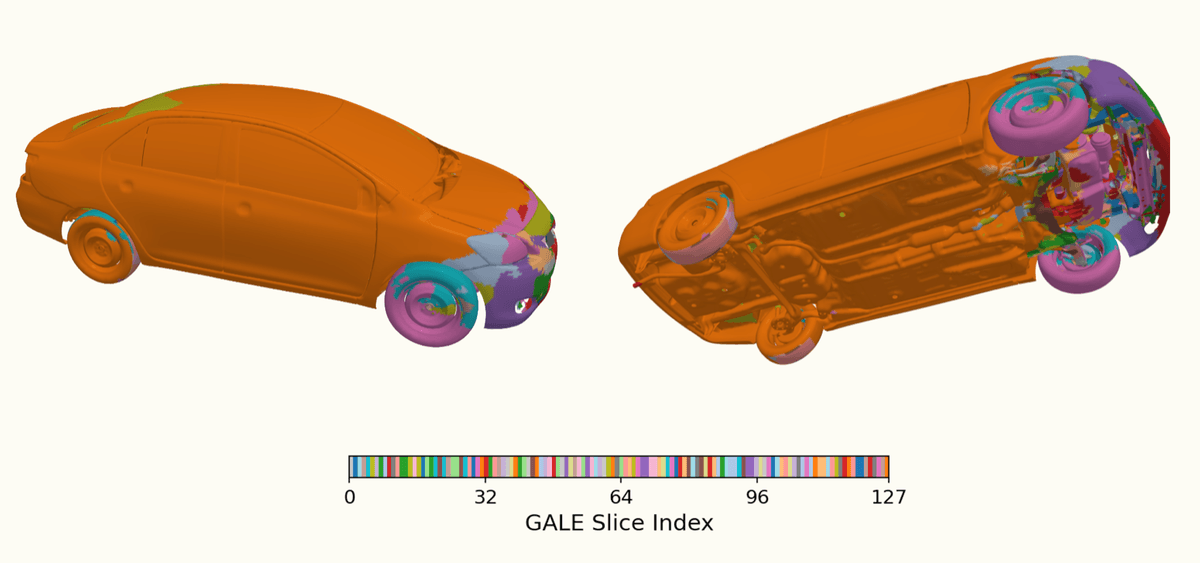 GeoTransolver GALE slice visualization showing specialization to different crash behaviors across the vehicle
Performance on engineering quantities of interest
For any crash model, the real question is whether the predictions are accurate enough to support the decisions engineers actually make.
Across held-out test cases spanning the modeled design space, SHIFT-Crash predicted peak deceleration within 3% of simulation, peak firewall intrusion within 2%, and delta-V within 2%. The model reproduced the shape and timing of the acceleration-time histories, not just the peak values. It captures both temporal structure and crash severity across cases that vary meaningfully in response.
Peak deceleration is closely tied to occupant loading severity. Firewall intrusion reflects survival space preservation. Delta-V is a widely used indicator of overall crash severity. When those metrics are derived from predicted full-field outputs and still align closely with simulation, it is a strong signal that the model is capturing useful underlying physics.
Conventional crash simulation remains essential for final validation. Physics AI moves crash-relevant physics earlier in the workflow and makes it available more often, at far lower time-to-answer.
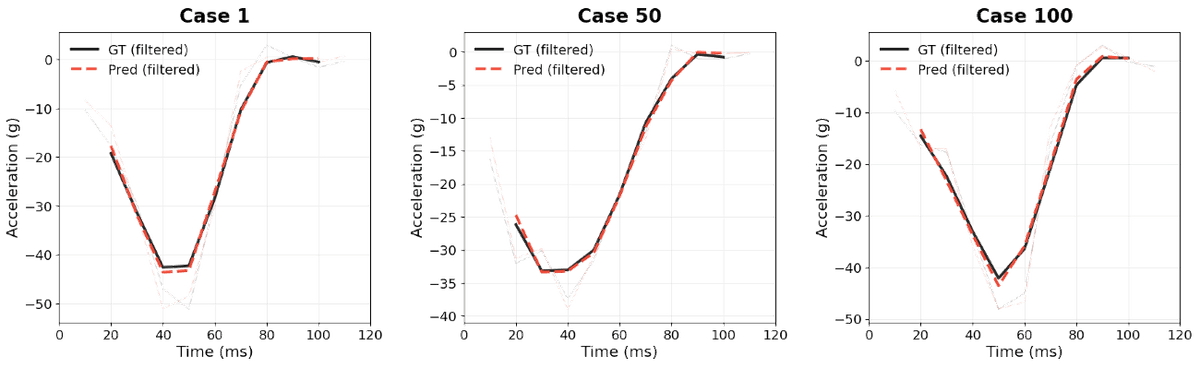 Peak deceleration comparison (ground truth vs. prediction) for three test cases spanning the severity spectrum
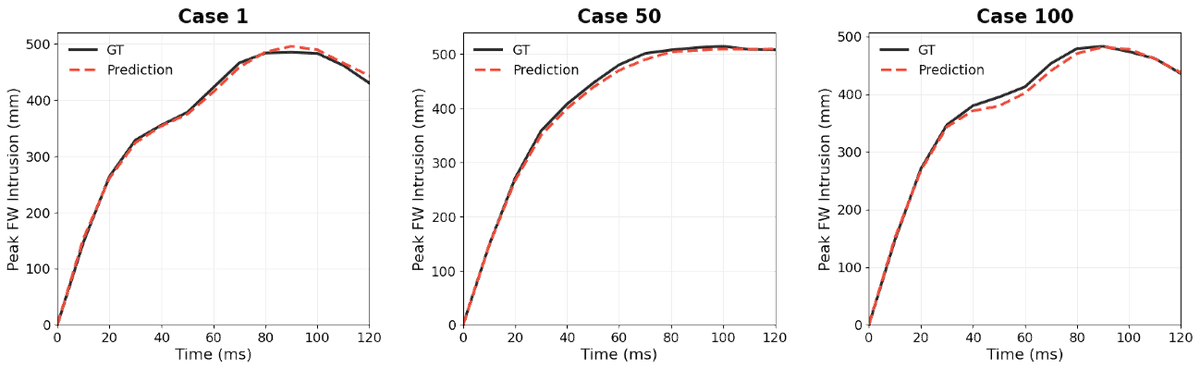 Peak firewall intrusion comparison showing prediction within 2% of simulation
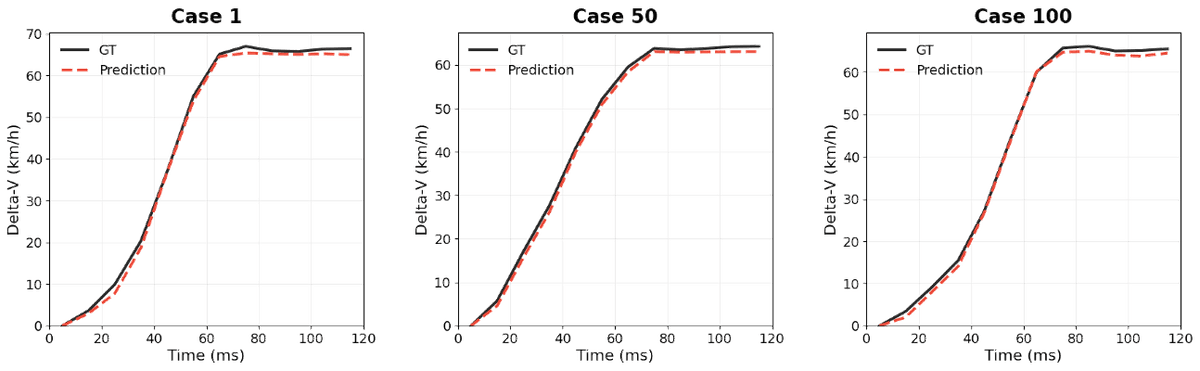 Delta-V comparison confirming sub-2% accuracy and model generalizability
Why inference speed changes the workflow
SHIFT-Crash runs inference in roughly 50 seconds on a single NVIDIA T4 GPU, compared with hours for a corresponding high-fidelity crash simulation on HPC infrastructure. That order-of-magnitude reduction in time-to-answer is what makes the model strategically interesting.
That speed reduction changes the relationship between engineering decisions and physical validation.
Early in development, teams often rely on simplified models because they are the only practical way to screen enough concepts in time. But simplified models come with a real cost: they exclude much of the physical behavior that ultimately determines whether a design is on track. A fast full-field crash model creates a path toward evaluating crash-relevant physics much earlier, before design choices harden and before major compute campaigns are required.
Later in the process, fast prediction provides a rapid directional assessment of whether a design appears to be trending toward or away from crash targets, allowing teams to focus high-cost simulation resources where they matter most. The real value is changing how frequently crash insight enters the engineering loop.
Use cases beyond screening
The speed of SHIFT-Crash inference opens applications that are impractical with traditional simulation:
- Optimization. Embed SHIFT-Crash in an optimization loop to search for the geometric and structural configuration that yields the best crash performance under specified constraints.
- Inverse problems. Given a target QOI, such as a maximum allowable HIC or firewall intrusion, identify the set of plausible vehicle designs and material selections that would meet that target.
- Generative design. Generate hundreds of candidate designs that satisfy multiple crash performance requirements simultaneously, exploring regions of the design space that manual iteration would never reach.
- Uncertainty quantification. Exercise the model across the parameter space to understand how sensitive crash outcomes are to variations in geometry and material properties.
Looking ahead
SHIFT-Crash represents the first application of Physics AI to full-vehicle crash at production-relevant scale and fidelity. Ongoing work is expanding the model’s output set to include principal stresses and plastic strain, providing even richer information for structural design decisions and material failure assessment. A detailed technical paper is in preparation.
For crash engineering teams evaluating how Physics AI could fit into their development workflows, Luminary offers technical deep-dive demonstrations of SHIFT-Crash and consultations on how the platform supports the full model lifecycle, from data production through training, deployment, and continuous improvement. Contact us to learn more.