Missile aerodynamics present a fundamentally challenging modeling problem. Supersonic flow over sharp, complex geometries produces strong nonlinearities driven by shock–shock and shock–boundary layer interactions. These effects are highly sensitive to geometry, control surface configurations, and operating conditions, making large-scale data generation both computationally expensive and operationally difficult within traditional CFD workflows.
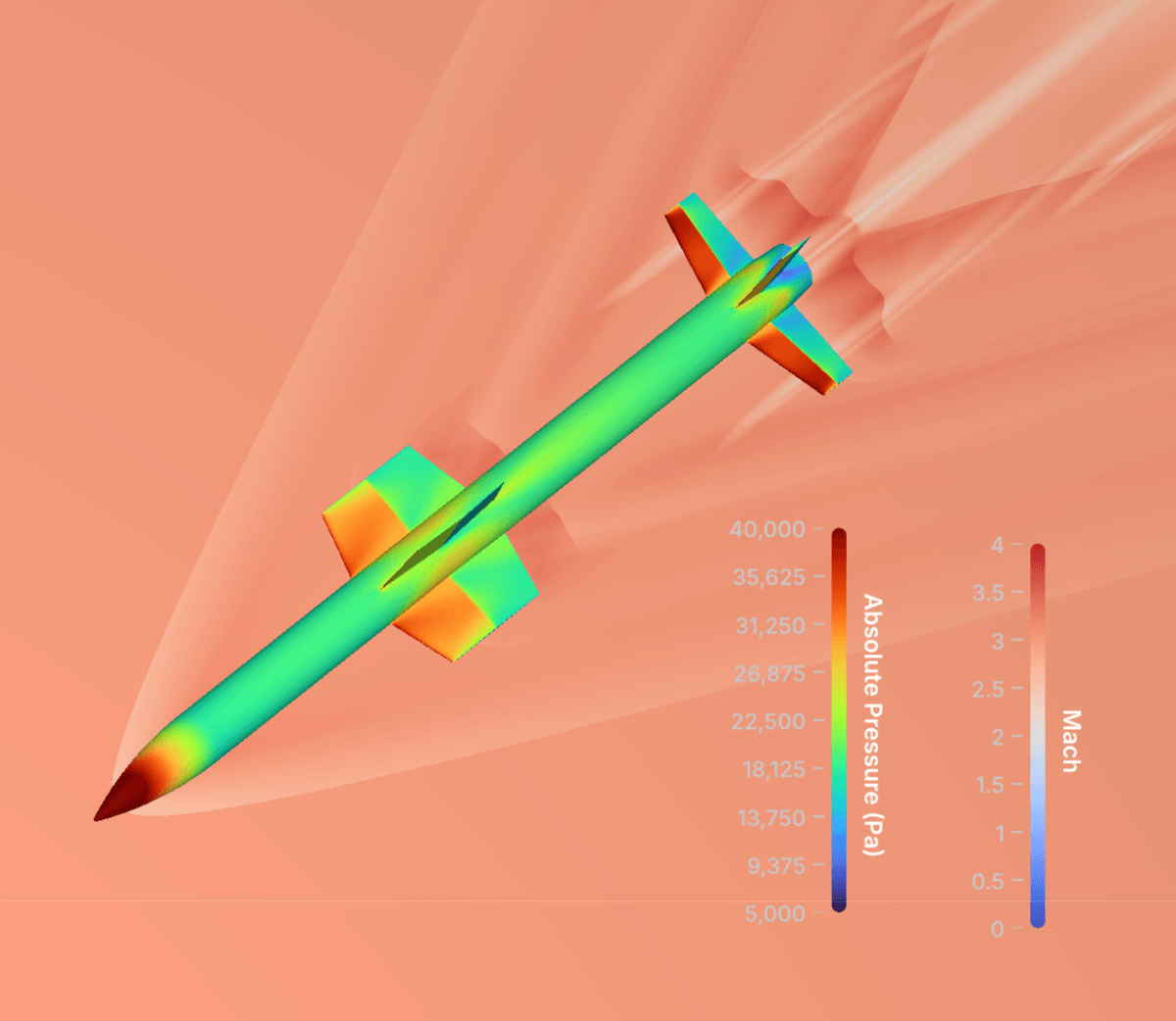
SHIFT-Missile representative flow field
Historically, this gap has been addressed with low-fidelity surrogate models such as Missile DATCOM. These semi-empirical tools remain widely used because they are fast and require no meshing or solver setup. However, they rely on simplified physics assumptions, degrade outside their calibration regimes, and reduce geometry to coarse parameterizations or text input decks. Outputs are typically limited to reduced scalar outputs (force and moment coefficients) which inhibits detailed engineering analysis and complex design decisions.
High-fidelity CFD improves accuracy but introduces a different bottleneck. Capturing supersonic flow features across realistic missile configurations requires careful meshing, significant compute per case, and expert setup and validation. As a result, generating sufficiently dense aerodynamic databases across meaningful design spaces is often impractical within program timelines.
SHIFT-Missile addresses this tradeoff directly. It is a Physics AI model trained on large-scale high-fidelity RANS simulation data to learn the underlying flow physics across a wide range of supersonic conditions and geometries. Rather than relying on empirical correlations, it captures shock interactions, boundary layer effects, and nonlinear flow behavior directly from data.
The model predicts surface pressure distributions and wall shear stress fields, enabling both detailed flow insight and derivation of integrated forces and moments. This richer output allows engineers to evaluate higher-order effects such as vibration loading and peak pressures, which are inaccessible in traditional low-fidelity tools.
Crucially, these predictions are generated in seconds on a single, consumer-grade GPU, with sub-second latency on high-end hardware. This enables real-time inference within design loops, digital twin environments, and flight simulation workflows, where rapid iteration and continuous feedback are required.
Building the Model
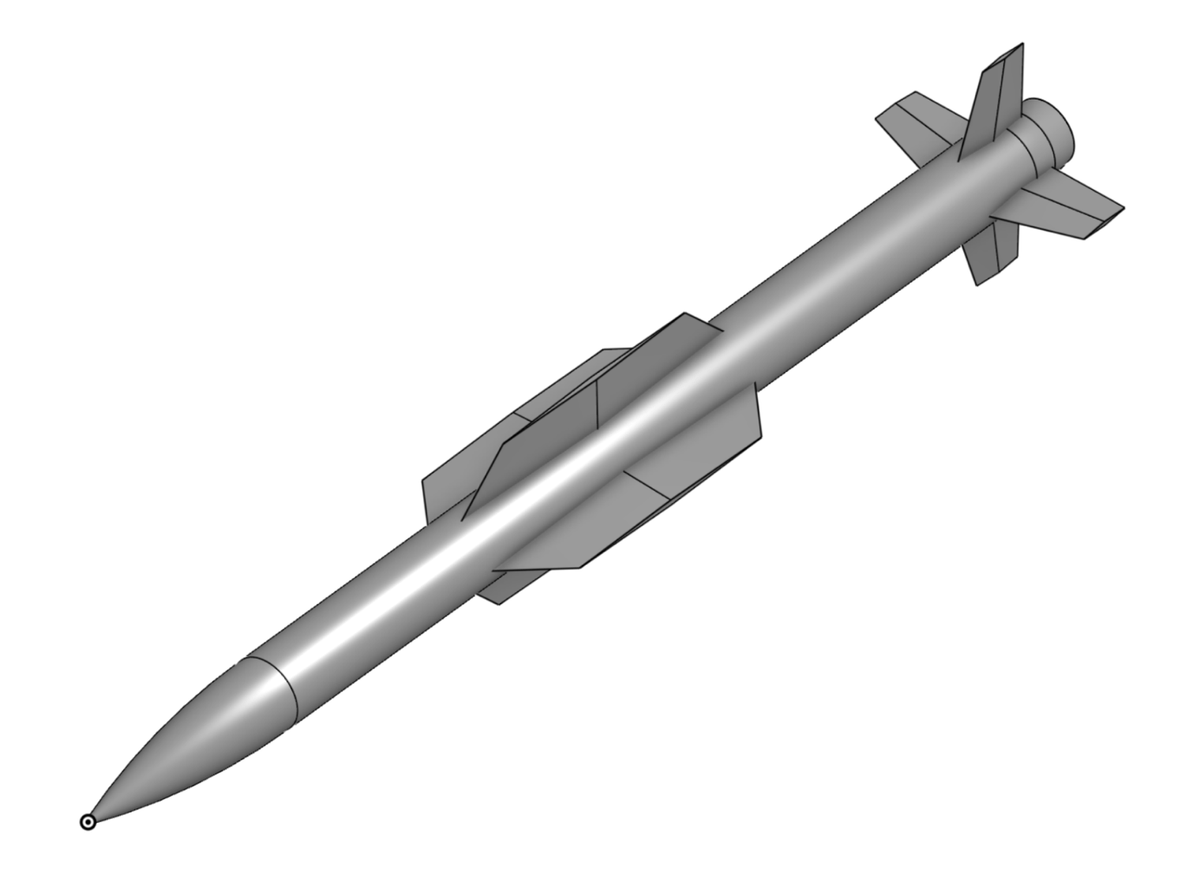
SHIFT-Missile baseline geometry with canards and tail fins
SHIFT-Missile is built on a Luminary-proprietary generic geometry parameterization with more than thirty geometric variables spanning body shape, fin geometry, and control surface configuration. It was designed to cover a broad family of representative high speed missile-like forms for modeling and analysis, not to replicate any specific real-world missile system.
That breadth makes it well suited for aerodynamic exploration across varied geometries and flight conditions. In the study presented here, a nine-parameter subset was varied, including nose radius, canard height, canard axial position, canard leading-edge angle, canard root length, tail fin height, tail fin leading-edge angle, freestream Mach number, and angle of attack.
Several geometric assumptions were held fixed to maintain a structured design space. The nose profile was defined as ogive, and the canard leading and trailing edge angles were set equal, though that constraint was not strictly enforced in the geometry definition.
High-Fidelity Simulation at Scale
Training data was generated using Luminary’s GPU-native CFD solver. Each RANS simulation employed the SA turbulence model along with several corrections (i.e. QCR2000, rotation, and compressibility correction for accuracy) to ensure accuracy between the simulations and flight test data. Below, the validation is shown between Luminary’s solver and Finner Missile experiments performed by the Air Force Research Laboratory. The solver also utilizes a new, state-of-the-art shock sensor to ensure stability in these high supersonic cases where shocks are thinner. Each case used a novel variant of Luminary Mesh Adaptation (LMA) where the adaptation is applied locally. This ensures better capturing of complex flow features and reducing the overall mesh size necessary to achieve convergence. The mesh size was chosen as 30 million control volumes and total iterations is 15,000 steps based on a grid convergence studies on the baseline geometry across a wide range of Mach conditions. Drag force values converged within 0.3% between 30M and 50M CV meshes across Mach 1.1 through 4.0.
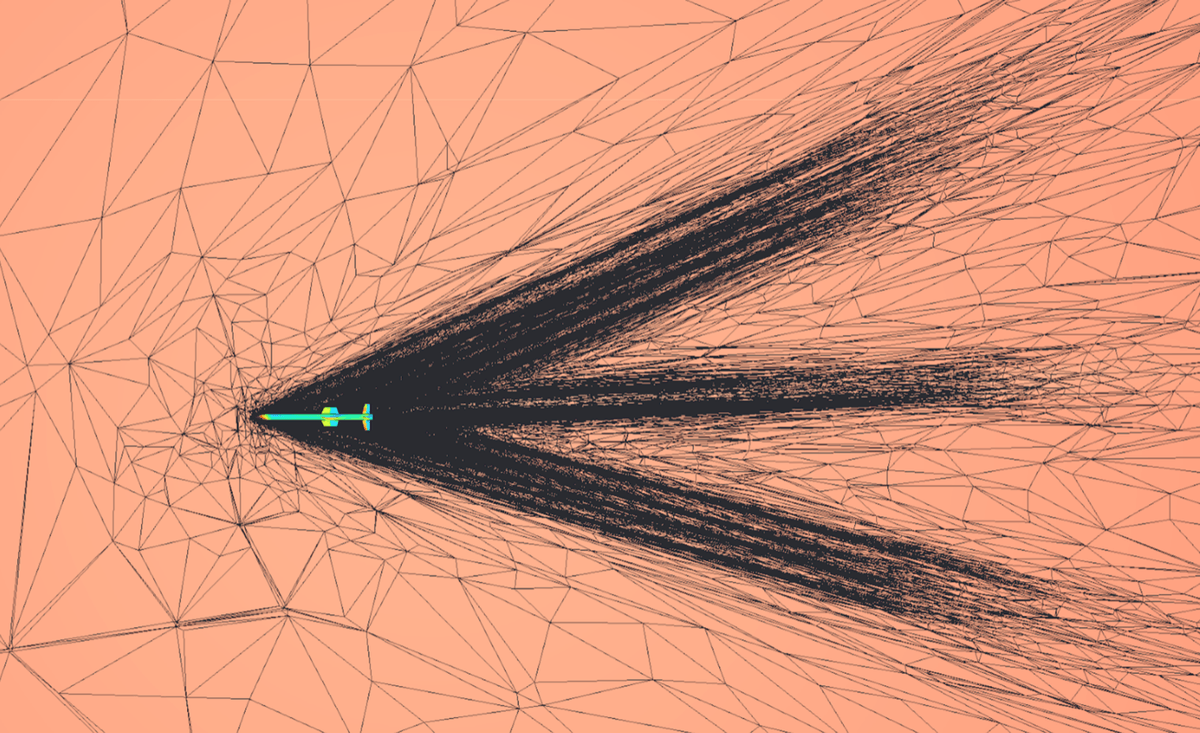
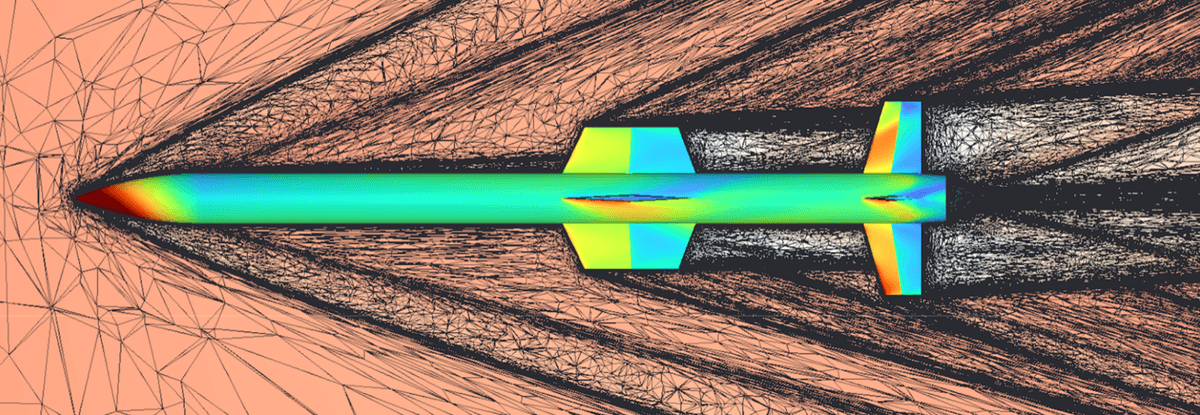
Comparison of wall shear stress and Mach contours with and without active mesh refinement regions. Active regions concentrate resolution near the body surface where shock structures interact with the boundary layer.
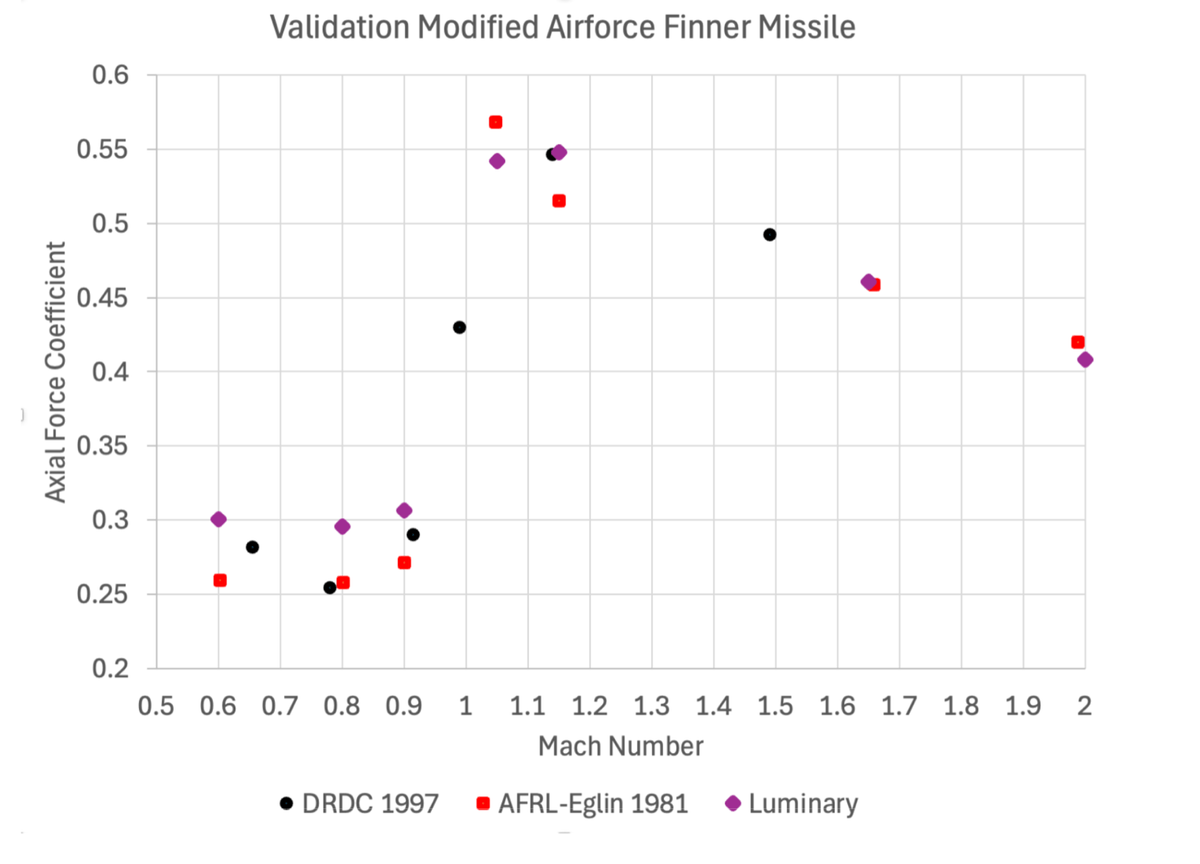
Validation of Luminary Cloud solver against Modified Finner Missile
The full training dataset comprises approximately 6,000 high-fidelity simulations, generated across four discrete Mach numbers (1.5, 2.0, 2.5, 3.0) with roughly 1,500 samples per Mach condition. The angle of attack is a continuous random variable in the range of 0 to 4 degrees.
Data generation was executed entirely through Luminary’s Pipelines feature, which allowed the team to submit thousands of simulation jobs at once and monitor progress without keeping local scripts alive for days or manual intervention. A single pipeline batch handled up to 1,500 runs autonomously and can scale to any dataset size.
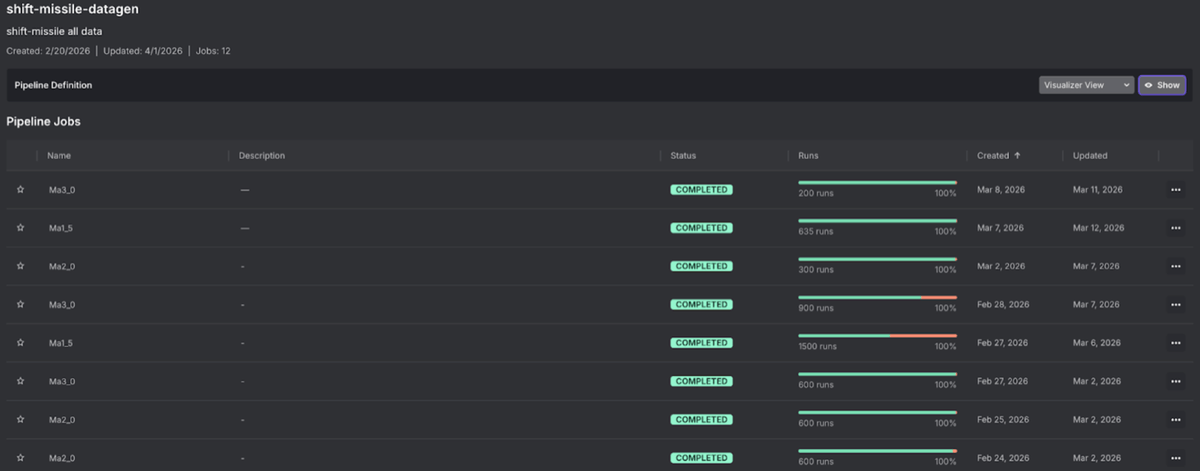
Luminary Pipelines managing large-scale data generation for SHIFT-Missile. Batches of geometry edge cases (256 runs) and angle-of-attack sweeps (64 runs) executing with 97-98% simulation success rates.
Model Architecture and Performance
SHIFT-Missile was trained using an in-house variant of the GeoTransolver architecture developed from NVIDIA’s PhysicsNeMo library. GeoTransolver has demonstrated stronger physics awareness than earlier architectures such as DoMINO and Transolver, and the model was further adapted for complex supersonic flow prediction.
To improve inference quality, the training process randomized both the number of query points and the number of geometry encoding points used per epoch, rather than holding them fixed. Query points varied from 30,000 to 60,000 per epoch, while geometry encoding points varied from 50,000 to 175,000 per epoch. This improved the model’s robustness to changes in point cloud sampling and discretization at inference time.
The model achieved strong agreement with CFD across all predicted quantities:
| Quantity | R² | N |
|---|---|---|
| Axial force (force_x) | 0.99997 | 2500 |
| Normal force (force_z) | 0.99996 | 2500 |
| Pitching moment (moment_y) | 0.99929 | 2500 |
Furthermore, the MAPE for each of the QoI was sub percent.
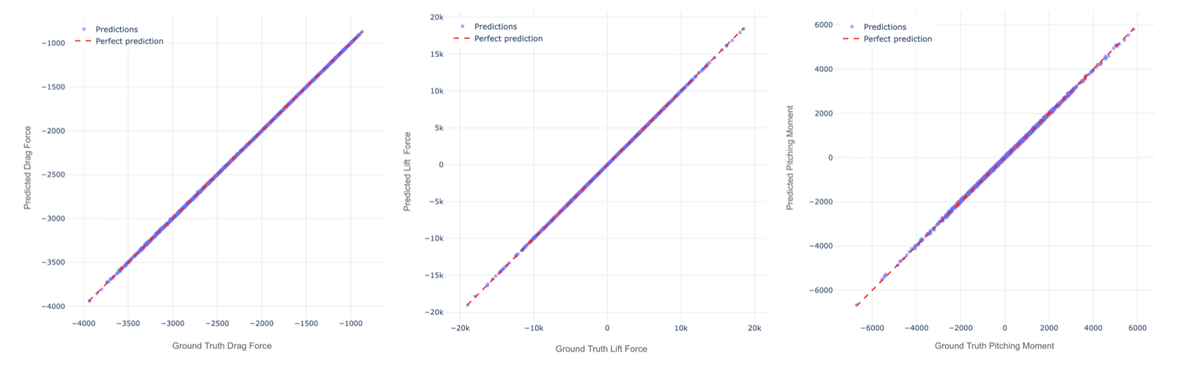
Axial force prediction accuracy showing R² = 0.9999 across 2500 test samples
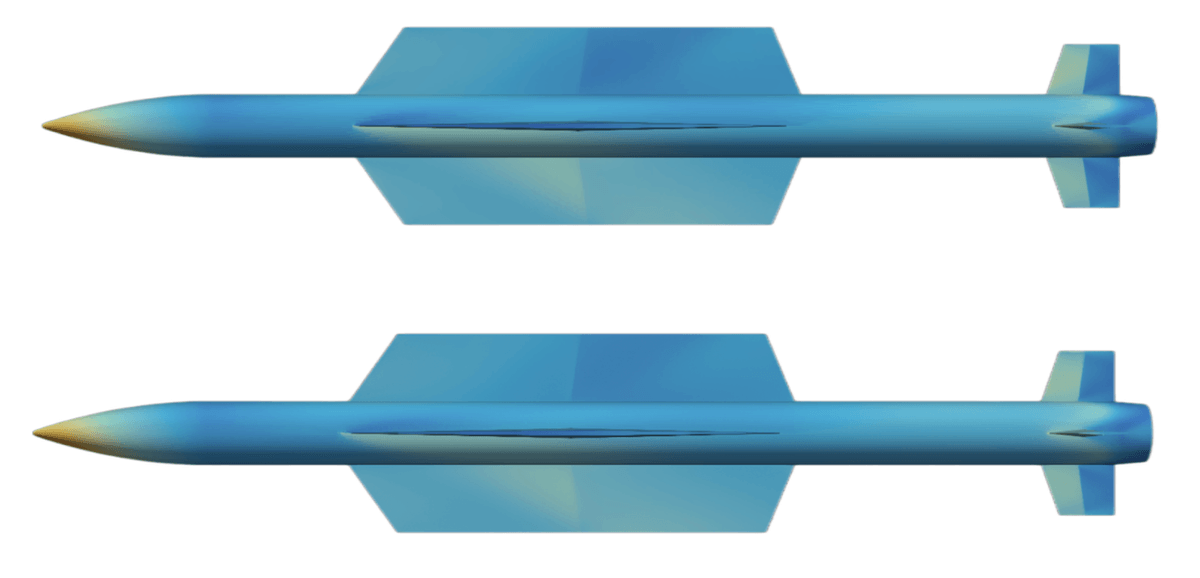
Pressure comparison showing the model captures complex flow patterns around control surfaces, including separation and reattachment features driven by shock-boundary layer interaction
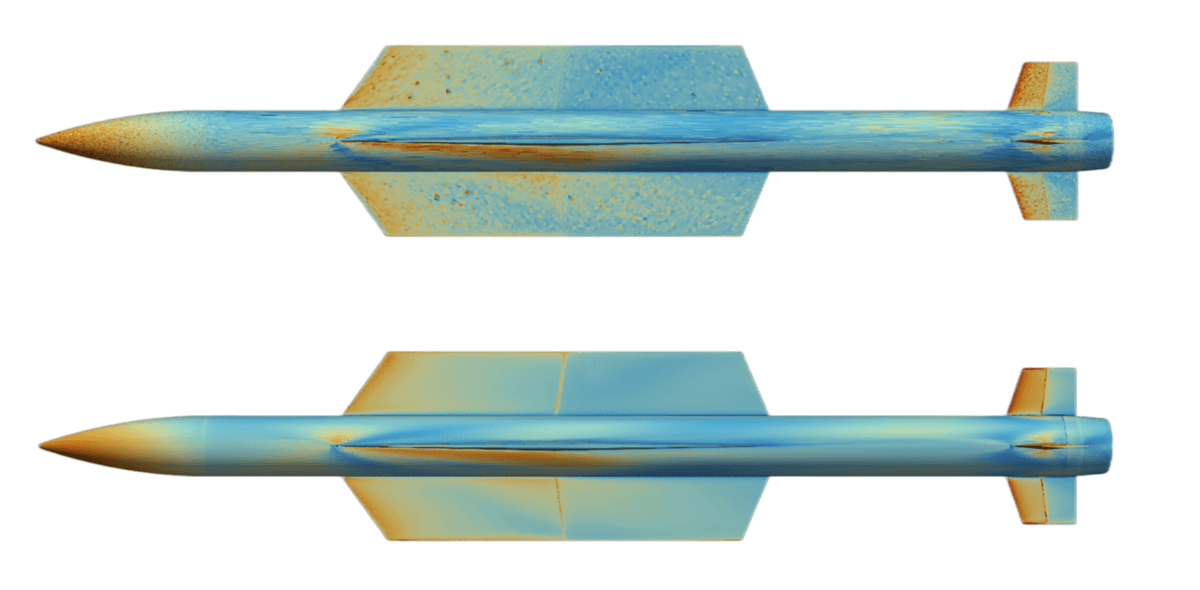
Wall shear stress comparison showing the model captures complex flow patterns around control surfaces, including separation and reattachment features driven by shock-boundary layer interaction
SHIFT-Missile captures the strongly nonlinear aerodynamic behavior present within the supersonic regime, where shock structure, pressure distribution, and integrated loads vary meaningfully with both geometry and operating condition. This is important because these effects are difficult to represent with traditional low-fidelity methods, yet they are central to missile aerodynamic analysis and design.
What This Enables
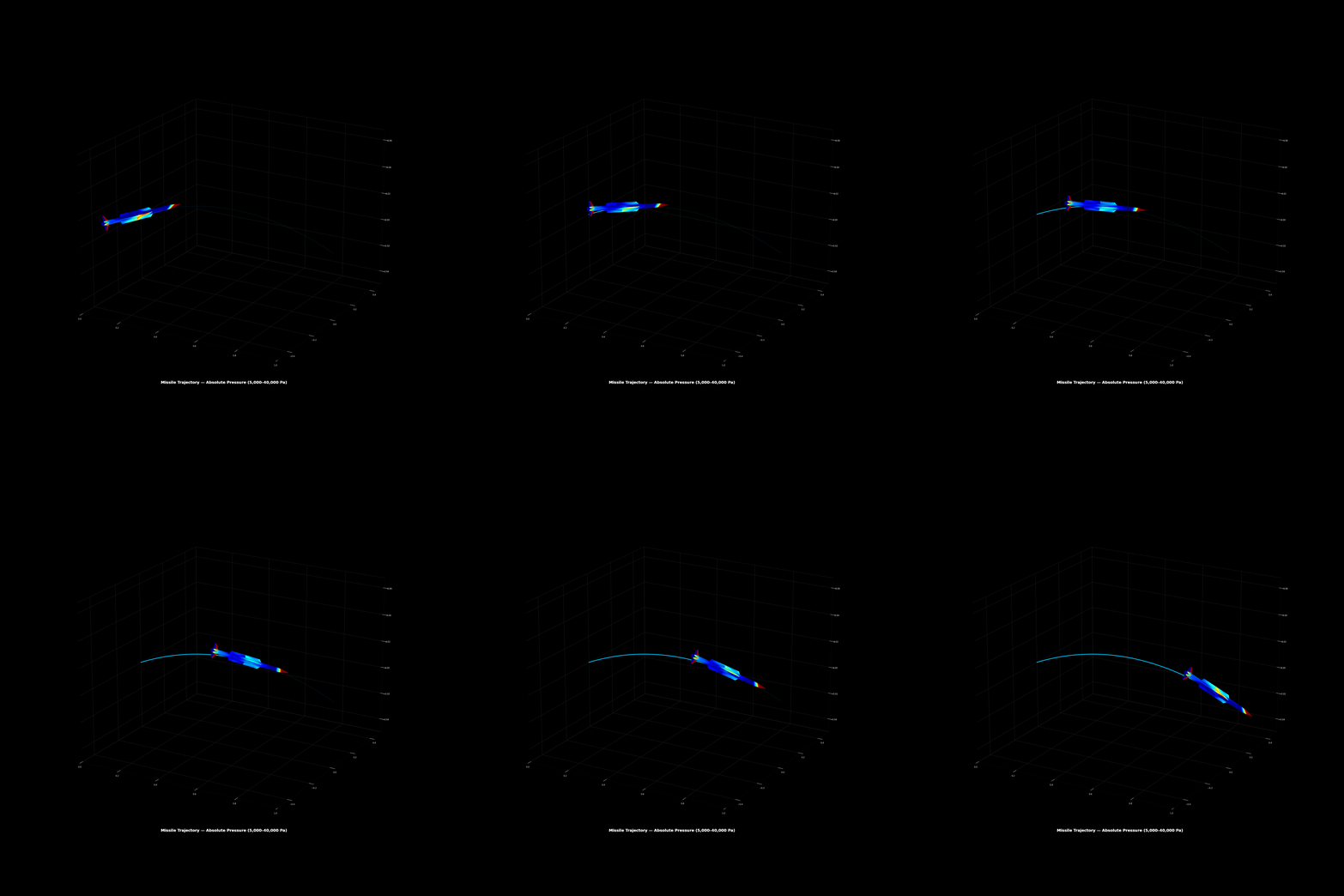
SHIFT-Missile is well suited to several practical applications in missile development workflows:
-
AeroDB generation. Rather than constructing sparse lookup tables from limited test points or expensive CFD campaigns, SHIFT-Missile enables dense aerodynamic coverage across the design space. Any point within the modeled geometric and operating envelope can be queried in seconds, reducing interpolation error and making AeroDB generation far more scalable.
-
Design optimization. Because predictions are available almost instantly, the model can be embedded directly inside optimization loops. Engineers can explore multidimensional trade spaces spanning geometry and flight conditions, making it practical to evaluate thousands of candidate designs in a single study.
-
Trajectory and mission analysis. Aerodynamic performance can be evaluated across changing Mach number, altitude, and angle of attack conditions along a flight profile without requiring prohibitively expensive CFD sweeps. This makes broader envelope analysis and worst-case loading studies much more tractable.
-
Uncertainty quantification. The speed of inference makes it practical to vary manufacturing or operational assumptions, such as surface roughness or related perturbations, and observe their effect on performance. This supports the construction of uncertainty bands around nominal predictions without requiring thousands of additional CFD runs.
-
Rapid large-scale inference. The model supports inference at a scale that would be impractical with conventional CFD. In one internal run, approximately 19,000 inferences were completed over two days on an NVIDIA T4 GPU, and the same workload could likely be executed substantially faster on higher-end hardware. This makes SHIFT-Missile viable for high-volume trade studies, batch evaluation, and deployment inside larger engineering workflows.
-
Coupled workflows and digital twin environments. Because the model predicts surface quantities as well as integrated loads, it can serve as a fast aerodynamic component within broader coupled analyses. For example, predicted pressure fields can be passed into downstream structural models to support rapid aero-structural iteration or mission-dependent loading assessment.
Supersonic Physics AI on the Luminary Platform
Building SHIFT-Missile exercised several Luminary platform capabilities that are directly relevant to organizations developing Physics AI models at scale:
-
GPU-native solver with supersonic extensions. Shock sensing and compressibility correction were developed to address the stability and accuracy demands of supersonic flow. These capabilities enable reliable automated data generation across design spaces with complex shock interactions.
-
Luminary Mesh Adaptation (LMA) with active regions. Active mesh refinement concentrates resolution near the body surface and other critical flow regions, improving accuracy and stability without requiring excessive global refinement.
-
Pipelines. The full 6,000-sample dataset was generated through Luminary Pipelines, enabling hands-free execution and management of large simulation campaigns without local scripting or manual orchestration.
-
GeoTransolver training via SDK. The model was trained using Luminary’s SDK-based workflow, demonstrating an end-to-end path from data generation through training that can be used to build and operationalize Physics AI models on the platform.
For defense organizations developing tactical missile systems, SHIFT-Missile demonstrates how high-fidelity aerodynamic prediction can be compressed from traditional simulation timelines to near-instant inference, while remaining grounded in high-fidelity training data.
Contact us to learn more about SHIFT-Missile, or explore our other SHIFT models including SHIFT-CCA and SHIFT-Submarine.