
Centrifugal pumps move fluids across nearly every industrial sector: water and wastewater treatment, oil and gas production, chemical processing, power generation, HVAC, and marine propulsion. They account for a significant share of global industrial energy consumption, making even small gains in hydraulic efficiency meaningful at scale. Whether the application is high-pressure hydrocarbon transport or municipal water distribution, pump performance directly impacts operating costs, energy use, system reliability, and regulatory compliance. Getting the design right matters.
Industrial pump design requires balancing performance, efficiency, and operating range, but traditional engineering workflows create a fundamental gap between early-stage assumptions and reality. This gap costs time, money, and limits the thoroughness of design exploration at the stage where it matters most.
Engineers typically begin pump design with 1D mean line tools that rely on simplified flow physics assumptions. These tools use the specific speed formulation (Ns = N√Q / H^(3/4)) to establish baseline impeller geometry and predict performance characteristics. Different impeller types (radial, mixed-flow, axial) are selected based on specific speed ranges, and initial 3D geometry is generated from these low-fidelity predictions.
The challenge emerges during validation. When designs reach high-fidelity viscous CFD simulation, actual performance often deviates significantly from 1D predictions. This gap exists because mean line tools cannot capture three-dimensional flow effects, viscosity, secondary flows, tip clearance losses, or the complex interactions between blade geometry and volute design. The deviation forces costly design iterations and extends development timelines.
The computational bottleneck compounds the problem. Generating a complete efficiency curve requires simulating multiple operating points, typically 70 to 120 percent of design flow rate, and sometimes down to 50 percent to capture turndown performance. Each high-fidelity CFD simulation requires hours of computation. Mapping performance across the full operating envelope for a single design variant is computationally impractical for most engineering teams. The result is a forced choice: accept sparse data points that miss critical performance characteristics, or face prohibitive simulation costs that limit design exploration.
This bottleneck is most acute during early-stage conceptual design, precisely when changes are cheapest to implement and have the greatest impact on final product performance.
SHIFT-Pump: Bridging the Gap Between 1D Tools and High-Fidelity CFD
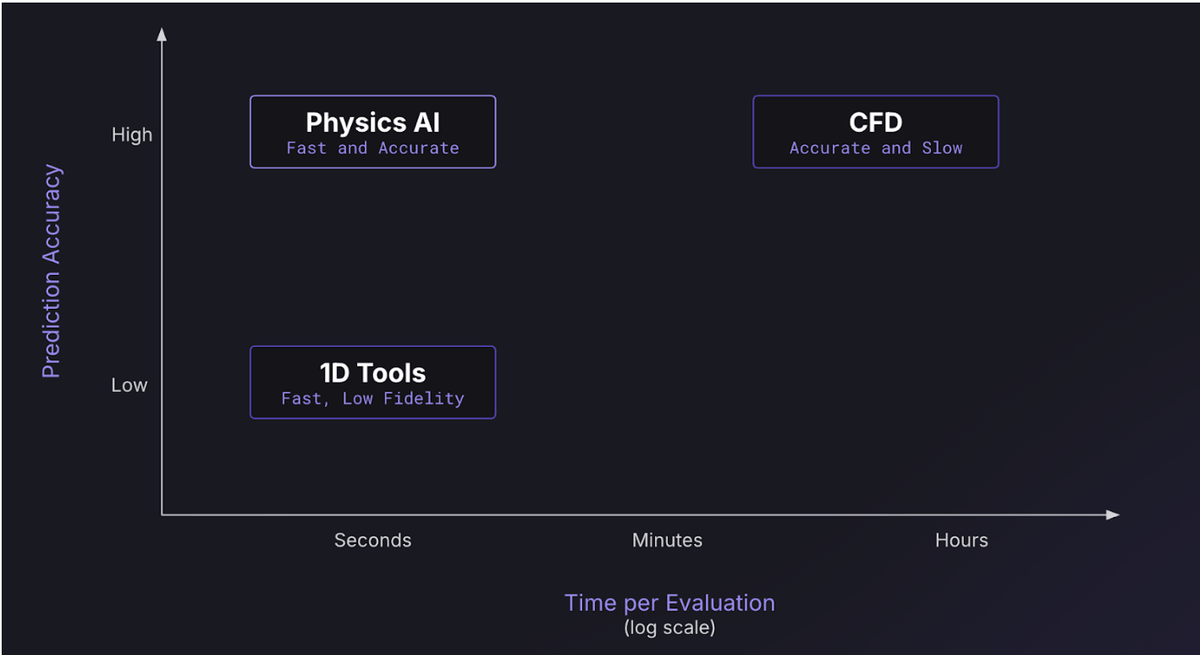
Physics AI fills the gap between 1D tools and high-fidelity CFD, delivering near-CFD accuracy at the speed of simplified methods
Luminary’s SHIFT-Pump is a Physics AI model designed to fill the gap between 1D mean line tools and high-fidelity CFD simulation. Trained on over 5,500 high-fidelity RANS simulations of pump geometries across diverse design parameters, SHIFT-Pump provides an intermediate layer that combines the speed of low-fidelity methods with the accuracy of CFD. The model is built using NVIDIA PhysicsNeMo and the DoMINO (Domain-Decomposed Inverse Neural Operators) architecture, enabling GPU-native inference at scale.
Other Physics AI models have emerged as proprietary features locked inside closed SaaS platforms, requiring customers to adopt an entire simulation toolchain to access a single model. SHIFT-Pump takes the opposite approach. Built on NVIDIA PhysicsNeMo and the DoMINO architecture, it can be deployed independently of any single platform, including on private cloud and on-premise infrastructure where data sovereignty and compliance requirements like ITAR and CUI govern how engineering data moves. The training dataset is also significantly larger and more rigorously constructed than existing datasets, with over 5,500 high-fidelity RANS simulations generated on Luminary’s GPU-native solver, giving engineering teams confidence in the physics underpinning every prediction. SHIFT-Pump is not intended to replace CFD validation. Instead, it addresses the gap between simplified assumptions and expensive full-physics simulation, providing near-instant performance predictions with CFD-level accuracy. Engineering teams can explore design space rapidly during conceptual development, then commit computational resources to high-fidelity CFD where it adds most value: validating final designs and capturing physics beyond the model’s training scope.
A critical capability distinguishes SHIFT-Pump from traditional surrogate models: the inclusion of operating conditions as model inputs. Rather than training separate surrogates for individual operating points, SHIFT-Pump accepts flow rate as a direct input alongside geometric parameters. This enables rapid generation of complete efficiency curves across wide operating ranges. Engineers can evaluate pump performance from 70 to 120 percent of design flow in seconds rather than weeks.
The model’s technical foundation rests on a carefully constructed parameterization of pump geometry and physics. SHIFT-Pump accepts 13 design variables as inputs: blade geometry parameters including inlet and outlet angles and curvature profiles; volute geometry including throat area; and operational parameters including rotational speed and flow rate. The model was trained on high-fidelity CFD data generated using Luminary’s high-fidelity, GPU-native CFD solver, with careful attention to ensuring geometric fidelity and consistent solution quality across the training dataset. SHIFT-Pump predicts three quantities of interest: actual head, torque, and efficiency.
Dataset Construction and Training Methodology
The SHIFT-Pump Physics AI model is built on a comprehensive dataset spanning the design space of industrial centrifugal pumps. The dataset construction began with baseline pump designs covering a range of specific speeds. Each baseline geometry was parameterized using 13 design variables that control blade profiles, volute characteristics, and operating conditions. The parameterization was structured to generate physically realistic pump configurations while covering sufficient design space to enable generalization.
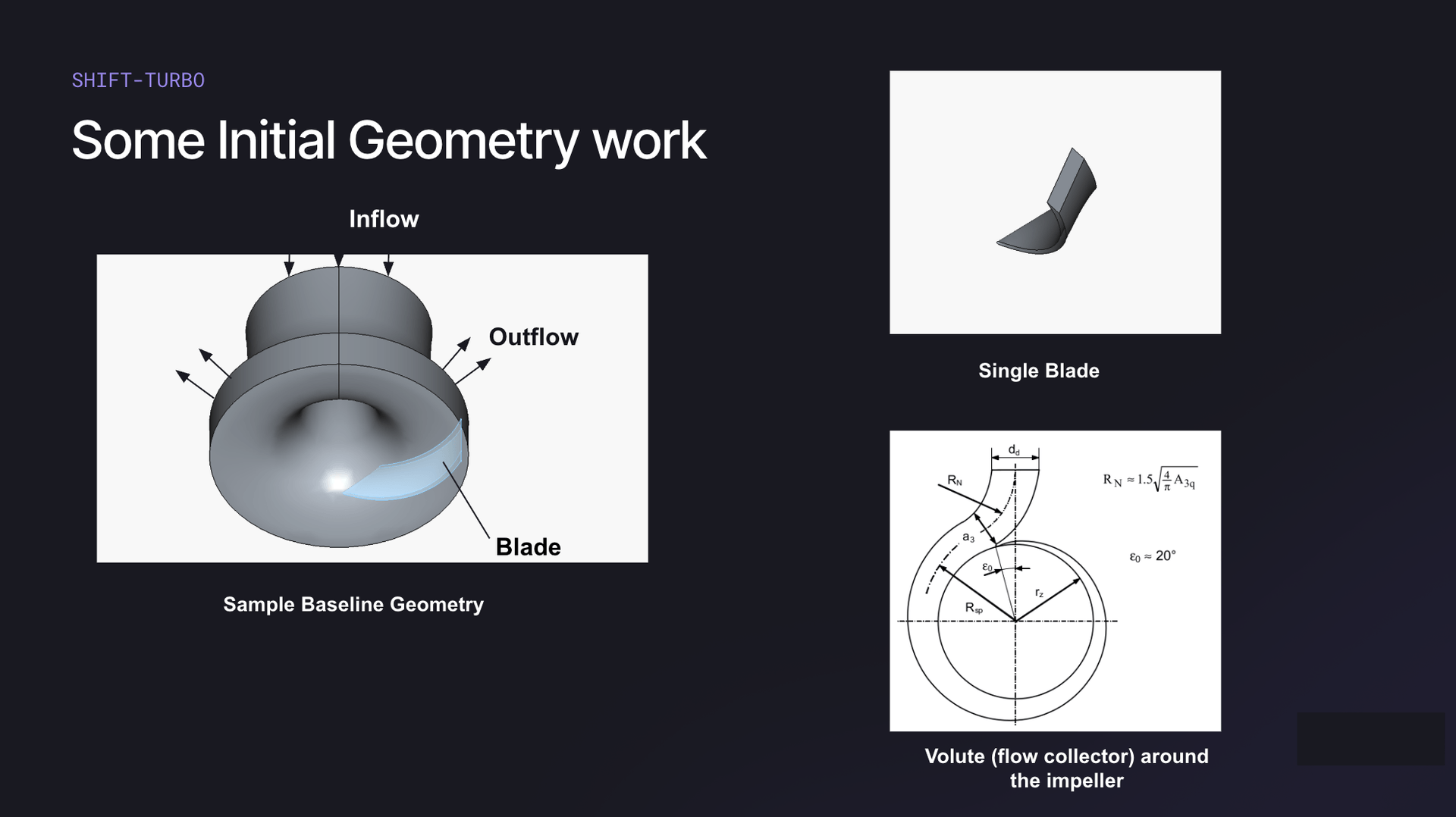
Blade geometry parameterization with design variables controlling angles, curvature, and thickness
The training dataset comprises approximately 5,560 high-fidelity RANS CFD simulations. Each simulation represents a unique combination of geometric parameters and operating conditions, with multiple operating points per geometry to capture off-design performance characteristics.
The training pipeline leverages NVIDIA PhysicsNeMo, a framework optimized for training Physics AI models on GPU infrastructure. SHIFT-Pump uses the DoMINO architecture, which decomposes the physical domain into overlapping subdomains and learns local mappings between geometric parameters, operating conditions, and flow physics. This architecture enables the model to capture spatial variations in flow fields while maintaining computational efficiency during inference.
The model predicts full flow field outputs, including pressure and velocity distributions across the pump domain. Scalar quantities of interest (actual head, torque, and efficiency) are then obtained by integrating these field predictions rather than being predicted directly as isolated scalars. This approach ensures the model captures the spatial physics governing pump performance, not just aggregate outcomes. The training process employed standard train/validation/test splits to ensure generalization to unseen designs. Performance metrics (R², mean squared error (MSE), and mean absolute percentage error (MAPE)) were tracked for each quantity of interest throughout training to monitor convergence and identify potential overfitting.
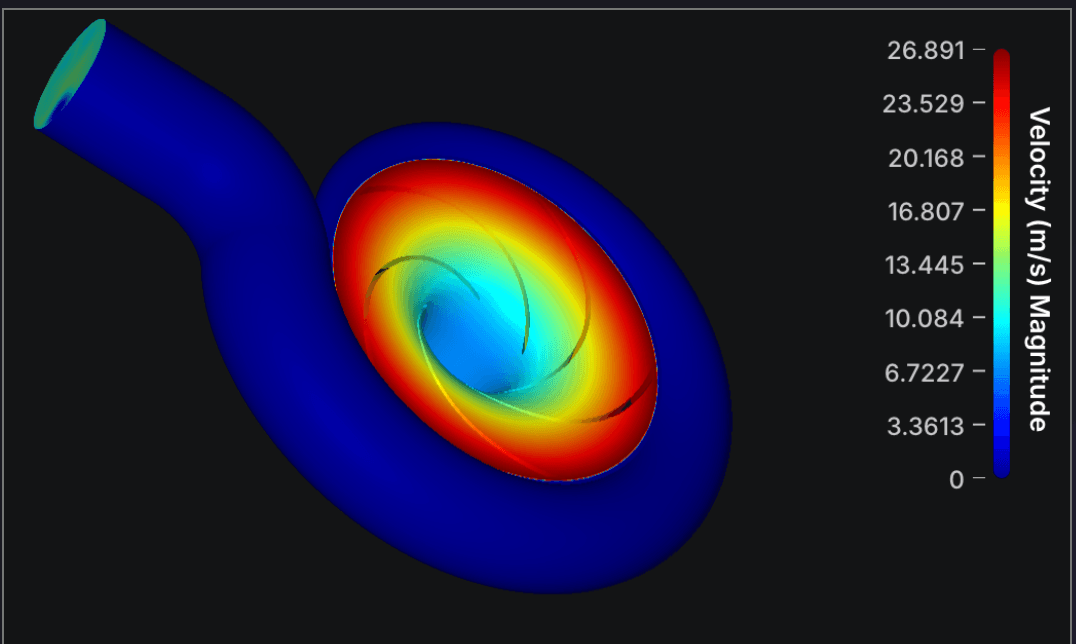
CFD flow field visualization showing the underlying physics captured in training data
Validation focused on ensuring the model accurately predicts performance across the full range of operating conditions, not just at the design point. Held-out test cases included geometries with parameter combinations not explicitly represented in the training set, as well as operating points spanning from low-flow recirculation regimes to high-flow conditions approaching choke.
Model Performance and Validation Results
SHIFT-Pump achieves high accuracy across all predicted quantities of interest, with performance metrics indicating the model has successfully learned the underlying physics governing pump performance. Torque prediction demonstrates particularly strong correlation with CFD ground truth, achieving R² = 0.996 and mean absolute percentage error of 3.69 percent across the test dataset. This level of accuracy is sufficient for early-stage design exploration and downselection, where engineering teams need to compare relative performance among design candidates rather than achieve absolute precision for certification.
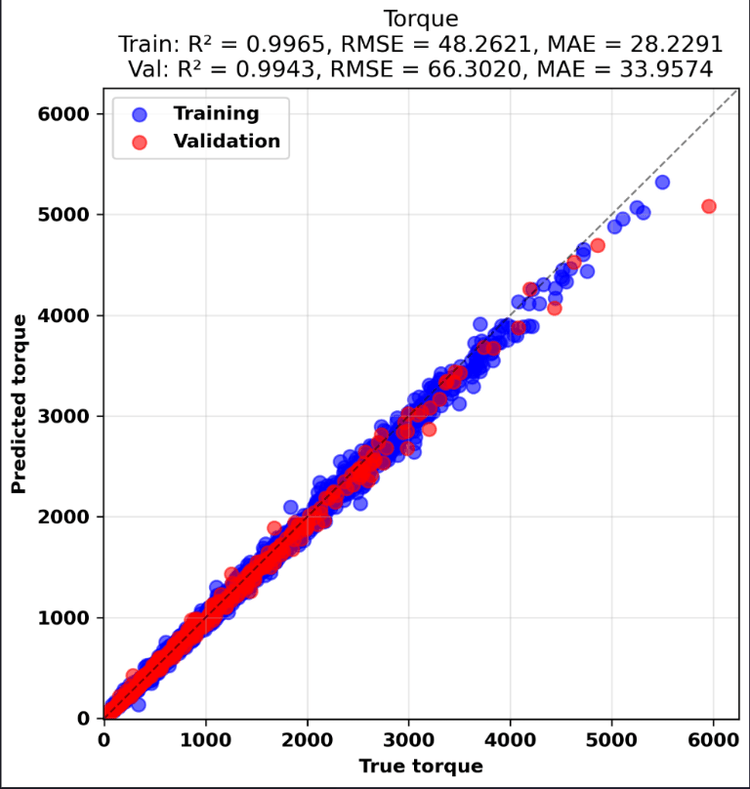
Torque prediction accuracy showing R² = 0.996 and MAPE = 3.69%
Head prediction exhibits similarly strong correlation with CFD baseline results across the operating range. The model accurately captures the relationship between flow rate and pressure rise, including the nonlinear effects that emerge at off-design conditions. This capability is critical for predicting efficiency curves, which depend on the interaction between head and torque as flow rate varies.
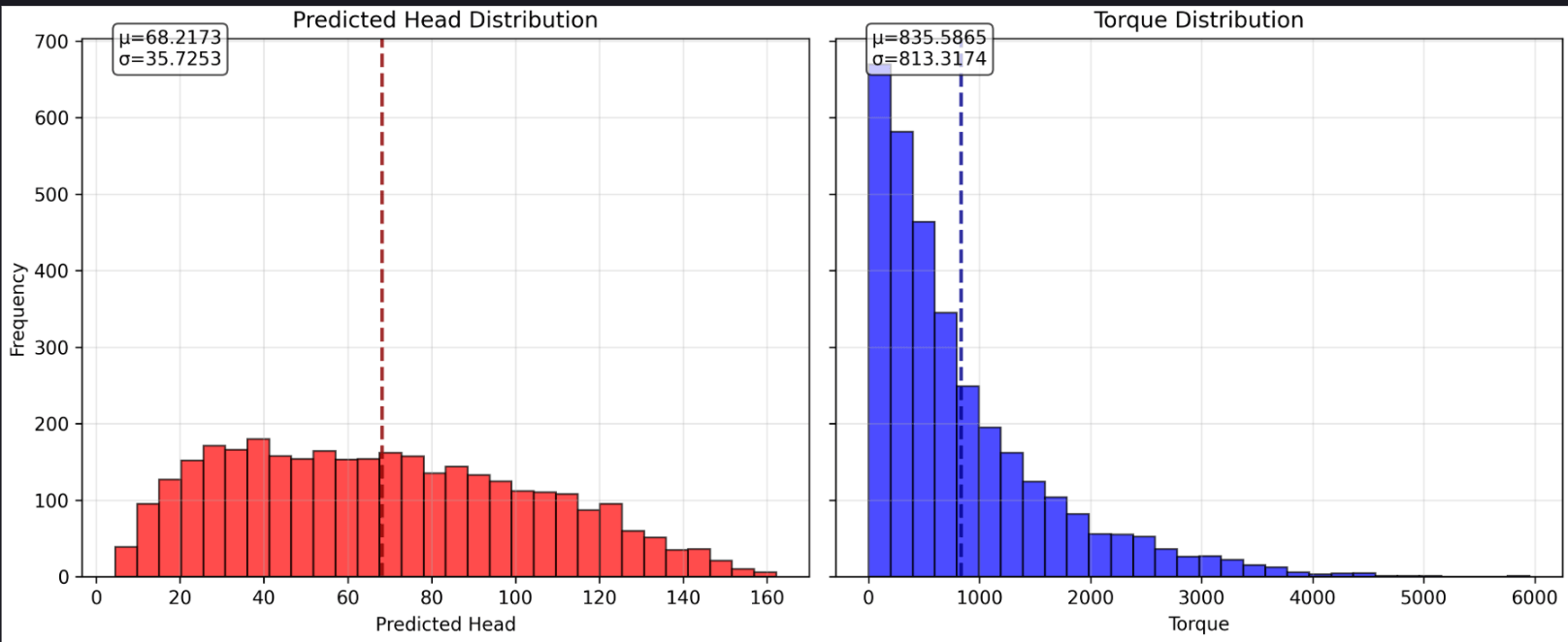
Head prediction showing strong correlation with CFD baseline across operating range
Efficiency prediction performance demonstrates the model’s ability to capture the complex interplay between geometric parameters, operating conditions, and losses. The model successfully predicts efficiency curves across flow rates ranging from 70 to 120 percent of design conditions, matching CFD predictions within acceptable tolerances for conceptual design. Predictions are delivered in seconds, enabling engineering teams to evaluate complete performance maps without the computational expense of running dozens of CFD simulations.
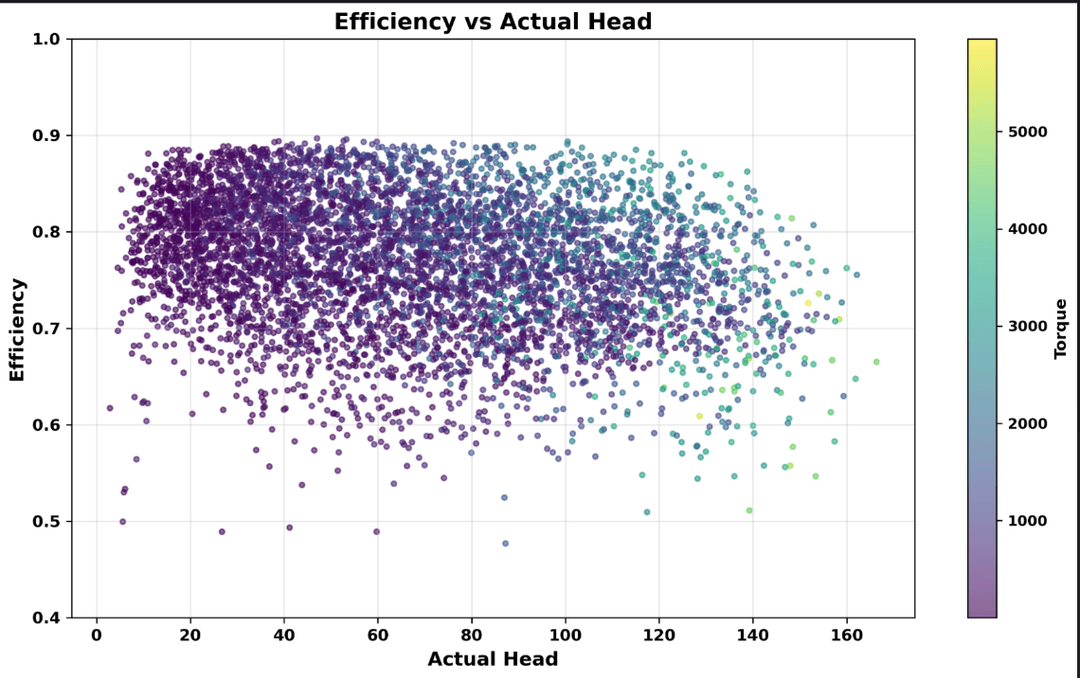
Efficiency operating envelope showing performance predictions across wide flow range
The speed advantage transforms design workflows.Generating a complete efficiency curve traditionally requires 20 to 40 individual CFD simulations across the operating range. Repeating that process across hundreds or thousands of design variants is computationally prohibitive. SHIFT-Pump compresses that entire exploration into seconds per design. SHIFT-Pump generates a complete performance map in seconds. This compression of the analysis timeline enables exploration of thousands of design variants in the time previously required to evaluate a single configuration. Engineering teams can conduct parametric studies, sensitivity analyses, and multi-objective optimization at a scale previously impractical with CFD alone.
The validation results demonstrate that SHIFT-Pump provides CFD-level accuracy at a fraction of the computational cost. The model’s ability to predict performance across operating conditions (not just at isolated design points) enables engineering teams to evaluate design robustness and off-design behavior during conceptual development. This shifts high-fidelity analysis earlier in the design cycle, where insights have the greatest impact on final product performance.
Optimization
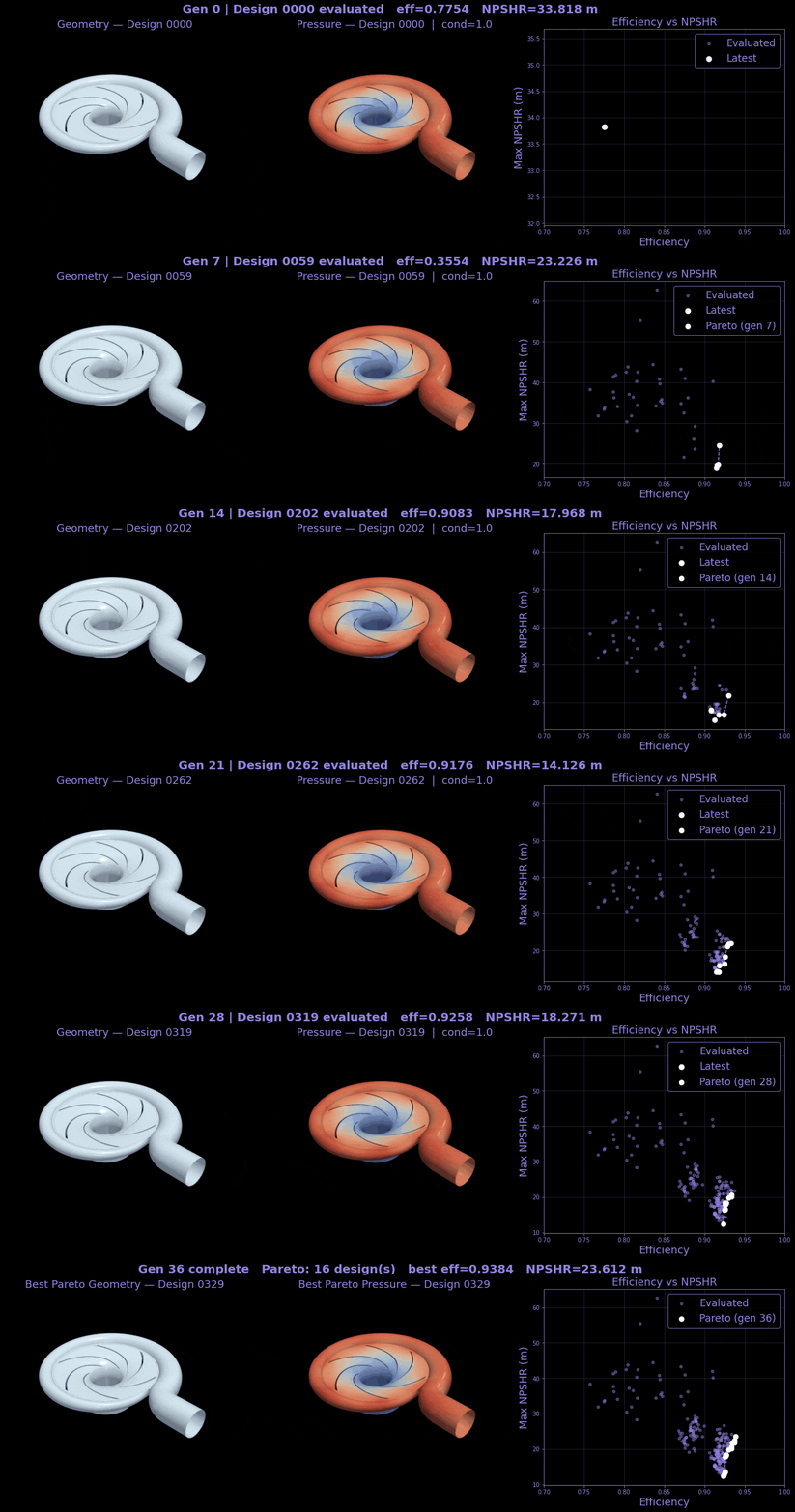
The speed of Physics AI inference makes it practical to embed SHIFT-Pump directly into optimization loops. In a demonstration study, a seven-parameter design space covering blade angles, rake, and meridional compactness was explored to balance hydraulic efficiency against suction-side cavitation risk (NPSHR). The optimizer evaluated 556 designs across multiple operating points (partial load through overload) and identified a high-performance Pareto front with efficiencies upwards of 0.94. The entire study completed in the time a traditional solver would need for a handful of individual runs.
This is the workflow transformation that Physics AI enables: not just faster answers for a single geometry, but the ability to search a meaningful design space with full operating envelope coverage at every candidate.
Implications for Industrial Pump Design
SHIFT-Pump demonstrates the potential of Physics AI to serve as an intermediate layer in industrial engineering workflows, filling the gap between simplified design tools and high-fidelity simulation. By providing near-instant predictions with CFD-level accuracy, Physics AI enables engineering teams to reserve high-fidelity simulation for its highest-value application: validating final designs and capturing physics beyond the model’s scope.
The ability to generate dense performance predictions across operating envelopes transforms early-stage design exploration. Engineering teams can now evaluate thousands of design variations, each characterized by a complete efficiency curve spanning turndown to high-flow conditions. Design decisions that previously relied on sparse data or engineering intuition can now be informed by comprehensive performance maps.
The workflow transformation is particularly impactful for companies developing product families or variants. A Physics AI model trained on a representative dataset can be applied across multiple programs, with the simulation investment amortizing over future development efforts.
Looking Ahead
Ongoing work focuses on expanding the dataset to cover broader ranges of pump types, specific speeds, and operating regimes. Future developments will explore integration with design optimization frameworks and parametric CAD tools, enabling automated design space exploration workflows that combine Physics AI predictions with constraint-based optimization.
Engineering teams interested in exploring rapid operating envelope prediction for industrial pump design are invited to contact Luminary for a technical deep dive demonstration.For technical leaders evaluating Physics AI integration into existing design workflows, Luminary offers consultations on dataset development, model training, and deployment strategies tailored to specific industrial applications.
Try a demo of SHIFT-Pump on our website.
