
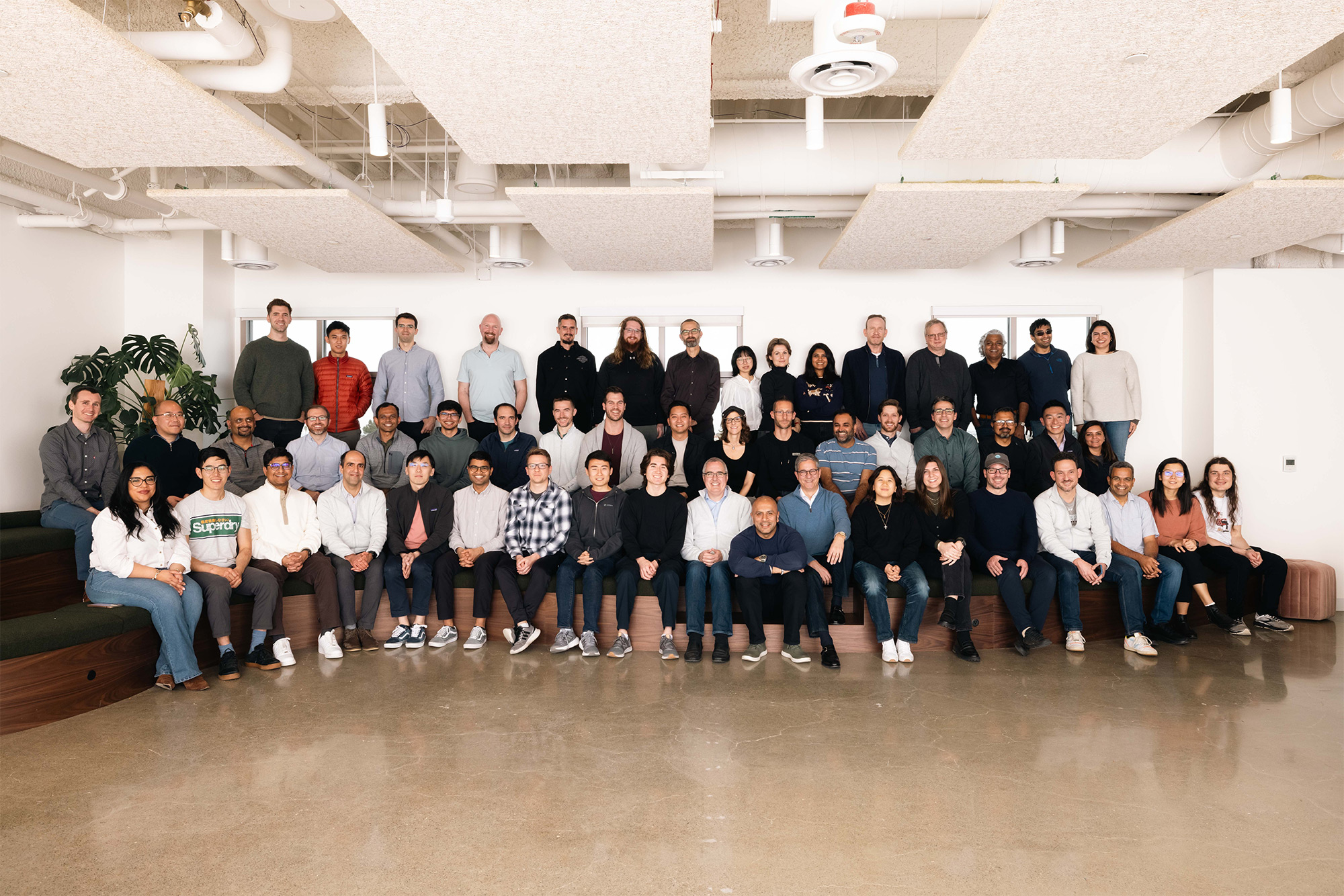
Luminary Cloud team
On March 13 2024, almost four years after Jason Lango and Juan Alonso first met in a conference room in Palo Alto, they formally launched the company they co-founded, Luminary Cloud.
“It is amazing to be able to tell the world what we’ve been up to and what we’re doing,” says Jason. “There’s a sense of wonder at having reached this point. Back when we started, we were just a handful of people brainstorming in a conference room in Sutter Hill Ventures. Technically, it was a company, but it’s a big leap to this point where we have a cutting-edge product, great set of customers, and a sizable team.”
Juan adds, “For the last couple of years we have known that we have the fastest flow solvers in the world and only a few selected customers have had access to it. I cannot wait to see the creativity of engineers in various industries unleashed by the possibilities that Luminary technology offers.”
Luminary Cloud’s computer-aided engineering platform is built to leverage the raw speed of GPU- and cloud-based processing by developing proprietary GPU solvers and a cloud-native platform from scratch. High fidelity simulations that until recently took hours or days can now be run in minutes or even seconds. And hundreds of these can be run simultaneously, turning month-long design exploration campaigns into afternoon projects. Complementary tools such as automated meshing and AI-powered Lumi Mesh Adaptation, further add to the ability to simplify and compress engineering workflows, and securely hosting everything on the cloud removes barriers to collaboration and sharing results.
The impact of the tool won’t just be the speed itself, but what that speed makes possible. Lightning fast analysis will allow engineers to ask questions and get immediate answers. That will change the way we design and innovate. Greater computational power and accessibility makes advanced tools such as large eddy simulations, sensitivity analyses, surrogate models including AI/ML, and uncertainty quantification feasible for a broader set of problems and users. Being able to replace or complement physical testing with simulation ultimately reduces costs and mitigates risks related to unknown areas of a product’s operating space. None of this will replace talented engineers, instead it will empower them.
“We’re finally enabling a vision that’s been around for a long, long time, but until now has never been practical,” explains Juan. “It has required too much hand-crafting, too much experience and expertise, and it has just not been usable by even the most highly-trained engineers.”
As a graduate student at Princeton University in 1996, Juan took part in some of the earliest experiments in automated design for aerospace applications, attempting to develop supersonic aircraft shapes for NASA’s High Speed Civil Transport program. But everything about that project was built from scratch and tailored exactly to the problem they were solving, and the software frequently failed to reach results or achieve sufficient accuracy. While cutting-edge back then, the technology and tools they had access to weren’t enough to make the concept of automated design work seamlessly.
“Now that vision that a lot of us have had in the community is becoming reality,” Juan says. “And the applications are endless.”
Luminary Cloud started with computational fluid dynamics, and in particular external aerodynamics, because of the expertise of its team and because many of the techniques required to resolve computational fluid dynamics (CFD) simulations would be applicable to other areas, too. Its existing physics solvers are already being used for internal flows and hydrodynamics, including the design of valves and pumps. In addition to CFD, the Luminary team is adding the capability to handle heat transfer, extending the platform’s reach to not just modeling fluids but also the closely-coupled interactions between thermal and fluids domains.
One of the many major global challenges for which the platform offers significant promise is sustainable aviation. The United Nations Framework Convention on Climate Change’s Paris Agreement commits 195 countries, including all major global economic powers, to reach net zero emissions of carbon dioxide by 2050. The aviation industry currently produces about one billion tonnes of CO2 annually, and the number of passenger seat miles flown is expected to triple by the middle part of this century.
“If aviation’s going to get to 2050 with zero emissions, sustainable aviation is the major imperative for research in aviation for the next 30 years,” Juan says. “It’s about fuels, it’s about electricity, it’s about hydrogen, it’s about advanced configurations. It’s about all these different things that we do not know how to do and, without the very best computational tools, carry too much risk.”
Aircraft evolve slowly and conservatively. Design missteps can be costly and dangerous, and certification can be complicated, so the safest route is usually to make minor adjustments to existing aircraft, or to stay safely within the envelope of past experience. But to cut CO2 emissions to nothing will require a design revolution. “With better tools, we can do better exploration. With better exploration, we can mitigate more risks. And with more mitigated risks we can create more aggressive designs,” explains Juan.
No one yet knows what 2050-era airplanes might look like, but what is certain is that data is going to play a central role in how we design all types of future products. The ability to run large numbers of simulations very rapidly and in parallel will produce huge amounts of information.
“We will eventually become a data company,” says Juan. “We’ll store your data in the cloud. That data is going to become king as we move forward. How we enable our customers to use their simulation data is going to be critically important.”
The datasets that Luminary Cloud will generate will also help power Jason and Juan’s idea of a smart engineering assistant. Leveraging artificial intelligence and machine learning capabilities, such a platform could not just provide suggestions for how and where to make modifications to improve and optimize designs, but additionally learn how to set-up, solve and visualize simulations better, allowing even novice users to extract significant insights.
Users, though, will play the most important role in the platform’s development over the next few years. Leaving stealth means opening up the product to a vast number of new customers, each with their own distinct needs and requirements. As a software-as-a-service platform, requiring no software installation and minimal hardware, and using a pay-as-you-go pricing model, instead of selling expensive and restrictive licenses, Luminary Cloud will be particularly well suited to a diverse mix of customers. And all of these prospective users will bring the company critical feedback.
“Everybody has a different analysis or design problem that they want to tackle,” explains Juan. “And they are the experts on the problems that they have.”
Luminary Cloud’s key philosophy has always been that by empowering smarter and faster design loops, engineers can build better products. The same will be true of its own tool. Each new customer will be a new design loop that will drive the platform’s development. The bigger the community, the better Luminary Cloud will become.

