
Aircraft design has historically been a slow, expensive grind. From early concepts to flight-ready prototypes, every step demands intensive simulation, physical testing, and careful validation—often stretching timelines into years and costs into billions. These constraints pressure engineers to commit to critical decisions early, often with incomplete data. The result? Lost design opportunities, rigid development paths, and costly late-stage rework.
Physics AI represents a new paradigm. By delivering accurate aerodynamic predictions in seconds—without manual meshing, solver setup, or post-processing—it opens the door to rapid, informed design exploration. But until now, organizations faced steep barriers to entry: training effective models demands massive quantities of high-fidelity simulation data.
That’s why Luminary developed the SHIFT model family—pretrained Physics AI models that help teams jumpstart their Physics AI deployment.
Today, we’re introducing SHIFT-Wing: a transonic aerodynamic model trained on the largest simulation dataset ever created for wing design. The model is built on NASA’s extensively validated Common Research Model, trained on 3,000+ RANS simulations, and enhanced by Luminary Mesh Adaptation (LMA) to achieve high accuracy for a broad range of wing designs and operating conditions.
Developed in partnership with Otto Aviation and trained on Luminary’s Physics AI Factory (recently detailed in the blog article: Luminary’s Physics AI Factory: The End-to-End Platform to Build & Deploy Physics AI Models), SHIFT-Wing achieves exceptional accuracy for lift (CL), drag (CD), pitching moment (CM), and surface pressures.
Partner perspective
“At Otto, we believe the future of aircraft design lies at the intersection of first principles and artificial intelligence. This partnership with Luminary Cloud will complement Otto’s ability to unlock scale in generation of Otto’s proprietary physics-based simulation data, making it possible for our engineers to explore, optimize, and validate aerodynamic concepts faster than ever before. By running our proprietary flight sciences methodologies on their simulation platform, we’re not only accelerating innovation but also developing next-generation surrogate AI models that bring physics-informed intelligence into every stage of our designs.”
- Obi Ndu, Chief Information & Digital Officer, Otto Aviation.
A growing partner ecosystem
SHIFT-Wing sits at the intersection of multiple innovations—built and validated in partnership with a cross-disciplinary ecosystem of leaders in design, simulation, and AI:
- Onshape provides cloud-native CAD with version control and parameterized design configurations, serving as a centralized source of geometry truth.
- Luminary Cloud’s Physics AI Factory enables fully integrated simulation, training, and inference workflows—eliminating costly data transfer and compute bottlenecks.
- Otto Aviation brings deep aircraft design domain expertise and real-world validation constraints.
- NVIDIA contributes the DoMINO model architecture and GPU acceleration, enabling simulation, training, and inference at industrial scale.
- Tecplot delivers high-performance CFD post-processing and interactive visualization tools, enabling engineers to explore large simulation datasets, automate analysis workflows, and extract actionable insights from Physics AI inference.
- nTop (nTopology) offers a computational design platform for advanced topology optimization and rapid, robust geometry variation for physics AI inference.
Building SHIFT-Wing
SHIFT-Wing parameterization and sampling strategy
Dataset Generation
We used Onshape’s cloud-native CAD platform to build a parameterized CRM model with full traceability. Geometry parameters included common planform design inputs, such as twist, camber, and sweep were varied systematically across thousands of design variants. Onshape’s built-in PDM, version control, and branch and merge capabilities were integrated directly into the training loop to programmatically generate thousands of design variants while maintaining full design intent and traceability.
_The SHIFT-Wing collaboration with Luminary demonstrates how Onshape’s industry-leading cloud-native CAD is uniquely positioned to power the next generation of AI-driven engineering. By integrating Onshape’s parametric modeling directly into the Physics AI pipeline, we’ve enabled engineers to programmatically generate and iterate on thousands of design variants while maintaining full design intent, version history, and auditability. This seamless data flow from CAD to AI and back to design decisions represents the future of engineering.” _
-
` — Darren Henry, SVP Onshape General Operations.*
SHIFT-Wing macro parameters
| Geometry Parameter | Min | Max |
|---|---|---|
| Aspect ratio | 7.5 | 11 |
| Root chord extension | 0% | 40% |
| ¼ chord sweep | 25 deg | 37.5 deg |
| Root twist (centerline) | 3 deg | 9 deg |
| Delta twist root-break | -3 deg | -7 deg |
| Delta twist break-tip | -1.5 deg | -7.5 deg |
| Fuselage diameter | 240 in | 258 in |
To ensure broad coverage and robust generalization, we employed Latin hypercube sampling for geometric diversity and ran boundary-condition sweeps across Mach and Reynolds numbers. Each configuration was simulated using Luminary’s GPU-native CFD solver—validated against V&V benchmarks including the High Lift Prediction Workshop—with mesh adaptation (~30M CVs) and y+ ≈ 1 near-wall resolution. The runs were orchestrated across a distributed cloud cluster, producing petabytes of annotated flow fields which were automatically tagged, versioned, and fed into the centralized training repository.
Model Training
Training was conducted on NVIDIA’s latest GPUs using the DoMINO model architecture, which our team contributed to as part of the broader SHIFT initiative. From the full dataset, 2,276 adapted-mesh simulations were selected for training, covering Mach 0.5–0.85 and a range of angles of attack, including flow separation, shock interactions, and off-design cases.
The model was trained with a composite loss function weighted by baseline performance on the DPW-Wing case at Mach 0.85. This physics-aware approach balances prediction accuracy across lift, drag, and moment.
A held-out test set was reserved to validate SHIFT-Wing’s generalization. It included both transonic and subsonic scenarios, with particular emphasis on challenging off-design configurations.
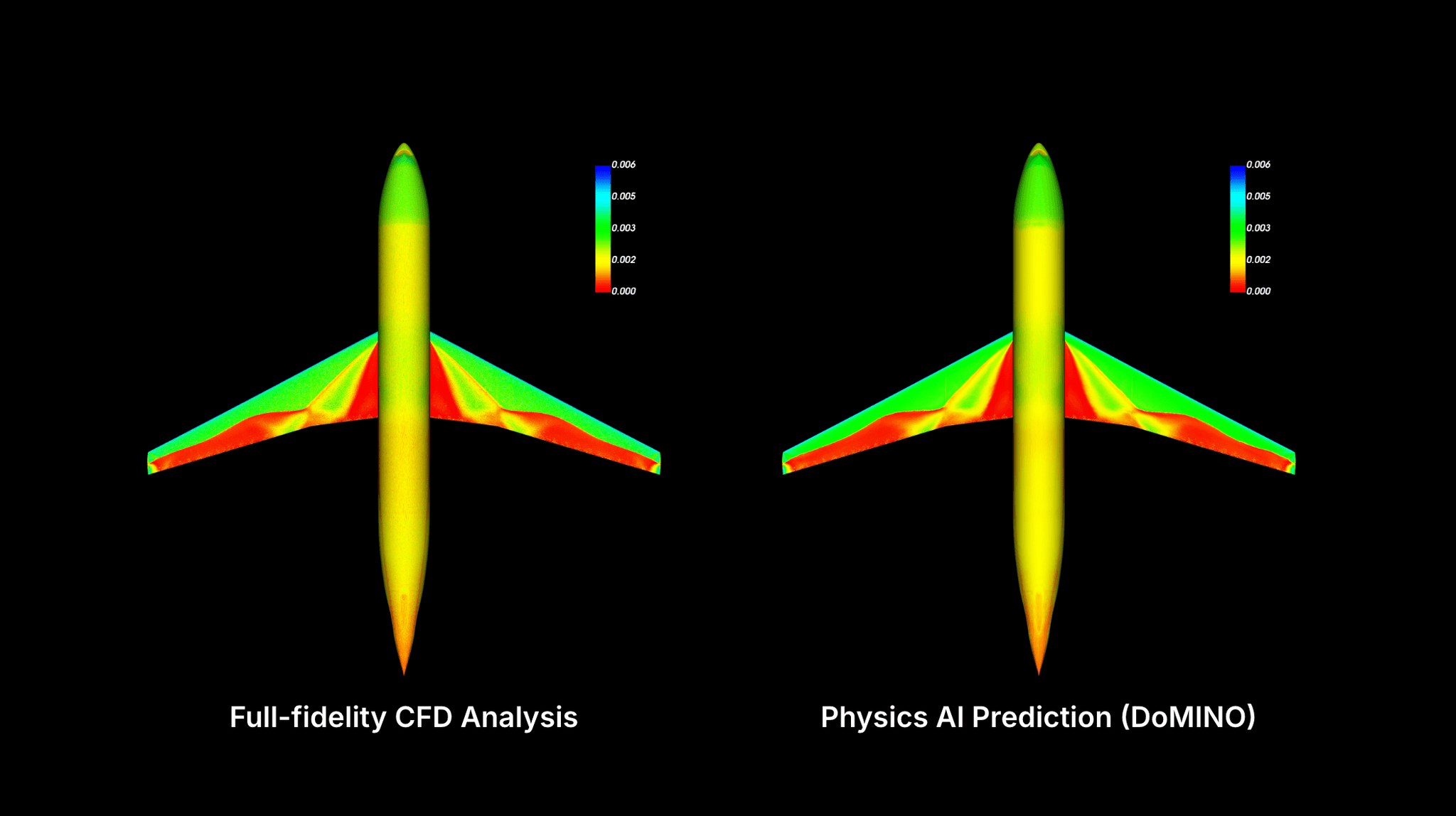
SHIFT-WING inference vs Full-fidelity CFD Analysis. Notably, shock waves are well resolved due to Luminary’s Mesh Adaptation.
Performance at a Glance
At Mach 0.85:
| Metric | Best | Median |
|---|---|---|
| CL error | 1.65% | 4.15% |
| CD error | 0.17% | 1.73% |
| CM error | 0.15% | 5.30% |
At Mach 0.50:
| Metric | Best | Median |
|---|---|---|
| CL error | 0.55% | 0.76% |
| CD error | 0.08% | 0.81% |
| CM error | 0.06% | 1.26% |
Across all configurations, SHIFT-Wing delivers:
- 92% of predictions within 5% of ground-truth CFD at Mach 0.85
- 98% of predictions within 5% at Mach 0.50
- 100% of predictions within 10% across the board
These results underscore the model’s accuracy, robustness, and generalization across wing geometries and flow conditions.
Inference
The model is already being used in commercial software. Tecplot has integrated SHIFT-Wing outputs into its Chorus and 360 platforms to navigate the dataset and evaluate design performance.
Demonstration of SHIFT-Wing inference for design exploration in Tecplot
Luminary has worked closely with nTop to leverage their powerful and robust implicit modeling kernel to power physics AI model training (see our recent joint webinar). Leveraging SHIFT-Wing, nTop generated CRM variants and demonstrated that the model could deliver instant inference on independently parameterized geometries within their platform.
SHIFT-Wing inference integrated directly into nTop’s platform
Leverage SHIFT-Wing to accelerate your innovation cycles
SHIFT-Wing is designed for tight integration into existing design workflows. Here’s how engineering teams can harness it:
1. Generate Data. Use the Luminary notebook interface to upload your geometry. Define sweep ranges over geometric and flow parameters, then launch batch simulations in the cloud with a single command.
2. Fine-Tune SHIFT-Wing. Select SHIFT-Wing from the model registry and fine-tune it with your newly generated simulation data. Extend the model with domain-specific variants, e.g., for aero-structural or aero-propulsive coupling. Luminary’s platform handles ingestion, training orchestration, and version tracking automatically.
3. Perform Inference. Once trained, the model can be deployed using Luminary’s Inference API or directly within your infrastructure. For each design candidate, the fine-tuned model outputs high-fidelity surface pressure distributions and performance metrics (CL, CD, CM) in seconds per design candidate.
Applications include:
- Early-stage control law development and dynamic response shaping
- Fast-turnaround exploration of control surface geometries
- Downselection in large design-of-experiment campaigns
- Support for regulatory documentation requiring analysis of many configurations
All predictions include confidence intervals and can be exported for downstream optimization, uncertainty quantification, or multi-disciplinary design integration.
Conclusion
SHIFT-Wing proves that Physics AI is a production-ready tool that’s reshaping the way aerospace design is done. Early adopters in defense and commercial sectors are already reporting significant time savings and fewer costly redesign cycles.
As more contributors add data and configurations, SHIFT-Wing will continue to evolve, enabling faster learning and deeper insights. Whether you’re validating early concepts, running certification studies, or exploring novel configurations, SHIFT-Wing offers a powerful acceleration lever.
Ready to accelerate your aircraft development process? View the sample dataset, request access to the full dataset, or contact us to discuss developing a custom model for your needs and explore how Physics AI can drive your next program to new heights.

