
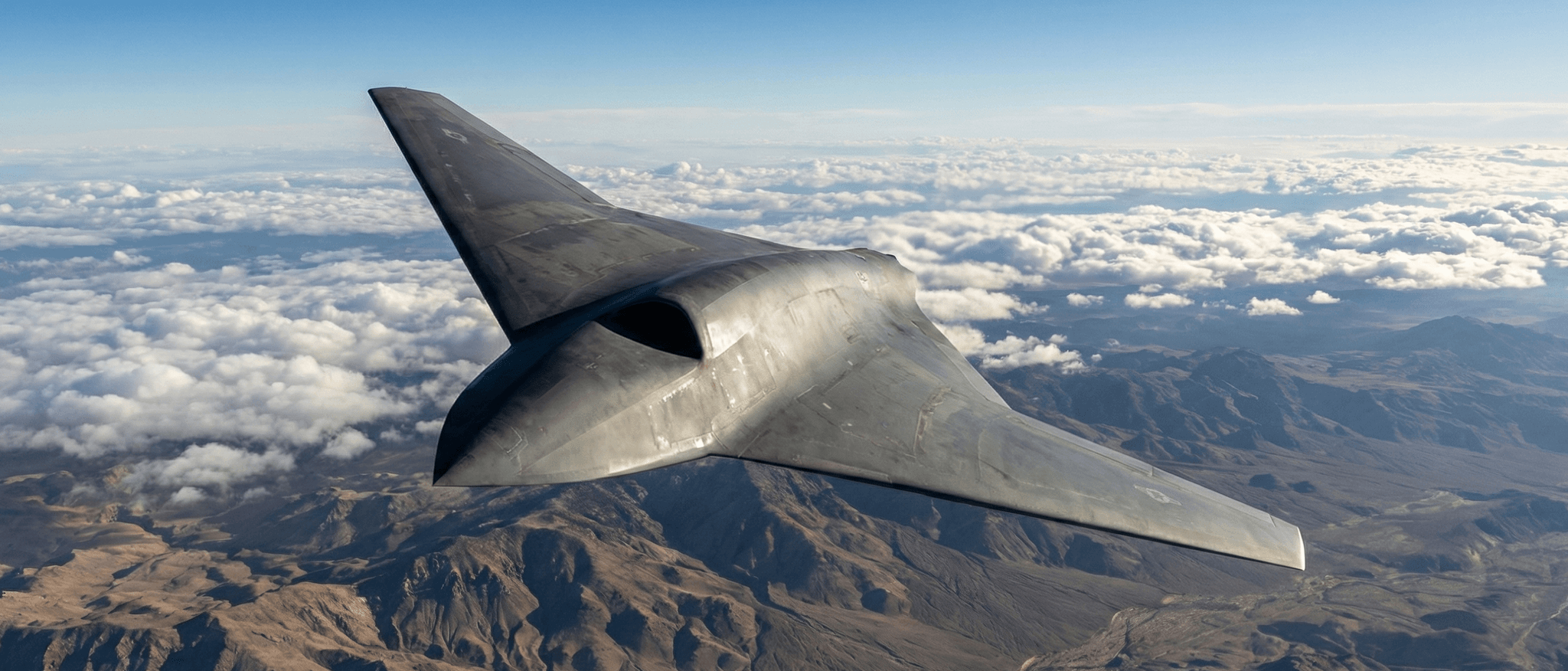
Collaborative Combat Aircraft, or CCAs, sit at the center of a rapidly accelerating shift in how advanced airpower is designed, procured, and deployed. These Group 5 unmanned aircraft are being developed as tightly integrated partners to crewed fighters, extending combat mass, sensing reach, and weapons capacity through human–machine teaming rather than replacing pilots outright. In U.S. Air Force doctrine, CCAs are expected to fly in contested airspace alongside fifth and sixth generation fighters, executing missions that range from sensing and targeting to electronic warfare and air to air combat, all while operating under varying levels of autonomy.
Collaborative Combat Aircraft programs are being asked to converge on credible designs under extreme uncertainty, compressed timelines, and unprecedented production scale. At the same time, they must remain affordable enough to support procurement at scale. The Department of Defense has signaled intent to acquire roughly one thousand aircraft at approximately 25 to 30 million dollars per vehicle, turning early design decisions into multi-tens-of-billions-of-dollars outcomes.
What makes this moment uniquely challenging is timing. Operational concepts continue to evolve, threat models remain fluid, and budgets are under scrutiny. Yet early downselects have already occurred, and contractors are expected to demonstrate confidence and credibility far earlier in the development cycle than traditional workflows typically support. Program teams are therefore required to reduce uncertainty quickly while retaining enough flexibility to respond to evolving requirements.
Earlier Design Tradeoffs
Aerospace development follows a familiar tradeoff curve. Early in a program, design freedom is high and the cost of change is low, but data is sparse and assumptions dominate. As programs mature, confidence increases while flexibility collapses as CAD becomes more complex, supply chains lock in, and downstream dependencies multiply.
CCA programs compress this curve. Teams are required to make consequential architectural decisions earlier, with less margin for iteration, while still meeting aggressive schedule and cost targets. This compression results in the disproportionate importance of early analysis, even as the tools traditionally used for high-confidence evaluation remain slow and resource-intensive.
Aerodynamics sits at the center of this tension. For CCA-class vehicles, aerodynamic performance shapes range, payload capacity, survivability, and propulsion sizing. It drives mission effectiveness and cascades into structural, thermal, and systems-level tradeoffs. Traditional CFD remains essential for resolving these physics with precision, but its cost and turnaround time constrain how broadly teams can explore the design space during early program phases.
As a result, early configuration decisions are often made with limited visibility into sensitivities, second-order effects, and interactions between design variables. Exploration narrows quickly, validation deepens selectively, and risk accumulates outside the areas teams have time to analyze in detail.
Physics AI as an Exploration Engine
Physics AI expands how CFD can be used within modern development cycles by shifting emphasis from isolated validation toward broad exploration.
By learning directly from high-fidelity simulations, Physics AI models provide fast, accurate predictions across a wide design space–while eliminating the slow, manual setup associated with traditional CFD. Engineers can evaluate large numbers of configurations early, when architectural decisions remain reversible, and use high-fidelity CFD selectively to confirm and refine promising directions. This approach preserves the role of physics-based simulation while enabling deeper, broader design exploration
The practical effect is increased visibility into trends, sensitivities, and tradeoffs across the design space. Rather than optimizing around a small set of candidate configurations, teams can understand how performance responds to variation, which parameters dominate outcomes, and where margins are robust or fragile. In programs where early confidence increasingly influences competitive outcomes, this broader situational awareness plays a central role.
For example, Luminary’s recently announced collaboration with Northrop Grumman underscores how Physics AI is moving from proof of concept into real program application. In this initiative Northrop Grumman and Luminary Cloud jointly developed a Physics AI model to explore and optimize spacecraft propulsion components in seconds rather than traditional simulation cycles that take hours or days. Early results from this work suggest that design exploration once confined to late in the schedule can now be done early, giving engineers deeper insight into performance tradeoffs and reducing execution risk on complex space programs.
A Physics AI Model for CCAs
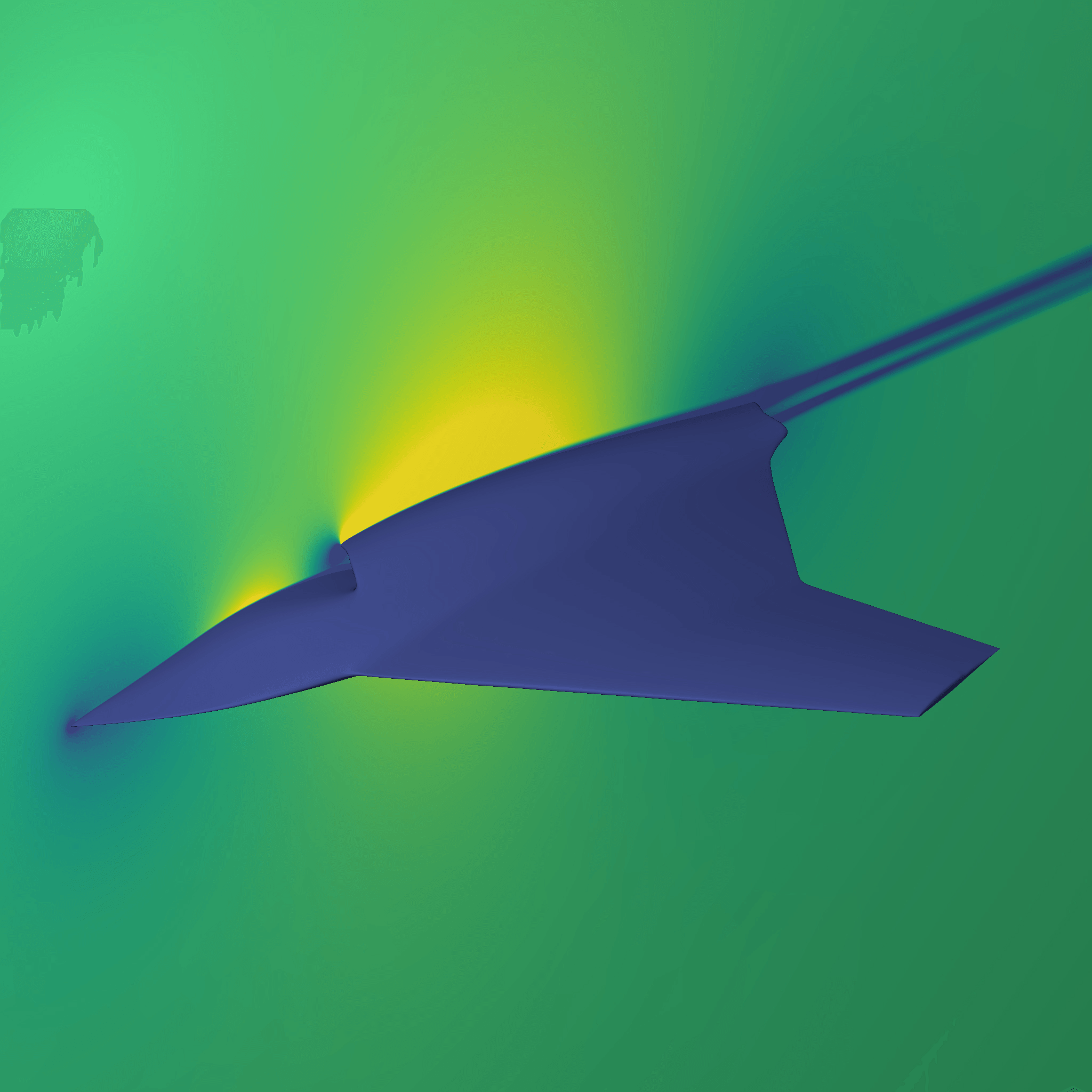
Visualization of the baseline SHIFT-CCA geometry at cruise conditions
Luminary’s [SHIFT models](part of Luminary’s SHIFT model family) are pretrained Physics AI models that deliver market-leading scale and accuracy for mission-critical applications. Today we’re introducing SHIFT-CCA, a Physics AI model focused on aerodynamic performance for Group 5 UAV-class configurations representative of Collaborative Combat Aircraft concepts. Developed in collaboration with nTop, the model required a robust end-to-end workflow from parametric geometry variation to simulation and model training.
Luminary and nTop collaborated to deliver this workflow:
- nTop provided fast, robust parametric geometry variation
- Luminary provided an end-to-end Physics AI platform to train and deploy the model
nTop’s implicit geometry representation enables “unbreakable” parametric models that can be used to generate many simulation-ready configurations with no failures. This removes a significant challenge to generating large datasets for Physics AI model training.
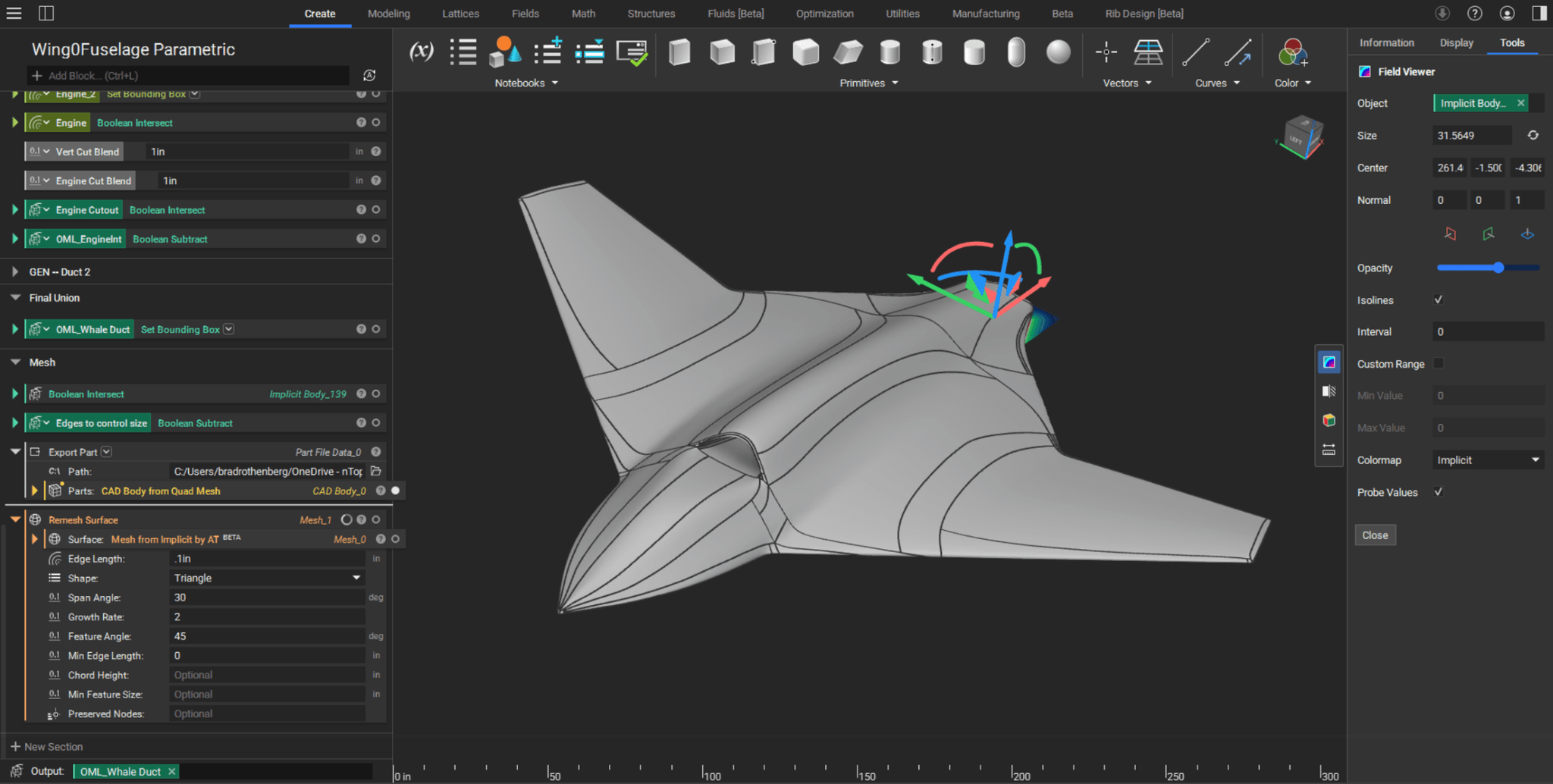
Parameterized CCA model in nTop
SHIFT-CCA is intentionally scoped for early-stage design exploration and trade studies. It supports rapid screening and sensitivity analysis across thousands of geometric variants, delivering high accuracy in the regions of the design space that matter most during early program decision-making.
Building the Model
The initial release targets representative cruise conditions. SHIFT-CCA predicts field quantities such as surface pressure and wall shear stress, along with integrated quantities including lift, drag, and lift-to-drag ratio. Predictions are generated in seconds, enabling interactive comparison across thousands of configurations within the design space and supporting workflows that emphasize understanding of the underlying physics impacting design tradeoffs.
The develop SHIFT-CCA, we trained the NVIDIA DoMINO model architecture on a large, systematically generated dataset derived from a parameterized Group 5 UAV reference configuration. Geometry variation was driven through robust parametric controls in nTop, enabling the generation of thousands of simulation-ready configurations without manual intervention or geometry failures. High-fidelity CFD simulations were performed on Luminary’s platform at representative cruise conditions to capture aerodynamic behavior across a broad and relevant region of the design space.
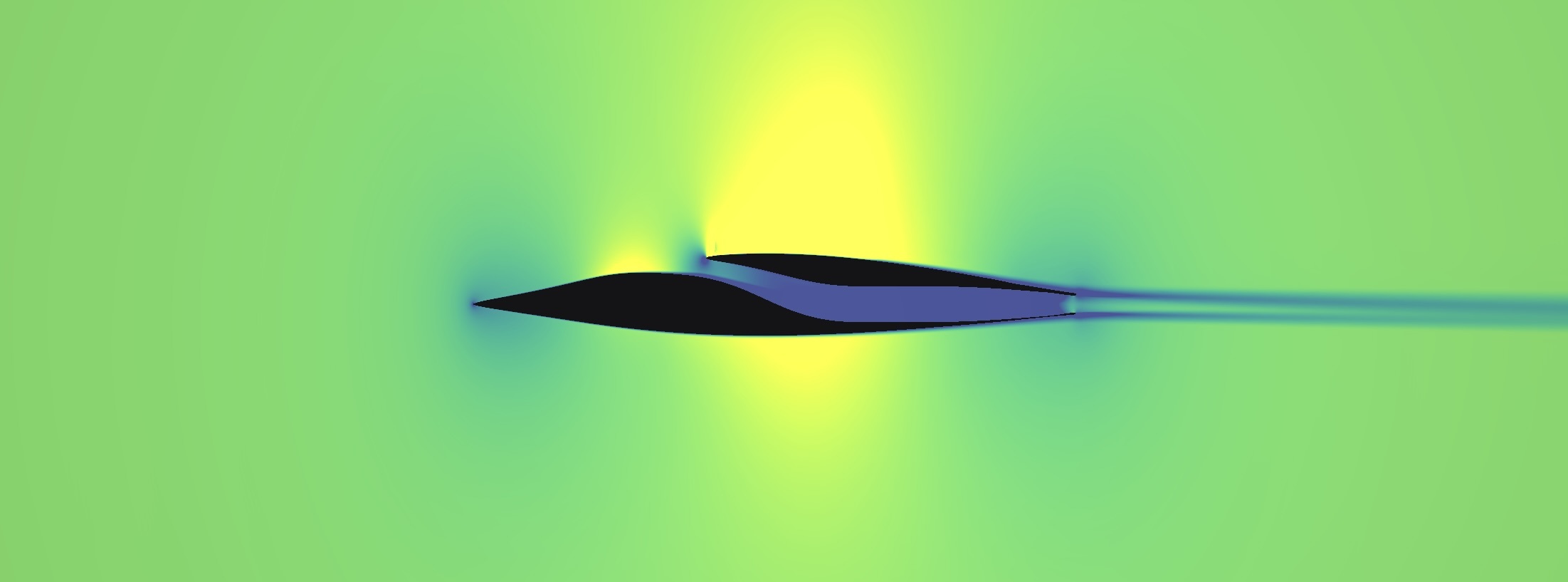
Cross-section of the baseline CCA geometry
Model performance was evaluated using standard regression metrics across force and moment quantities, with results summarized using R² and normalized mean absolute error for both training and validation sets. Across all predicted quantities, the model demonstrates strong agreement with CFD, with high correlation and low normalized error, and comparable performance between training and validation. This consistency indicates stable generalization across the sampled design space and supports use of the model for early-stage screening and trade studies. Equivalent performance is obtained when predictions are expressed in aerodynamic coefficient form, ensuring fidelity in the quantities most commonly used for design evaluation.
Detailed methodology and evaluation results are provided in the appendix.
What this enables in practice
For teams competing in Collaborative Combat Aircraft programs, the value of SHIFT-CCA is not speed for its own sake. It is competitive leverage in an environment where early confidence, credibility, and execution risk increasingly shape downselects. Primes are being asked to converge on viable designs under compressed schedules, evolving requirements, and cost scrutiny, while demonstrating that those designs can be executed at scale.
- Demonstrate credible design exploration and optimization. SHIFT-CCA allows teams to move beyond narrow point designs and show broad, defensible understanding of the aerodynamic design space. By screening thousands of configurations early, teams can identify robust regions where performance margins persist across uncertainty, strengthening the technical case behind early architectural decisions.
- Reduce program risk while design freedom still exists. By broadening design exploration early in the design process, sensitivities and second-order effects are resolved before they become schedule or cost drivers. High-fidelity CFD is still applied, but more selectively and with clearer intent, focused on validating the most promising directions rather than searching for them.
- Support on-time, on-budget execution in a downselect-driven environment. Earlier visibility into tradeoffs and risk concentration allows program leadership to make more confident decisions around configuration, margins, and investment. In competitive CCA procurements, this strengthens a prime’s ability to demonstrate readiness to execute, not just technical ambition.
SHIFT-CCA does not replace traditional simulation. It changes the economics of asking the right questions early enough so the answers still influence outcomes.
Looking ahead
Future releases will expand both the design space and the physics represented, including additional planform variation and more realistic propulsion boundary conditions.
SHIFT-CCA represents an initial step toward deploying Physics AI with practical focus in defense programs. As CCA development timelines continue to compress and program stakes increase, approaches that expand early insight while preserving engineering rigor are likely to play an increasingly important role in how teams compete and deliver.
Try out the SHIFT-CCA model with our interactive physics AI inference demo. To learn more about how Luminary is enabling aerospace and defense organizations to make Physics AI their competitive advantage, talk to an expert today.
You can also access our open-source SHIFT datasets from our Hugginface page.
Appendix
How the model was built
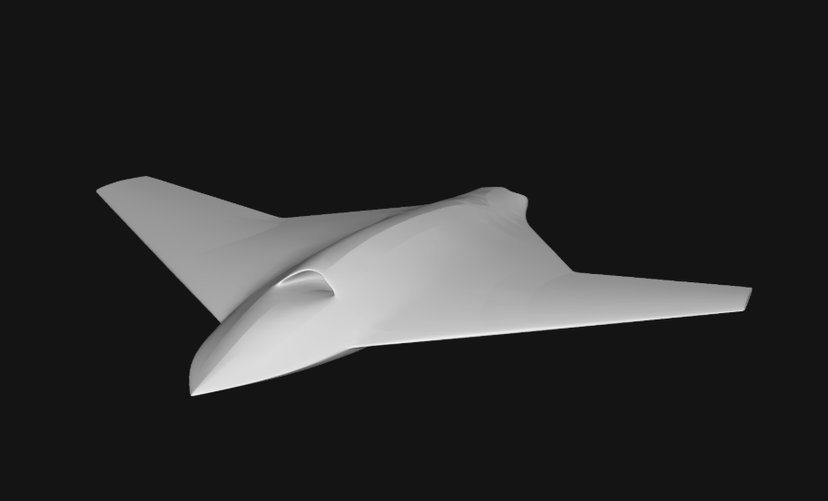
SHIFT-CCA baseline geometry
Parameterizing the geometry and defining the design space
The training data for SHIFT‑CCA was generated from a Group 5 UAV reference configuration that was created in nTop. Geometry variation is defined explicitly through parametric controls rather than manual shape edits, enabling systematic exploration of aerodynamic design variables.
Table 1
Geometric parameters defining the design space for the SHIFT-CCA training dataset
| Parameter | Min | Max |
|---|---|---|
| C root [ft] | 16 | 20 |
| Panel Break Span [%] | 35 | 50 |
| Panel 1 LE Angle [deg] | 30 | 45 |
| Panel 2 LE Angle [deg] | 30 | 45 |
| Panel 1 TE Angle [deg] | -45 | -30 |
| Panel 2 TE Angle [deg] | 15 | 30 |
| Wing Tip Close Angle [deg] | 0 | 15 |
The baseline geometry itself underwent multiple iterations, particularly around the inlet and duct, to reduce separation and stabilize the flow field. Only after converging on a stable baseline was large‑scale data generation initiated. To control complexity and improve learnability, the initial dataset fixes the span across all design variants. Additional planform variation is planned for future releases.
High‑fidelity simulation and data generation
The training data was generated using Luminary’s CFD solver at representative cruise conditions aligned with CCA-class operating envelopes. Approximately 4,000 geometry variants were simulated for the initial release, with a stretch target of 6,000 cases to further expand coverage.
A deliberate decision was made to begin with an open-duct configuration. Early experiments showed that poorly constrained boundary conditions introduced large flow-field variability that obscured geometric effects. By simplifying the propulsion representation for the initial release, the dataset emphasizes clean aerodynamic trends that are appropriate for early-stage trade studies and sensitivity analysis.
Beyond coverage, the dataset exhibits physically consistent structure across key aerodynamic coefficients. As shown in Figure 1, correlations observed between lift, drag, and pitching moment reflect expected aerodynamic relationships, including lift–drag coupling driven by induced drag effects and a strong lift–moment correlation consistent with conventional wing configurations. Similar behavior was previously observed in the SHIFT-Wing dataset. The presence of these physics-consistent patterns indicates that the design space captures meaningful aerodynamic relationships rather than arbitrary variation, providing structured signal for subsequent model training.
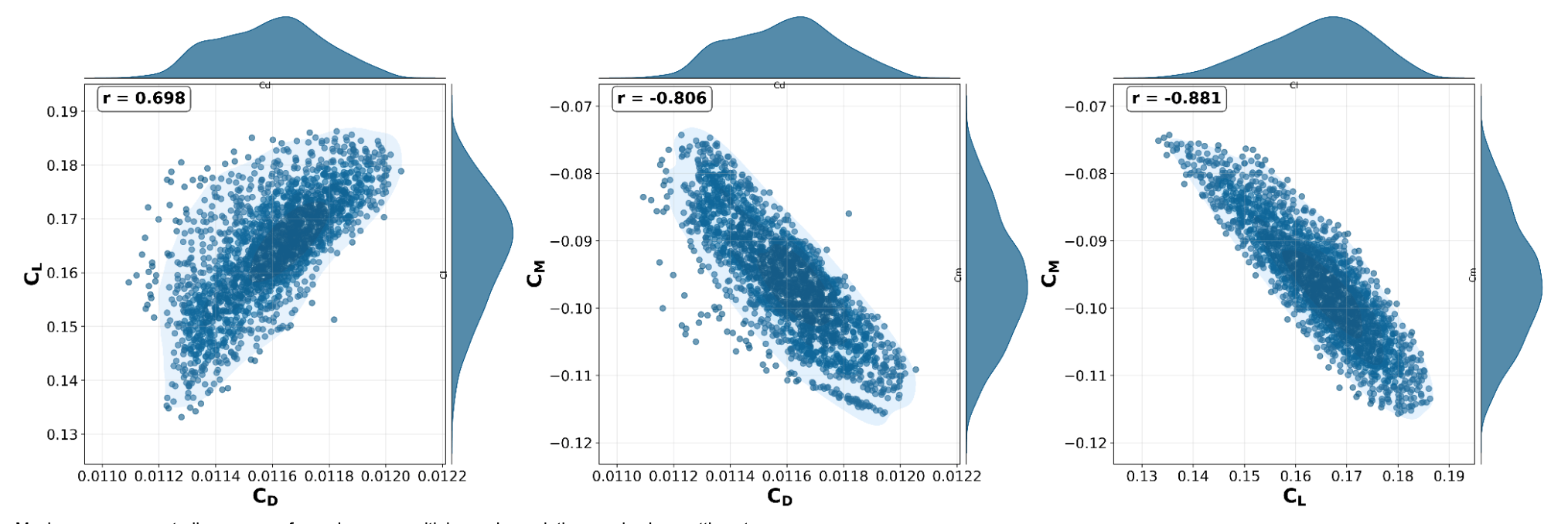
Relationship between aerodynamic quantities in the training dataset
Mesh convergence studies were performed across multiple mesh resolutions and solver settings to quantify numerical sensitivity and inform production simulation settings. These studies establish realistic expectations for model accuracy and help separate numerical noise from geometric effects within the dataset.
Model training and evaluation
Initial model training was performed on a subset of the dataset to validate training behavior and convergence characteristics prior to scaling to the full training set. Subsequent training used the complete dataset.
Model evaluation emphasizes out-of-sample performance and behavior near the boundaries of the design space, where nonlinear aerodynamic effects and geometric interactions are most pronounced. Performance is summarized in Table 2 using R² and normalized MAE for Cd (drag coefficient), Cl (lift coefficient) and CPM (pitching moment coefficient), evaluated on both training and validation sets.
Across all predicted quantities, high R² values and low normalized MAE are observed, with similar metrics between training and validation. This consistency indicates stable generalization across the sampled design space, with no evidence of systematic bias or degradation in performance at higher force or moment magnitudes.
Table 2
Error metrics for validation set.
| Quantity | R2 | nMAE |
|---|---|---|
| Drag Coefficient [Cd] | 0.957 | 2.7% |
| Lift Coefficient [Cl] | 0.990 | 1.2% |
| Pitching Moment Coefficient [CPM] | 0.993 | 1.0% |

