
Physics-informed AI-accelerated simulations – physics AI – deliver speed-ups of several orders of magnitude over traditional methods, and simplify workflows by eliminating tasks like meshing and physics setup. With just a 3D model or basic design inputs, users get near real-time feedback, cutting design cycles from days to seconds. These tools make high-quality insights accessible to a broader range of engineers, including designers, enabling earlier, faster, and more innovative product development.
The key challenge? Training accurate AI models requires hundreds to thousands of high-fidelity, accurate simulations. As Tim Costa, Senior Director of CAE, EDA, and Quantum at NVIDIA, described it: *“Physics AI models are essential for real-time interactive engineering analysis and design, but require tremendous amounts of data.” *This is where Luminary Cloud proves invaluable, offering a practical and powerful solution to transform your simulation workflow.
In this blog, we’ll explore how physics AI is transforming product development, the workflow for building these solutions, and why Luminary is the best tool for generating high-quality datasets. We’ll also cover how Luminary and NVIDIA showcased a real-time virtual wind tunnel with NVIDIA’s Omniverse Blueprint at Supercomputing 24, highlighting the potential of physics AI for interactive design.
Modern Product Development
In modern product development, reducing time and cost while ensuring performance and innovation is critical. CAD and computer aided engineering (CAE) tools have become indispensable, revolutionizing how products are designed, tested, and validated across industries. CAE simulations—spanning fluid dynamics, structural mechanics, thermal analysis, and beyond—now compete with physical prototypes, often complementing or replacing them (see diagram below). These simulations not only save time and resources but also provide unique insights into performance metrics that physical tests can’t always capture, enabling engineers to push the boundaries of design and functionality.
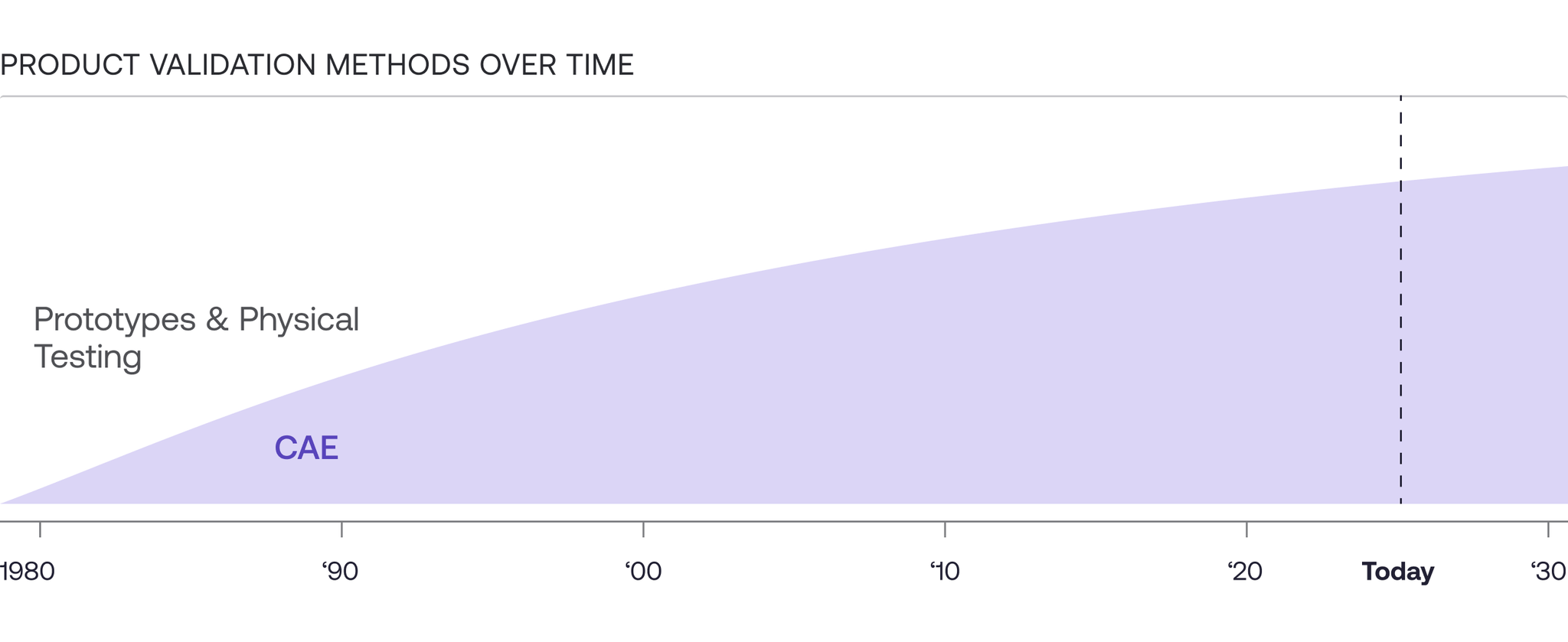
Diagram of simulation adoption in engineering (CAE) for product validation, showing method usage. Adapted from Cambashi (2023CAE Market UBS Webinar) with modifications by Luminary Cloud.
Computational Fluid Dynamics (CFD) is rapidly advancing with better scale-resolving methods and adoption of accelerated compute architectures, making simulations faster and more accurate. However, deploying these tools effectively still requires deep expertise in fluid physics and numerical methods; the technical complexity and high computational demands have kept CFD out of reach for many engineers.
CFD Workflows
The traditional CFD workflow typically begins by simplifying a 3D model—a manual, time-consuming step—followed by meshing, where the simulation domain is discretized (divided) into elements whose size and distribution directly impact solution quality. Simulation setup involves defining constraints like boundary conditions and material properties, and must accurately represent the real world environment. In addition, the parameters of the numerical solver – determining how the physical governing equations are solved – are specified; these also influence solution quality and speed.
Simulations take hours to days, depending on problem complexity and availability of compute resources. The results are analyzed through post-processing to extract insights like force values or flow fields and are validated against physical measurements to ensure accuracy.
A single simulation offers valuable insights, but the true power of CFD (and simulation in general) lies in exploring scenarios by varying operating conditions or modifying 3D models. Automated workflows for creating simulation databases enable engineers to evaluate performance across large design spaces, supporting downstream tasks, for example designing the flight control logic from an aircraft simulation database with different slat, flap, and control surface deflections.
Traditionally focused on single simulations, CFD post-processing now faces the challenge of analyzing large-scale databases to build tools that not only extract meaningful insights, but drive greater efficiency and better decisions earlier in product development.
AI/ML in CFD
AI/ML techniques excel at analyzing large datasets, identifying patterns, trends, and relationships to enhance insights. Methods like regression, clustering, and dimensionality reduction simplify complex datasets, enabling engineers to extract performance metrics or identify anomalies. Neural networks, such as convolutional neural networks (CNNs) for structured data and graph neural network (GNNs) for unstructured meshes or point clouds, further optimize workflows by automating tasks like feature extraction and predictive modeling, accelerating design iterations and reducing reliance on costly simulations.
Physics AI, or physics-informed AI/ML, goes further by introducing information about the physical system being simulated to enhance the model. This results in models that learn new physics, build surrogates for computationally expensive physics, and allow auxiliary information (physical test data, new simulations) to update the model.
Approaches like physics-informed neural networks (PINNs) combine physics-based constraints with data-driven learning, delivering greater accuracy and robustness. This is achieved through embedding physical laws like mass, momentum, and energy conservation directly into model training through custom loss functions, such that predictions align with governing physics even when data is sparse.
Many of these AI models operate without the need for predefined grids or meshes, enabling efficient handling of complex geometries and high-dimensional problems. This removes the need for specialized physics expertise or complex CFD tools, empowering new users, like product designers, to integrate simulation insights earlier in development. This is where physics AI is expected to make the biggest impact: integrating simulation earlier in the product design workflow (see figure).
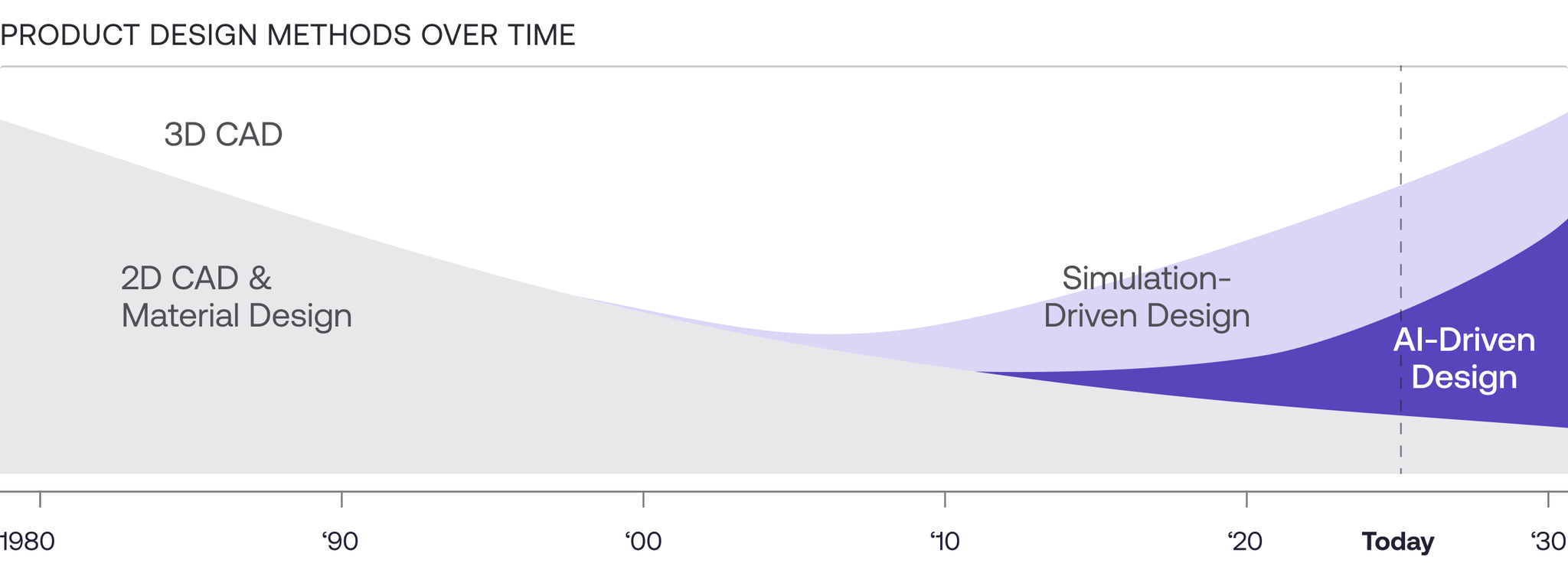
Diagram of growing adoption of simulation-driven methods in iterative product development. Adapted from Cambashi (2023 CAE Market UBS Webinar), with modifications by Luminary Cloud.
Physics AI Workflow
We’ve discussed physics AI and its potential to revolutionize simulations, but what does it take to bring this capability into your organization? Let’s break down the process step by step.
The physics AI workflow combines traditional tools and specialized software:
Dataset Generation
- Dataset Sample Definition: Define geometry and simulation conditions for the AI training dataset. Choices depend on deployment needs and AI model architecture. Geometry variations can be created using CAD tools like SolidWorks, NX, Blender, and Autodesk, or custom utilities that operate on discrete models (e.g., mesh morphing).
- Running Simulations: Simulation software generates high-fidelity training data based on the defined samples. Time and cost depend on simulation software scalability and compute resources availability.
Model Training
- Pre-Processing: Prepare simulation results for AI model compatibility, such as down-sampling or vectorizing data.
- Training: Execute computationally intensive training on local hardware or cloud platforms (AWS, GCP, Azure) using open-source frameworks, like NVIDIA Modulus, and/or commercially available physics AI frameworks. The output of this step is a trained AI model.
Interactive Inference
-
Model Hosting: Store and manage trained models for future use, often with multiple architectures or datasets.
-
Inference Workloads: Run the AI model on new inputs using lighter infrastructure compared to simulation or training.
-
Interactive Interface: Provide a user-friendly interface for modifying inputs, running inference, and visualizing results. Tools like NVIDIA Omniverse, Blender, or vendor solutions can support this step.
The specific tools used depend on user expertise, workload requirements, and available compute resources – often a key bottleneck. Most importantly, the size and quality of the simulation dataset are vital to the accuracy and success of the trained model for any use case. This is where Luminary excels, offering the ideal foundation for supporting physics AI. In the next section, we’ll explore why.
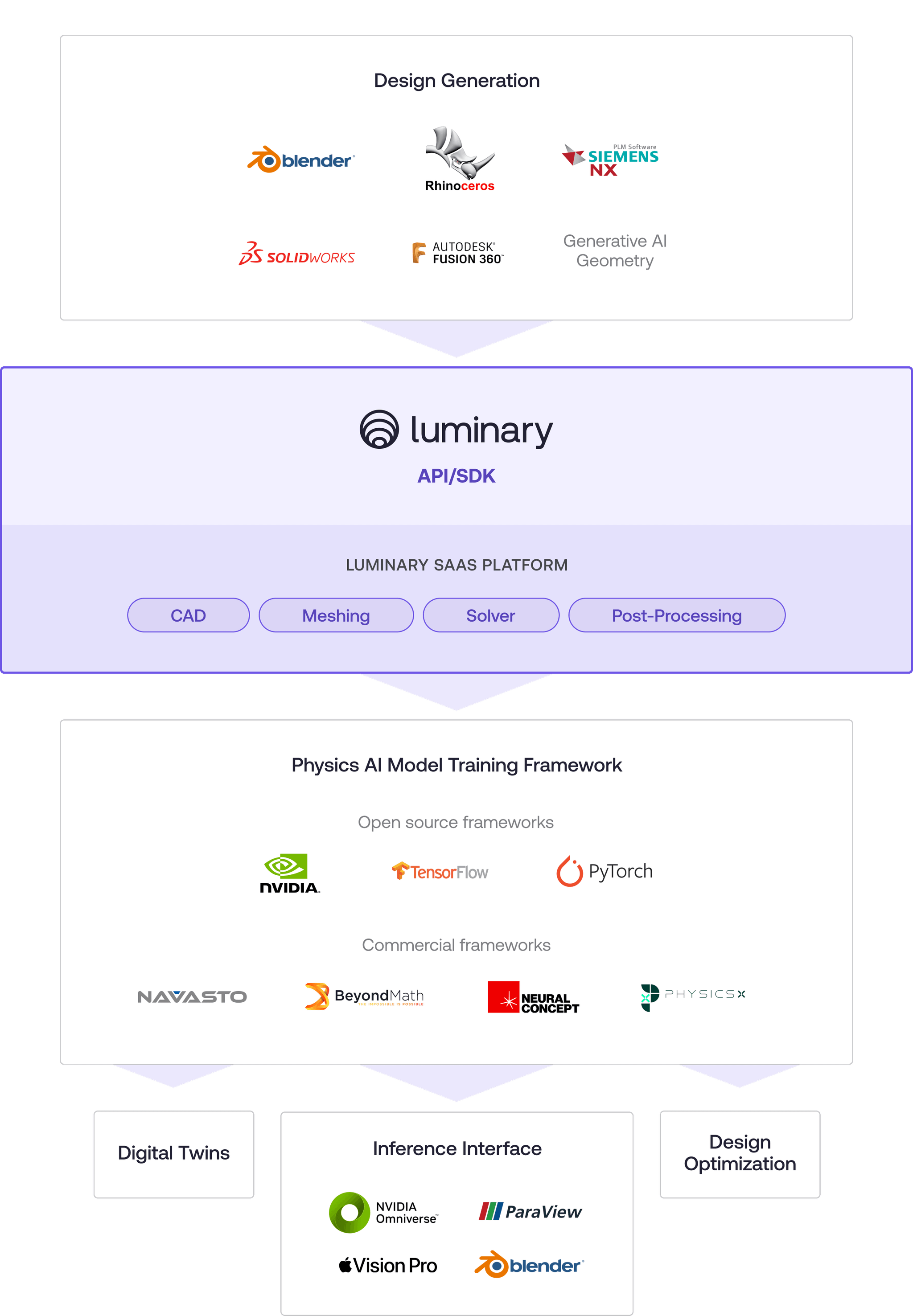
Diagram of the Physics AI workflow with Luminary Cloud and potential software tools at each stage
Why Luminary is the Ideal Fit for Physics AI
Luminary excels at supporting physics AI for the same reasons it’s an outstanding tool for traditional CFD.
An end-to-end cloud platform
Many organizations rely on fragmented software tools across separate compute resources, creating bottlenecks, compatibility issues, and inefficiencies. Engineers can spend more time migrating data and troubleshooting workflows than focusing on design and analysis.
Luminary simplifies this with a seamless, end-to-end platform that eliminates the need for on-premise resources. Its GPU-native CFD solvers, built on NVIDIA CUDA-X libraries, run on cutting-edge GPU hardware through the Google Cloud Platform (GCP) and integrate easily via API or a browser-based interface, fitting naturally into existing workflows. This removes the burden of procuring and maintaining on-premise resources, giving access to the newest NVIDIA accelerated hardware as soon as it’s available.
Generating high-quality simulation data
Luminary stands out as the premier tool for generating high-quality simulation datasets, a cornerstone of any successful physics AI workflow. Our GPU-native solvers deliver unparalleled speed and fidelity, while our Simulation-as-a-Service model provides elastic cloud compute to handle even the most demanding (large) workloads.
A perfect example is how Luminary’s accelerated, cloud-native design is a natural fit with the NVIDIA Omniverse Blueprint for real-time computer-aided engineering digital twins. NVIDIA engineers used Luminary to build the dataset for this Blueprint, with Tim Costa stating “Luminary Cloud’s cloud-native, GPU-accelerated CFD capabilities allowed us to generate the high-fidelity simulation data needed to train the underlying physics AI model in our Modulus physics AI framework in a matter of hours.”
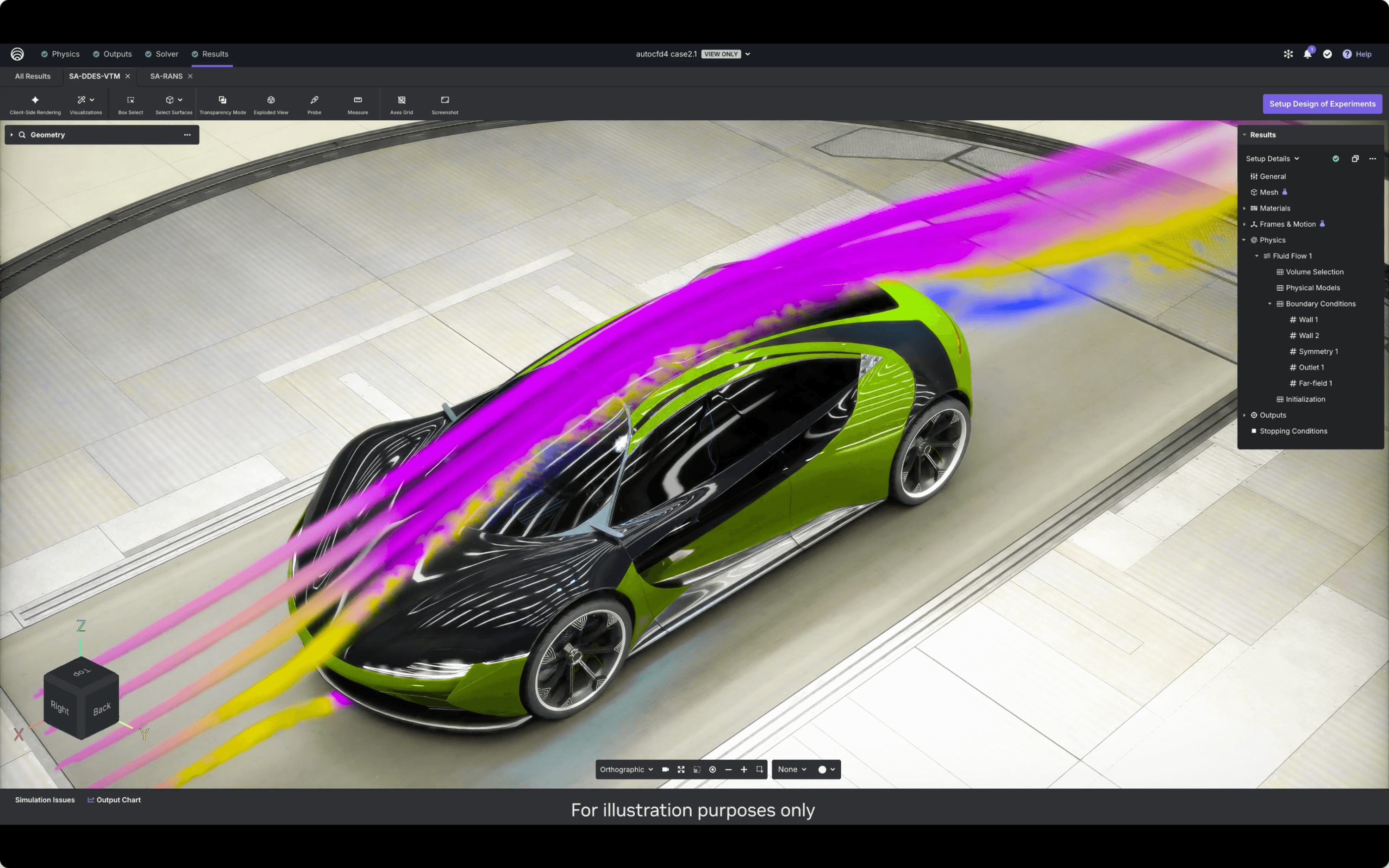
Example of the NVIDIA Omniverse real-time wind tunnel in the Luminary Cloud UI
This blueprint combines a physics AI framework with NVIDIA Omniverse APIs to enable real-time performance with high-quality visualization. The simulation AI can be provided by an ISV, or trained with NVIDIA Modulus using a dataset of simulation results. Using Luminary’s API, anyone building with the blueprint can rapidly generate a large database of high-fidelity simulations to train the simulation AI for their specific CAE application.
Looking Ahead
With features like automated mesh adaptation and customizable modeling fidelity (e.g., RANS, DES, LES), Luminary ensures results are both accurate and robust — critical for any engineering workflow. The cloud-native and secure storage of the Luminary Cloud platform make it easy to store datasets, curate them with associated metadata (so that, e.g., a user can retrieve all simulations run on two-door sedans with 5-spoke wheels), and access the information via secure API when necessary for AI training workloads.
We’re very excited to show you what we’re building, and the CAE solution with the NVIDIA Omniverse Blueprint is just the beginning.
To learn more about our partnership news with NVIDIA, read the press release. You can also try Luminary Cloud for free by signing up. To discuss how we can help with your Physics AI model development initiatives, you can talk to our sales team.

