
At Luminary, we believe the future of physical product design is real-time, intuitive, and unconstrained by traditional simulation bottlenecks.
Physics foundation models can transform early stage automotive design by giving designers real-time feedback on the physics-based performance implications of design decisions. However, the lack of high-quality training data has been a barrier to their development. Luminary SHIFT Models provide access to both high-quality datasets and pretrained foundation models for a variety of applications and industries.
Our first physics foundation model, SHIFT-SUV, is a massive step forward in that direction—purpose-built for high-fidelity aerodynamic inference, without requiring CFD expertise or meshing. It was developed in collaboration with Honda and NVIDIA, combining deep automotive domain expertise with cutting-edge AI and GPU computing.
SHIFT-SUV is based on thousands of parametrically morphed variants of the AeroSUV platform—an open-access, SUV reference model developed by FKFS (Forschungsinstitut für Kraftfahrwesen und Fahrzeugmotoren Stuttgart) as an extension of the DrivAer concept.
We’re releasing both the dataset and the SHIFT-SUV pretrained model to the public as open source, and we’re eager to collaborate with the community. Whether you’re fine-tuning SHIFT for proprietary geometries, contributing new data, or exploring novel model architectures, we want to work with you - contact us via the form at shift.luminarycloud.com/develop. You can also download a sample dataset (99 simulations, volume fields omitted) from Hugging Face as a starting point.
If you’re interested in learning more, sign up for our upcoming webinar here.
Instant engineering insights—integrated into your workflow.
SHIFT Models deliver high-fidelity physics predictions directly within existing design tools—enabling rapid iteration without interrupting creative flow. With SHIFT-SUV, designers can explore geometry variations and instantly assess aerodynamic performance, without preprocessing, mesh generation, or solver configuration.
Built on high-fidelity transient simulation data, SHIFT-SUV brings the accuracy of CFD into the early stages of design—no simplification, no domain expertise required. It empowers engineers and designers to work faster, more intuitively, and more creatively. As a demonstration, we’ve integrated SHIFT-SUV inference directly into Blender, a widely used 3D modeling tool in automotive design workflows. Modify geometry and receive feedback in seconds, right in your design environment.
It’s a fundamentally new way to interact with aerodynamics—instant, intuitive, and non-intrusive.
“The Physics AI solution built with the Luminary Cloud SHIFT-SUV foundation model and Blender integration provides immediate insights into vehicle performance that designers and engineers need.”
— Fong Loon Pan, Principal Aero Design Lead, Honda
A new approach to product development
To appreciate the impact of SHIFT-SUV, it’s worth understanding the current reality of automotive design. Across every stage—from early concept to pre-production—design and aerodynamics teams often face friction due to (a) simulation bottlenecks and (b) toolchain and expertise mismatches.
Additionally, the challenges of performing high-quality simulation using traditional tools makes design iteration painfully slow. In particular, the process of cleaning and defeaturing geometry (to ensure CFD suitability) and appropriate mesh generation for the desired accuracy is a slow, often manual, and compute-resource intensive workflow.
The role of aerodynamics and simulation evolves significantly across four major phases of the design process—Early Concept, Styling Development, Engineering Development, and Pre-production. An illustrative example might look something like the following:
- Early Concept: In this stage, designers often explore 20+ concepts, but simulation fidelity is low (CFD error margins of ±10–15%). Geometries are simplified, typically lacking underbodies, and are meshed coarsely. These models use Reynolds-averaged Navier-Stokes (RANS) solvers and provide only directional feedback on design decisions, with little to no test correlation.
- Styling Development: Here, 5–10 variations are evaluated with moderate fidelity (±5–10%), incorporating more detailed exteriors and basic underbodies. Medium-resolution meshes and RANS/Delayed Detached Eddy Simulation (DDES) modeling allow for limited test correlation for metrics of interest, such as lift and drag.
- Engineering Development: This phase introduces high-fidelity components and finer meshes. 1–3 base designs might be tested across 10–30 component variations. Modeling uses DDES with full underbody and cooling detail. CFD accuracy improves to ±3–5%, with strong correlation to physical tests.
- Pre-production: The final stage deals with 1–2 production-intent designs at very high fidelity (< ±3%), including gaps, seals, and production-ready geometry. Meshes are very fine, and the models are extensively validated with wind tunnel testing.
SHIFT fundamentally changes this. Instead of gating feedback from high-fidelity CFD simulations until late-stage design, SHIFT enables near-instant inference at every stage—even during early styling. Designers can interactively explore aerodynamics without waiting for expensive CFD runs or relying on oversimplified surrogates. They don’t have to be experts in mesh generation or ensure the geometry model is manifold or watertight. Using Physics AI models doesn’t just speed up portions of the workflow, it fully removes them, collapsing design iteration loops from days to minutes.
Powered by NVIDIA PhysicsNeMo
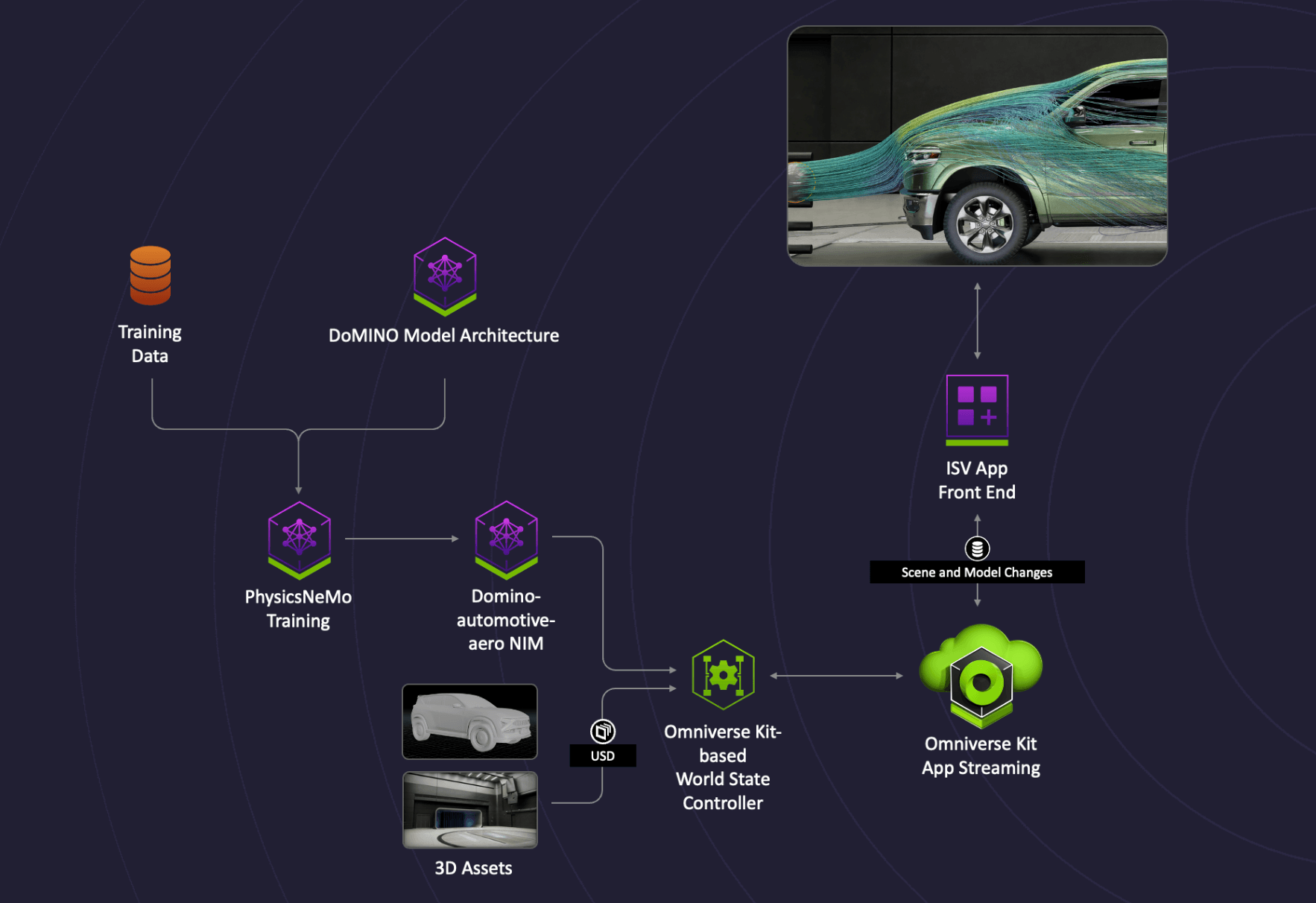
NVIDIA Omniverse Windtunnel Blueprint diagram.
SHIFT-SUV was trained using NVIDIA’s open-source PhysicsNeMo library and leverages the DoMINO model architecture, one of the most advanced Physics AI models available today. Here’s how DoMINO stands out:
| Feature | DoMINO |
|---|---|
| Input Format | Accepts STL files, making it compatible with any of the most widely used CAD formats |
| Architecture Type | Point-cloud based architecture optimized for 3D geometries |
| Scalability | Excellent scalability across compute resources, suited for deployment for industrial-scale problems |
| Memory Efficiency | High, allowing efficient training and inference even on complex surfaces |
| Volume Prediction | Supports accurate volume flow predictions |
| Surface Prediction | Provides reliable aerodynamic quantities and integrated values for model surfaces |
Compared to other Physics AI model architectures, DoMINO delivers exceptional performance for surface inference, strong memory efficiency, and broad scalability—all critical features for powering real-time workflows.
Building the SHIFT Foundation Model
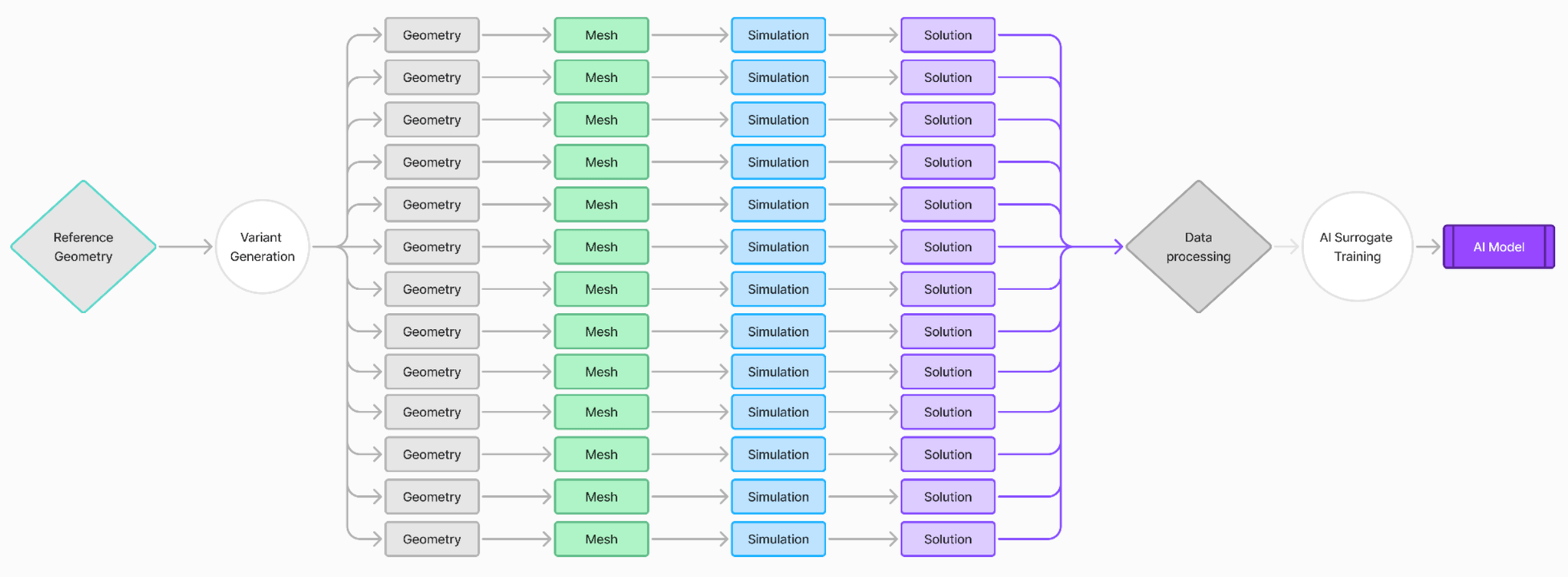
Physics AI model training workflow diagram.
Honda, our development partner on SHIFT-SUV, brought deep insight into real-world styling and engineering workflows. Their involvement ensured the training dataset reflects industrially relevant geometries and that our tools integrate seamlessly into early stage design environments like Blender. This feedback loop enabled us to ground SHIFT-SUV not just in academic accuracy, but in production-grade usability.
To support generalization across vehicle designs, we built SHIFT-SUV on an initial dataset of over 1,000 high-fidelity simulations generated using our in-house solver stack. This dataset was curated with input from Honda and covers both discrete configurations (e.g., underbody types, cooling systems, vehicle backs) and continuous deformations (e.g., windshield angle, hood radius, rear taper). We are continually adding to the dataset and re-training the model on our path to build a model trained on 25,000 variations, making it the largest SUV dataset in the world.

Geometry variations in Blender.
Solving the data bottleneck
Training a physics foundation model requires tremendous amounts of data, and generating physics data at scale requires an architecture that eliminates friction at every layer of the pipeline. The bottleneck in simulation-driven model training isn’t just speed, it’s logistics: queuing jobs, allocating compute, managing simulation workflows, transferring data, and maintaining hardware.
SHIFT-SUV was built on a cloud-native platform designed to abstract all of that complexity. Users don’t manage clusters, spin up nodes, or wait in queues. Instead, our platform orchestrates the full simulation-to-training pipeline: from geometry ingestion and preprocessing to simulation execution and dataset curation. All of this is handled through a Python SDK that integrates directly into existing design and simulation environments.
Under the hood, simulations are executed across dynamically scaled cloud infrastructure, using containerized solvers tuned for a given physics regime. Job distribution, fault recovery, and data management are handled automatically—eliminating the typical bottlenecks of local clusters or manual resource scheduling.
For the SHIFT-SUV model, we ran over 1,000 DES simulations, each requiring about 1.2 hours on NVIDIA H100 GPUs. But it’s not just the raw compute speed that makes this feasible—it’s the orchestration layer that ensures every simulation runs at peak utilization, with zero manual overhead.
This fully automated, SDK-driven approach means that teams can train high-fidelity models at scale without building or managing their own simulation infrastructure and workflows. Whether you’re fine-tuning SHIFT-SUV on proprietary geometries or extending the dataset with your own variants, the Luminary platform ensures the data bottleneck is never the limiting factor.
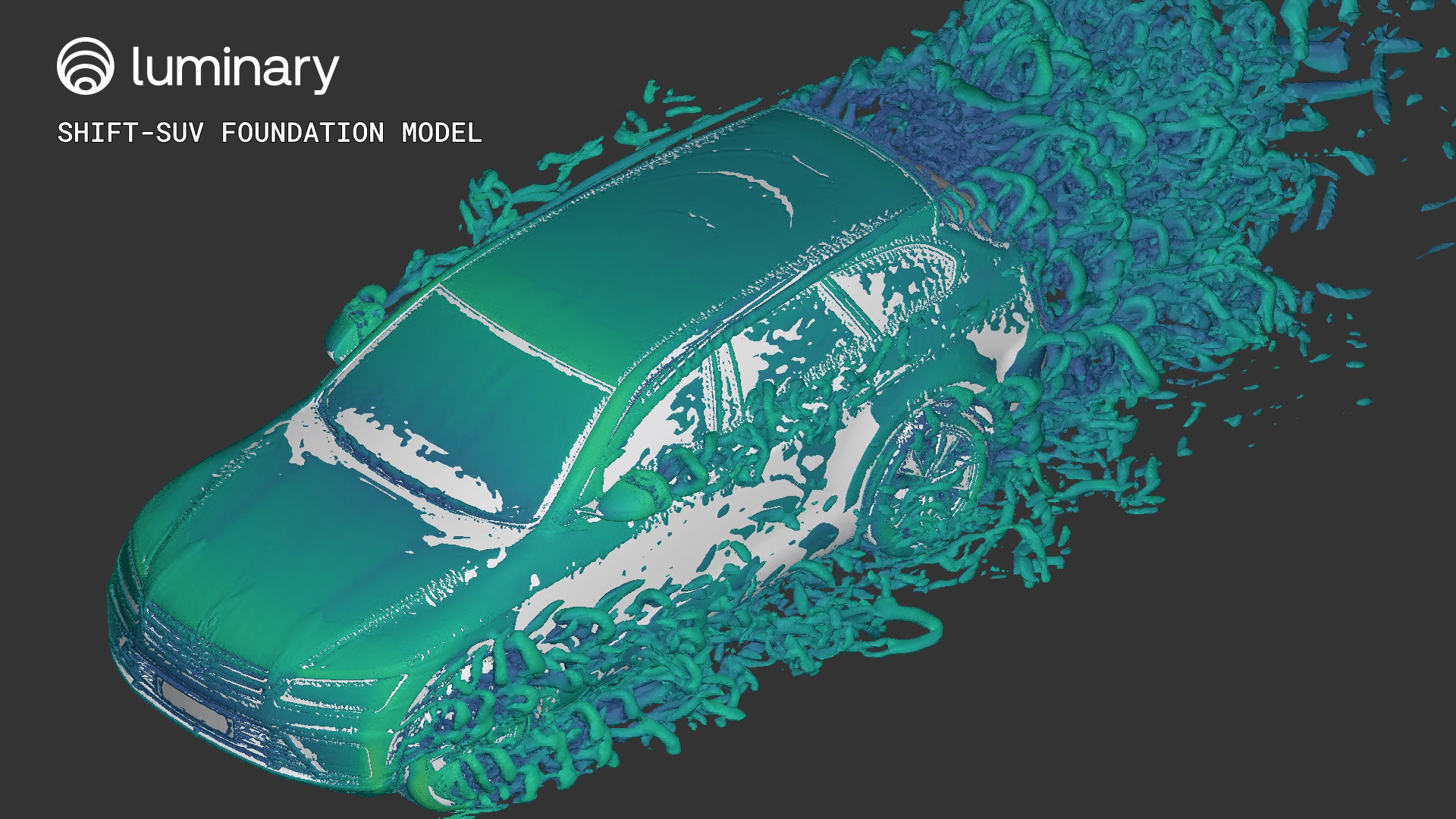
Isosurface of q-criterion on the AeroSUV model.
Training the SHIFT-SUV model
SHIFT-SUV was trained on NVIDIA GPUs using PhysicsNeMo’s DoMINO architecture. We explored two primary training configurations, one learning the surface fields and another learning both volume and surface information.
| Data Size | Model Type | NVIDIA GPU | # of epochs | Time per epoch (s) | Total time (hours) |
|---|---|---|---|---|---|
| 100 | Surface | A100-8 | 800 | 8.8 | 1.9 |
| 100 | Surface + Volume | H100-8 | 800 | 36.5 | 8.1 |
| 500 | Surface | H100-8 | 1000 | 40.1 | 11.1 |
| 1000 | Surface | H100-8 | 1000 | 49.2 | 13.7 |
These training times highlight how efficient the DoMINO architecture is—even for large-scale, high-fidelity aerodynamic data. Luminary directly contributed to this efficiency with 50x speed up in model training performance, available to anyone leveraging the DoMINO architecture. The lightweight nature of the point-cloud architecture enabled rapid iteration across different configurations and hyperparameters, allowing us to move quickly from dataset curation to production-ready inference.
Inference accuracy and validation
To evaluate SHIFT-SUV’s performance, we performed extensive validation across multiple training configurations. While the initial SHIFT-SUV model has been trained on a dataset of 1,000 parametric SUV designs, we also benchmarked performance when training on a subset of 500 fastback variants. These experiments provide insight into how training scope impacts model generalization and inference fidelity.
Inference was conducted using the DoMINO neural operator architecture, and results were validated against ground-truth CFD values for drag and downforce.
Specialization vs generalization
We observed a trade-off between specialization and generalization:
- Training only on Fastback (500 cases) led to** improved drag prediction accuracy** on the fastback geometry itself—achieving a mean relative error of 2.10%, with 94% of predictions under 5% error.
- Training on the full 1k dataset, however, improved generalization to other SUV variants, and delivered better downforce predictions on fastback samples, at the cost of slightly worse drag accuracy (3.44% mean relative error on drag vs. 2.10%).
| Training Dataset | Mean Relative Error | Max Relative Error | % < 5% Error |
|---|---|---|---|
| Fastback 500 | 2.10% | 6.35% | 94.00% |
| Full 1k (on fastback) | 2.89% | 7.26% | 85.71% |
| Full 1k (overall) | 3.44% | 8.60% | 75.00% |
Real-world prediction examples
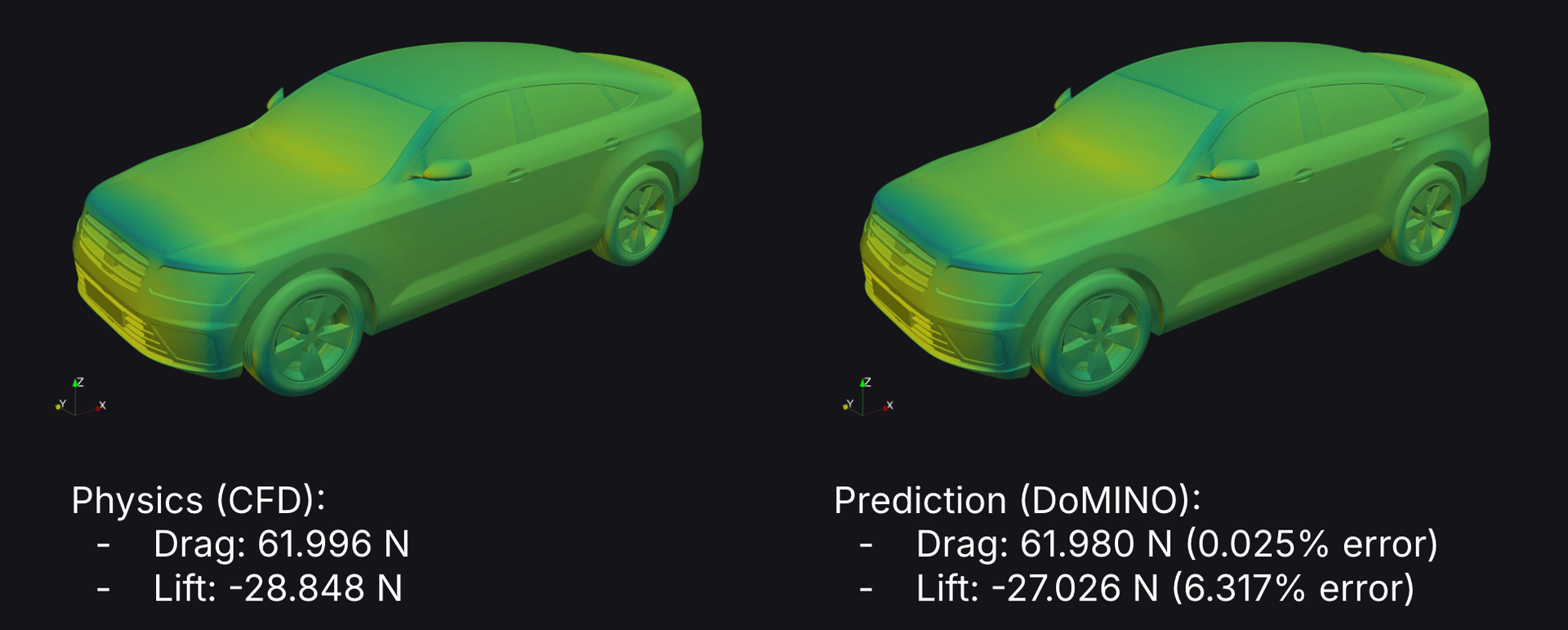
Comparison between drag and lift predictions for the fastback variation.
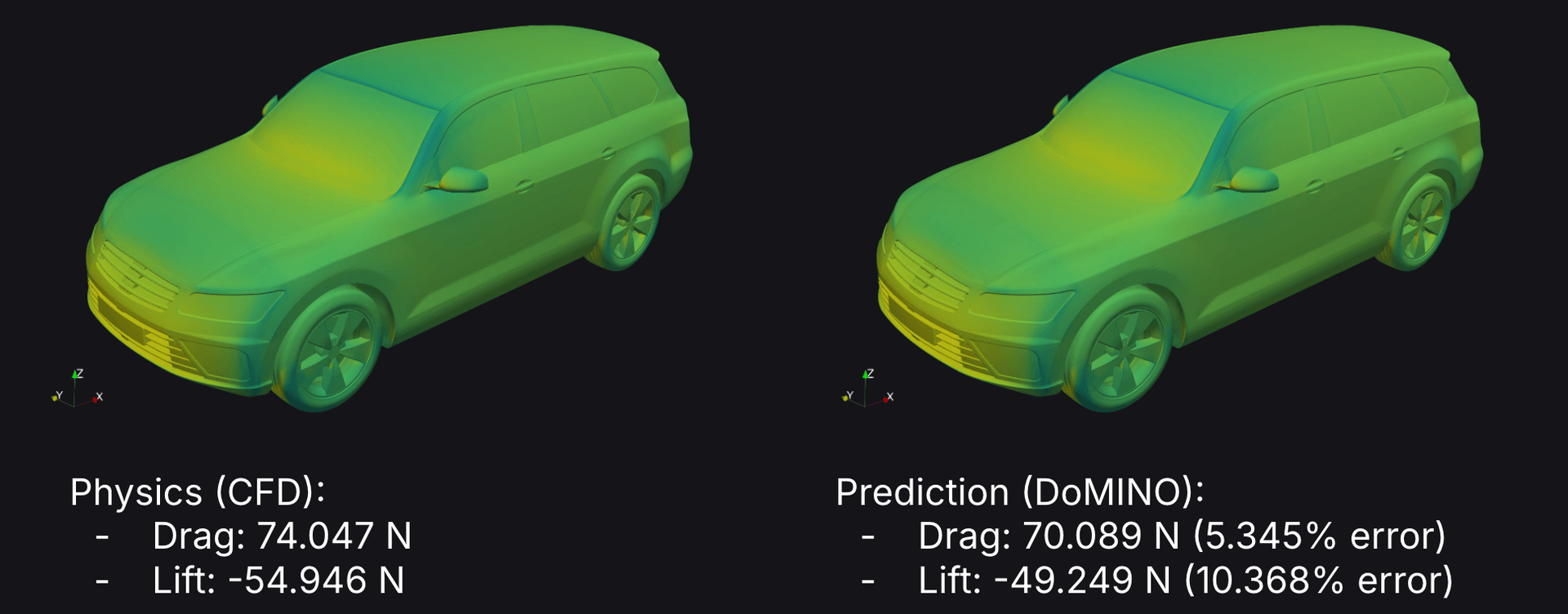
Comparison between drag and lift predictions for the wagon variation.
To demonstrate the model’s practical accuracy, we ran inference directly on test geometries in Blender, comparing SHIFT-SUV predictions to high-fidelity CFD results:
| Variant | CFD Drag | DoMINO Prediction | CFD Lift | DoMINO Prediction |
|---|---|---|---|---|
| Fastback | 61.996 N | 61.980 N (0.025% error) | -28.848 N | -27.026 N (6.317% error) |
| Estate | 74.047 N | 70.089 N (5.345% error) | -54.946 N | -49.249 N (10.368% error) |
These results show SHIFT-SUV is highly reliable for inference within the fastback class, with performance degrading gracefully on OOD (out-of-distribution) shapes like the wagon. This validates SHIFT-SUV’s use as for early-stage aerodynamic feedback.
Across the test set, SHIFT-SUV achieves an average drag prediction error of approximately** 3.45%, with maximum errors around 6.5**%. Notably, 75% of all predictions fall within a 5% error margin, and every single prediction remains within 10%. These levels of accuracy position SHIFT-SUV ahead of conventional surrogate modeling approaches, and highlight its effectiveness in delivering high-fidelity aerodynamic inference directly from raw geometry inputs.
Stay tuned for more information - we’ll continue to publish details about our methodology, validation, and results in the coming months. As the size of the SHIFT-SUV dataset continues to grow, the prediction errors and the generalizability of the model will continue to improve.
Looking ahead
SHIFT-SUV is just the beginning for Luminary. We’re actively growing the SHIFT-SUV dataset in 2025, and we’re continuing our collaboration with Honda and NVIDIA to expand the model’s coverage of vehicle types, deformation strategies, and use cases. Meanwhile, our SDK makes it easy to embed Physics AI model inference into your design tools—whether that’s Blender, Rhino, or CAD.
SHIFT represents a fundamental rethinking of the physical product development process—from simulation as a bottleneck to simulation as an enabler of real-time creativity. By leveraging foundation models like SHIFT-SUV, automotive teams can make design decisions faster and with greater confidence.
Our open-source commitment is central to this mission. By releasing both the dataset and model, we hope to spark a wave of collaborative innovation—from fine-tuning on proprietary geometries to experimenting with new training objectives and model architectures.
Get in touch to try it out, contribute to the dataset, or collaborate on model training: shift.luminarycloud.com/develop.
If you’re interested in learning more, you can sign up for our upcoming webinar here.
Acknowledgements
We credit FKFS (Forschungsinstitut für Kraftfahrwesen und Fahrzeugmotoren Stuttgart) for the development of the AeroSUV model, which was made publicly available for non-commercial research purposes. SHIFT-SUV would not be possible without this valuable contribution to the research community.
While SHIFT-SUV extends the AeroSUV dataset substantially in scale and scope, it does not change the licensing restrictions of the original model—AeroSUV remains available for non-commercial use only.
We hope that the SHIFT-SUV dataset, built on AeroSUV, will benefit the broader research community by helping to support continued advancements in physics AI research.

