
In aerospace and defense, program leaders face a growing dilemma: development timelines are collapsing, yet safety, certification, and mission assurance remain uncompromising. In some fast-moving sectors—such as unmanned systems, hypersonics demonstrators, and next-generation space platforms—program cycles that once spanned five years are now expected in as little as eighteen months. Even in traditional programs, leadership is demanding faster iteration between gate reviews.
Traditional design workflows—characterized by brittle CAD (computer-aided design) models, slow simulation loops, and rigid phase-gate reviews—were never built for this pace. The result is familiar: early design choices harden too quickly, innovation is stifled, and costly surprises emerge late in the program.
A new approach is taking hold. By combining computational design with physics-based AI, aerospace teams can explore broader design spaces earlier, validate assumptions faster, and reduce downstream risk—while still operating inside the rigorous gate and certification frameworks the industry depends on.
The Aerospace Design Challenge
Every aerospace program wrestles with the same lock-in problem: once geometry or performance assumptions are frozen, changes become painful and expensive. Two bottlenecks keep this cycle in place:
- CAD Fragility and Early Lock-In Risks. Traditional CAD systems struggle with parametric flexibility. A single change can break geometry dependencies, sending engineers into tedious repair cycles. This fragility discourages exploration and forces teams to commit earlier than they should.
- Simulation Bottlenecks. Even with large compute budgets, legacy solvers run serially and scale poorly. Engineers may only test a handful of designs in the time available, narrowing the design space and pushing manufacturability and performance trade-offs downstream.
These constraints translate into risk: phase-gate reviews proceed with limited exploration, raising the likelihood of redesigns after Preliminary Design Review (PDR) or Critical Design Review (CDR).
The Solution: Computational Design + The Physics AI Factory
The collaboration between nTop and Luminary addresses these bottlenecks through a fundamentally new model that makes design iteration faster, more robust, and more informative for decision-making.
| nTop — Enables Computational Design for Fast, Robust Parametric Modeling at Scale | nTop replaces fragile geometry with implicit modeling, encoding design intent as reusable logic. Instead of manually building parts, engineers define an aircraft parametric envelope that can be explored dynamically, without geometry failures. |
|---|---|
| Luminary Cloud — The Physics AI Factory for Model Development | Luminary turns simulation into a scalable data-generation pipeline. Thousands of designs can be meshed, simulated, and translated into physics-rich training datasets. From there, the same factory produces high-fidelity Physics AI models—ready for inference at scale. |
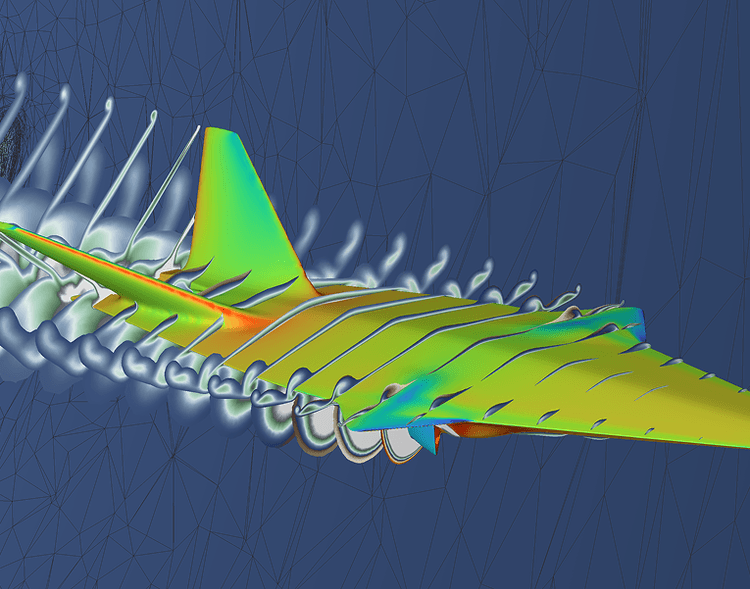
Visualization of a simulated nTop aircraft variation in Luminary
The Inverse Design Workflow: From Weeks to Hours
A nTop–Luminary demonstration, showcased in a joint webinar, shows how this plays out in practice:
1. Build a Parametric Design Space. nTop created a fully parametric aircraft model and rapidly generated hundreds of design variations across a wide design envelope.
2. Generate Simulation Data at Scale. Luminary simulated the designs in minutes with their GPU-native solver and cloud parallelism.
3. Train Physics AI Models. The NVIDIA PhysicsNeMo DoMINO model was trained to infer full flow fields (pressure, velocity) across new designs. DoMINO training completed in 14 hours on 8 A100 GPUs, with the trained model obtaining <5% validation loss.
4. Optimize via Inverse Design. With models trained, an optimizer was wrapped around the model to target performance objectives (e.g. maximizing range). Key metrics, including lift and drag, were calculated directly from the integrated aircraft surface predictions.
Aircraft optimization in nTop leveraging model inference.
Inference time fell from 1.5 hours to 3 minutes per design point. Hundreds of alternatives were explored, with Physics AI predictions matching CFD within ~5% error. This level of fidelity is ideal for early-phase exploration, with CFD rigor applied later in the cycle.
As Aerospace industry leaders emphasized at nTop’s nCDS 2025 conference, the goal isn’t to replace simulation but to augment engineering judgment with predictions at scale. Physics AI makes that possible.
Why This Matters for Aerospace Programs
This workflow doesn’t eliminate phase gates—it strengthens them. By enabling broader exploration before PDR and CDR, teams bring forward more robust, better-understood options for review. By the time high-fidelity simulation and test campaigns begin, major risks are already surfaced and reduced.
Key benefits include:
- Reduced downstream redesigns Early exploration lowers the chance of late discoveries derailing schedules.
- Broader design trade space Hundreds of alternatives can be evaluated before requirements harden.
- Program confidence Leaders face gates with clearer data, better trade-off visibility, and reduced uncertainty.
- Supplier alignment Parametric models and physics-based surrogates can be shared across organizational boundaries, reducing friction in multi-contractor environments.
The Future of Aerospace Design with Physics AI
Aerospace programs can no longer rely on brittle tools and linear processes designed for decades-long timelines. Modern tools now make it possible to explore broadly, learn quickly, and converge with confidence—without breaking the structures of certification, safety, and program control.
That is the promise of nTop and Luminary: a design loop that fuses computational design, parametric modeling, and scalable simulation into a workflow that compresses the design–simulate–optimize cycle from weeks to minutes.
Whether you are building unmanned aerial vehicles (UAVs), commercial aircraft, or next-generation defense platforms, the message is clear: modern programs demand modern tools. With computational design and physics-based AI, aerospace leaders can reduce iteration time, expand the design space, and deliver better outcomes, faster.
Ready to modernize your aerospace design process?
See how nTop’s Computational Design and Luminary’s Physics AI Factory combine to reduce iteration time, expand design space, and deliver better outcomes.

