
Spacecraft design has never been a fast process. Even in the conceptual phase, every new idea—a different nozzle contour, a revised expansion ratio, a small tweak to geometry—demands another round of analysis. Engineers run through empirical models, low-fidelity flow solvers, and simplified simulations to estimate performance. But as designs mature, validating those early trends with high-fidelity CFD becomes a bottleneck—each detailed simulation can take hours, even for a single configuration. It’s the cost of fidelity, and for decades, that tradeoff has defined how propulsion systems are built.
That’s beginning to change.
Luminary Cloud, working with Northrop Grumman’s Space Systems group, has developed a Physics AI model that predicts high-fidelity fluid dynamics results for spacecraft thruster nozzles in seconds. Trained on data from Luminary’s GPU-native solver, the model reproduces complex flow physics with remarkable precision—delivering results more than three thousand times faster than traditional simulation methods while cutting compute costs by over four orders of magnitude.
Nozzle Physics AI model inference in Luminary Web App
Performance Predictions in Seconds
Traditional simulation remains the gold standard for evaluating the performance and reliability of engineering designs, but is increasingly untenable as design spaces grow and mission timelines compress. A single design iteration might take hours of solver runtime and half a day of preprocessing. Multiply that by hundreds of design variations, and you quickly reach program-level bottlenecks.
Luminary’s Physics AI model completes an equivalent prediction in just 2–5 seconds on a single NVIDIA L4 GPU—no manual meshing, no solver queue, no waiting.
The resulting model can be deployed such that engineers can make changes to the geometry or operating conditions and see the flow field update in nearly real time, enabling exploration of hundreds of designs per day rather than per month.
What’s Inside the Model
The demonstration centers on a Thrust-Optimized Parabolic (TOP) nozzle, a class of high-efficiency bi-propellant thrusters widely used in spacecraft attitude and orbital control systems. The model is trained to predict Mach number distributions and flow-field characteristics for realistic operating conditions drawn from Aerojet Rocketdyne MR-series data.
Each sample in the training set corresponds to a high-fidelity CFD solution generated using Luminary’s compressible flow solver. The dataset covers:
-
Geometry parameters — throat radius, length fraction, expansion ratio
-
Flow parameters — chamber pressure, ambient altitude
-
Gas model — MON-3 propellant, frozen composition, constant thermophysical properties derived from NASA’s CAE tool
In total, the dataset includes ~2000 samples, spanning the design envelope of real flight hardware.
Under the hood, the AI model is built on NVIDIA’s PhysicsNeMo DoMINO framework. Training used a 90/10 split between training and holdout validation data, with a loss function based on the L₂ error in Mach number at the nozzle exit.
The model achieved a median error of 5.2%, with minimum cases as low as 1.6%, validating its predictive reliability against high-fidelity CFD simulation.
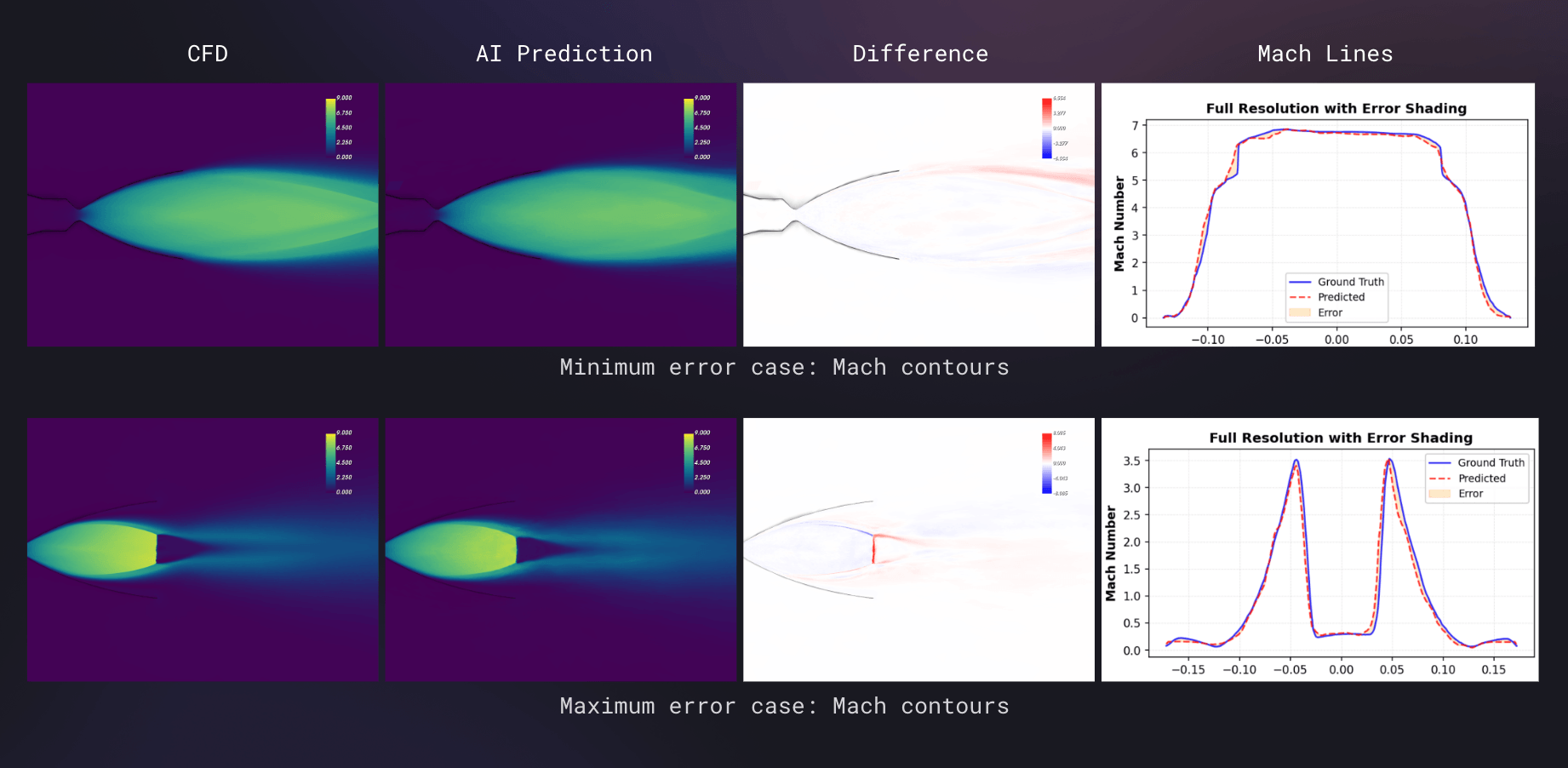
Physics AI model prediction vs CFD solver
The L2 norm used here is overly sensitive to slight shifts in the predicted y-location of the shocks, despite being in very good agreement in terms of shape, amplitude, and location of the distributions. We believe this is contributing to the median error looking somewhat large, despite being incredibly accurate given the sharp discontinuities in the flow field.
How the Model Was Trained
Training on high-quality data is essential for Physics AI models to make predictions with the accuracy required for engineering design decisions. As the saying goes, “garbage in, garbage out.” To ensure physical results, the training dataset underwent rigorous validation before model development.
The team benchmarked the solver against the EUCASS P6.2 cold-flow experiment, comparing shock structure, separation locations, and surface pressure distributions.
Overlayed schlieren images from the experiment showed excellent agreement between CFD and experimentally measured shock locations.
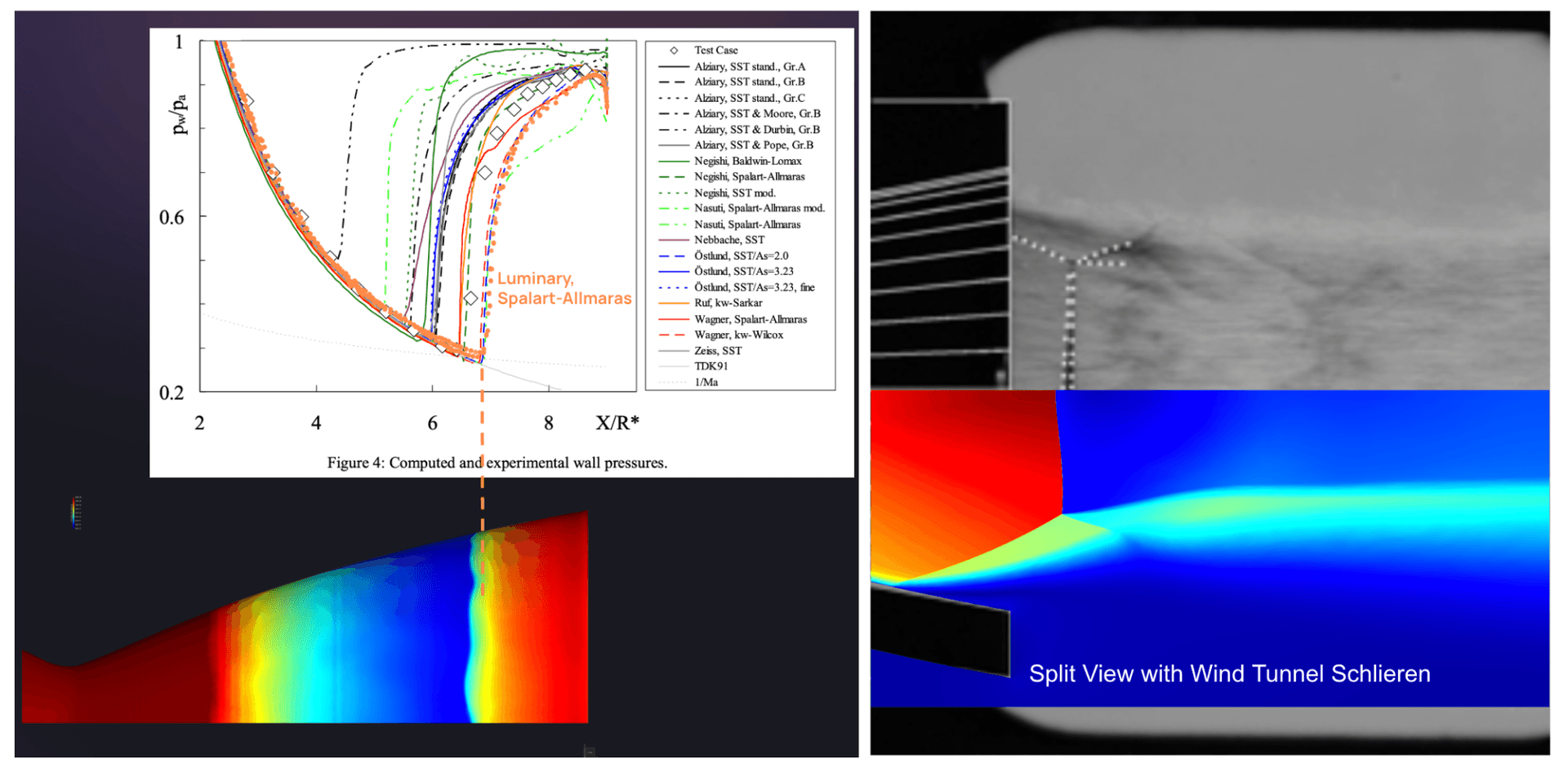
Luminary CFD solver validation on EUCASS experiment
Training data was generated using a Latin Hypercube sampling scheme across the full design and operating space, ensuring broad but efficient coverage.
| Parameter | Minimum | Maximum |
|---|---|---|
| length fraction | 60% | 90% |
| expansion ratio | 50 | 400 |
| throat radius [mm] | 2.5 | 16 |
| chamber pressure [bar] | 6 | 12 |
Each case was meshed using Luminary Mesh Adaptation (LMA), which automatically adapts to accurately resolve the physics based on the geometry and operating conditions, ensuring shocks, separation regions, and Mach discs are captured.
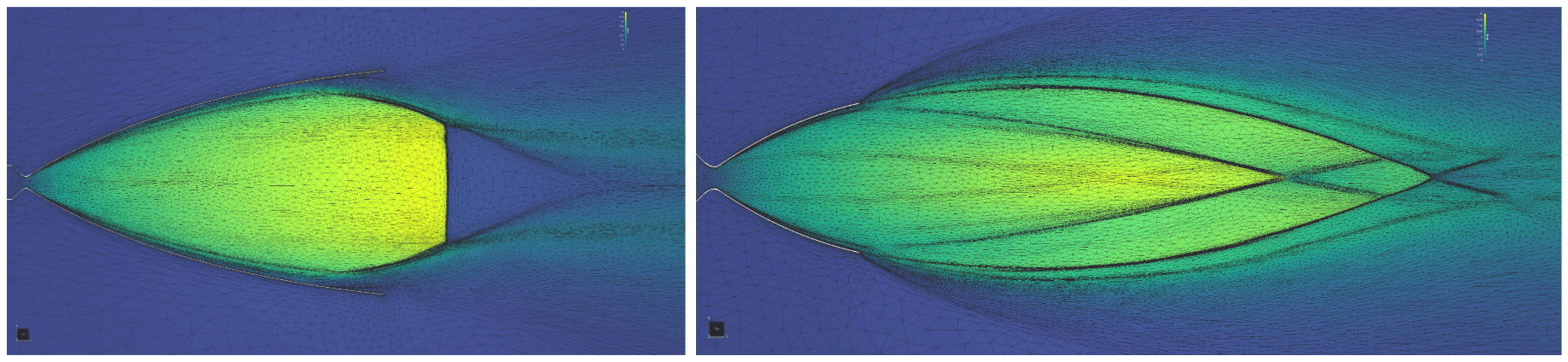
Visualization of nozzle flow with mesh adaptation to accurately resolve complex flow fields
This is where the synergy of Luminary’s platform shines. The same GPU infrastructure that accelerates CFD also powers AI training, enabling rapid turnarounds and massive parallel data generation. This is central to Luminary’s Physics AI Factory—a pipeline where simulation data flows directly into model training, evaluation, and deployment.
A Compounding Advantage
Physics AI is the next level of complexity in AI and Northrop Grumman is bringing this technology to our design engineers to dramatically speed up hardware development
— Han Park, Vice President, Artificial Intelligence Integration, Northrop Grumman Space Systems
Each simulation that engineers run as part of a program—whether for thruster nozzles, airfoils, or vehicle aerodynamics—contributes to a growing Physics AI training data corpus. As that corpus expands, the models become more accurate and generalizable, reducing the need for expensive high-fidelity reruns. That speedup lets teams explore broader design spaces and run more virtual experiments, which in turn generates even richer data. The result is a genuine flywheel: better models enable faster exploration, and faster exploration produces the data that makes the models even better.
For organizations like Northrop, the advantage is structural: faster development, lower costs, and higher mission reliability.
“Physics AI is the next level of complexity in AI and Northrop Grumman is bringing this technology to our design engineers to dramatically speed up hardware development,” said Han Park, vice president, artificial intelligence integration, Northrop Grumman Space Systems. “Using AI to make something small, like a spacecraft thruster, puts us on a path to do much bigger things, like using AI to design larger components or even an entire spacecraft.”
This project began as a proof of concept; it’s quickly becoming a foundation for a new way of designing flight hardware. The results will be showcased publicly at NVIDIA GTC DC, where attendees can see real-time AI inference on a live propulsion geometry.
To learn more about Luminary’s work with mission-grade Physics AI and upcoming demonstrations at NVIDIA GTC, visit luminarycloud.com.

