Closing the simulation-to-experiment gap is the foundation of trustworthy Physics AI.
Physics AI makes a simple promise: train a model on thousands of simulations to learn the underlying physics phenomenon and you get a surrogate that accurately predicts physical behavior in seconds instead of hours. A problem sits inside the premise, though, and it has consequences for anyone using these models to make engineering decisions.
The CFD simulations which serve as the backbone of training Physics AI models are numerical approximations of physical reality. Every approximation carries systematic biases: turbulence closure assumptions, transition modeling deficiencies, and mesh sensitivity artifacts. These biases are most pronounced precisely where accuracy matters most, at suction peaks, shocks, and the onset of flow separation. As such, a Physics AI surrogate trained exclusively on CFD data does not correct for these errors. It learns them, encodes them, and propagates them across every design variant and every downstream quantity of interest.
Physics AI models can draw on a range of physical data sources, including simulation, test, and operational. Training exclusively on approximations of reality and learning from its biases is the challenge the engineering community has to confront as Physics AI moves from research promise into production workflows, and it is one Luminary has been working to solve.
The Gap Between Simulation and Physical Measurement
Consider a conventional aerodynamic design workflow for a commercial aircraft wing leveraging Physics AI. Engineers generate thousands of CFD runs spanning a range of angles of attack, Mach numbers, and geometric configurations. A Physics AI model is then trained on this data and is leveraged for rapid design exploration. In an ideal world, the Physics AI model is accurate and this workflow would work exceptionally well.
The biases learned using just simulation data emerge at validation. When physical wind-tunnel measurements are compared against model predictions, discrepancies appear. Pressure coefficient distributions do not align. Shock locations are shifted. Suction peaks are overestimated. These discrepancies are systematic, physically traceable artifacts inherited from the CFD solver and now permanently encoded in the model.
For design decisions, certification preparation, and performance verification, this matters greatly. A surrogate that faithfully reproduces the biases of a CFD solver is just a faster route to the same inaccurate answers.
A Principled Framework for Model Grounding
Luminary’s response to this problem is a methodology called model grounding: a principled data fusion approach that closes the gap between numerically approximated data and physical truth by bringing test and operational sensor data into a workflow that has historically relied on bias-prone simulation data alone.
Using the NASA CRM-HL Wing-Body dataset, one of the most rigorously validated reference configurations in transonic aerodynamics, we built and tested a three-step calibration pipeline.
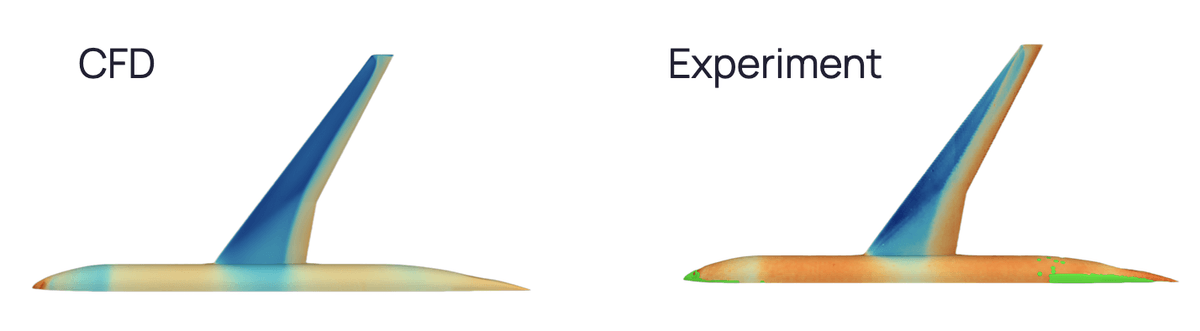
Figure 1: NASA CRM-HL Wing-Body (No Tail) reference configuration used for the HLPW-5 validation study.
The first step is coordinate registration. Wind-tunnel PSP (Pressure-Sensitive Paint) measurements are aligned with the CFD mesh, gaps are filled using Gaussian Process inference, and a surface pressure reference is produced on every mesh node.
The second step is baseline model training. Our GeoTransolver architecture is trained on approximately 2,300 CFD simulations at Mach 0.70 and 0.85, achieving R² values above 0.9994 against CFD predictions across lift, drag, and moment quantities.
The third step, and the most consequential, is training a correction head. With the pretrained GeoTransolver frozen, a lightweight neural network learns the residual gap between CFD-based predictions and experimental measurements.
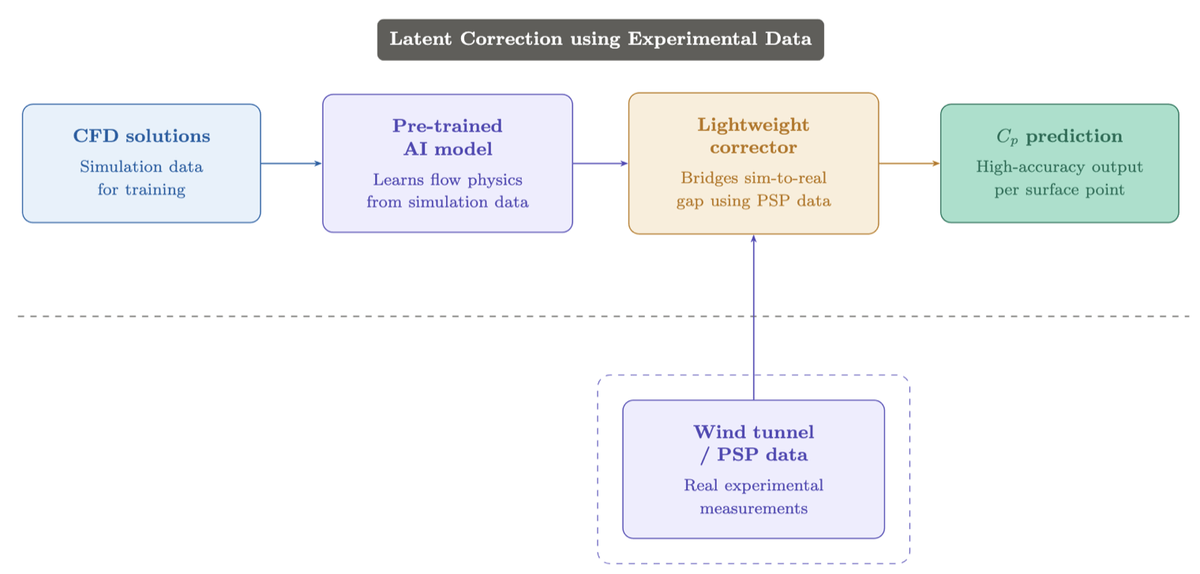
Figure 2: Overview of the latent correction framework. CFD simulation data trains a Physics AI model (Stage 2), whose internal representations are refined by a lightweight corrector (Stage 3) supervised on real wind-tunnel PSP measurements. The corrector closes the simulation-to-reality gap without exposing proprietary geometry, yielding high-accuracy surface C_p predictions (Stage 4).
The architecture is deliberate. The heavy lifting of learning aerodynamic physics is done once, at scale, from simulation data. The correction is targeted and efficient, and needs orders of magnitude less data than what would be required for full physics learning.
What the Data Shows
The performance improvement after model grounding is substantial. Before calibration, applying the GeoTransolver baseline directly against experimental PSP data produces R² values ranging from 0.36 to 0.76 depending on the flow condition. After calibration against a handful of experimental runs, predictions reach R² values between 0.94 and 0.97, with RMSE consistently below 0.10. The improvement is sharpest at higher Mach numbers and steeper angles of attack, exactly the conditions where CFD modeling is least reliable and where accurate prediction carries the most engineering consequence.
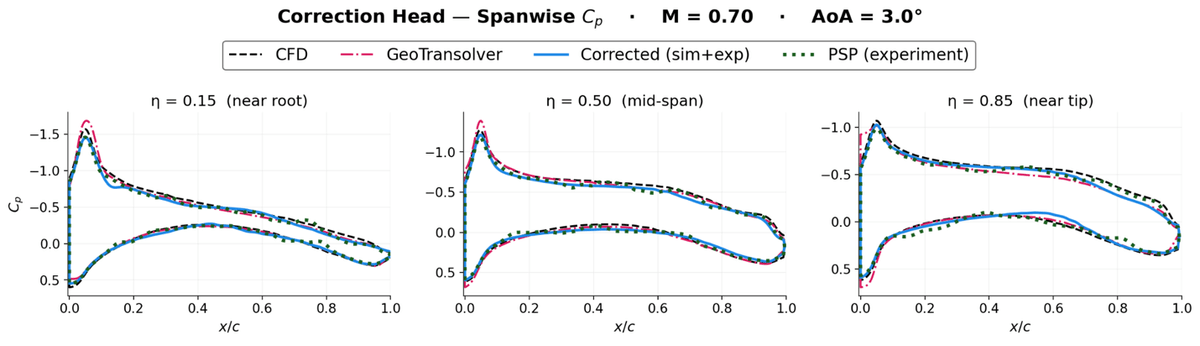
Figure 3: Spanwise C_p across models at M = 0.70, AoA = 3.0°.
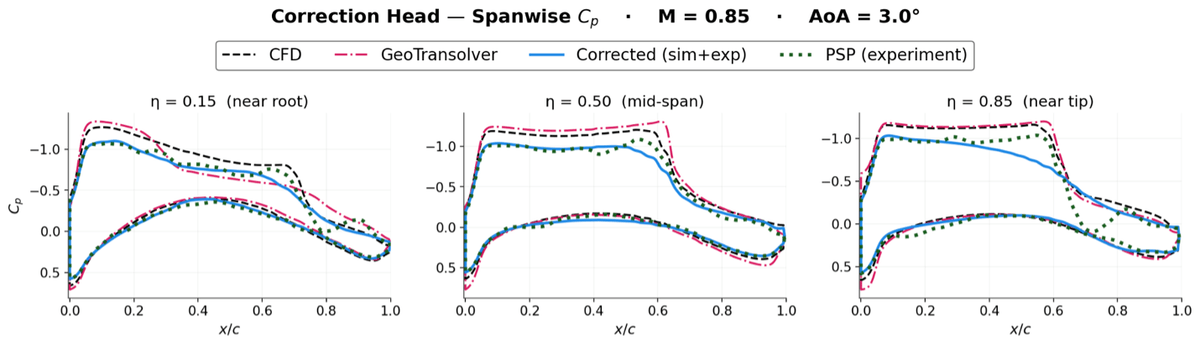
Figure 4: Spanwise C_p across models at M = 0.85, AoA = 3.0°.
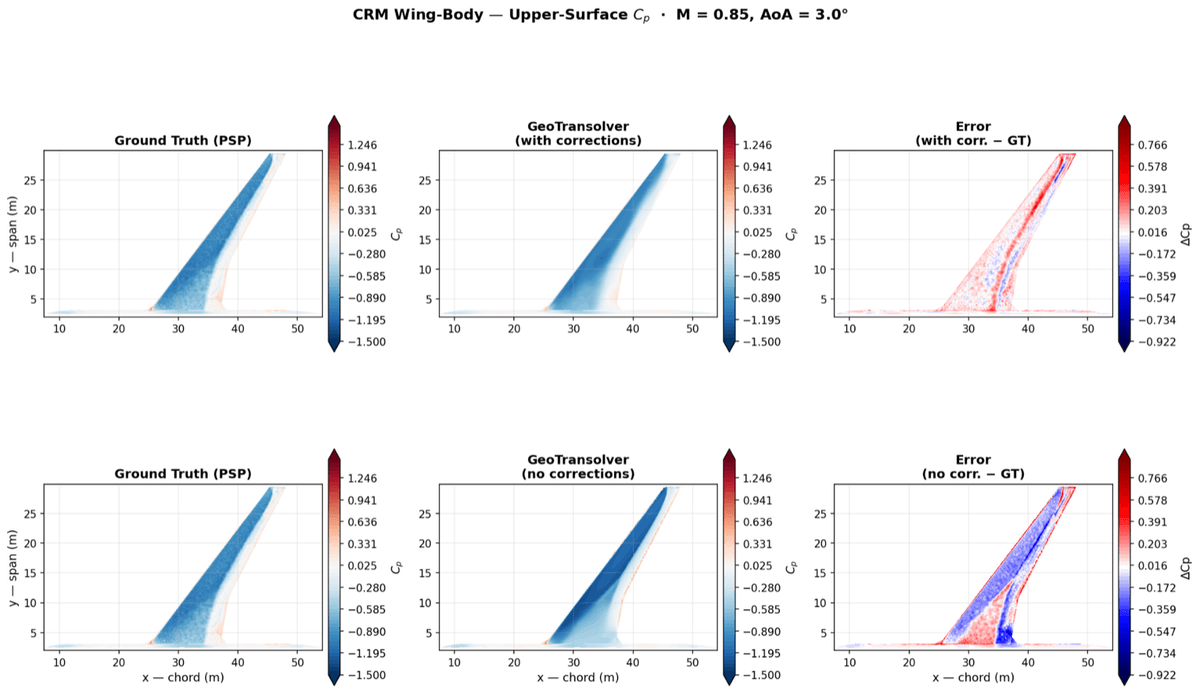
Figure 5: Predicted full-surface Cp compared against experimented ground truth with and without the correction at M = 0.85, AoA = 3.0.
The corrected pressure distributions track wind-tunnel measurements closely across the full wing span, from root to tip. Shock locations and suction peak magnitudes that the CFD-only model consistently misrepresents are resolved accurately by the grounded surrogate.
A More Trustworthy Foundation for Physics AI
The results from this work point to a clear design principle for production-grade Physics AI systems. Simulation-trained surrogates are powerful, but they require experimental anchoring before engineers can trust them in real workflows. The correction layer is efficient by design: a compact model, trained on a limited number of experimental runs, built on top of a large-scale surrogate that already encodes physical understanding. This preserves the core efficiency advantage of Physics AI while addressing the accuracy limitation that pure simulation cannot self-correct.
As Physics AI expands into higher-stakes applications, from aircraft certification to crashworthiness validation, model grounding moves from a best practice to a baseline expectation. The models that engineers trust with their designs will be the ones validated against physical reality, beyond the simulations that trained them.
Model grounding is part of how Luminary operationalizes Physics AI across the full model lifecycle, from data production through deployment. To see Physics AI in action, try the Physics AI prediction demo, or contact us to discuss grounding a surrogate against your own test data.