
Figure 1: SHIFT-Battery predicts module surface temperatures and channel-slice velocity across a pack-scale cold plate in roughly half a minute.
Battery pack thermal management sits at the intersection of three constraints that engineers cannot trade off independently. Temperature governs cell lifetime, because elevated or uneven module temperatures accelerate capacity fade and irreversible degradation. Temperature governs usable range, because excessive heat forces conservative charge and discharge limits that cut effective energy density. And temperature governs safety, because localized hotspots are the initiating condition for thermal runaway. A pack that performs well in a temperate lab can fail any of these constraints once it is asked to deliver sustained high-load operation in a hot climate or a fast charge from a sub-zero cold soak. The cooling system is what holds the design together across that operating envelope, and the geometry of the cold plate is one of the most consequential things a pack designer can change.
Pack designers know what they need from a thermal model: max operational module temperature, which governs cell life and safety; pressure drop across the cooling circuit, which sets the load on the external coolant pump that lives elsewhere in the vehicle; and the in-channel velocity field, where peak velocities and their locations are a leading indicator of long-term erosion of the cold plate. The hard part is producing those predictions quickly enough to actually iterate on the geometry. Full conjugate heat transfer (CHT) CFD gives every quantity a designer could want and has been validated against test data for decades, but a pack-scale run with millions of mesh elements, coupled solid and fluid domains, and super-linear scaling with resolution is too expensive to put inside a daily design loop. 1D lumped-parameter tools sit at the opposite end of the trade. They run in seconds, but the spatial physics that matters most for thermal design (local hotspots, flow maldistribution through bends, recirculation in turns) collapses into empirical correlations derived from idealized geometries, and the predictions still need a CHT run to be trusted before they are believed.
The result is a familiar pattern across battery and EV programs. Cold plate channel design gets a small number of CHT studies early in the program to set the layout, then settles into a manual, intuition-driven iteration loop with low-fidelity tools, with occasional CHT spot-checks. The geometry space that actually gets explored is much narrower than the geometry space that matters, because the iteration cadence required to explore the broader space does not exist within current tooling.
SHIFT-Battery: A Surrogate That Inherits the Physics
SHIFT-Battery is a Physics AI surrogate model for battery pack cold plate cooling channel design. It is trained on high-fidelity CHT simulations of parameterized cold plate channels under a parameterized set of pack operating conditions, and at inference time it predicts temperatures on the module surfaces and velocity on a slice through the channel center, along with the headline scalar quantities of interest (max module temperature, pressure drop, peak channel velocity). A single inference takes roughly half a minute on a GPU. That is enough margin to put the model inside a parametric design sweep, an optimization loop, or an interactive design tool that a thermal engineer can drive directly. Battery pack thermal design is inherently multi-physics and touches multiple engineering teams (thermal management, safety, pack endurance, controls). A surrogate of this kind serves all of them from a single trained artifact, a point we return to below.
CHT remains the source of ground truth throughout the workflow. The training data, the validation methodology, and the model’s domain of validity all trace back to high-fidelity solver runs. SHIFT-Battery is the layer that takes the physics already captured in those runs and makes it usable inside an iterative design workflow, where running a fresh CHT simulation for every candidate geometry costs too much time to be practical.
Pack Configuration and Physics Setup
The training problem is built around a representative pack topology. The pack is a 10s3p arrangement of 30 VDA 355 NMC modules (10 modules in series, 3 strings in parallel), each module a 12s1p internal configuration of prismatic NMC cells. Nominal pack voltage is 444 V. Heat generation per module is modeled as ohmic heating only (Q = I²R, with no electrochemical loss model), which gives a clean parameterization of pack thermal load by C-rate. The surrogate is trained over a 20 to 100 W per module range, corresponding roughly to 0.5C through 1.25C operation.
The cold plate is aluminium. The coolant is a 25% propylene glycol and water mixture, with property values given in the appendix of the underlying NAFEMS paper. Across the full parameter range studied, the channel flow stays in the laminar regime (Re < ~2700), which simplifies the CHT setup and keeps the dataset consistent across cases.
The channel geometry is parameterized by six geometric variables (number of turns, number of parallel paths, filling ratio, path gap, taper ratio, and taper curvature) and three operating variables (power per module, inlet mass flow rate, and TIM thickness). Samples are drawn by Latin hypercube sampling with integer parameters rounded post-sampling.
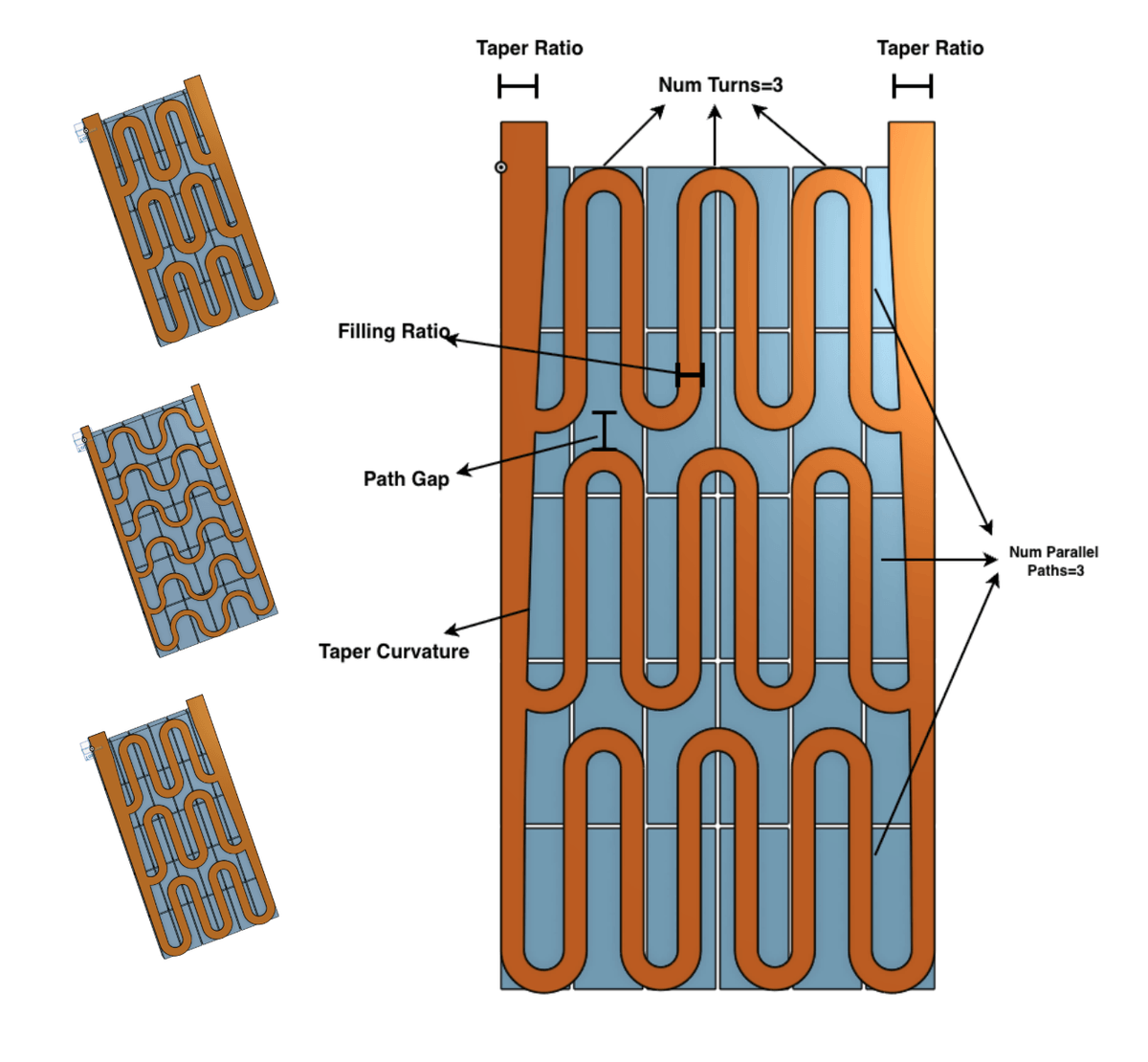
Figure 2: Candidate channel geometries sampled across the design space. The geometric parameterization spans a wide range of turn counts, parallel-path topologies, and taper profiles.
The training dataset is over 1,300 LHS-sampled CHT cases on this parameter space, with an 85/15 train/validation split. The dataset surfaces a useful structural observation up front: pressure drop correlates with inlet mass flow rate, max module temperature correlates with power per module, and the channel geometry plays a central role in the inverse relationship between the two. A channel that reduces pressure drop typically pushes max temperature up, and vice versa. Pack designers know this trade-off exists. SHIFT-Battery makes it tractable to navigate.
Model Architecture: GeoTransolver
SHIFT-Battery is built on NVIDIA’s GeoTransolver architecture (Adams et al., 2025), a geometry-aware transformer designed for physics field prediction on unstructured CAE meshes. GeoTransolver replaces the quadratic cost of full attention over high-resolution meshes with three coordinated mechanisms:
- Physics-aware state-slice self-attention. Mesh tokens are grouped into learned “physical states” that capture coherent flow or thermal structure. Attention happens within and across these states, which keeps the computation tractable on pack-scale meshes without throwing away long-range physics.
- GALE (Geometry-Aware Latent Embeddings). At every transformer block, a cross-attention step attends to a shared geometry and boundary-condition context vector, injected at every layer. The model never loses geometric grounding as it goes deeper. This is what lets the same trained model handle channel layouts with different turn counts and topologies.
- Multi-scale ball queries. Inspired by DoMINO, ball queries at multiple radii capture fine near-wall detail (the part of the field where temperature gradients and pressure losses concentrate) and global flow patterns across the plate in a single unified context.
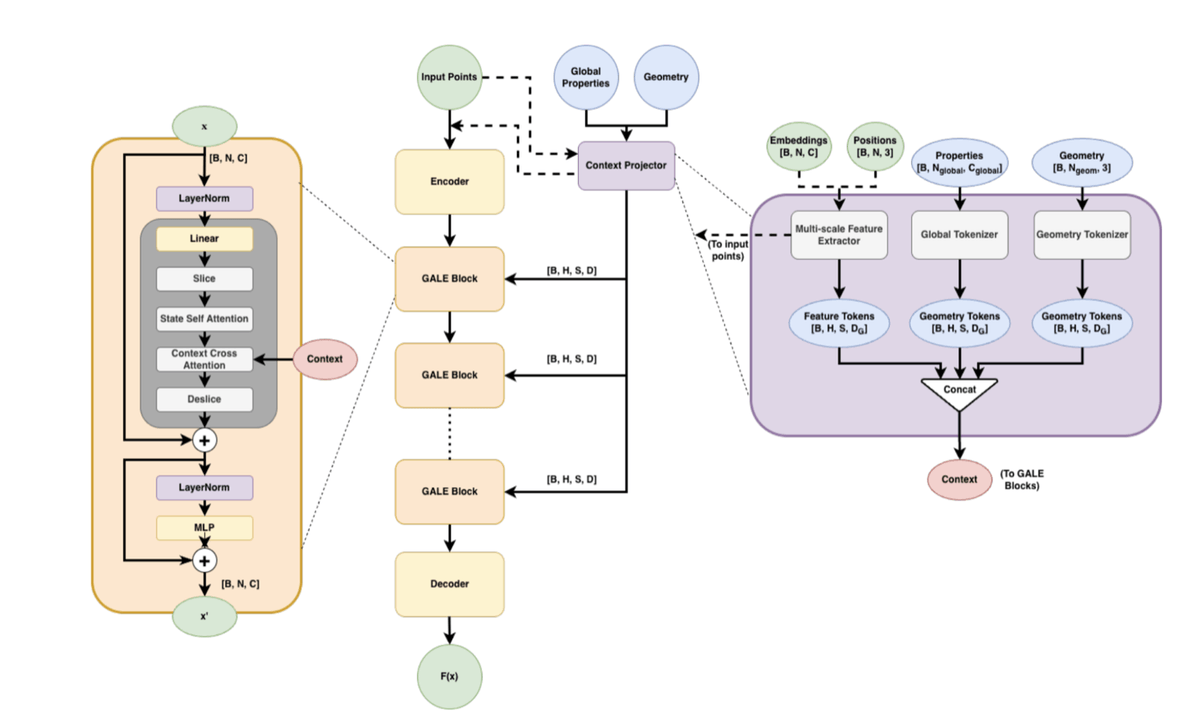
Figure 3: GeoTransolver architecture used to train SHIFT-Battery. State-slice attention, GALE geometry embeddings, and multi-scale ball queries combine to deliver field-level predictions on unstructured pack-scale meshes.
The training pipeline is the standard SHIFT pipeline: solver-grade data production from CHT runs, transformation and preprocessing into the input format GeoTransolver expects, model training on multi-GPU infrastructure, and packaging of the trained model into an inference artifact that can be queried inside engineering workflows. Training was run on 8 × NVIDIA H100 GPUs. Parameter count, total training time, and optimizer settings are reported in the model card.
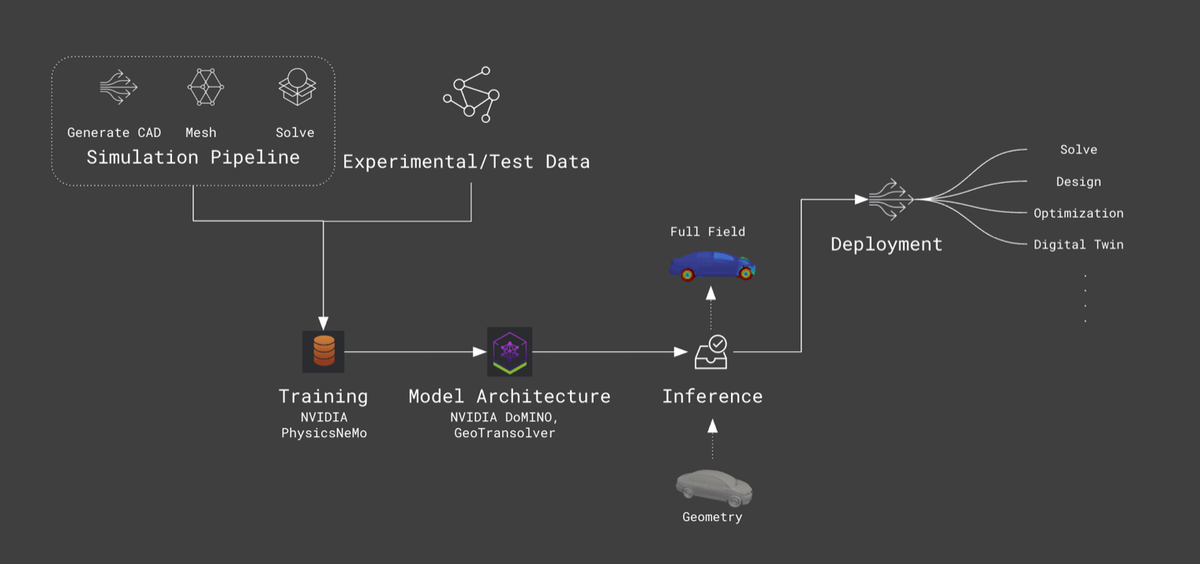
Figure 4: SHIFT-Battery model lifecycle — high-fidelity solver data, preprocessing for GeoTransolver, multi-GPU training, and packaging into an inference artifact for engineering workflows.
Training Results
SHIFT-Battery delivers accurate predictions across the three quantities of interest that pack thermal designers actually use:
| Quantity of Interest | Validation accuracy (n = 198) |
|---|---|
| Max module surface temperature | R² = 0.9658, MAE = 0.874 K |
| Pressure drop across channel | R² = 0.9966, MAE = 256.5 Pa |
| Peak channel velocity | R² = 0.9983, MAE = 0.00863 m/s |
The model predicts temperatures on the module surfaces and velocity on a slice through the channel center. The scalar QoIs are computed from those field predictions, which forces the model to learn the spatial physics that governs them. Max module temperature is captured accurately because the hottest point in this pack topology lies on the top surface of the module, where the model predicts directly.
Inference Speed and a New Workflow
The headline workflow result is the time delta between a CHT run and a SHIFT-Battery inference:
| Workflow | Meshing time | Prediction time | Total |
|---|---|---|---|
| CHT CFD (8 × H100, 8000 iterations) | 45 min | 35 min | 80 min |
| SHIFT-Battery inference | N/A | 0.5 min | 0.5 min |
The full per-case cycle drops from roughly 80 minutes to roughly 30 seconds. That moves the budget per design candidate from “an afternoon” to “interactive,” which changes who can drive the design loop. A CHT-grade prediction in half a minute can sit inside a parametric sweep, a multi-objective optimizer, or an interactive design tool that a thermal engineer drives directly without setting up a solver case. Channel layout becomes something a pack engineer iterates on at their desk in real time, with no hand-off and no wait.
It’s worth highlighting one use case that is hard to do with traditional methods: a sensitivity analysis on the channel geometry itself. Because GeoTransolver predicts fields conditioned on geometry tokens, the model can be queried at the slice level to estimate the relative contribution of individual geometry sections to a given QoI. For example, in the SHIFT-Battery dataset, the tapered inlet header shows up as a disproportionate contributor to pressure drop, when present. The slice study itself runs in roughly 4 minutes (8 forward passes through the trained model). An equivalent adjoint sensitivity study would take hours per QoI and requires a specially constructed dual problem for each, which is less commonly available across coupled multi-physics setups.
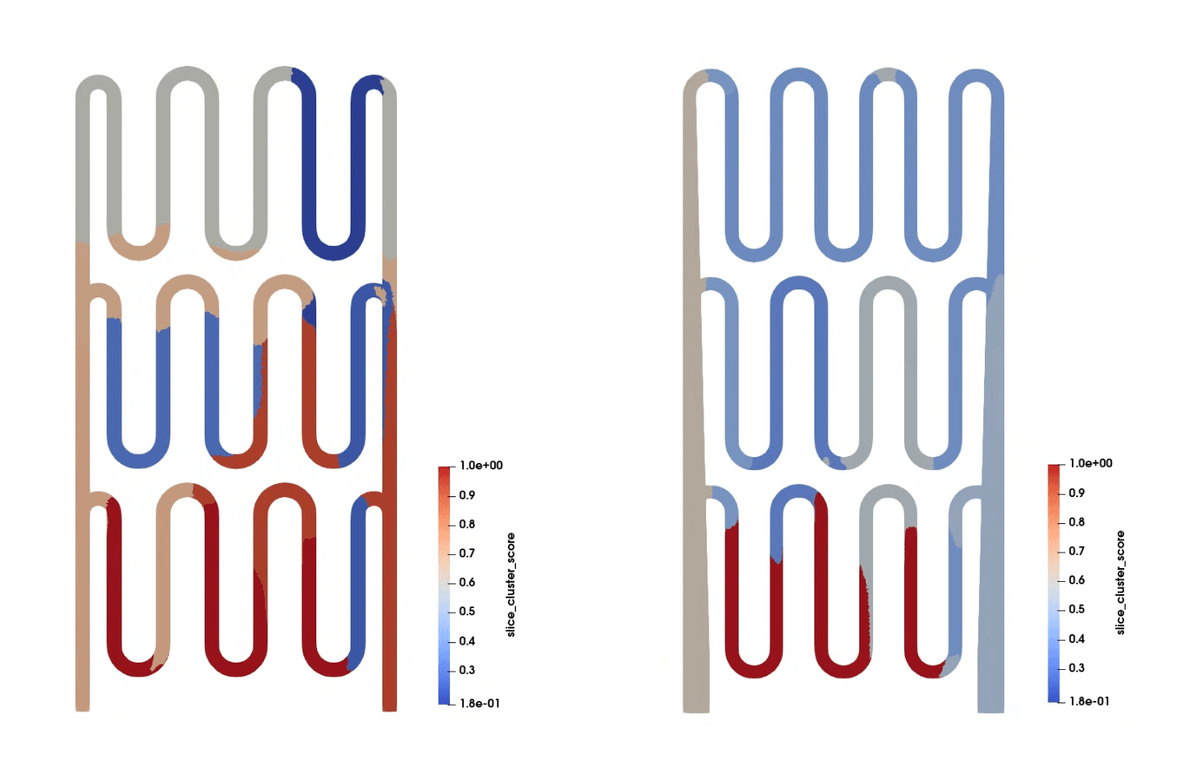
Figure 5: Slice-level geometry sensitivity for pressure drop. The tapered inlet header (highlighted) contributes disproportionately, identifying a clear lever for early-stage redesign.
Who Uses This Model
A cold plate channel design surrogate that runs in seconds and does not require CFD expertise to query has a different distribution profile than a CHT model. Inside a pack development organization, the same trained SHIFT-Battery model can be used by:
- BTMS (Battery Thermal Management System) engineers running channel layout trade studies during the early architecture phase, where the most consequential design decisions are made.
- Thermal and structural safety teams sweeping operating-envelope corner cases to surface hotspot risk before any of those cases are built or tested.
- Pack endurance and reliability engineers evaluating how channel design choices interact with long-duration thermal loading and module aging.
- Optimization engineers and Physics AI developers wrapping the model in gradient-based or Bayesian optimization loops for automated cold plate design exploration.
The common thread is that none of these users needs to set up a CHT case. The handoff problem (the one or two CFD specialists who become the bottleneck for an entire program) goes away once a validated surrogate is available, because the model only needs the new geometry and operating conditions to produce a field prediction. This is the workflow story Luminary’s platform is built around: take solver-grade data, train a model that captures the relevant physics, and then make that model available to every team that needs it, with full traceability back to the dataset and validation it came from.
What’s Next
The current SHIFT-Battery model is scoped to the parameter space described above. Several extensions are already in progress:
- Heat flux predictions and HTC computations. The next iteration of SHIFT-Battery will demonstrate heat flux prediction and subsequent heat transfer coefficient calculations, enabling even more in-depth analysis of the designs in question.
- Uncertainty quantification. Future iterations of the model will include field-level uncertainty estimates of any prediction, enabling even greater confidence in model predictions beyond retrospective test error confidence.
- Multi-physics coupling toward thermal runaway. Transfer learning from the current CHT-trained surrogate to thermal runaway risk scenarios, which require coupled electrochemical and thermal physics beyond the ohmic-only model used in the current dataset.
- Closed-loop optimization. Embedding SHIFT-Battery as the evaluator inside gradient-based and Bayesian optimization frameworks for automated cold plate design, building on the slice-level sensitivity capability shown above.
Try It
SHIFT-Battery is part of Luminary’s SHIFT family of Physics AI models. The SHIFT-Battery dataset is available on Hugging Face: view the sample dataset, request access to the full dataset, or contact us for a technical walkthrough.
Want to see SHIFT-Battery in action? Try the interactive web app demo to explore pack-scale cold plate predictions in your browser.