
2D Turbulent Flat Plate (Zero Pressure Gradient)
verification
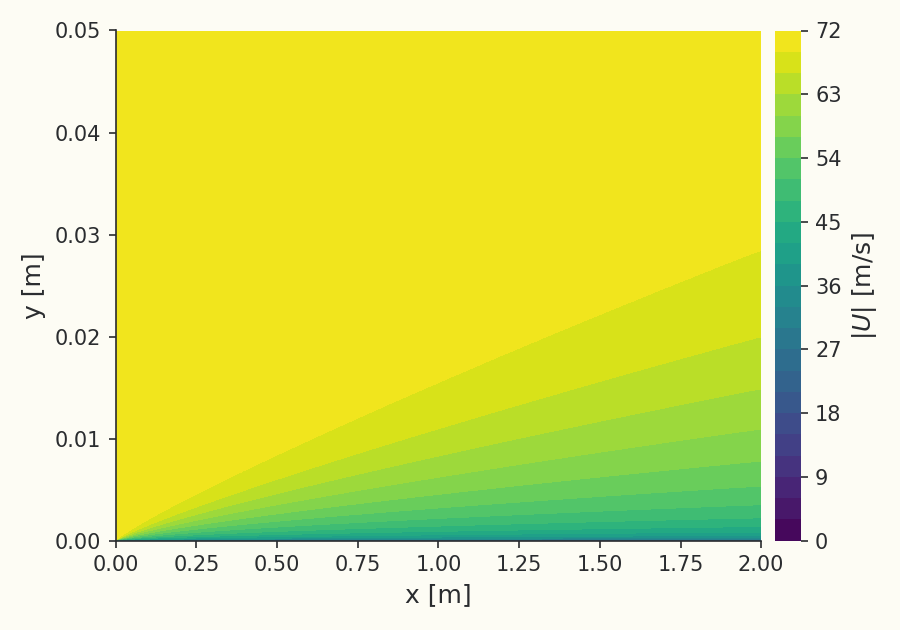
Overview
The 2D zero-pressure-gradient (ZPG) turbulent flat plate is a canonical verification case for Reynolds-averaged Navier–Stokes (RANS) turbulence models. A sharp flat plate is aligned with a uniform free stream; a turbulent boundary layer grows along its length with (nominally) no streamwise pressure gradient. Because the case has no geometric complexity, it isolates the turbulence model and the discretization, making it suited to code-to-code verification, the goal here is to reproduce, on the same grids, the results the NASA Turbulence Modeling Resource publishes for its reference codes CFL3D and FUN3D using the Spalart–Allmaras (SA) one-equation model.
This is a grid-convergence study: the case is solved on a family of five successively refined structured grids (35×25, 69×49, 137×97, 273×193, 545×385, each a 2× refinement), and the integrated quantities are tracked as the mesh is refined toward the continuum ().
Problem Setup
The free-stream Mach number is and the Reynolds number is per unit length, matching the NASA TMR specification. The plate occupies with the leading edge at ; the domain extends upstream to a symmetry plane ahead of the plate and to in the wall-normal direction. The boundary conditions match the CFL3D and FUN3D 2DZP decks: a total-pressure characteristic inflow ( Pa, K), a static back-pressure outflow, a far-field Riemann upper boundary, a no-slip wall on the plate, a slip wall over the pre-plate region, and symmetry on the spanwise planes (the mesh is one cell thick in ).
Air is modeled as an ideal gas with Sutherland's law for the dynamic viscosity and a laminar Prandtl number . Turbulence closure is the Spalart–Allmaras model. The discretization uses the high-accuracy preset with no limiter and an FDS convective flux. Each grid is converged in pseudo-time with the density residual driven to its plateau so that the remaining error is spatial.
Quantities of Interest
The verification targets are those published on the NASA TMR SA results page:
- The grid convergence of the skin-friction coefficient at and of the total drag coefficient , each plotted against . On the finest 545×385 grid the Luminary lies within 0.05% of CFL3D (0.0028599) and within 0.31% of FUN3D (0.0028525); at lies within 0.06% of CFL3D (0.0027056) and within 0.06% of FUN3D (0.0027054). CFL3D and FUN3D bracket the answer from opposite sides, reflecting their cell-centered versus node-centered discretizations.
- The skin-friction distribution along the plate on the finest grid.
- The law of the wall, versus , at and , shown against the analytic viscous-sublayer and log-law theory.
- The eddy-viscosity profile at , and the streamwise growth of its boundary-layer peak .
Sources
Reference , , / and eddy-viscosity data from the NASA CFL3D and FUN3D codes.
Results
Finest-grid and vs CFL3D / FUN3D
| Code | at | |
|---|---|---|
| Luminary | 0.0028613 | 0.0027071 |
| CFL3D | 0.0028599 | 0.0027056 |
| FUN3D | 0.0028525 | 0.0027054 |
Values on the finest grid (545 × 385).
Reference: NASA Langley Turbulence Modeling Resource, "2D Zero Pressure Gradient Flat Plate Verification Case" (SA model).: https://tmbwg.github.io/turbmodels/flatplate_sa.html
Grid convergence of at
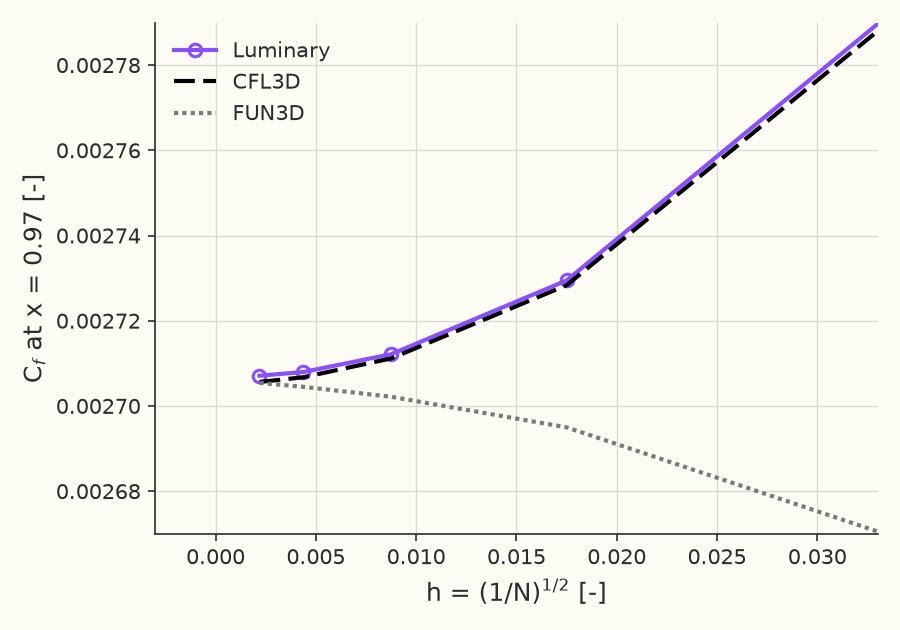
Reference: NASA Langley Turbulence Modeling Resource, "2D Zero Pressure Gradient Flat Plate Verification Case" (SA model). (CFL3D / FUN3D, grid convergence of at ): https://tmbwg.github.io/turbmodels/flatplate_sa.html
Grid convergence of
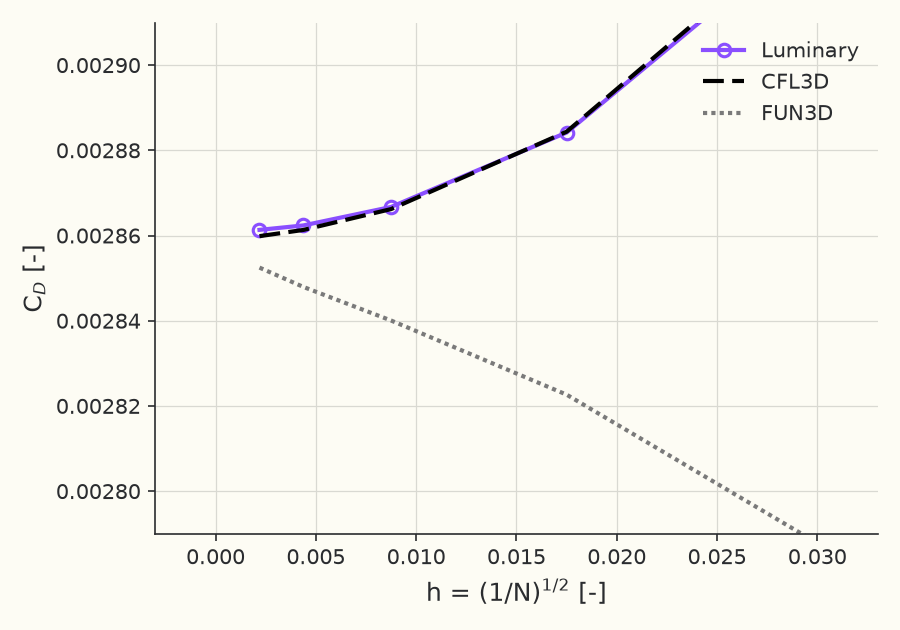
Reference: NASA Langley Turbulence Modeling Resource, "2D Zero Pressure Gradient Flat Plate Verification Case" (SA model). (CFL3D / FUN3D, grid convergence of ): https://tmbwg.github.io/turbmodels/flatplate_sa.html
Skin-friction coefficient along the plate
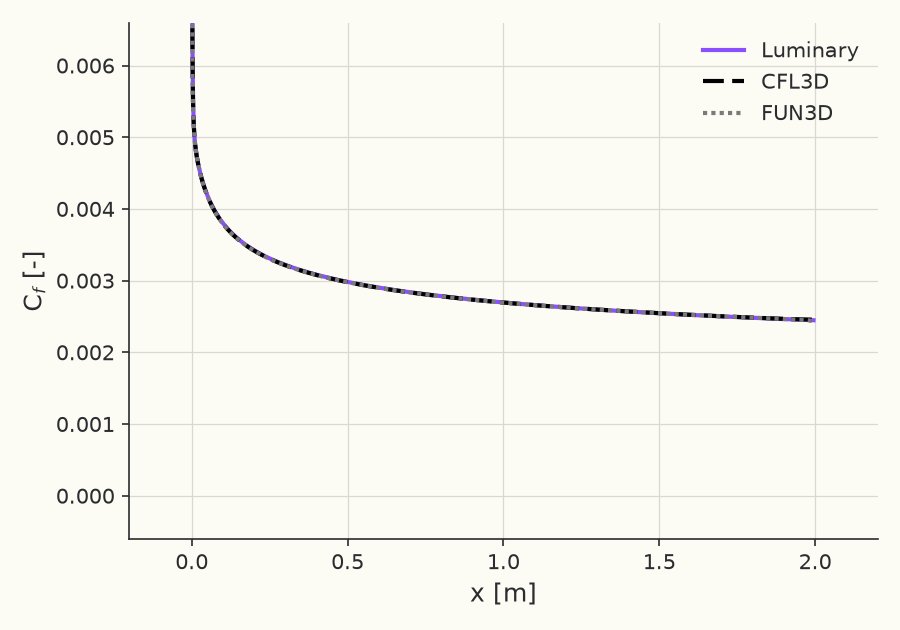
Reference: NASA Langley Turbulence Modeling Resource, "2D Zero Pressure Gradient Flat Plate Verification Case" (SA model). (CFL3D / FUN3D, on the finest grid): https://tmbwg.github.io/turbmodels/flatplate_sa.html
Law of the wall: vs
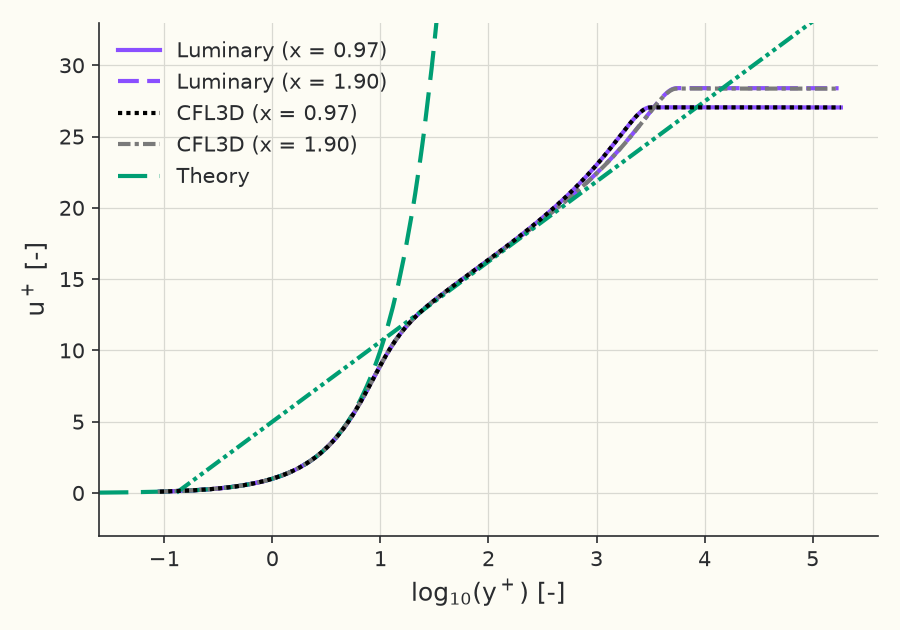
Reference: NASA Langley Turbulence Modeling Resource, "2D Zero Pressure Gradient Flat Plate Verification Case" (SA model). (CFL3D vs at and ): https://tmbwg.github.io/turbmodels/flatplate_sa.html
Eddy-viscosity profile at
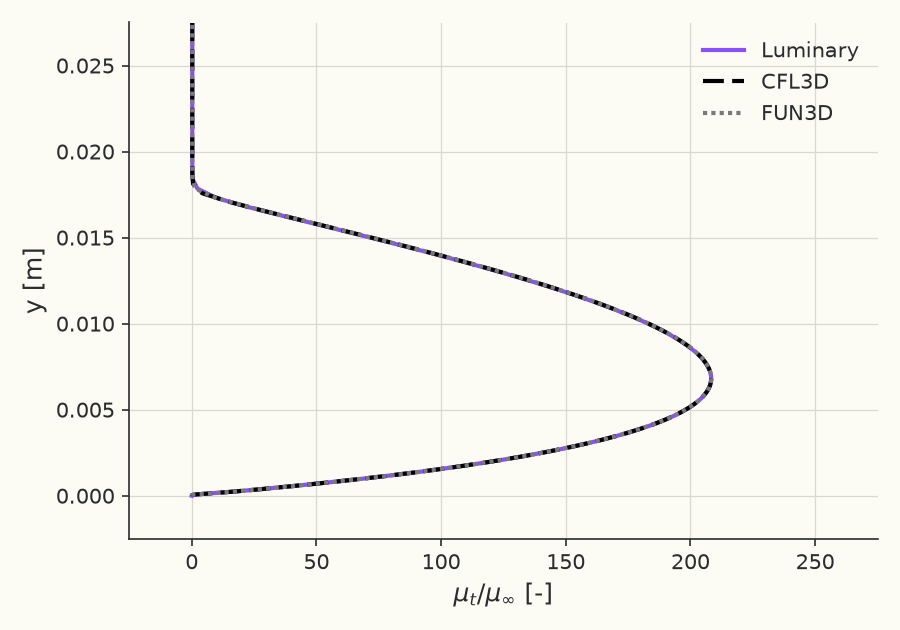
Reference: NASA Langley Turbulence Modeling Resource, "2D Zero Pressure Gradient Flat Plate Verification Case" (SA model). (CFL3D / FUN3D eddy viscosity at ): https://tmbwg.github.io/turbmodels/flatplate_sa.html
Peak eddy viscosity in the boundary layer
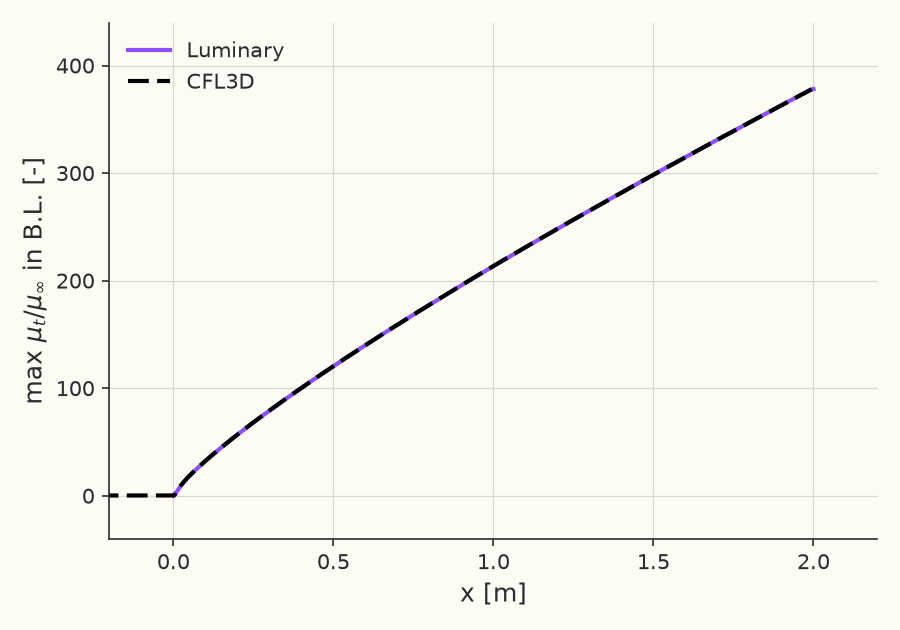
Reference: NASA Langley Turbulence Modeling Resource, "2D Zero Pressure Gradient Flat Plate Verification Case" (SA model). (peak in the boundary layer vs x): https://tmbwg.github.io/turbmodels/flatplate_sa.html
Solver configuration
- features exercised
- Verification2DRANSSpalart–AllmarasIdeal gasSteadyEnergy equation