Turbulent Natural Convection in a Tall Cavity
validation
Overview
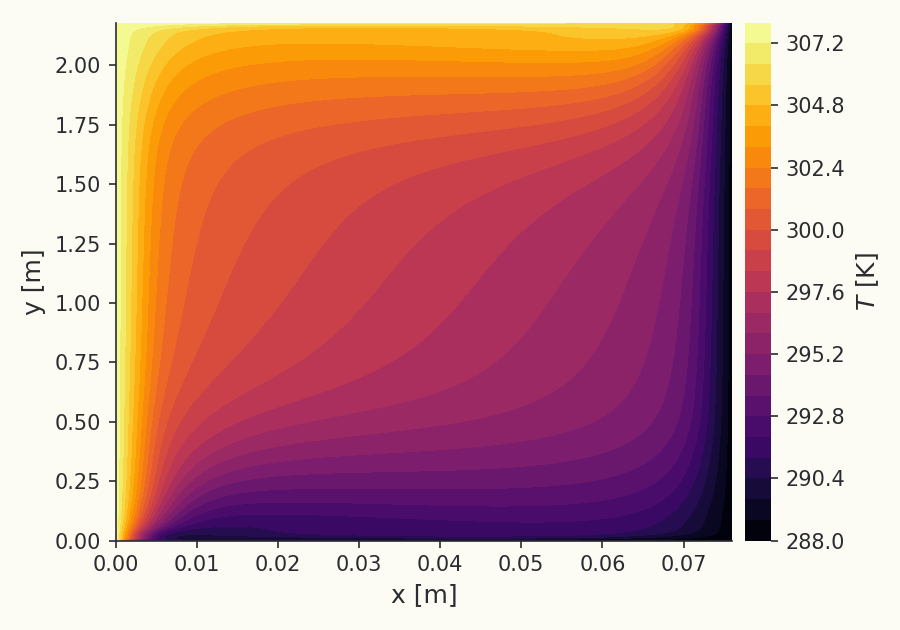
A tall, sealed rectangular enclosure filled with air is heated along one vertical wall and cooled along the opposite vertical wall, with the top and bottom held adiabatic. The temperature difference makes the air near the hot wall lighter and the air near the cold wall heavier, so buoyancy drives a slender upward "jet" along the hot wall and a matching downward jet along the cold wall, closing into a slow recirculation around a stably stratified core. At the conditions reproduced here the wall boundary layers are turbulent, so this enclosure exercises a buoyancy-coupled turbulence model and extends the laminar differentially-heated cavity into the turbulent-buoyancy regime.
The buoyancy is modeled with the Boussinesq approximation: the density is treated as constant everywhere except in the gravitational body force, where the small thermal expansion of the air supplies the driving term . This is the appropriate model for the modest temperature difference of this experiment, and it is the natural-convection path validated against Betts & Bokhari's measurements.
Problem Setup
The cavity has height and width , an aspect ratio of ; the third dimension is large, so the flow is treated as two-dimensional on a quasi-2D plane. The hot wall is held at and the cold wall at , a difference about a mean of ; the top and bottom walls are adiabatic and all walls are no-slip. Gravity is in .
Air is modeled with constant properties at the mean temperature: dynamic viscosity , specific heat , and a laminar Prandtl number . The Boussinesq expansion coefficient is . These set the width-based Rayleigh number,
which places the flow in the turbulent buoyant regime. Turbulence is closed with the SST model, integrated to the wall. The enclosure is solved on a single structured grid whose across-width nodes are clustered toward both vertical walls with an explicit near-wall spacing, giving on each wall so the buoyant boundary layers are fully resolved. Because the only reference is a single experiment (not a published grid-refinement family), the grid was refined privately until the mid-height profiles stopped changing and one converged grid is reported.
Quantities of Interest
The validation quantities are horizontal traverses across the cavity width at mid-height (): the vertical velocity and the temperature , where is the hot wall and the cold wall. The vertical-velocity traverse exposes the two wall jets, a positive (upward) peak in the thin hot-wall layer and a mirror-image negative (downward) peak in the cold-wall layer, separated by a near-quiescent core. The temperature traverse shows the steep wall-layer gradients and the gentle, stratified variation across the core. Both are compared with the measurements of Betts & Bokhari, together with the peak up- and down-flow velocities at mid-height.
Sources
Measured turbulent natural convection of air () in a tall enclosure, aspect ratio ; case 1 has K, . The measured mid-height profiles are the Betts & Bokhari data hosted in the ERCOFTAC Classic Collection (case 79).
Results
Mid-height vertical velocity
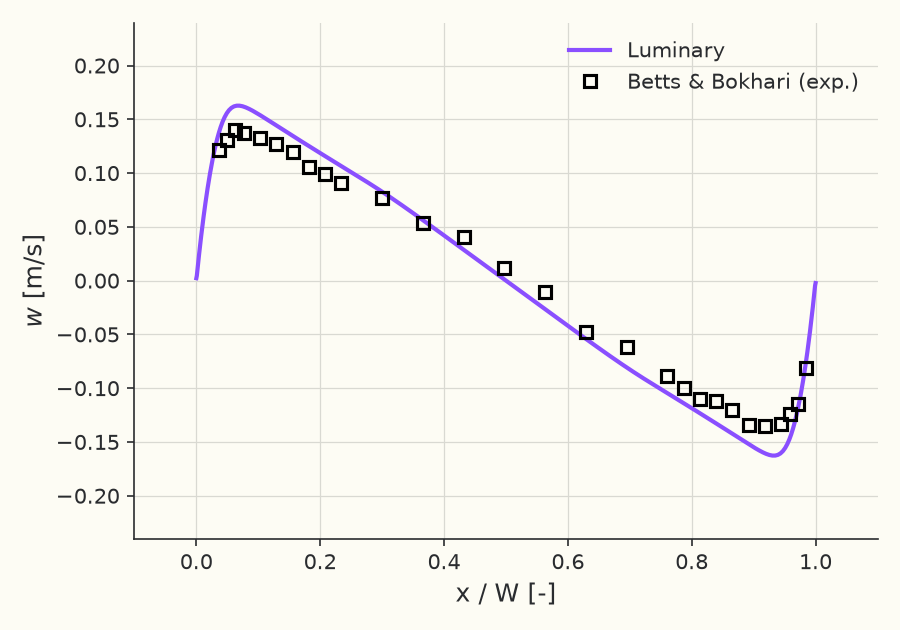
Reference: P. L. Betts and I. H. Bokhari, "Experiments on turbulent natural convection in an enclosed tall cavity," International Journal of Heat and Fluid Flow, 21(6):675–683, 2000. (measured mid-height () vertical velocity at ): https://doi.org/10.1016/S0142-727X(00)00033-3
Mid-height temperature
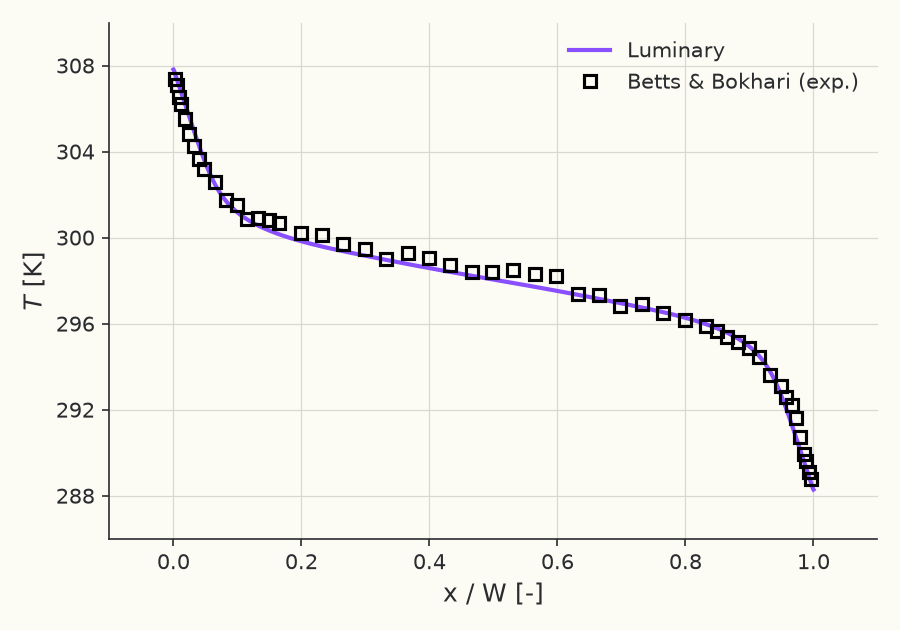
Reference: P. L. Betts and I. H. Bokhari, "Experiments on turbulent natural convection in an enclosed tall cavity," International Journal of Heat and Fluid Flow, 21(6):675–683, 2000. (measured mid-height () temperature at ): https://doi.org/10.1016/S0142-727X(00)00033-3
Mid-height peak vertical velocities
| Source | [m/s] | [m/s] |
|---|---|---|
| Luminary | 0.16266 | -0.16266 |
| Betts & Bokhari (exp.) | 0.14 | -0.135 |
Peak upflow (hot-wall jet) and downflow (cold-wall jet) vertical velocity at mid-height (), compared with Betts & Bokhari at .
Solver configuration
- features exercised
- Validation2DRANSk–ω SSTConstant densitySteadyEnergy equationBuoyancy / gravity