
Supersonic Expansion (Prandtl–Meyer Fan)
verification
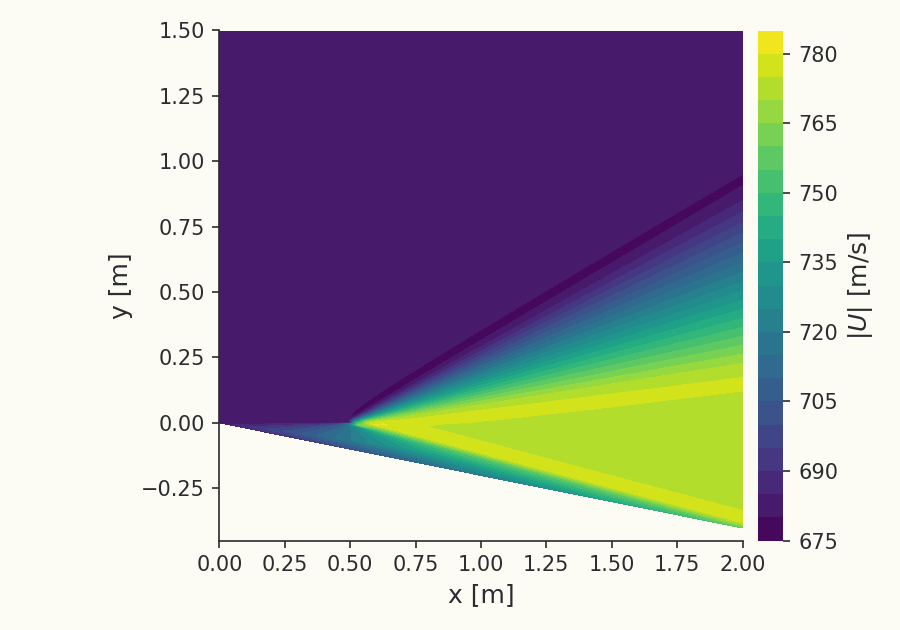
Overview
When a supersonic stream flows around a convex corner it expands: the flow turns away from itself through a continuous fan of Mach waves centered on the corner, accelerating to a higher Mach number while its pressure, density and temperature fall. Unlike a shock, the expansion is isentropic and spread over a finite angular fan, so the process is reversible and the post-expansion state follows from the Prandtl–Meyer function together with the isentropic flow relations. For a given upstream Mach number and turning angle, the downstream Mach number is fixed by , and the pressure and temperature ratios then follow from the isentropic relations evaluated at and .
The solution is closed-form and free of any modeling assumption, so the case verifies that the solver captures a smooth supersonic expansion, the compression complement of the oblique-shock wedge, at the correct strength.
Problem Setup
A Mach-2 uniform stream flows along a flat wall that turns away by at a convex corner; the opposite wall is parallel and the domain is sized so the expansion fan leaves through the downstream boundary without reflecting. The flow is modeled as inviscid (Euler), compressible and steady, with an ideal gas (). The walls are slip boundaries, the inlet imposes the supersonic freestream, and the outlet is a supersonic pressure outlet that extrapolates the interior state. A second-order FDS scheme with no limiter is used.
The grid is a structured convex-corner mesh built so the turning angle is exactly . The flow downstream of the fan is uniform and aligned with the deflected wall, where the post-expansion state is sampled.
Quantities of Interest
The verification quantities are the post-expansion flow state:
- the post-expansion Mach number ;
- the static-pressure ratio ;
- the static-temperature ratio .
Each is compared to the exact Prandtl–Meyer and isentropic result for , a turn and .
Sources
Authoritative tabulation of the Prandtl–Meyer function and the isentropic flow relations used as the analytic reference.
Results
Post-expansion state vs the Prandtl–Meyer solution
| Source | |||
|---|---|---|---|
| Luminary | 2.6 | 0.39305 | 0.76688 |
| Analytic | 2.5984 | 0.39307 | 0.76583 |
Post-expansion Mach number and the isentropic , sampled in the uniform region above the deflected wall.
Solver configuration
- features exercised
- Verification2DInviscidIdeal gasSteadyEnergy equation