
Stokes's First Problem (Impulsively Started Wall)
verification
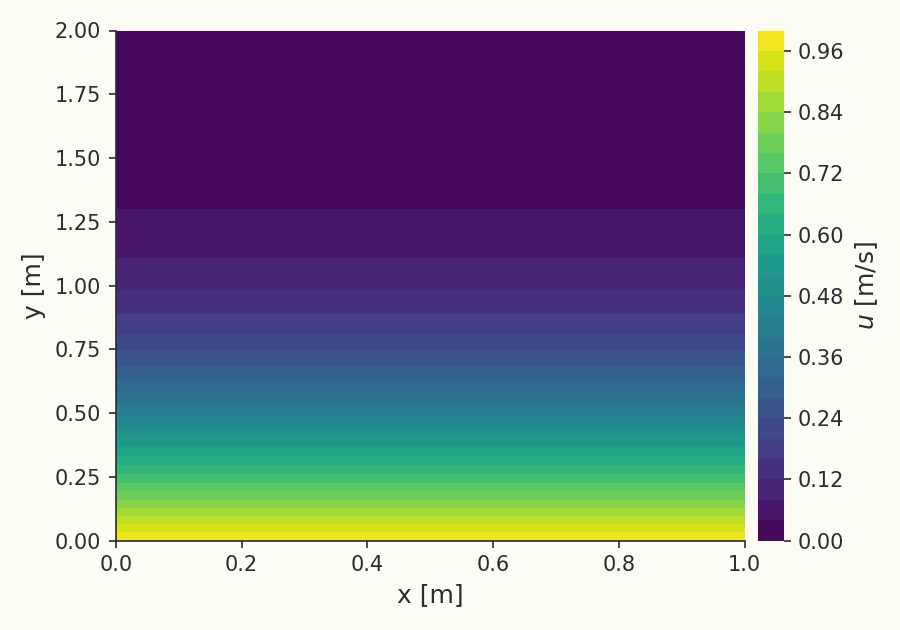
Overview
Stokes's first problem, also called the Rayleigh problem, is the textbook unsteady viscous flow that develops when an infinite plane wall bounding a fluid at rest is impulsively set into steady motion in its own plane. Momentum diffuses away from the wall into the fluid, and a shear layer of thickness grows in time. Because there is no pressure gradient and the flow is independent of the streamwise coordinate, the problem has a closed-form self-similar solution: the velocity profile is the complementary error function of a single similarity variable, so profiles taken at different instants collapse onto one curve. The case exercises the unsteady (implicit) time integration coupled to the wall-normal diffusion operator, with no convective or pressure-gradient terms. The reference solution is the one given by Schlichting & Gersten.
Problem Setup
The domain is a tall, thin slab above the moving wall: a streamwise length m and a wall-normal height m, meshed as a single spanwise layer of cells so the simulation is quasi-two-dimensional. The fluid is initially at rest everywhere. At the lower wall begins translating in its own plane at the constant speed m/s, imposed through the solver's moving-frame mechanism so the no-slip wall carries the fluid with it without any normal motion. The streamwise faces are a translational periodic pair, which removes any dependence on ; the top boundary is a symmetry plane placed far above the wall so the diffusing shear layer never reaches it over the simulated interval, matching the quiescent far field; and the spanwise faces are symmetry planes. The fluid has constant density kg/m³ and constant viscosity Pa·s, giving a kinematic viscosity m²/s. The second-order implicit time scheme advances a fixed step s to a final time s, at which the shear-layer thickness m is still well inside the domain.
Quantities of Interest
The verification quantity is the streamwise velocity profile . With no pressure gradient the streamwise momentum balance reduces to the one-dimensional diffusion equation subject to at the wall and far from it, starting from rest. Its exact self-similar solution is where is the complementary error function. The computed profile is sampled at three physical times ( s) and plotted as against the similarity variable , collapsing onto the single curve. The computed at the similarity stations and is reported beside its exact values; the two agree within 0.1% of the analytic solution.
Sources
Stokes's first problem (the Rayleigh problem): the impulsively started wall has the exact similarity solution .
Results
Similarity collapse of the velocity profile
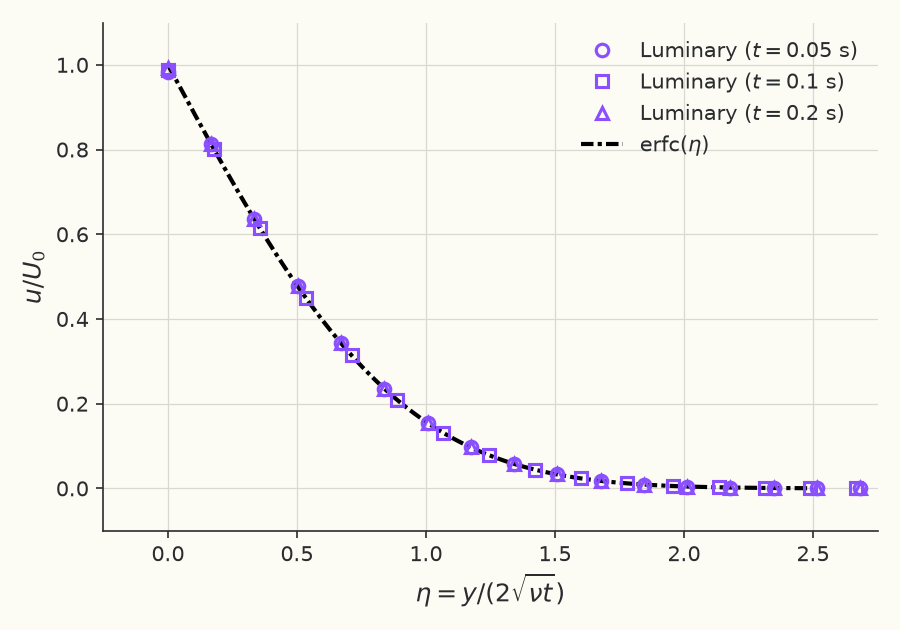
Reference: H. Schlichting and K. Gersten, Boundary-Layer Theory, 8th ed., Springer-Verlag, Berlin Heidelberg, 2000. (similarity solution ): https://doi.org/10.1007/978-3-642-85829-1
Similarity-solution comparison
| Source | at | at |
|---|---|---|
| Luminary | 0.47951 | 0.15732 |
| (Schlichting & Gersten) | 0.4795 | 0.1573 |
The computed at two similarity stations at the final time beside their exact values.
Solver configuration
- features exercised
- Verification2DLaminarConstant densityUnsteady