
RAE 2822 Transonic Airfoil: Validation (SA)
validation
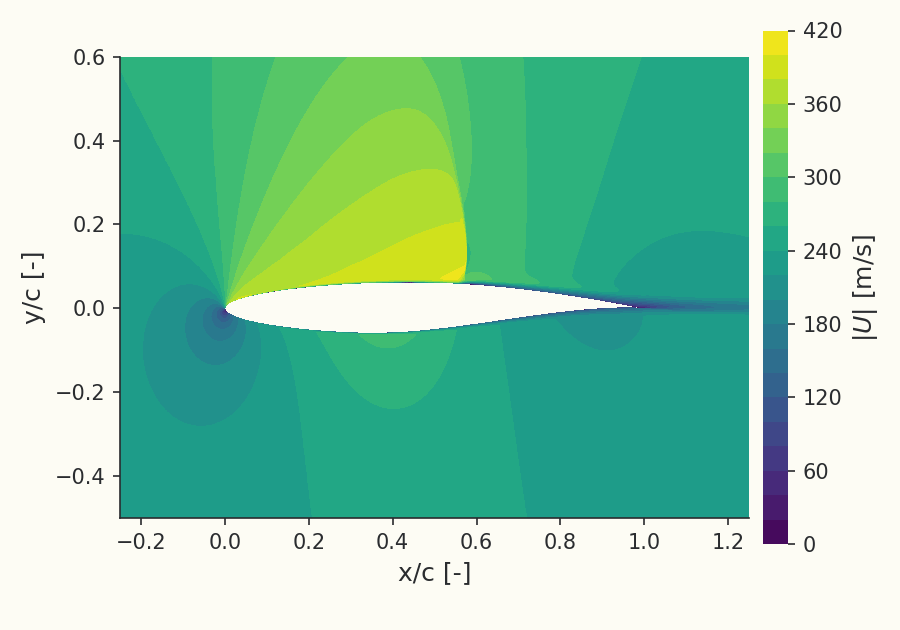
Overview
The RAE 2822 is a supercritical aerofoil section whose transonic wind-tunnel campaign, documented in AGARD Advisory Report 138 by Cook, McDonald and Firmin, is a recurring validation benchmark in computational aerodynamics. The measurements include surface pressure distributions together with boundary-layer and wake surveys, across a range of Mach numbers and incidences in a compressible, shocked flow.
This case reproduces the report's Case 9 at the corrected free-stream conditions , and . These are the free-air conditions adopted by the High-Order CFD Workshop, obtained by correcting the wind-tunnel reference values (, ) for tunnel-wall interference. At these conditions a supersonic pocket forms over the forward upper surface and is terminated by a near-normal shock near mid-chord. The Luminary Spalart–Allmaras solution is compared to the measured surface pressure and to the reported lift and drag.
Problem Setup
The aerofoil has unit chord and lies in the x–y plane at ; the integrated surface force is projected onto the wind axes to recover lift and drag. The fluid is ideal-gas air with Sutherland viscosity at a free-stream Mach number of ; the static pressure is set so the chord Reynolds number equals , and the reference pressure and velocity follow the free stream so that the force-coefficient and pressure normalizations are exact. Turbulence is modeled with Spalart–Allmaras, the discretization is second-order, and each run is driven to a deep residual floor. Transition is fixed near the leading edge, as in the workshop specification.
The boundary conditions are a no-slip adiabatic wall on the aerofoil and a Riemann far field on the outer boundary. The study is run as a grid-convergence sweep over the workshop's five nested, body-fitted grids around the section, from a 506-cell grid to a 129,536-cell grid. The experimental data are the Case-9 surface pressures and forces from AGARD AR-138, digitized from the report.
Quantities of Interest
The validation quantities are the surface pressure coefficient , including the chordwise location of the upper-surface shock, and the integrated lift and drag coefficients. Lift and drag are tracked across the grid family as a function of the grid spacing to assess grid convergence, and the finest-grid values are tabulated beside the AGARD Case-9 measurements; the finest-grid pressure distribution is overlaid on the measured . On the finest grid (129,536 cells) Luminary returns , within of the measured , and against the measured . Transonic drag combines wave drag from the shock with the viscous contribution, so the comparison reflects both the shock capturing and the boundary-layer response of the turbulence model.
Sources
Corrected conditions , , (free-air, from the tunnel reference , ); transition fixed at 3% chord; nested linear grid family (``rae2822_level{1..5}.msh``).
Case 9: measured surface and integrated /. Surface-pressure points digitized from the report (via the SU2 test suite); the RAE 2822 dataset is hosted on the NASA Turbulence Modeling Resource.
Results
Lift and drag at Case 9 vs experiment
| Code | ||
|---|---|---|
| Luminary | 0.79319 | 0.018765 |
| AGARD case 9 (exp.) | 0.803 | 0.0168 |
Values on the finest grid (129,536 cells, \( \alpha = 2.79^\circ \)).
Wind-axis and on the finest grid at , , , compared to the AGARD Case-9 measurements.
Grid convergence of
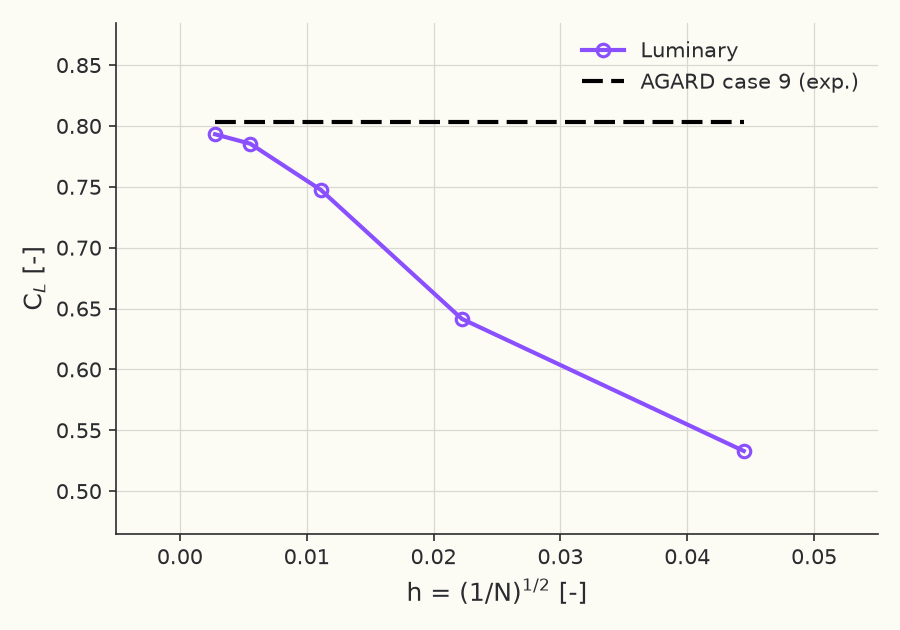
Reference: P. H. Cook, M. A. McDonald and M. C. P. Firmin, "Aerofoil RAE 2822: Pressure Distributions, and Boundary Layer and Wake Measurements," AGARD Advisory Report No. 138, 1979. (/, Case 9): https://tmbwg.github.io/turbmodels/Bradshaw/d2/f8621.txt
Grid convergence of
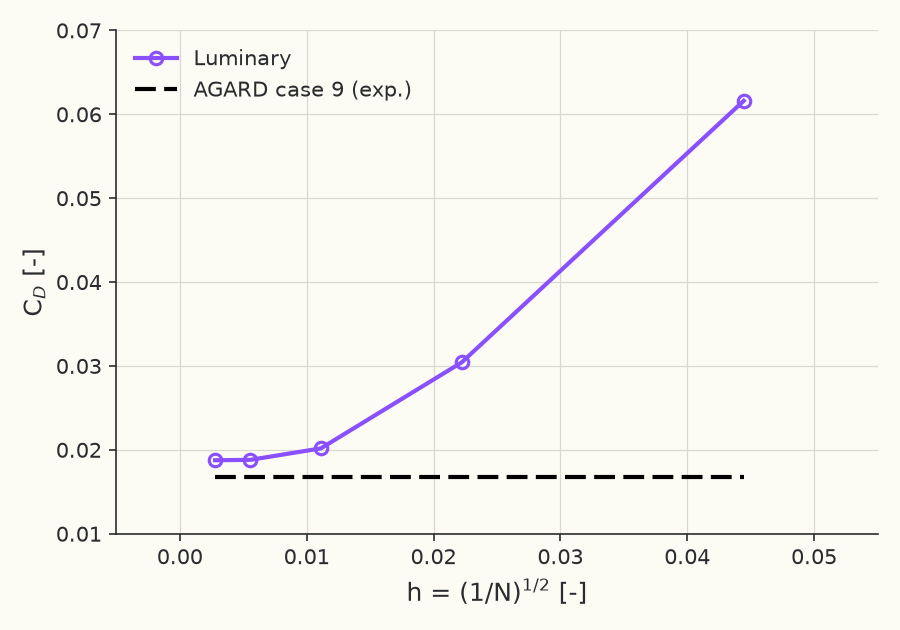
Reference: P. H. Cook, M. A. McDonald and M. C. P. Firmin, "Aerofoil RAE 2822: Pressure Distributions, and Boundary Layer and Wake Measurements," AGARD Advisory Report No. 138, 1979. (/, Case 9): https://tmbwg.github.io/turbmodels/Bradshaw/d2/f8621.txt
Surface pressure coefficient at Case 9
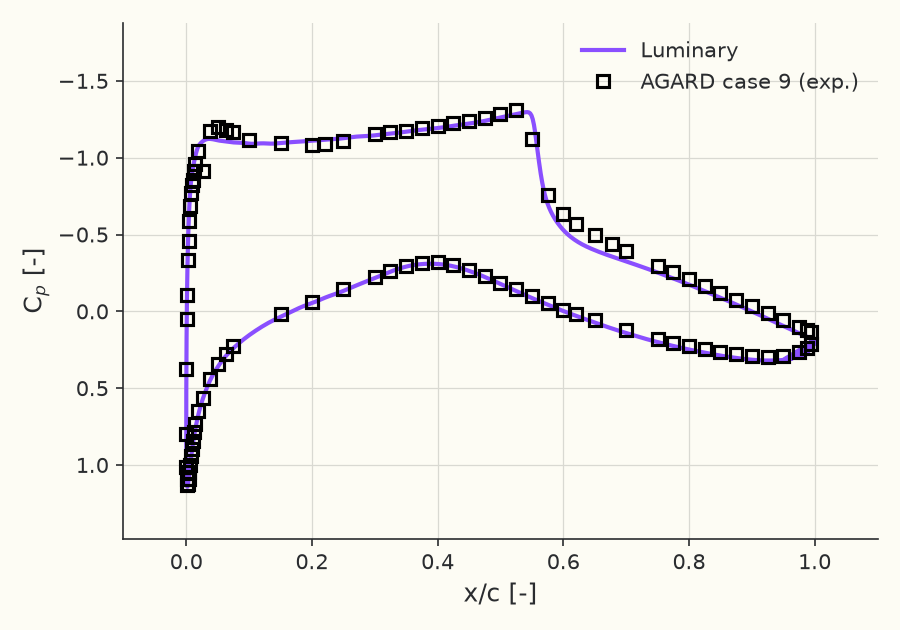
Reference: P. H. Cook, M. A. McDonald and M. C. P. Firmin, "Aerofoil RAE 2822: Pressure Distributions, and Boundary Layer and Wake Measurements," AGARD Advisory Report No. 138, 1979. (surface , Case 9): https://tmbwg.github.io/turbmodels/Bradshaw/d2/f8621.txt
Solver configuration
- features exercised
- Validation2DRANSSpalart–AllmarasIdeal gasSteadyEnergy equation