
Acoustic Point Sources in a Cube: FW-H Against Direct CFD and 1/r Decay
verification
Animation of the divergence of the velocity (the dilatation) on a plane through the cube, which shows the tone radiated by the (a) monopole, (b) dipole and (c) quadrupole source.
Overview
A compact acoustic source radiates a spherically spreading wave whose amplitude falls as , a decay of dB per decade of distance. This case places a monopole, a dipole and a quadrupole source at the centre of a cube, predicts the radiated tone with the Ffowcs Williams-Hawkings analogy evaluated on a permeable surface around the source, and compares its decay with distance with the pressure the flow solver computes directly at the same points.
Problem Setup
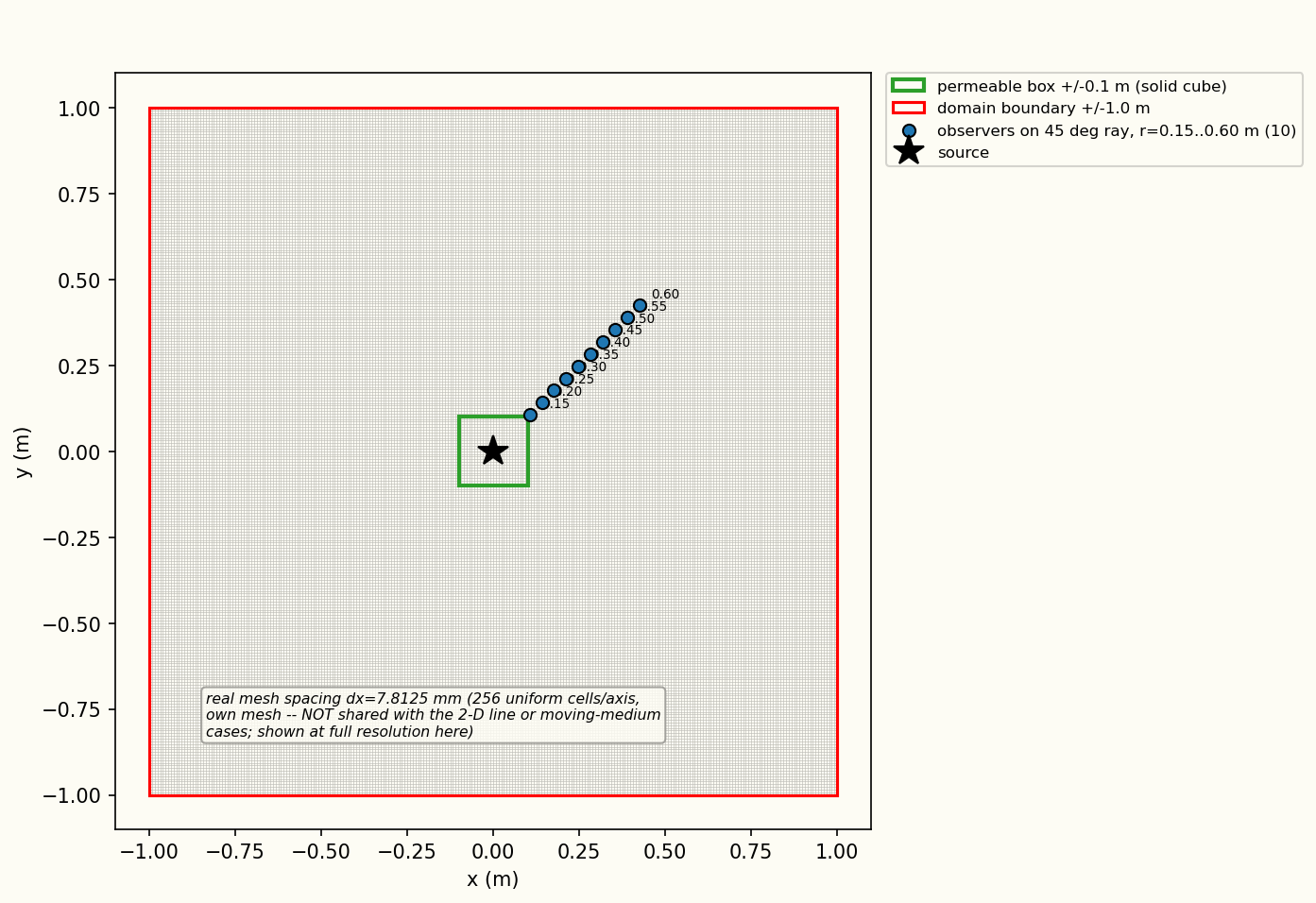
The domain is a cube of half-width m filled with a still, laminar ideal gas at Pa and K with a constant dynamic viscosity of kg/(m s). The source is a Gaussian energy source of width m, driven at Hz with a ramp over its first three periods, and the pole separation of the dipole and quadrupole is m. The Ffowcs Williams-Hawkings surface is a closed permeable box m on a side. The ten observers lie on a ray at in the plane, at distances from m to m from the source. Time integration is second-order implicit with s and 400 steps.
Quantities of Interest
The level of the source tone at each observer, from the Ffowcs Williams-Hawkings prediction and from the directly simulated pressure, over the interval before the first reflection from the domain boundary reaches the observer, and the slope of each level against compared with the dB per decade of a decay.
Results
Mesh and domain
Tone level against distance
Decay slopes
| Source | FW-H slope (dB/decade) | Direct-CFD slope (dB/decade) | Ideal 1/r slope (dB/decade) |
|---|---|---|---|
| Monopole | -19.938 | -22.387 | -20 |
| Dipole | -19.988 | -22.329 | -20 |
| Quadrupole | -19.772 | -22.519 | -20 |
Slope of the tone level against from a least-squares fit.
Discussion
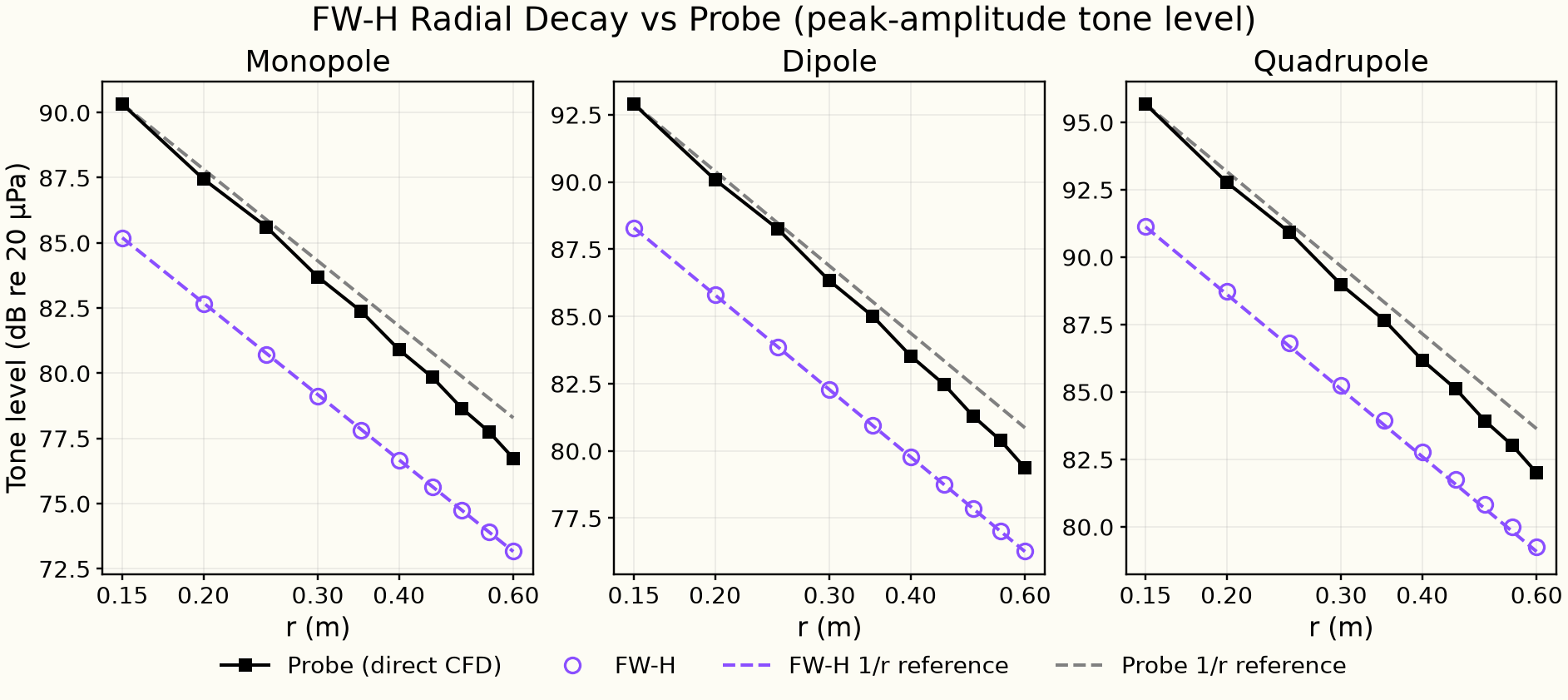
Sound spreading out from a small source in open space gets quieter with distance in a fixed way: each time the distance doubles, the pressure amplitude halves, a drop of 6 dB. Over a tenfold increase in distance that is a drop of 20 dB, the "" law. The plot of tone level against distance uses a logarithmic distance axis, so this law is a straight line, drawn dashed for each result.
The Ffowcs Williams-Hawkings (FW-H) prediction follows the law for all three sources. Its fitted slopes are , and dB per decade, within dB per decade of the ideal . The method takes the flow solution on a small box around the source and carries the sound from there to each observer with a formula that is exact for sound travelling through still air, so it has no loss on the way.
The direct CFD (computational fluid dynamics) level falls off faster, at to dB per decade. This is expected. The direct CFD value is the wave after the solver itself has carried it across the grid to the observer, and every cell it passes through takes a little energy out of it. The further the wave travels, the more it loses to this numerical dissipation, so its level drops faster than alone would give, and the direct CFD points bend away below their dashed line.
Solver configuration
- features exercised
- Verification3DLaminarIdeal gasUnsteadyEnergy equationFW-H (solid / permeable surface)