
3D ONERA M6 Wing
verification
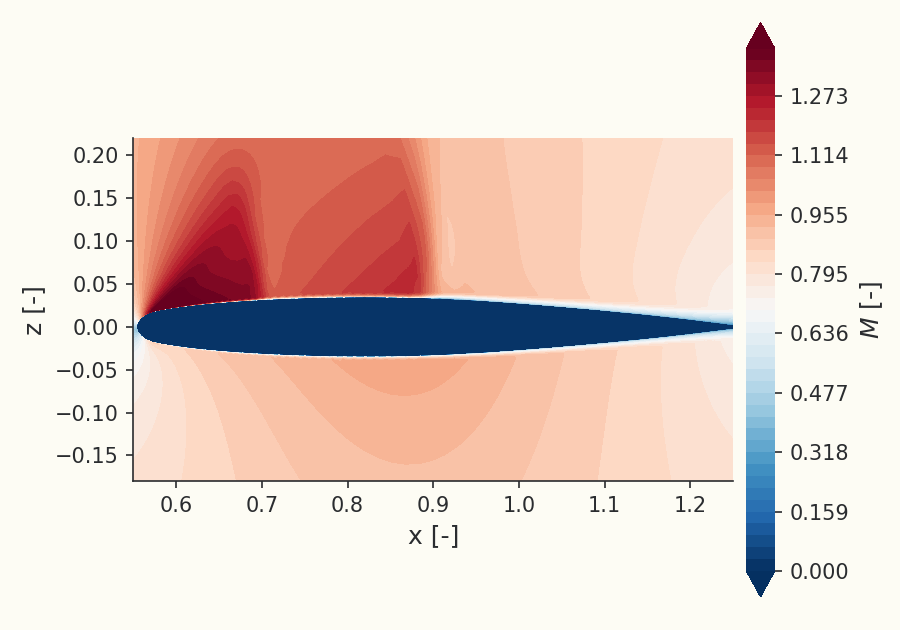
Overview
The ONERA M6 wing is a three-dimensional transonic geometry whose surface pressures and integrated forces are documented across many CFD codes and experiments. This case reproduces the NASA Turbulence Modeling Resource numerics verification (Case 2308) at and , a transonic condition that develops a -shock on the upper surface, exercising the solver and turbulence model on a three-dimensional shock and the resulting loads.
With no analytic solution, verification here means showing that the solver's Spalart–Allmaras (SA) result converges, under systematic grid refinement, toward the lift and drag, and the surface pressure distributions, produced by the NASA reference codes CFL3D (structured) and FUN3D run on the same wing. The reference data use the negative-SA variant; this case is run with the standard SA model. The case is also a validation: the surface-pressure sections are compared against the wind-tunnel measurements of Schmitt & Charpin (AGARD AR-138), so each span-station figure shows both the code-to-code agreement and the comparison with experiment.
Problem Setup
The flow is compressible (ideal-gas air, Sutherland viscosity) at free-stream Mach number and Reynolds number based on the root chord , at an angle of attack . Turbulence is modeled with Spalart–Allmaras using the verification inflow value , with a second-order, low-dissipation discretization. The wing has a leading-edge sweep of , a taper ratio of , and a semispan of root chords.
The boundary conditions are a Riemann far-field (outer radius root chords), an adiabatic no-slip wall on the wing, and a symmetry plane at the root (), the wing is solved as a half-model. The grids are generated by NASA's own structured wing grid generator at the published cell counts (135,168, 1,081,344, 8,650,752, and 69,206,016 cells, refined by successive doubling in each direction), so the comparison to the CFL3D structured family is grid-for-grid. Luminary's coefficients are reported on the finest published grid (L1, 69,206,016 cells), which is CFL3D's finest structured grid. Forces are referenced to the planform area and the mean aerodynamic chord ; incidence is applied in the x–z plane, so lift and drag are the free-stream-aligned projections of the integrated wing force.
Quantities of Interest
The verification quantities are the lift coefficient and the drag coefficient , each shown converging under grid refinement toward the CFL3D and FUN3D references, plotted against the grid-spacing measure ; drag is split into its pressure () and viscous () components, each with its own convergence figure. A finest-grid table reports the Luminary , , , and on the finest published grid (L1, 69,206,016 cells, the same grid as CFL3D's finest structured level) beside each reference code's own grid-converged value; on this grid Luminary's is within 0.2% and within 0.3% of both CFL3D and FUN3D. The per-grid trends are read from the convergence figures.
The pointwise check is the surface pressure coefficient at seven span stations (), where the location and strength of the upper-surface shock at each station indicate whether the solution, not just its integrals, matches the references and the measured pressures. Each section overlays Luminary, the CFL3D and FUN3D codes, and the Schmitt & Charpin experimental taps. At the root station () the CFD and the experimental show an offset; the wind-tunnel measurements were taken at a lower test Reynolds number than the verification condition, which is documented for this case.
Sources
Reference grid-convergence force coefficients and span-station surface from the NASA CFL3D (structured) and FUN3D codes at , .
Wind-tunnel surface-pressure measurements on the ONERA M6 wing at , (Case 2308), at the seven span stations ; hosted on the NASA TMR validation page.
Results
Finest-grid and vs CFL3D / FUN3D
| Code | (total) | (pressure) | (viscous) | |
|---|---|---|---|---|
| Luminary | 0.27007 | 0.017013 | 0.011719 | 0.0052938 |
| CFL3D | 0.26932 | 0.016956 | 0.011654 | 0.0053026 |
| FUN3D | 0.26955 | 0.016947 | 0.011668 | 0.0052794 |
Luminary on its finest grid (69,206,016 cells); the reference codes at their own grid-converged (finest published) grid. The per-grid trends are in the grid-convergence figures.
Luminary's coefficients are reported on the finest published grid (L1, 69.2M cells). The CFL3D and FUN3D values are each code's own grid-converged (finest published) estimate.
Reference: NASA Langley Turbulence Modeling Resource, "ONERA M6 Wing Verification Case" (Case 2308, SA-neg model).: https://tmbwg.github.io/turbmodels/onerawingnumerics_val_sa.html
Grid convergence of
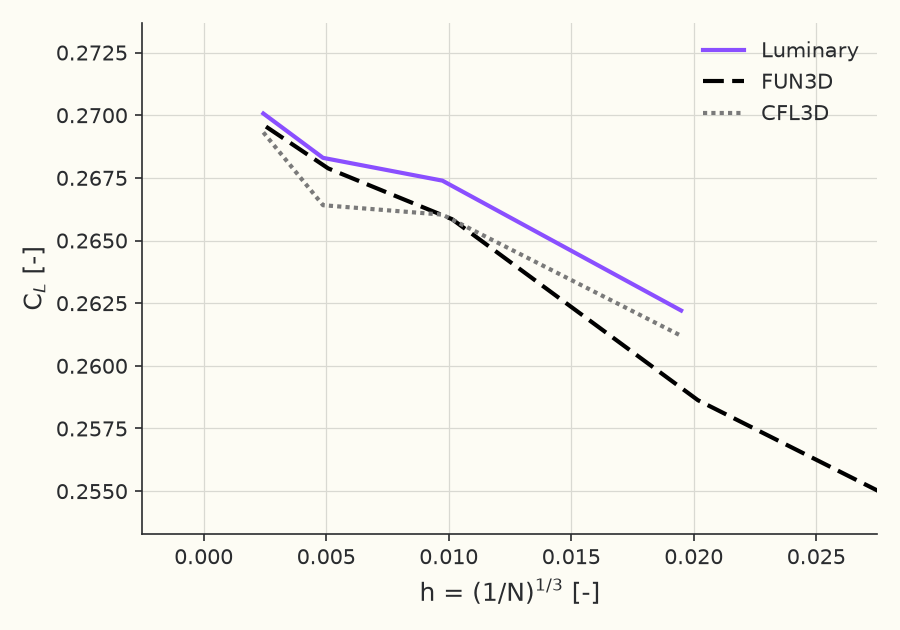
Reference: NASA Langley Turbulence Modeling Resource, "ONERA M6 Wing Verification Case" (Case 2308, SA-neg model). (CFL3D (structured) / FUN3D (prism-hex), grid convergence of the force coefficients at ): https://tmbwg.github.io/turbmodels/onerawingnumerics_val_sa.html
Grid convergence of total
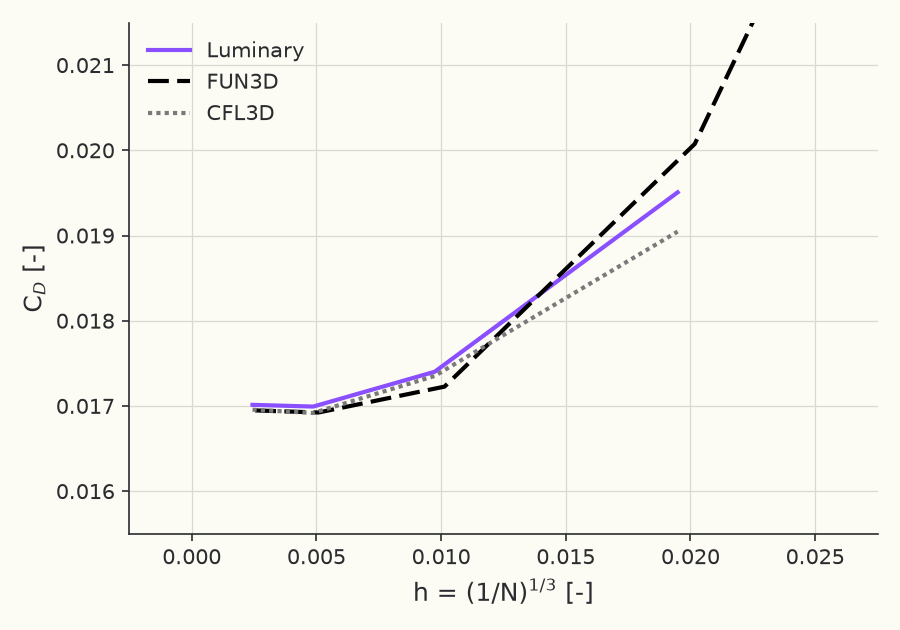
Reference: NASA Langley Turbulence Modeling Resource, "ONERA M6 Wing Verification Case" (Case 2308, SA-neg model). (CFL3D (structured) / FUN3D (prism-hex), grid convergence of the force coefficients at ): https://tmbwg.github.io/turbmodels/onerawingnumerics_val_sa.html
Grid convergence of pressure drag
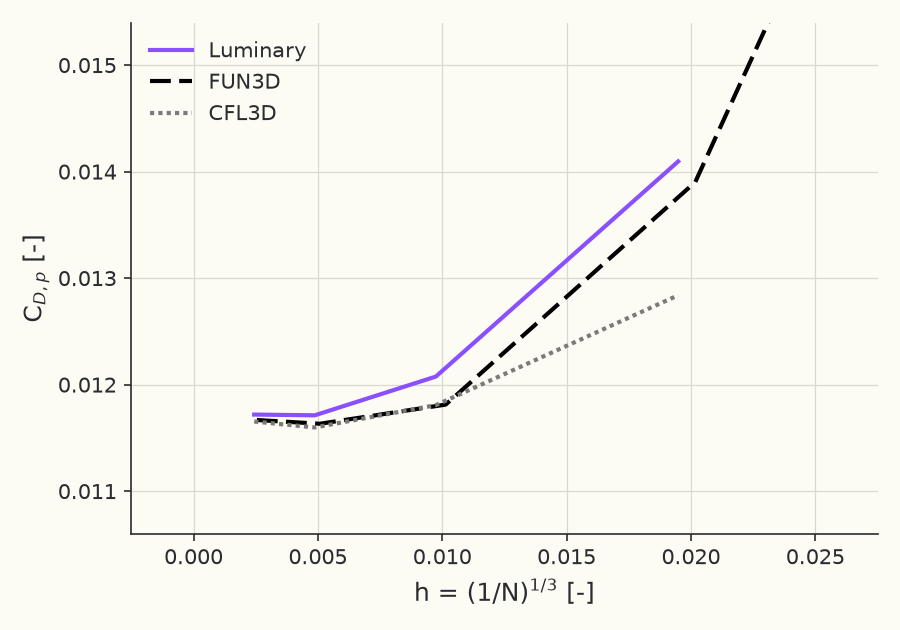
Reference: NASA Langley Turbulence Modeling Resource, "ONERA M6 Wing Verification Case" (Case 2308, SA-neg model). (CFL3D (structured) / FUN3D (prism-hex), grid convergence of the force coefficients at ): https://tmbwg.github.io/turbmodels/onerawingnumerics_val_sa.html
Grid convergence of viscous drag
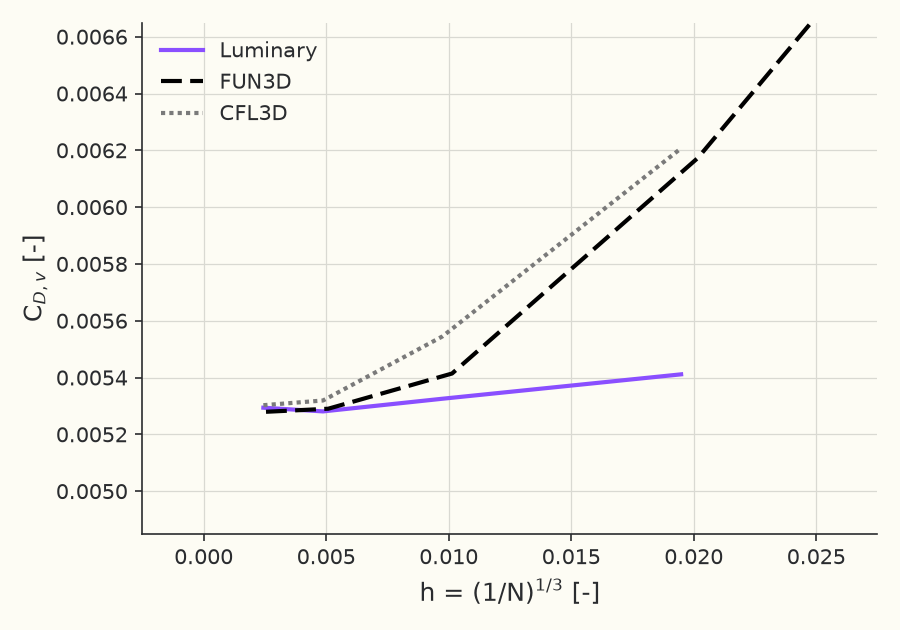
Reference: NASA Langley Turbulence Modeling Resource, "ONERA M6 Wing Verification Case" (Case 2308, SA-neg model). (CFL3D (structured) / FUN3D (prism-hex), grid convergence of the force coefficients at ): https://tmbwg.github.io/turbmodels/onerawingnumerics_val_sa.html
Surface at
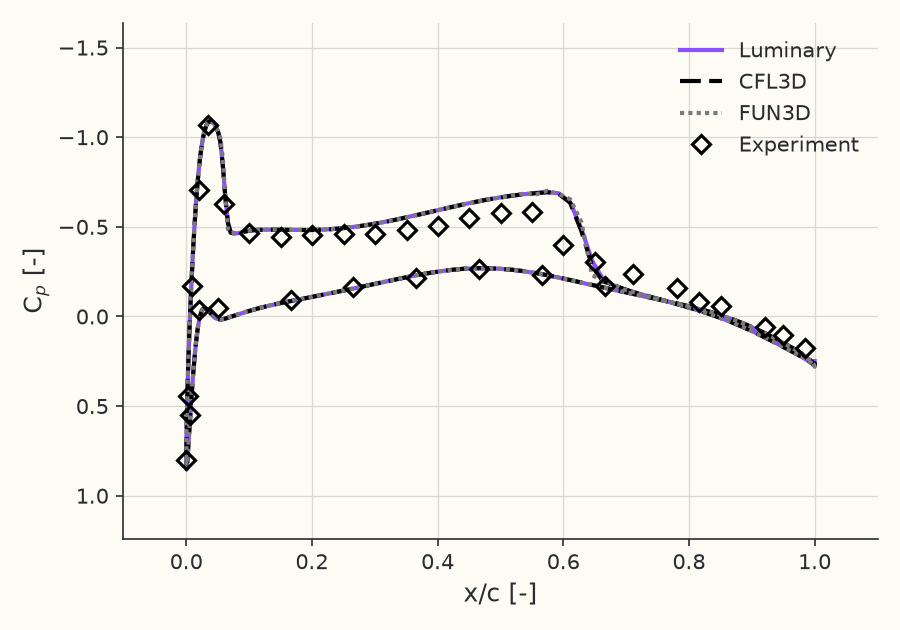
Reference: NASA Langley Turbulence Modeling Resource, "ONERA M6 Wing Verification Case" (Case 2308, SA-neg model). (CFL3D / FUN3D surface at the seven span stations (matching grid level)): https://tmbwg.github.io/turbmodels/onerawingnumerics_val_sa.html
Surface at
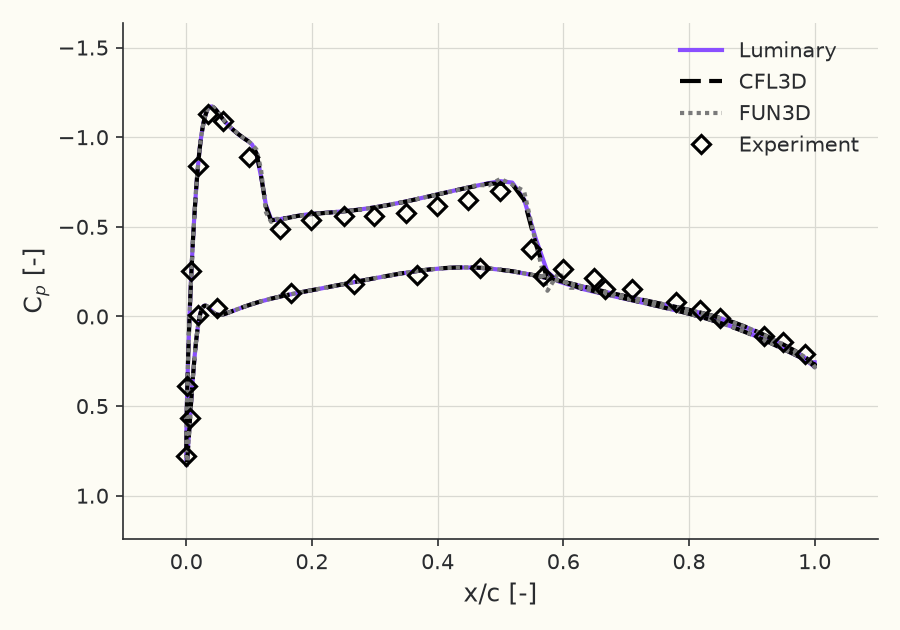
Reference: NASA Langley Turbulence Modeling Resource, "ONERA M6 Wing Verification Case" (Case 2308, SA-neg model). (CFL3D / FUN3D surface at the seven span stations (matching grid level)): https://tmbwg.github.io/turbmodels/onerawingnumerics_val_sa.html
Surface at
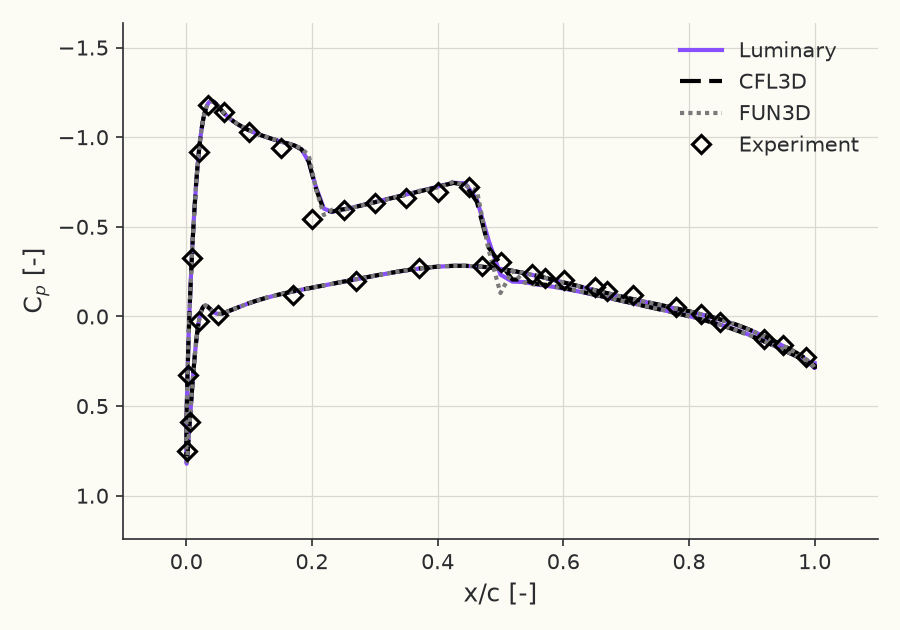
Reference: NASA Langley Turbulence Modeling Resource, "ONERA M6 Wing Verification Case" (Case 2308, SA-neg model). (CFL3D / FUN3D surface at the seven span stations (matching grid level)): https://tmbwg.github.io/turbmodels/onerawingnumerics_val_sa.html
Surface at
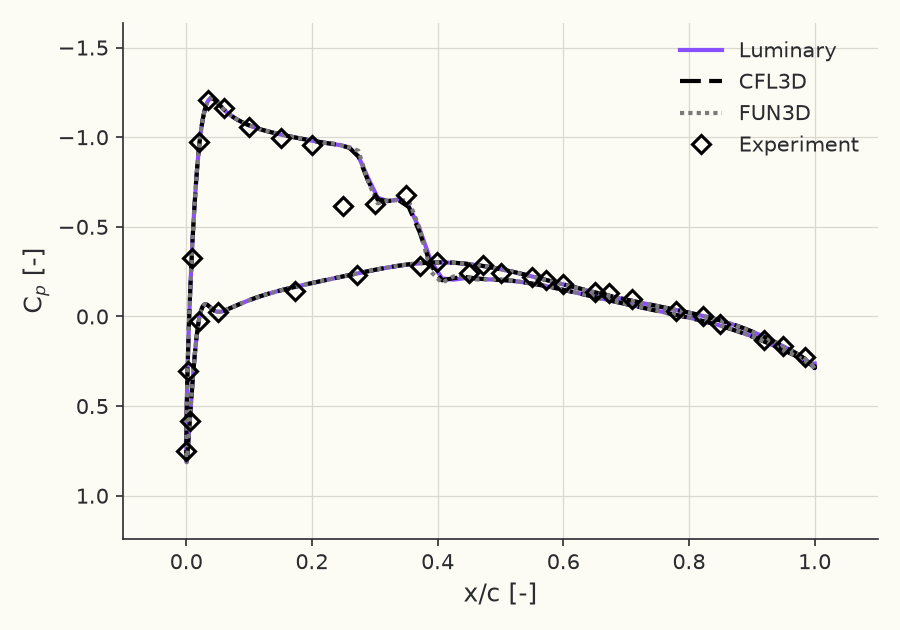
Reference: NASA Langley Turbulence Modeling Resource, "ONERA M6 Wing Verification Case" (Case 2308, SA-neg model). (CFL3D / FUN3D surface at the seven span stations (matching grid level)): https://tmbwg.github.io/turbmodels/onerawingnumerics_val_sa.html
Surface at
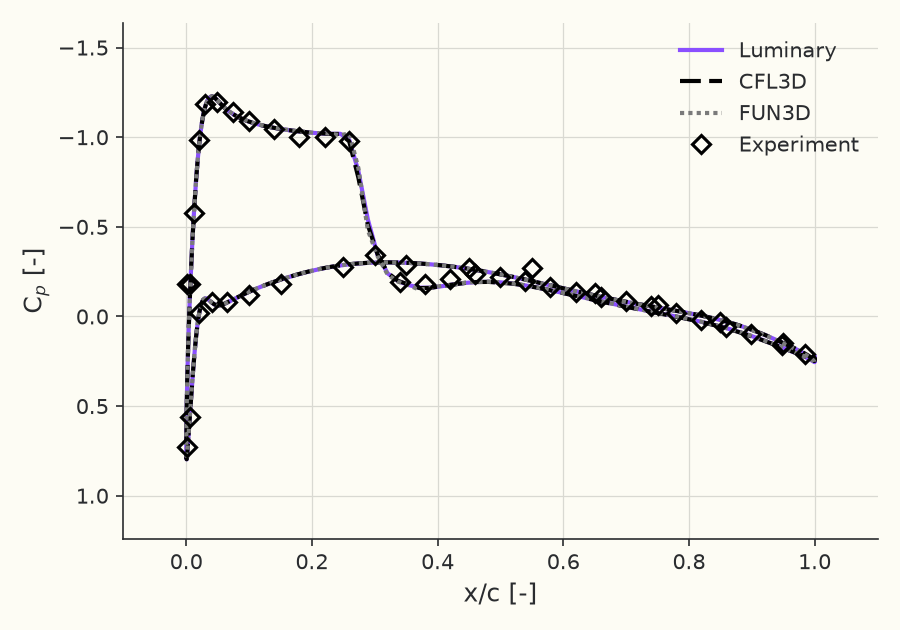
Reference: NASA Langley Turbulence Modeling Resource, "ONERA M6 Wing Verification Case" (Case 2308, SA-neg model). (CFL3D / FUN3D surface at the seven span stations (matching grid level)): https://tmbwg.github.io/turbmodels/onerawingnumerics_val_sa.html
Surface at
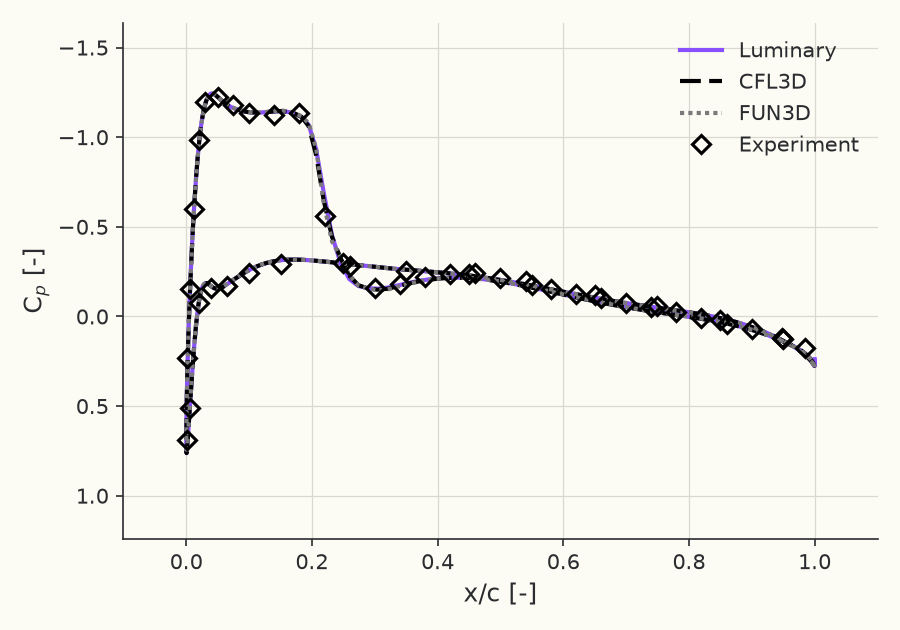
Reference: NASA Langley Turbulence Modeling Resource, "ONERA M6 Wing Verification Case" (Case 2308, SA-neg model). (CFL3D / FUN3D surface at the seven span stations (matching grid level)): https://tmbwg.github.io/turbmodels/onerawingnumerics_val_sa.html
Surface at
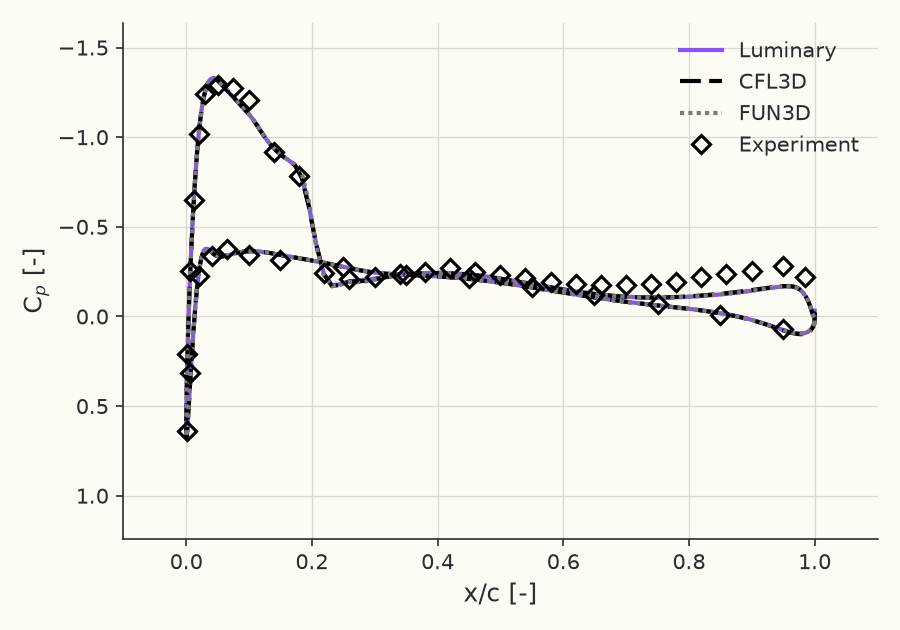
Reference: NASA Langley Turbulence Modeling Resource, "ONERA M6 Wing Verification Case" (Case 2308, SA-neg model). (CFL3D / FUN3D surface at the seven span stations (matching grid level)): https://tmbwg.github.io/turbmodels/onerawingnumerics_val_sa.html
Solver configuration
- features exercised
- VerificationValidation3DRANSSpalart–AllmarasIdeal gasSteadyEnergy equation