
2D NACA 0012 Airfoil: Validation (SA)
validation
Overview
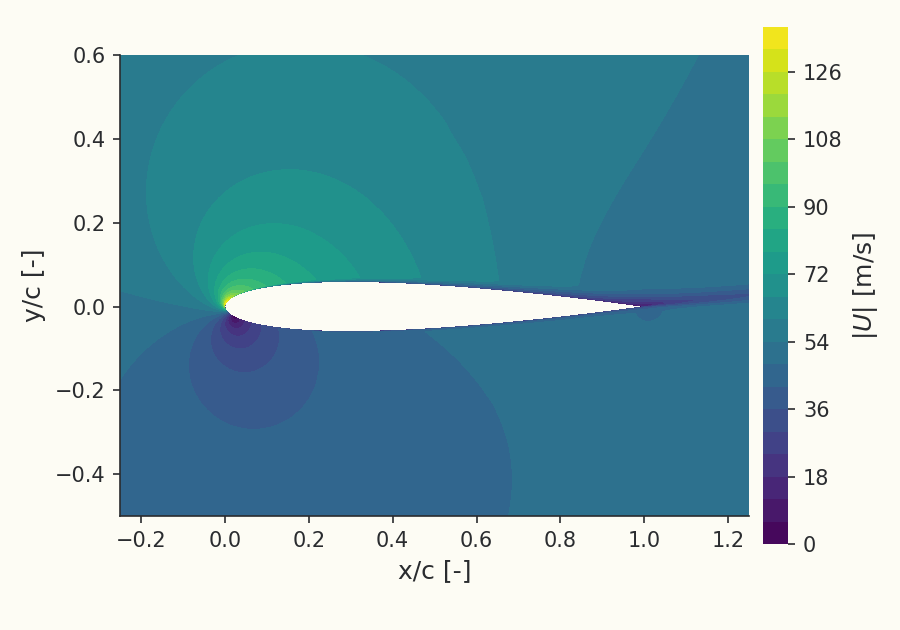
The NACA 0012 is a symmetric airfoil section whose low-speed lift, drag, and surface pressure distribution have been documented across many wind-tunnel campaigns, making it a standard validation benchmark for turbulence models. At the incidence used here the flow stays attached over most of the chord, with a leading-edge suction peak on the upper surface.
This validation case compares Luminary's Spalart–Allmaras solution against experiment as well as against reference codes: the surface pressure of Gregory & O'Reilly and the lift and drag of Ladson, with the NASA CFL3D and FUN3D reference codes shown alongside. Conditions follow the NASA Turbulence Modeling Resource validation page, , , , run on the same 897 × 257 C-grid CFL3D used, so the code-to-code comparison is grid-for-grid.
Problem Setup
The airfoil has unit chord and lies in the x–y plane at an angle of attack of ; lift and drag are recovered by projecting the integrated surface force onto the wind axes. The free stream is air at and a chord Reynolds number of . Turbulence is modeled with Spalart–Allmaras, with the far-field point-vortex correction active. Discretization is second-order with no limiter, and every run is driven to a deep residual floor.
The boundary conditions are a no-slip adiabatic wall on the airfoil and a Riemann far field on the outer C-boundary. The mesh is NASA's published Family-I structured C-grid at 897 × 257 points, converted to a quasi-2D unit-span grid; using CFL3D's own grid removes mesh resolution as a variable in the comparison. The experimental data span two facilities and Reynolds numbers: Gregory's pressure data at and Ladson's forces at ; both are shown as reported.
Quantities of Interest
The validation quantities are the surface pressure coefficient at and the integrated lift and drag coefficients. The pressure distribution is compared to the CFL3D reference and to Gregory's upper-surface measurements; the lift and drag are tabulated beside CFL3D, FUN3D, and Ladson's tripped-boundary-layer measurement, each at . The upper-surface skin-friction coefficient is shown against CFL3D as a supporting boundary-layer check.
Sources
Reference , and / from the NASA CFL3D code on the 897 × 257 grid, .
Digitized upper-surface at ().
Measured / at , , boundary-layer tripped (80-grit).
Results
Lift and drag at vs CFL3D and experiment
| Code | ||
|---|---|---|
| Luminary | 1.0907 | 0.012453 |
| CFL3D (SA) | 1.0909 | 0.012311 |
| FUN3D (SA) | 1.0983 | 0.01242 |
| Ladson (exp.) | 1.0586 | 0.01191 |
Values on the finest grid (897 × 257, \( \alpha = 10^\circ \)).
Wind-axis and at (897 × 257 grid). The Ladson measurement is the 80-grit-trip data interpolated to .
Surface pressure coefficient at
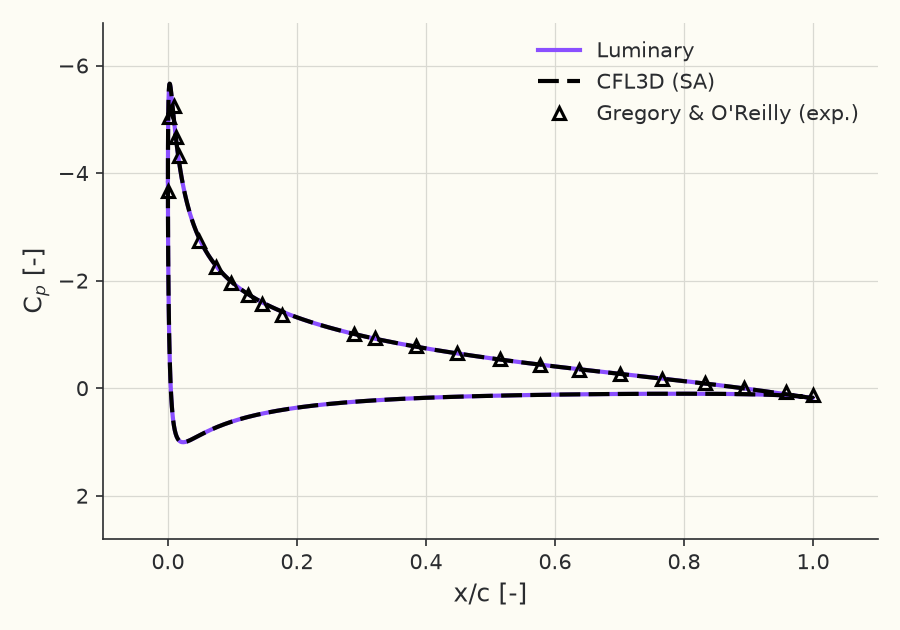
Reference: NASA Langley Turbulence Modeling Resource, "2D NACA 0012 Airfoil Validation Case" (SA model, with far-field point-vortex correction). (CFL3D (SA), surface at ): https://tmbwg.github.io/turbmodels/naca0012_val_sa.html
Skin-friction coefficient at
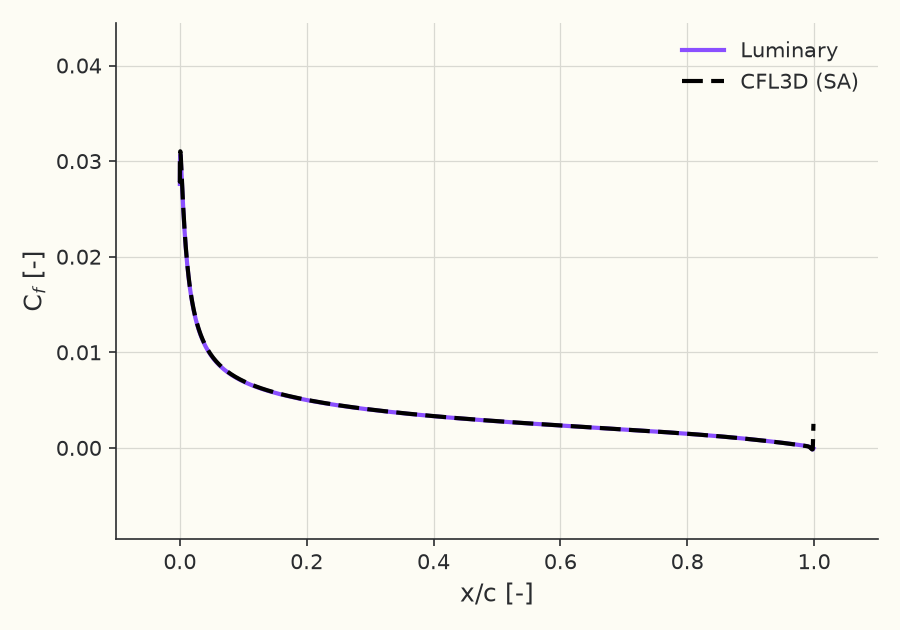
Reference: NASA Langley Turbulence Modeling Resource, "2D NACA 0012 Airfoil Validation Case" (SA model, with far-field point-vortex correction). (CFL3D (SA), upper-surface at ): https://tmbwg.github.io/turbmodels/naca0012_val_sa.html
Solver configuration
- features exercised
- VerificationValidation2DRANSSpalart–AllmarasIdeal gasSteadyEnergy equation