
Transonic NACA 0012 (Inviscid Euler)
verification
Overview
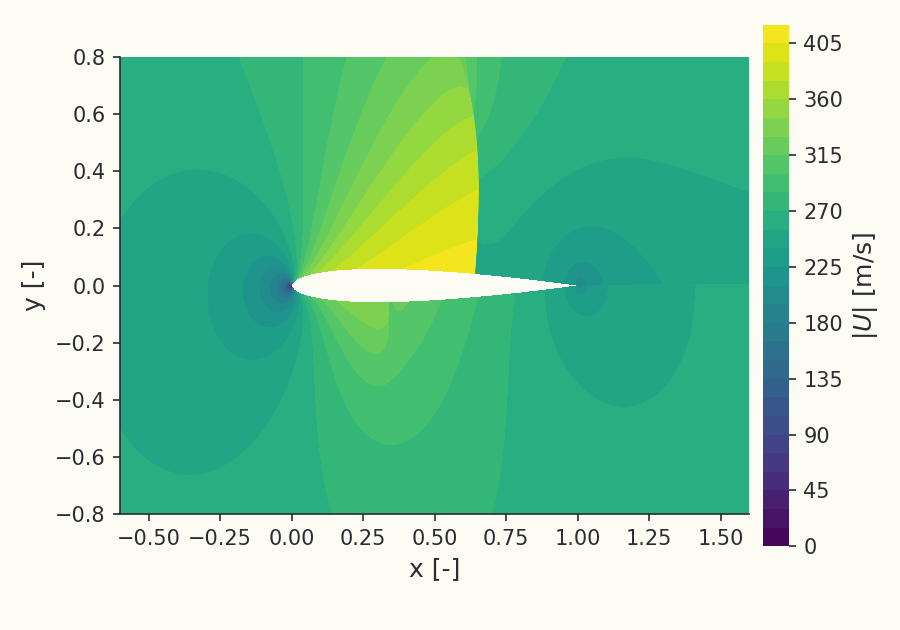
This case verifies the solver on the steady inviscid (Euler) flow over a NACA 0012 airfoil at a free-stream Mach number of and an angle of attack of . At these conditions the flow accelerates past the speed of sound over the upper surface, forming a supersonic pocket that closes through a near-normal shock. It follows the Vassberg–Jameson grid-convergence study, which used a nested family of grids to establish reference lift, drag, and pitching-moment values for the two-dimensional Euler equations.
Because the flow is inviscid, the physical drag is the wave drag of the shock; the remaining drag in any discrete solution is numerical, so the integrated coefficients are a measure of discretisation error as the mesh is refined.
Problem Setup
The airfoil follows the analytic NACA 0012 thickness equation, extended slightly in chord so that the upper and lower surfaces close into a sharp trailing edge; the reference chord used to normalise the coefficients is unity. The grids reproduce the reference recipe: a Karman–Trefftz conformal map carries the airfoil to a near-circle, and an O-mesh of unit-aspect-ratio cells is grown outward as concentric quasi-circles to a far-field boundary about 150 chords away. A nested family of these meshes is used, each level a uniform coarsening of the next finer one.
The free stream is set through a characteristic far-field boundary at inclined at ; the airfoil is a slip (inviscid) wall. The flow is modelled as an ideal gas and solved with a second-order upwind scheme. Each grid level is run to a deep steady-state residual.
Quantities of Interest
The verification quantities are the wind-axis lift coefficient , the drag coefficient , and the pitching-moment coefficient about the quarter chord. Their behaviour as the mesh is refined is compared against the reference FLO82, OVERFLOW, and CFL3D trends across the grid family, and the finest-grid values are tabulated beside each reference code on the 4096 × 4096 grid (CFL3D's finest grid for this study is 2048 × 2048). On the 4096 × 4096 grid, Luminary's lies within 0.3% to 1.6% of the three codes, its within 0.1% to 0.9%, and its within 0.4% to 2.7%. The CFL3D data shown are the flux-splitting solution without the study's optional point-vortex far-field correction, matching the characteristic far-field boundary used here; the convergence plots begin at the 256-cell grid, the coarsest mesh the reference study places in its asymptotic range. Because the transonic lifting solution contains a shock, the formal order of accuracy of each method in the reference study reduces toward first order, so the coefficients approach a value with a residual spread among the reference codes of about one percent in and two percent in .
Sources
Source of the airfoil/O-mesh construction and the FLO82, OVERFLOW and CFL3D grid-convergence and continuum , , values.
Results
Finest-grid , , vs FLO82 / OVERFLOW / CFL3D
| Source | |||
|---|---|---|---|
| Luminary (4096 × 4096) | 0.35162 | 0.022524 | 0.038003 |
| FLO82 (4096 × 4096) | 0.35714 | 0.022738 | 0.039051 |
| OVERFLOW (4096 × 4096) | 0.35252 | 0.022501 | 0.03815 |
| CFL3D (2048 × 2048) | 0.35459 | 0.022606 | 0.038761 |
All codes are reported on the 4096 × 4096 grid, except CFL3D, whose finest grid for this study is 2048 × 2048 (no 4096 × 4096 CFL3D solution was obtained).
Grid convergence of
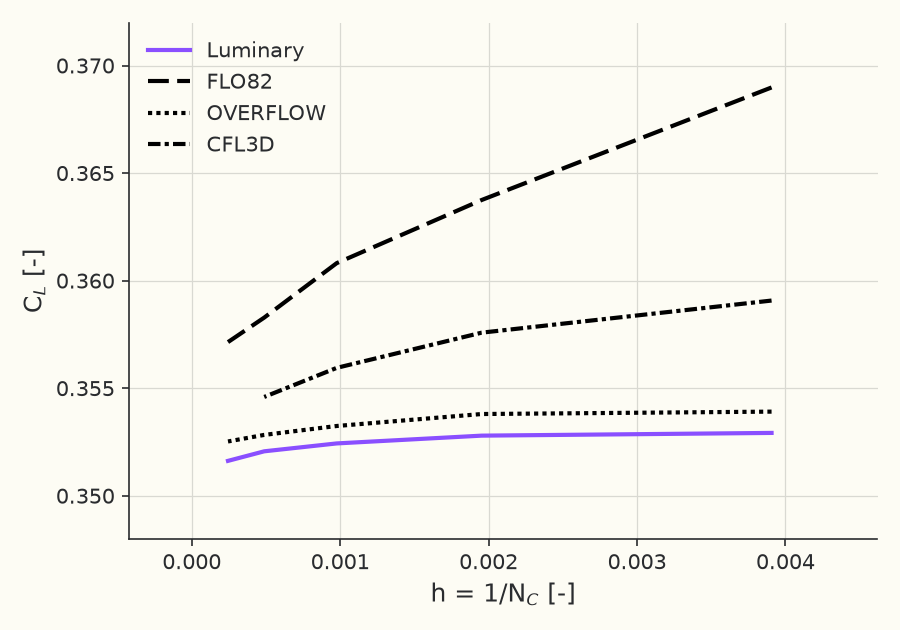
Reference: J. C. Vassberg and A. Jameson, "In Pursuit of Grid Convergence for Two-Dimensional Euler Solutions," Journal of Aircraft, 47(4):1152–1166, 2010. (FLO82 (Table 3), OVERFLOW (Table 5) and CFL3D (Table 8, no vortex correction), grid convergence of ): https://doi.org/10.2514/1.46737
Grid convergence of
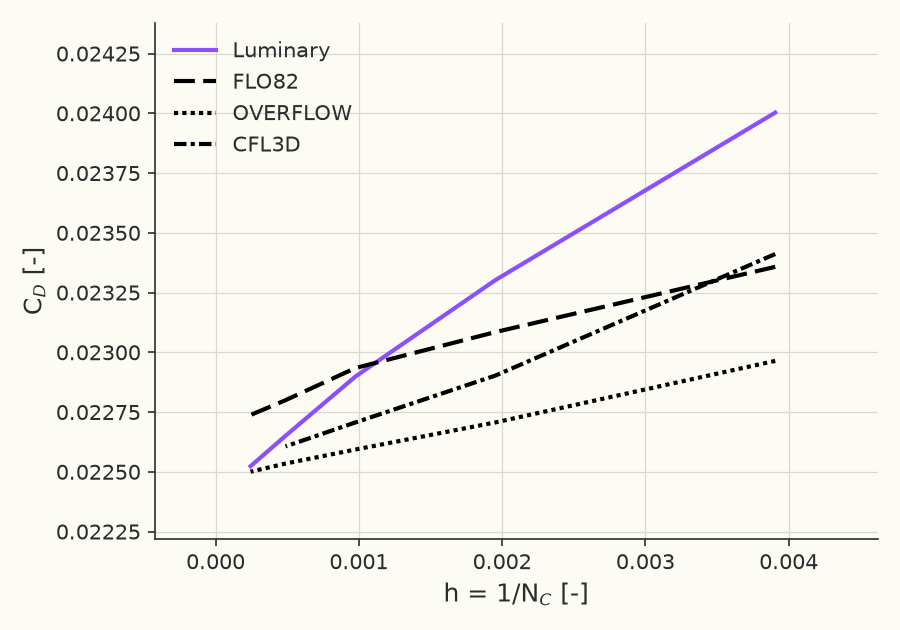
Reference: J. C. Vassberg and A. Jameson, "In Pursuit of Grid Convergence for Two-Dimensional Euler Solutions," Journal of Aircraft, 47(4):1152–1166, 2010. (FLO82 (Table 3), OVERFLOW (Table 5) and CFL3D (Table 8, no vortex correction), grid convergence of ): https://doi.org/10.2514/1.46737
Grid convergence of
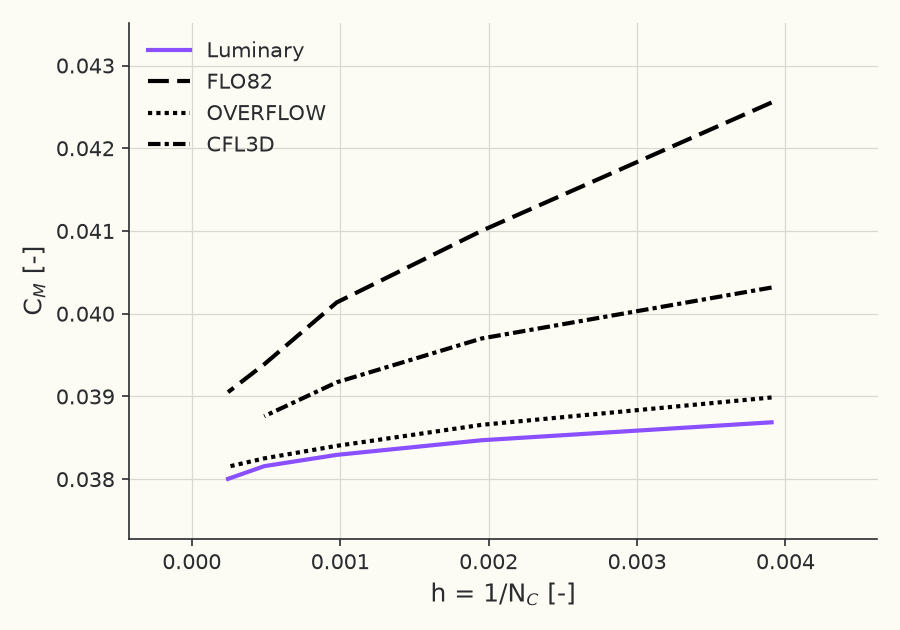
Reference: J. C. Vassberg and A. Jameson, "In Pursuit of Grid Convergence for Two-Dimensional Euler Solutions," Journal of Aircraft, 47(4):1152–1166, 2010. (FLO82 (Table 3), OVERFLOW (Table 5) and CFL3D (Table 8, no vortex correction), grid convergence of ): https://doi.org/10.2514/1.46737
Solver configuration
- features exercised
- Verification2DInviscidIdeal gasSteadyEnergy equation