
Lid-driven Cavity at Re = 1000
verification
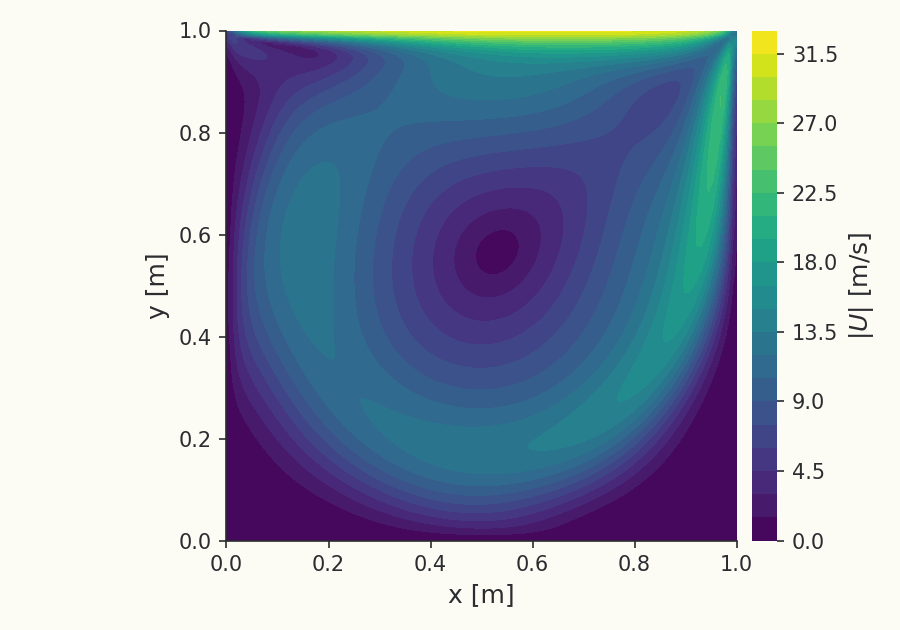
Overview
The lid-driven cavity is the standard closed-domain benchmark for incompressible Navier–Stokes solvers. Fluid is confined in a square box; the top wall translates in its own plane at a constant speed while the remaining three walls are no-slip and stationary. Viscous traction from the moving lid sets up a large primary recirculation that fills the cavity, with weaker counter-rotating eddies trapped in the lower corners. The geometry has no inflow or outflow, so the solution is governed purely by the wall boundary conditions and the Reynolds number, which makes it a clean test of a solver's treatment of viscous transport, pressure–velocity coupling and corner singularities, free of any far-field or boundary-condition ambiguity.
At the flow is steady and laminar, so the case is a verification exercise against a reference solution rather than a turbulence or transition study.
Problem Setup
The domain is a unit square with the lid (top wall) moving tangentially at constant speed . The Reynolds number is built on the cavity side length . The flow is solved as incompressible (constant density), laminar and steady, using a second-order FDS convective scheme with no limiter. The lid motion is imposed through a constant-translation reference frame attached to the top wall; the other three walls are stationary no-slip boundaries, and the spanwise faces are symmetry planes (quasi-2D).
The mesh is a 129×129 uniform Cartesian grid, the same resolution used for the reference benchmark, so the centerline profiles are compared on a like-for-like grid.
Quantities of Interest
The verification quantities are the two cavity centerline velocity profiles:
- , the horizontal velocity, sampled along the vertical centerline ;
- , the vertical velocity, sampled along the horizontal centerline .
Both are normalised by the lid speed and compared to the tabulated benchmark values of Ghia, Ghia & Shin (1982). The benchmark was published as a table of values at discrete grid stations, so it is shown as symbols (one per tabulated point) rather than a continuous line.
Sources
Benchmark centerline and velocity profiles for the lid-driven cavity (Tables I–II), .
Results
along the vertical centerline
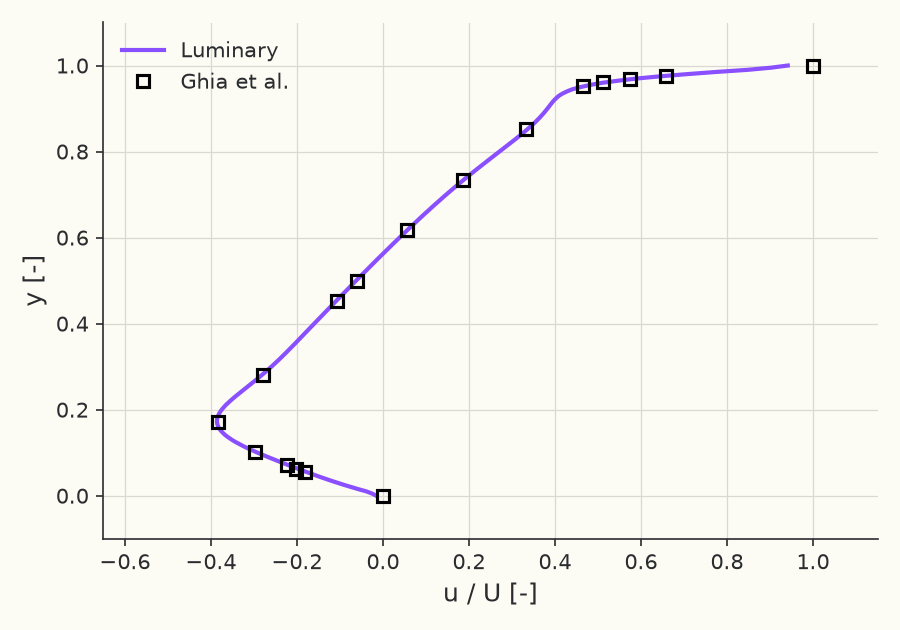
Reference: U. Ghia, K. N. Ghia and C. T. Shin, "High-Re solutions for incompressible flow using the Navier–Stokes equations and a multigrid method," J. Comput. Phys. 48(3):387–411, 1982. (Table I, ): https://doi.org/10.1016/0021-9991(82)90058-4
along the horizontal centerline
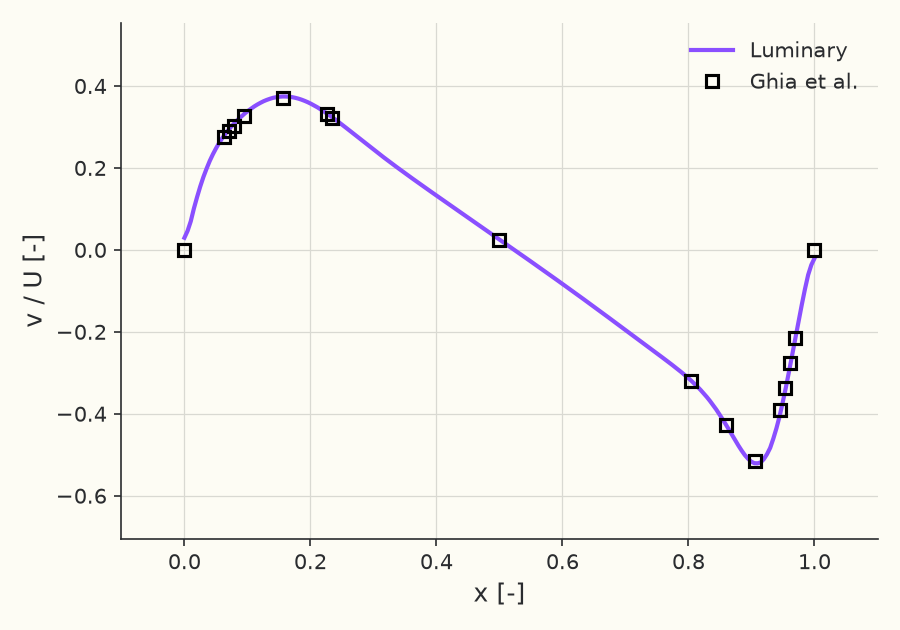
Reference: U. Ghia, K. N. Ghia and C. T. Shin, "High-Re solutions for incompressible flow using the Navier–Stokes equations and a multigrid method," J. Comput. Phys. 48(3):387–411, 1982. (Table II, ): https://doi.org/10.1016/0021-9991(82)90058-4
Solver configuration
- features exercised
- Verification2DLaminarConstant densitySteady