
Laminar Sphere at Re = 100 (Drag Coefficient)
verification
Overview
Steady, incompressible laminar flow past a smooth sphere at a diameter Reynolds number is a classic three-dimensional external-flow verification. At this Reynolds number the flow is steady and axisymmetric: the boundary layer separates near the rear of the body and forms a closed, toroidal recirculation bubble that trails it, well below the onset of wake unsteadiness. The integrated drag coefficient is a sensitive, well-characterised scalar that exercises a fully three-dimensional body-fitted mesh and the viscous, pressure, and separation physics together.
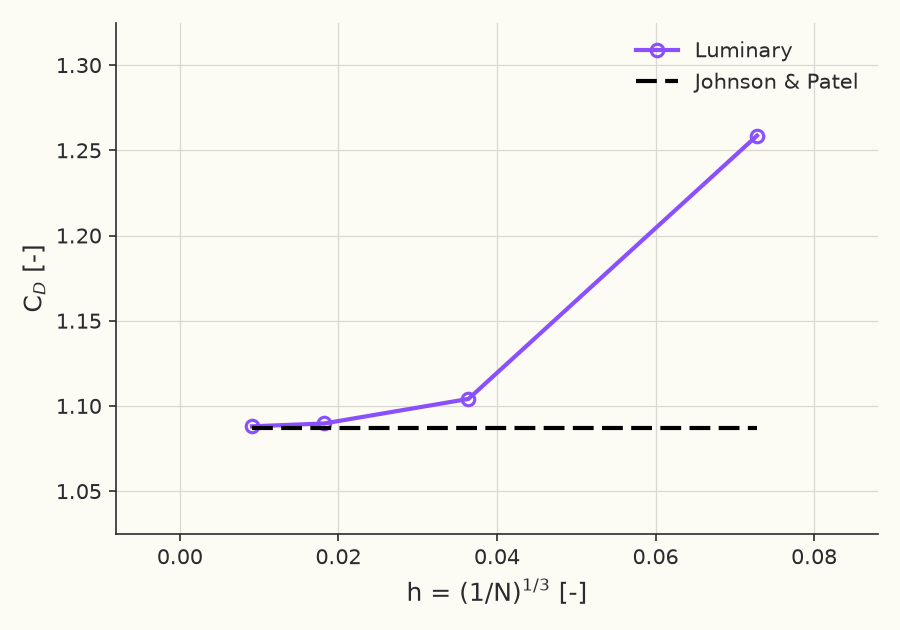
The computed total drag coefficient is compared against the high-resolution body-fitted computations of Johnson & Patel (1999), who report at . This is a code-to-code verification against an independent numerical reference rather than a laboratory measurement. The drag is computed on a family of four successively refined grids; on the finest grid , within 0.1% of the reference value.
Problem Setup
A unit-diameter sphere is centred in a spherical far-field placed sixty diameters away, far enough that the outer boundary does not influence the near-body flow or the drag. It is meshed as a fully three-dimensional structured hexahedral grid (a cubed-sphere O-grid, with no symmetry plane imposed). The grids are built procedurally: the six faces of a cube are subdivided with an equiangular spacing and wrapped onto concentric spherical shells, so the surface is resolved with near-uniform cells and without the polar singularity of a latitude–longitude mesh; the radial spacing is then graded geometrically from a fine first cell at the wall, resolving roughly thirty cells across the laminar boundary layer on the finer grids and capturing the steady recirculating near-wake, out to the far field. Four grids form a perfectly nested family with a constant refinement ratio of two (each coarser grid's vertices are a subset of the next finer one's), from a few thousand to about 1.3 million cells.
The flow is solved as incompressible laminar flow with constant density and constant viscosity, with the density and viscosity chosen so that the diameter Reynolds number is exactly . The free stream enters through a far-field boundary at which the velocity magnitude is imposed, and the sphere surface is a no-slip wall. The pressure–velocity coupling uses a Rhie–Chow flux with a Krylov-AMG linear solver and no limiter, and the solve is run to a steady-state residual target.
Quantities of Interest
The verified quantity is the total drag coefficient
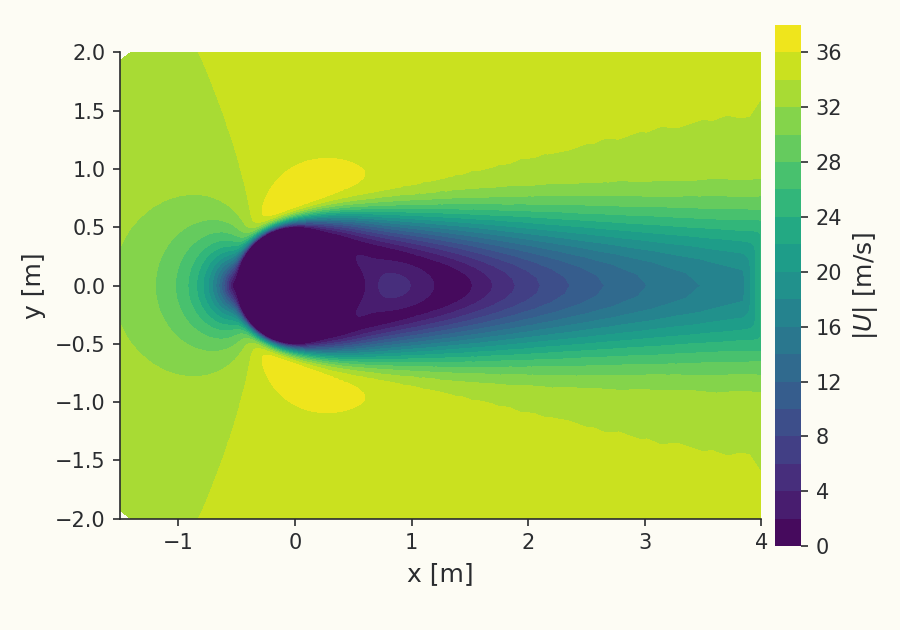
with the drag force integrated over the sphere surface (skin friction plus pressure) and normalised by the frontal area . The contour of velocity magnitude through the streamwise mid-plane shows the steady separated wake and the recirculation bubble behind the sphere.
Sources
High-resolution computations of steady and unsteady flow past a sphere; at , used as the verification reference.
Results
Drag coefficient vs Johnson & Patel (1999)
| Source | |
|---|---|
| Luminary | 1.088 |
| Johnson & Patel | 1.087 |
Total drag coefficient (friction + pressure, normalised by the frontal area ) on the finest grid.
Grid convergence of
Reference: T. A. Johnson and V. C. Patel, "Flow past a sphere up to a Reynolds number of 300," Journal of Fluid Mechanics 378, 19–70 (1999). ( at ): https://doi.org/10.1017/S0022112098003206
Solver configuration
- features exercised
- Verification3DLaminarConstant densitySteady