
Laminar Pipe Flow at Re = 500 (Hagen–Poiseuille)
verification
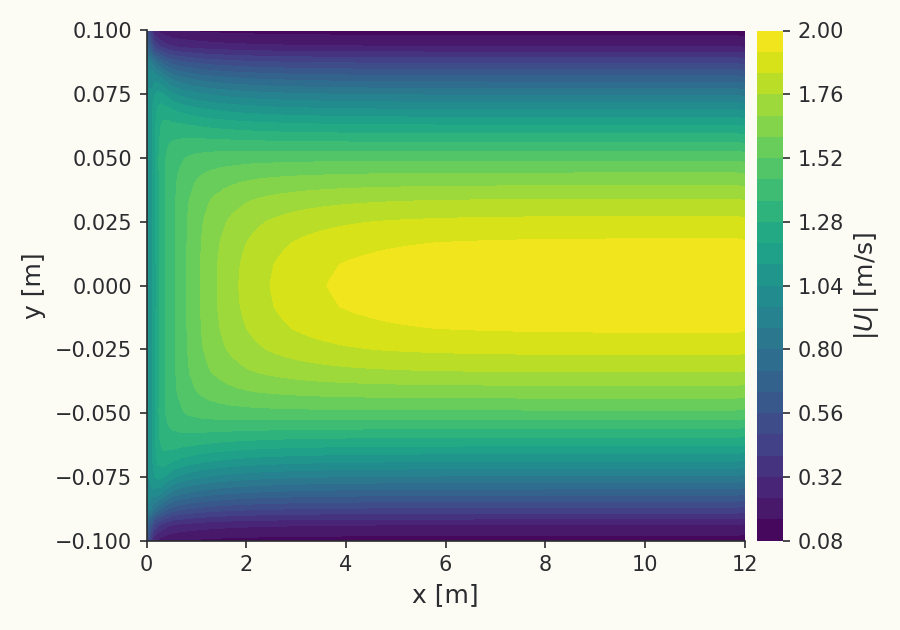
Overview
Fully-developed laminar flow in a straight circular pipe is one of the viscous flows with a closed-form exact solution, which makes it a verification of a solver's viscous and pressure-gradient terms. Far enough downstream of the entrance the velocity profile becomes parabolic and independent of streamwise position, the Hagen–Poiseuille solution, and the pressure falls linearly along the pipe at a rate fixed by the viscosity and flow rate. The case is run in three dimensions, rather than as an axisymmetric reduction, so the full 3D viscous operator is exercised. Both the developed velocity profile and the friction factor are compared against the analytic results given by White (1994).
Problem Setup
A pipe of diameter m and length m carries a constant-density fluid at a diameter Reynolds number of 500. The flow enters through a uniform velocity inlet at the mean velocity m/s, leaves through a constant-pressure outlet, and the pipe wall is a no-slip adiabatic surface. The pipe is long enough that the laminar entrance length ( m) is contained within the domain, leaving the downstream half of the pipe fully developed.
The mesh is a structured "butterfly" (O-H) cross-section, a central square block ringed by four sectors bounded by the circular wall, so there is no degenerate axis line, extruded along the pipe axis into hexahedral cells. The solution is converged to a deep residual floor so the measured profile and pressure gradient are resolved.
Quantities of Interest
Two analytic comparisons are made in the fully-developed region. First, the axial velocity profile across the pipe is compared with the Hagen–Poiseuille parabola , whose centerline value is twice the mean velocity. Second, the streamwise pressure gradient is extracted along the axis and converted to the Darcy friction factor , which for laminar pipe flow equals . At the analytic value is ; Luminary returns , within 0.4% of the analytic value.
Sources
Hagen–Poiseuille laminar pipe flow: parabolic velocity profile and friction factor.
Results
Fully-developed velocity profile
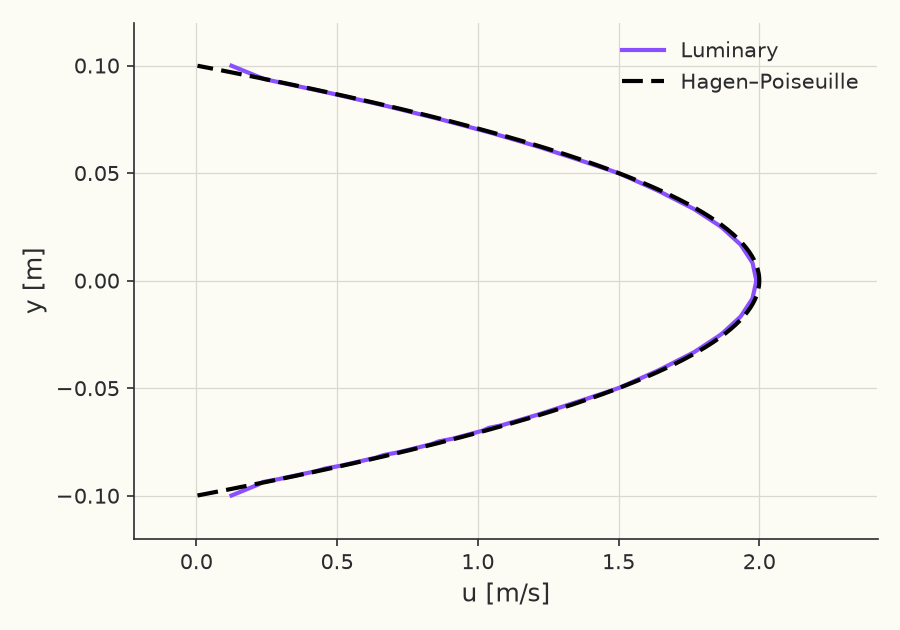
Reference: F. M. White, Fluid Mechanics, 3rd ed., McGraw-Hill, New York, 1994. (parabolic fully-developed profile): https://www.mheducation.com/
Friction factor vs
| Source | |
|---|---|
| Luminary | 0.12846 |
| Hagen–Poiseuille | 0.128 |
Darcy friction factor from the fully-developed axial pressure gradient compared with the Hagen–Poiseuille law .
Solver configuration
- features exercised
- Verification3DLaminarConstant densitySteady