
Laminar Flat Plate
verification
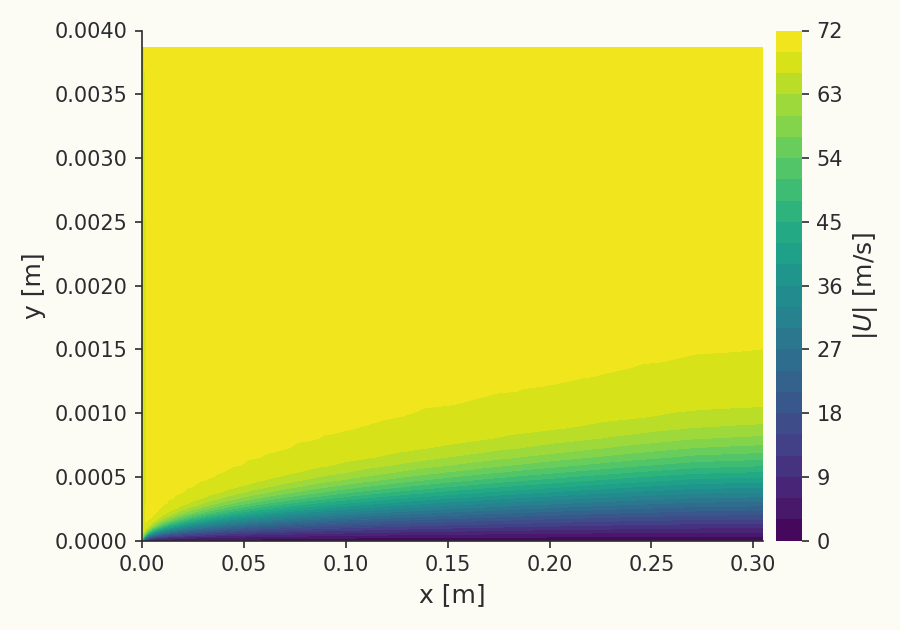
Overview
A uniform stream flows over a sharp flat plate aligned with the flow, forming a laminar boundary layer. With zero pressure gradient and constant properties, the boundary-layer equations admit the Blasius similarity solution, which provides analytic references for the skin-friction distribution, the boundary-layer growth, and, with heat transfer, the local Nusselt number. The solver result is compared against this known analytic answer.
Problem Setup
The plate is 0.3048 m long. The freestream is air at low Mach number (≈ 0.2) with velocity 69.1687 m/s and temperature 297.62 K, giving a length-based Reynolds number of about 1.3 × 10⁶, within the laminar regime over the plate. The plate is held isothermal at 197.62 K, so a thermal boundary layer ( K) develops alongside the velocity boundary layer; the energy equation is solved with one-way coupling at constant density. The leading edge sits at the origin, with a symmetry plane upstream to avoid a singular leading-edge boundary layer.
Quantities of Interest
- Velocity profile across the boundary layer at m, plotted against the Blasius similarity variable , normalised by the boundary-layer edge velocity at the station (which equals the free-stream here).
- Skin-friction coefficient compared pointwise along the plate, plus the integrated friction-drag coefficient . The computed is 0.0011639, within 0.03% of the Blasius value 0.0011642.
- Local Nusselt number from the wall heat flux, comparing the thermal boundary layer to the Blasius correlation.
These analytic curves provide references for the solver's viscous flux discretization, wall-shear-stress evaluation, and wall heat-transfer for laminar boundary layers.
Sources
Origin of the Blasius similarity solution and the , , and relations.
Results
Integrated skin-friction drag
| Source | Friction drag coefficient |
|---|---|
| Luminary | 0.0011639 |
| Blasius | 0.0011642 |
Reference: Blasius solution (Schlichting & Gersten, 2000)
Laminar velocity profile
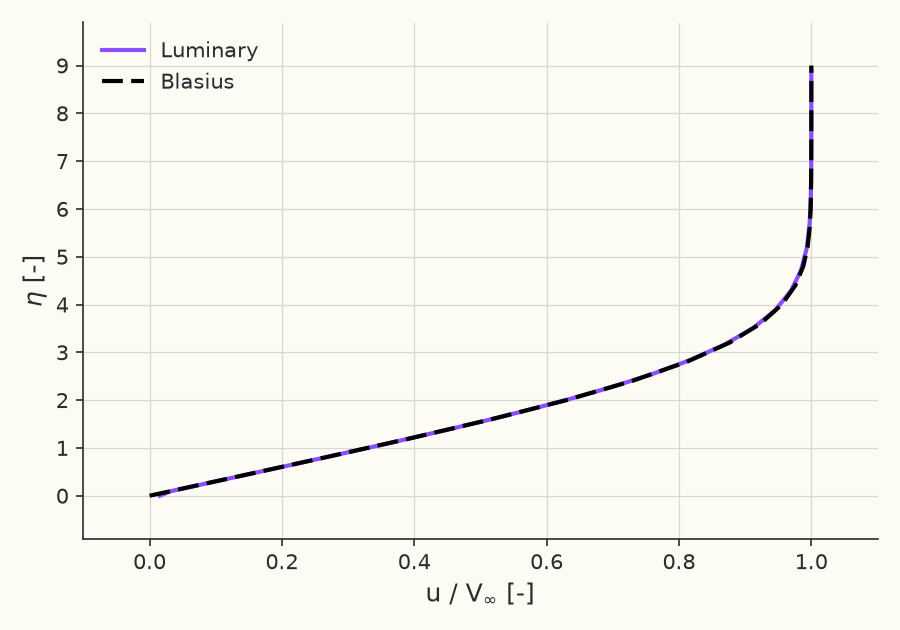
Reference: Blasius solution (Schlichting & Gersten, 2000)
Skin-friction coefficient
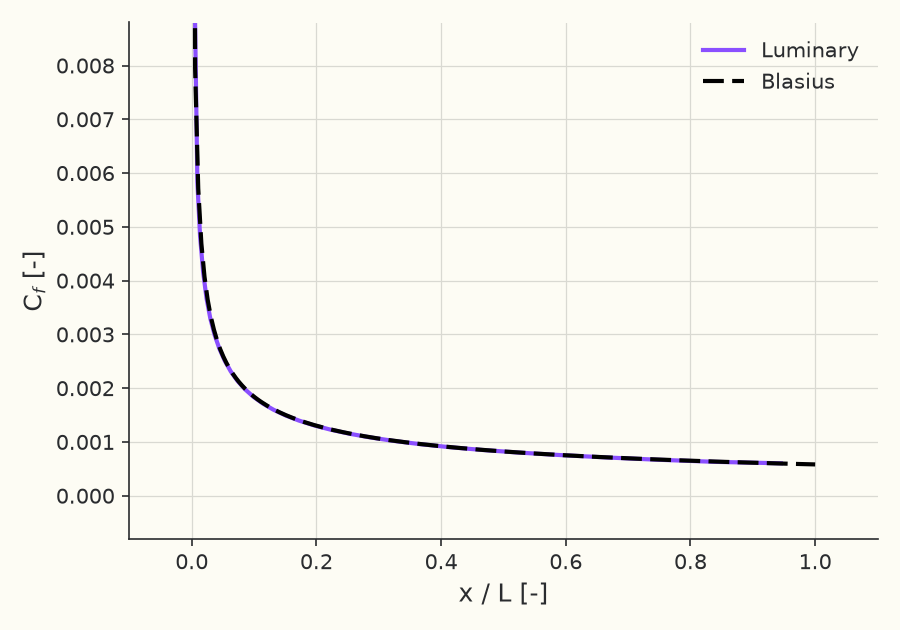
Reference: Blasius solution (Schlichting & Gersten, 2000)
Local Nusselt number
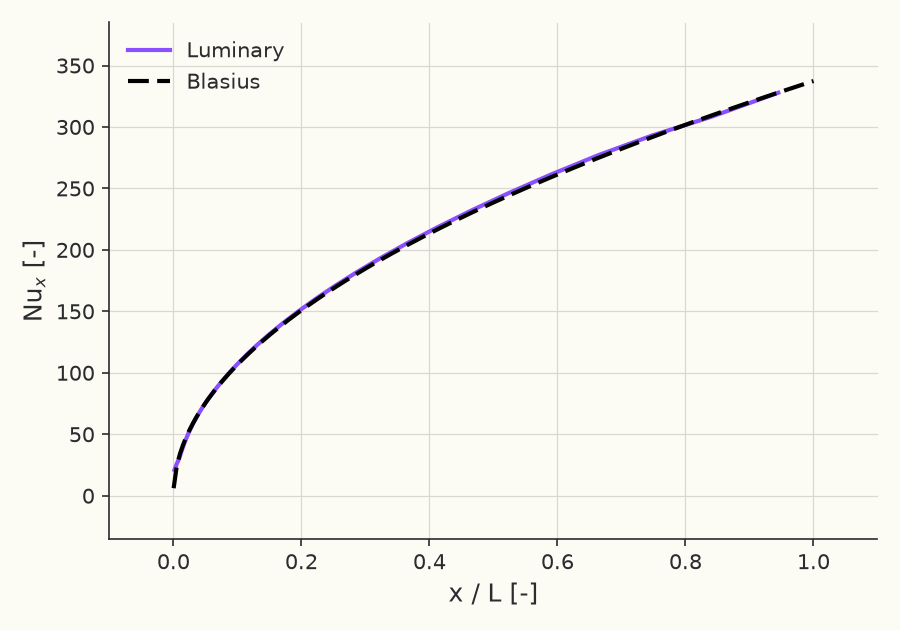
Reference: Blasius solution (Schlichting & Gersten, 2000)
Solver configuration
- features exercised
- Verification2DLaminarConstant densitySteadyEnergy equation