
Laminar Circular Cylinder at Re = 100: FW-H Against Literature
validation
Animation of the divergence of the velocity (the dilatation) on a plane through the cylinder, which shows the sound radiated by the vortex shedding, with isosurfaces of the vortical structures in the wake.
Overview
A circular cylinder in a laminar cross-flow sheds an alternating vortex street whose surface-pressure fluctuations radiate a tone at the shedding frequency. This case predicts the far-field sound of a Reynolds-number-100, Mach-0.15 cylinder with the Ffowcs Williams-Hawkings analogy, evaluated on the cylinder wall and on a closed permeable surface in the same flow solution, and compares the angular distribution of the shedding tone with a published reference.
Problem Setup
The flow is laminar with ( m/s, K, Pa) and a constant dynamic viscosity chosen so that for a cylinder of diameter . The O-grid is one diameter deep and periodic in the spanwise direction, and a sponge layer that absorbs the outgoing sound starts at and is thick. Time integration is second-order implicit with s.
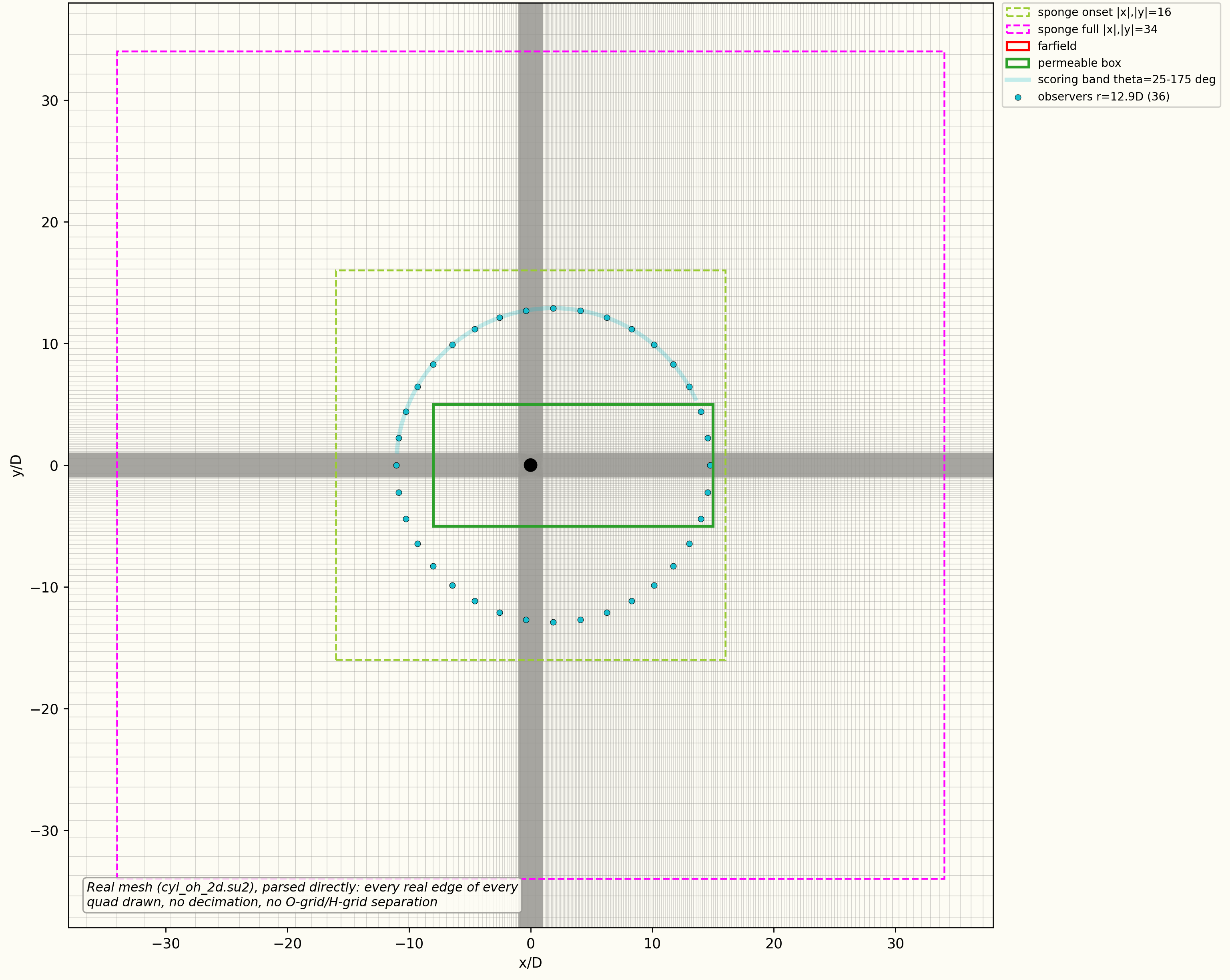
The Ffowcs Williams-Hawkings analogy is evaluated on the cylinder wall and on a permeable box spanning and , open on its spanwise faces. Both integrals are repeated over 50 copies of the span to represent a long cylinder. The acoustic pressure is recorded at 36 observers spaced apart on an arc of radius about , at mid-span.
Quantities of Interest
The frequency of the shedding tone, and its level around the observer arc from both integration surfaces, normalized by its maximum between and and compared with the reference curve, with the RMS difference between the two over that arc.
Sources
Results
Mesh and domain
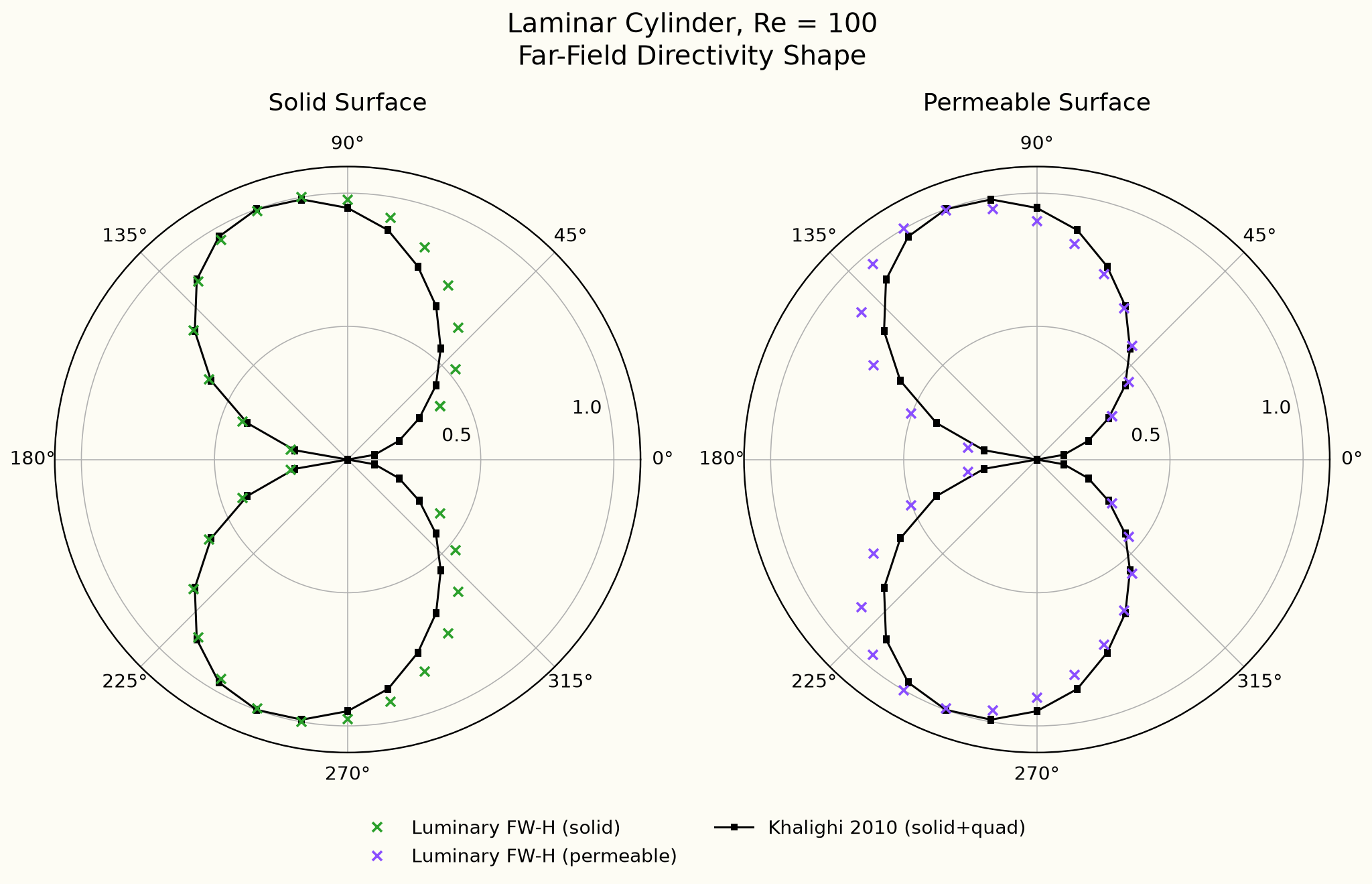
Far-field directivity of the shedding tone
Reference: Y. Khalighi, A. Mani, F. Ham and P. Moin, “Prediction of Sound Generated by Complex Flows at Low Mach Numbers,” AIAA Journal 48(2), 306–316 (2010). (digitized far-field directivity of the laminar cylinder), https://doi.org/10.2514/1.42583
Directivity: difference from the reference curve
| FW-H surface | Shedding tone (Hz) | RMS difference from the reference curve (dB) |
|---|---|---|
| Solid | 8.1946 | 0.9304 |
| Permeable | 8.329 | 0.98396 |
Shedding-tone frequency and the RMS difference between the normalized directivity levels and the reference curve over the same arc.
Reference: Y. Khalighi, A. Mani, F. Ham and P. Moin, “Prediction of Sound Generated by Complex Flows at Low Mach Numbers,” AIAA Journal 48(2), 306–316 (2010). (digitized far-field directivity of the laminar cylinder), https://doi.org/10.2514/1.42583
Discussion
At this low Reynolds number the wake is a regular street of vortices that leave the top and the bottom of the cylinder in turn. Each one pushes the cylinder sideways, so the cylinder radiates a single clean tone, here at Hz from the cylinder-wall surface and Hz from the permeable surface. The sound has a dipole pattern: loud above and below the cylinder, quiet along the flow direction. In the directivity plot that shows up as two lobes, one up and one down.
The plot compares the shape of this pattern, with each curve divided by its own maximum between and . Both Ffowcs Williams-Hawkings (FW-H) surfaces reproduce the reference: the two lobes, their width, and the quiet directions along the flow axis. Over the scored arc the root-mean-square difference from the reference is dB for the cylinder wall and dB for the permeable surface, about 11% in pressure amplitude.
Solver configuration
- features exercised
- Verification2DLaminarIdeal gasUnsteadyEnergy equationFW-H (solid / permeable surface)