3D Hemisphere Cylinder
verification
Overview
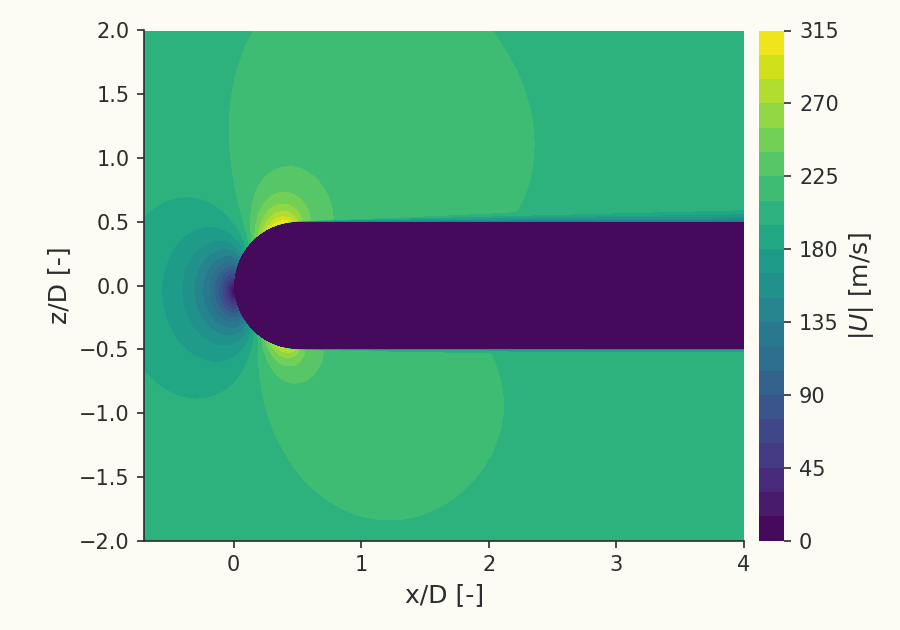
The hemisphere cylinder, a cylindrical body capped by a hemispherical nose, is a canonical three-dimensional verification geometry. At angle of attack it develops a fully three-dimensional boundary layer that wraps from the windward to the leeward side, making it a test of how a turbulence model and solver predict three-dimensional skin friction and the resulting forces. This case reproduces the NASA Turbulence Modeling Resource grid-convergence verification at an incidence of (lifting but still attached), so the lift, drag and pitching-moment build-up are all checked.
With no analytic solution, verification here means showing that the solver's Spalart–Allmaras (SA) result converges, under systematic grid refinement, toward the same lift and drag as the NASA reference codes CFL3D (structured) and FUN3D (prism/hex) run on the same body. The reference data use the negative-SA variant; for this attached flow it is mathematically equivalent to the standard SA model, so the comparison is direct.
Problem Setup
The flow is compressible (ideal-gas air, Sutherland viscosity) at free-stream Mach number and Reynolds number based on the cylinder diameter , at an angle of attack . The body is a hemisphere of radius faired into a cylinder of total length . Turbulence is modeled with Spalart–Allmaras using the verification inflow value , with a second-order, low-dissipation discretization and no limiter.
The boundary conditions are a Riemann far-field (outer radius ), an adiabatic no-slip wall on the body, and a symmetry plane at , the body is solved as a half-domain, with the incidence applied in the x–z plane so the flow remains symmetric. The grids are generated by NASA's own hemisphere-cylinder grid generator at the published structured cell counts (19,200, 153,600, 1,228,800, 9,830,400 and 78,643,200 cells, refined by successive doubling in each direction), so the comparison to the CFL3D structured family is grid-for-grid. Forces are referenced to the half-body side-projected area .
Quantities of Interest
The verification quantities are the lift coefficient , the drag coefficient and the pitching-moment coefficient (taken about the nose), each shown converging under grid refinement toward the CFL3D and FUN3D references, plotted against the grid-spacing measure . Drag is split into its pressure () and viscous () components; on this slender, attached body the viscous part dominates. A finest-grid table reports the Luminary coefficients numerically beside the two reference codes on the matching grid. On the finest solved grid (78,643,200 cells, the same grid as CFL3D's finest structured level), the Luminary viscous drag is within 0.19% of CFL3D and within 0.13% of FUN3D, and the lift is within 0.36% of CFL3D and within 0.27% of FUN3D.
Sources
Reference , , , and grid-convergence data from the NASA CFL3D (structured) and FUN3D (prism/hex) codes at .
Results
Finest-grid coefficients vs CFL3D / FUN3D at
| Code | (total) | (pressure) | (viscous) | ||
|---|---|---|---|---|---|
| Luminary | 0.014881 | 0.01218 | 0.0015753 | 0.010605 | -0.0022029 |
| CFL3D | 0.014935 | 0.012202 | 0.0016174 | 0.010585 | -0.0022418 |
| FUN3D | 0.014841 | 0.012249 | 0.0016571 | 0.010591 | -0.0021552 |
Values on the finest grid (78,643,200 cells).
Compared at the same grid level: Luminary on its finest grid (78,643,200 cells); CFL3D and FUN3D at the nearest grid in their own families (CFL3D's structured family and FUN3D's prism/hex family share this refinement). The reference families extend to ≈78.6M cells, shown in the grid-convergence figures.
Reference: NASA Langley Turbulence Modeling Resource, "3D Hemisphere Cylinder Verification Case" (SA-neg model).: https://tmbwg.github.io/turbmodels/hc3dnumericspart2_val_sa.html
Grid convergence of at
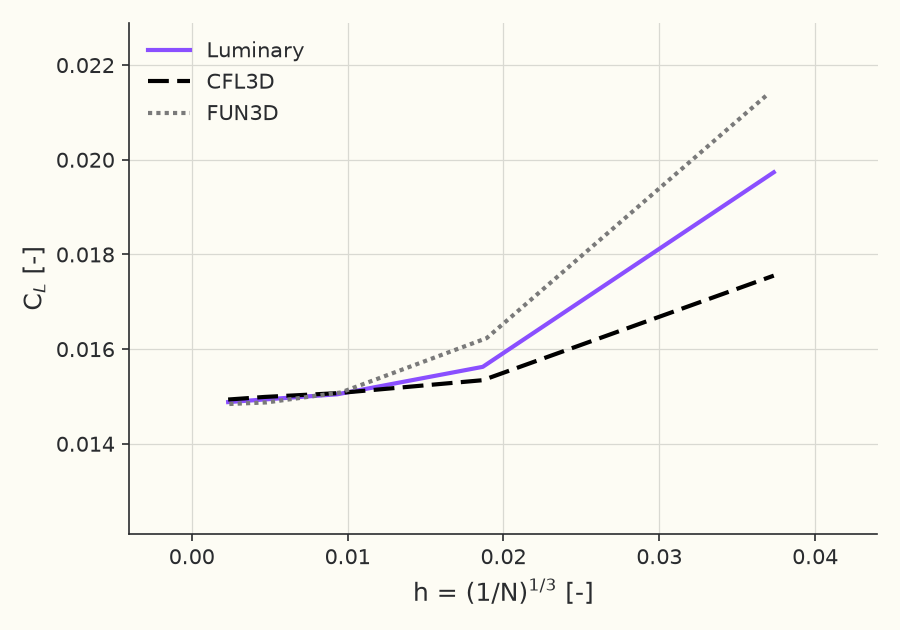
Reference: NASA Langley Turbulence Modeling Resource, "3D Hemisphere Cylinder Verification Case" (SA-neg model). (CFL3D (structured) / FUN3D (prism/hex), grid convergence of the force and moment coefficients at and ): https://tmbwg.github.io/turbmodels/hc3dnumericspart2_val_sa.html
Grid convergence of total at
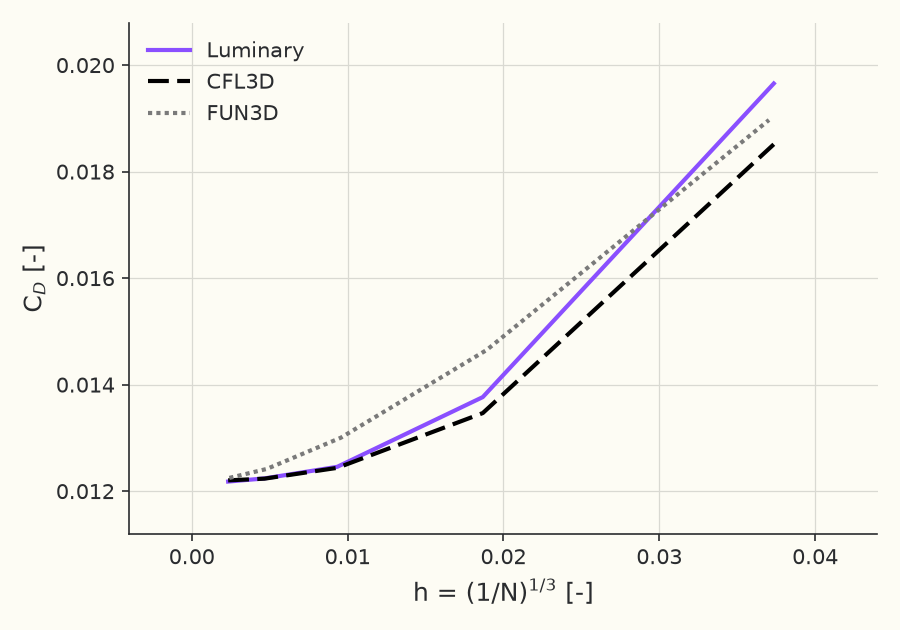
Reference: NASA Langley Turbulence Modeling Resource, "3D Hemisphere Cylinder Verification Case" (SA-neg model). (CFL3D (structured) / FUN3D (prism/hex), grid convergence of the force and moment coefficients at and ): https://tmbwg.github.io/turbmodels/hc3dnumericspart2_val_sa.html
Grid convergence of pressure drag at
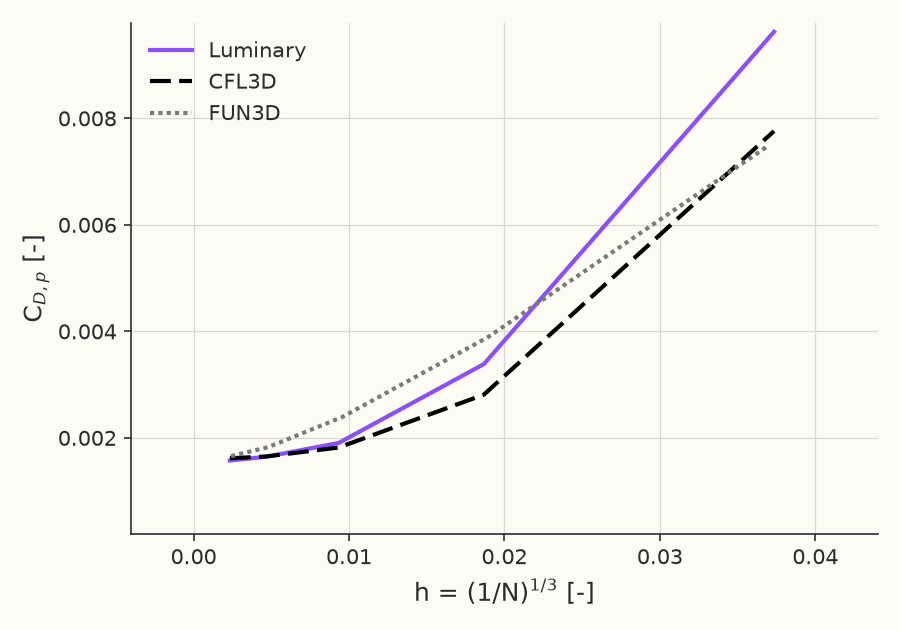
Reference: NASA Langley Turbulence Modeling Resource, "3D Hemisphere Cylinder Verification Case" (SA-neg model). (CFL3D (structured) / FUN3D (prism/hex), grid convergence of the force and moment coefficients at and ): https://tmbwg.github.io/turbmodels/hc3dnumericspart2_val_sa.html
Grid convergence of viscous drag at
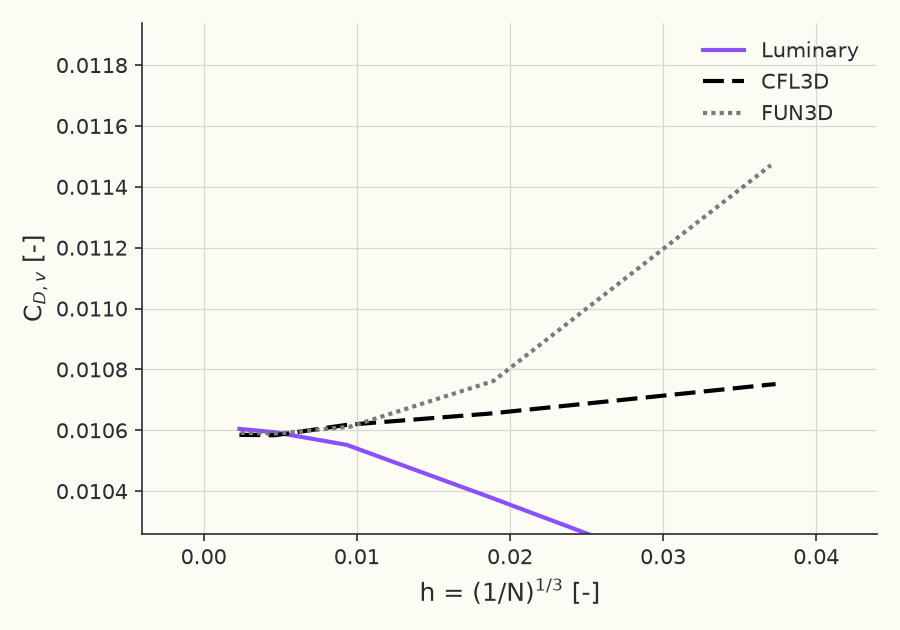
Reference: NASA Langley Turbulence Modeling Resource, "3D Hemisphere Cylinder Verification Case" (SA-neg model). (CFL3D (structured) / FUN3D (prism/hex), grid convergence of the force and moment coefficients at and ): https://tmbwg.github.io/turbmodels/hc3dnumericspart2_val_sa.html
Grid convergence of pitching moment at
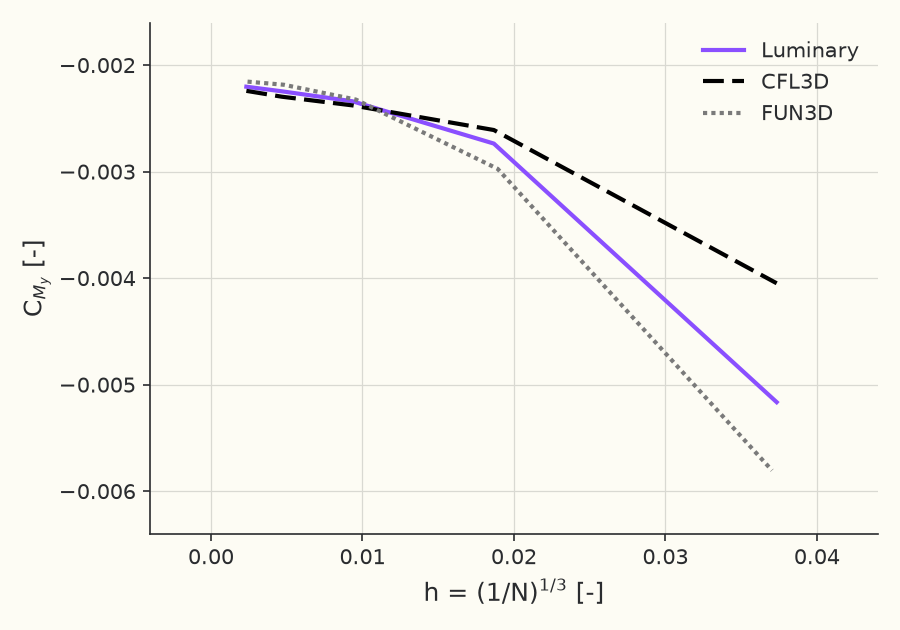
Reference: NASA Langley Turbulence Modeling Resource, "3D Hemisphere Cylinder Verification Case" (SA-neg model). (CFL3D (structured) / FUN3D (prism/hex), grid convergence of the force and moment coefficients at and ): https://tmbwg.github.io/turbmodels/hc3dnumericspart2_val_sa.html
Solver configuration
- features exercised
- Verification3DRANSSpalart–AllmarasIdeal gasSteadyEnergy equation