
Flow over a Heated Plate
verification
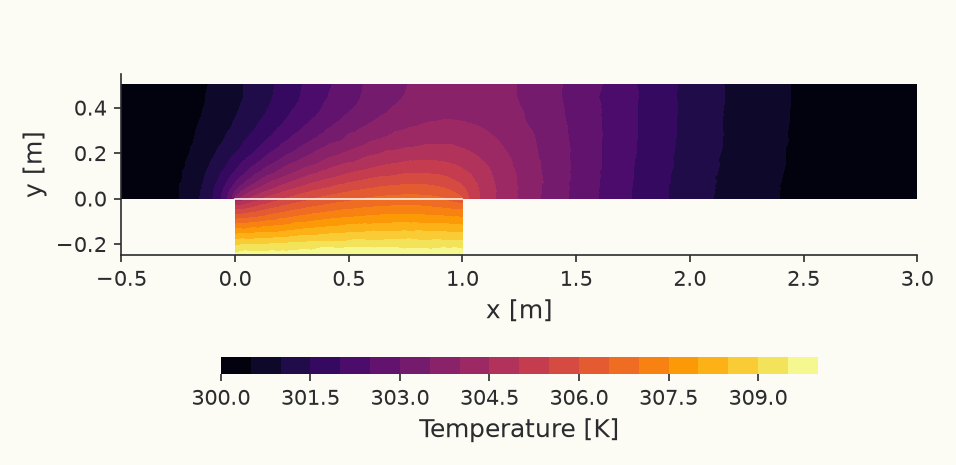
Temperature in the fluid and solid regions on the mid-span plane at the final simulated time.
Overview
This case examines transient conjugate heat transfer between a laminar fluid flow and a heated solid plate. The temperature solution is compared with the OpenFOAM–FEniCS result reported by Rodenberg et al.
Problem Setup
A fluid enters the channel at and . The fluid and solid thermal conductivities are . The bottom solid boundary is maintained at , and the remaining external solid boundary is adiabatic. The transient solution uses and advances to .
Quantities of Interest
Temperature is sampled along the line from to at and compared with the published OpenFOAM–FEniCS values.
Sources
Section 3.1 presents the conjugate-heat-transfer example coupling an OpenFOAM fluid solution to a FEniCS solid heat-conduction solution.
Results
Temperature along the sampling line at
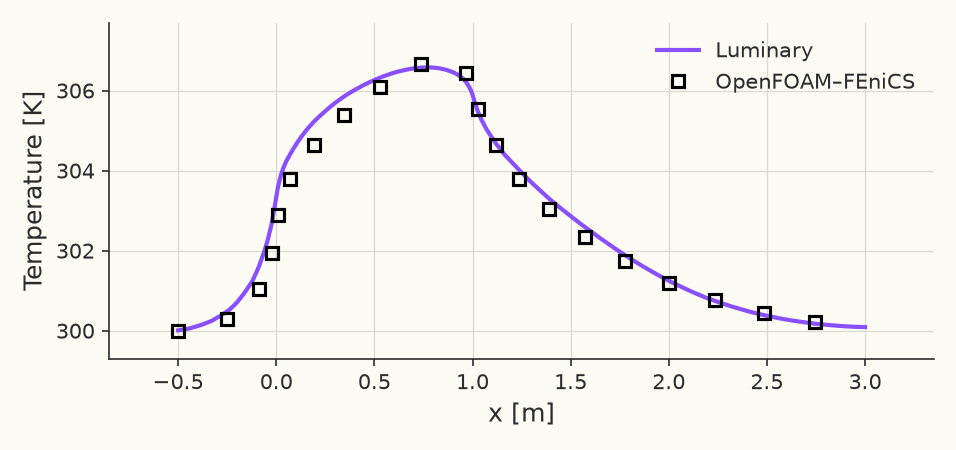
Reference: B. Rodenberg, I. Desai, R. Hertrich, A. Jaust, and B. Uekermann, "FEniCS–preCICE: Coupling FEniCS to other simulation software," SoftwareX 16 (2021) 100807. (Fig. 8(c), OpenFOAM–FEniCS temperature comparison), https://www.sciencedirect.com/science/article/pii/S2352711021001072
Solver configuration
- features exercised
- Verification3DLaminarConstant densityUnsteadyEnergy equationConjugate heat transfer