
Heated Laminar Pipe (Constant Wall Heat Flux)
verification
Overview
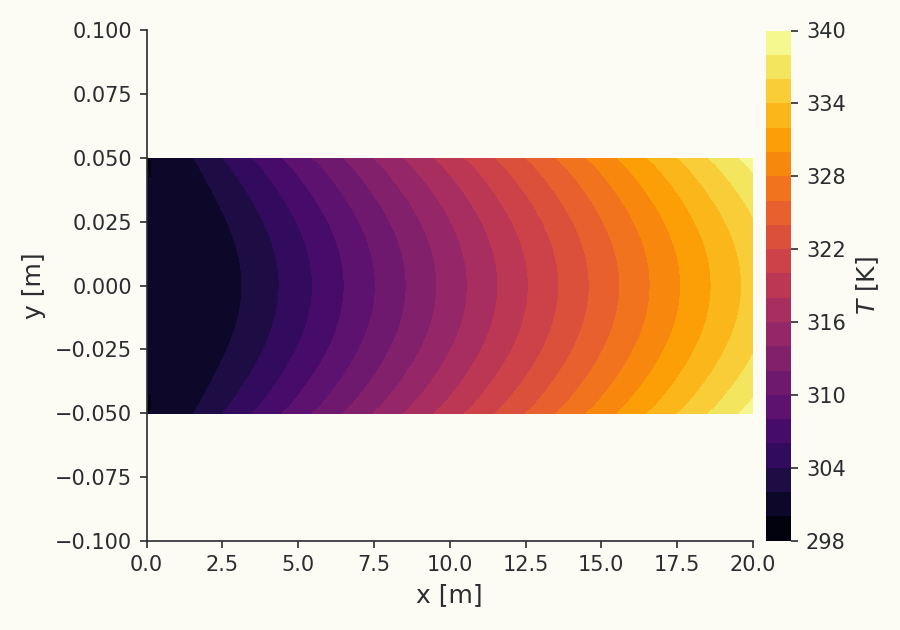
This case verifies the solver's convective heat-transfer prediction for the textbook problem of fully-developed laminar flow in a circular pipe with a uniform wall heat flux. When both the velocity and temperature fields are fully developed, the Nusselt number reaches the exact analytic value , a constant that is independent of the Reynolds number and Prandtl number . Reproducing this dimensionless number, and the way the local Nusselt number decays from the thermal entrance toward it, exercises the coupled momentum and energy solution for an incompressible, constant-property fluid.
Problem Setup
The geometry and flow are those of the companion Hagen–Poiseuille case: a straight circular pipe of diameter m and length m, with a uniform inlet velocity giving . The fluid is incompressible (constant density) with the energy equation active, a Prandtl number , and constant properties. The wall is a no-slip boundary carrying a uniform heat flux into the fluid; the inlet temperature is uniform and the outlet is a static-pressure boundary.
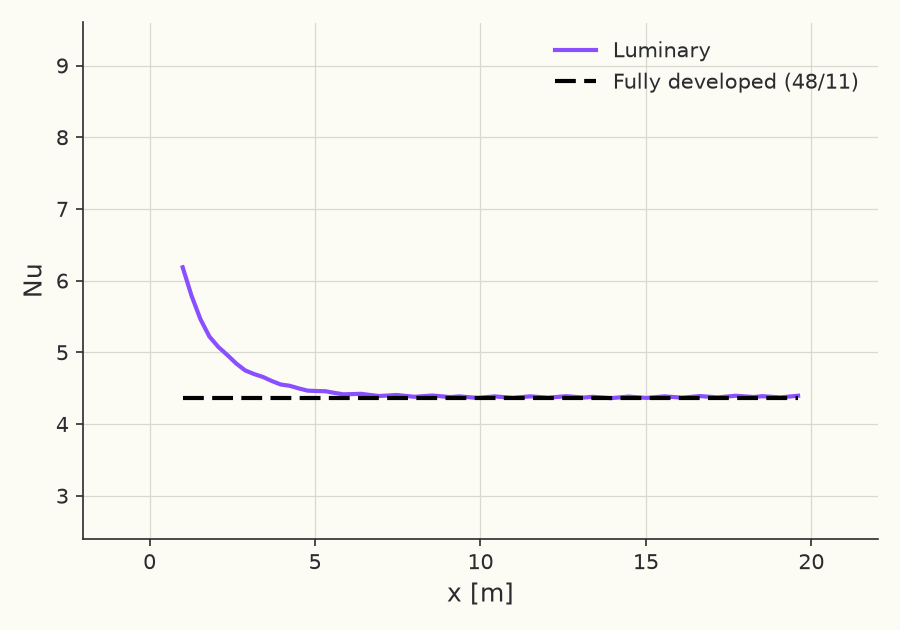
With and the thermal entrance length is m, so the flow is both hydrodynamically and thermally fully developed over the downstream portion of the pipe, where the Nusselt number is sampled.
Quantities of Interest
The primary quantity is the Nusselt number , where the convective coefficient is formed from the imposed wall heat flux , the local wall temperature , and the mass-flux-weighted bulk (mixing-cup) temperature across the cross-section. The local is high in the thermal entrance region and relaxes onto the fully-developed plateau; the developed-region value, averaged over m on the finest grid, is , within 0.34% of the exact .
Sources
Fully-developed laminar pipe flow with uniform wall heat flux: , independent of and .
Constant-heat-flux Nusselt number for fully-developed laminar pipe flow.
Results
Local Nusselt number
Reference: T. L. Bergman, A. S. Lavine, F. P. Incropera, D. P. DeWitt, Fundamentals of Heat and Mass Transfer, 7th ed., Wiley, 2011. ( (uniform wall heat flux)): https://books.google.com/books/about/Fundamentals_of_Heat_and_Mass_Transfer_7.html?id=5cgbAAAAQBAJ
Fully-developed Nusselt number vs
| Source | |
|---|---|
| Luminary | 4.3783 |
| Fully developed (48/11) | 4.3636 |
Nusselt number averaged over the fully-developed region ( m) on the finest grid, compared with the exact constant-heat-flux value .
Solver configuration
- features exercised
- Verification3DLaminarConstant densitySteadyEnergy equation