
Generic Truck Utility (GTU): DDES
Flagship benchmark showcase
Overview
The Generic Truck Utility (GTU) is an open, realistic generic pickup-truck and SUV model introduced by Ford to give the automotive-aerodynamics community a shared, non-proprietary geometry for trucks and SUVs, in the same spirit as the DrivAer model for passenger cars. The full-scale model is modular, supporting many part configurations.
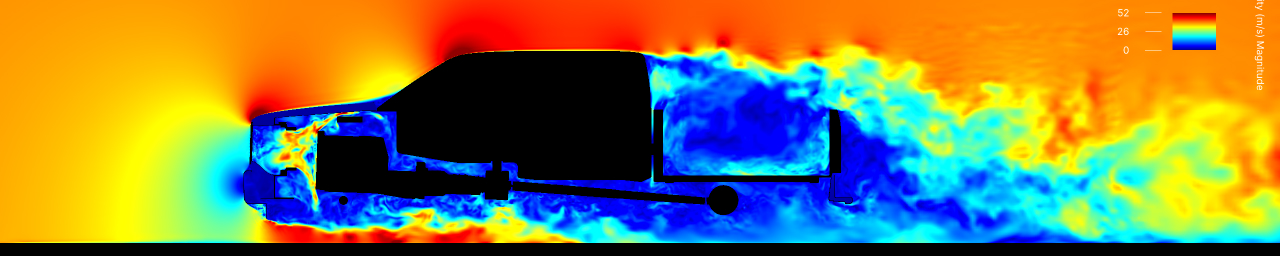
This is a flagship benchmark. Luminary computed the GTU with a Delayed Detached Eddy Simulation (DDES), a hybrid RANS-LES, scale-resolving transient simulation of the full vehicle. The results reproduced here are taken from Luminary's own summary and are not recomputed in this repository. The emphasis is the accuracy of geometry-induced force deltas: how the drag and lift change when individual parts are removed from the baseline, compared against both the Ford experiment and Ford CFD.
Problem Setup
The geometry is the GTU in the 4x2 baseline configuration plus two part-removal variants: side mirrors removed, and the chin spoiler (front airdam) removed. The flow uses the ideal-gas coupled solver with Sutherland's-law viscosity, a second-order spatial discretization with no limiters, and a BDF2 implicit time integration at ; the run advances 20,000 steps with statistics collected from iteration 2,000.
Turbulence is treated with Spalart-Allmaras DDES. The formulation adds a shear-layer-adapted length scale with a vortex-tilting measure for grey-area mitigation, a shielding function to protect attached boundary layers from premature switching, and a blended centered/upwind convective scheme to limit dissipation in the LES regions. The mesh is a 122-million-cell SnappyHexMesh grid with distance-based refinement and mirrored wake refinement boxes, 5 boundary-layer layers at an expansion ratio of 1.2, and a target on the body surfaces, which carry wall functions. Boundary conditions are a far-field inlet and a pressure outlet, slip walls upstream and on the ceiling and side walls, five translating wind-tunnel belts with rotating wheels, and a no-slip floor near and downstream of the body.
Quantities of Interest
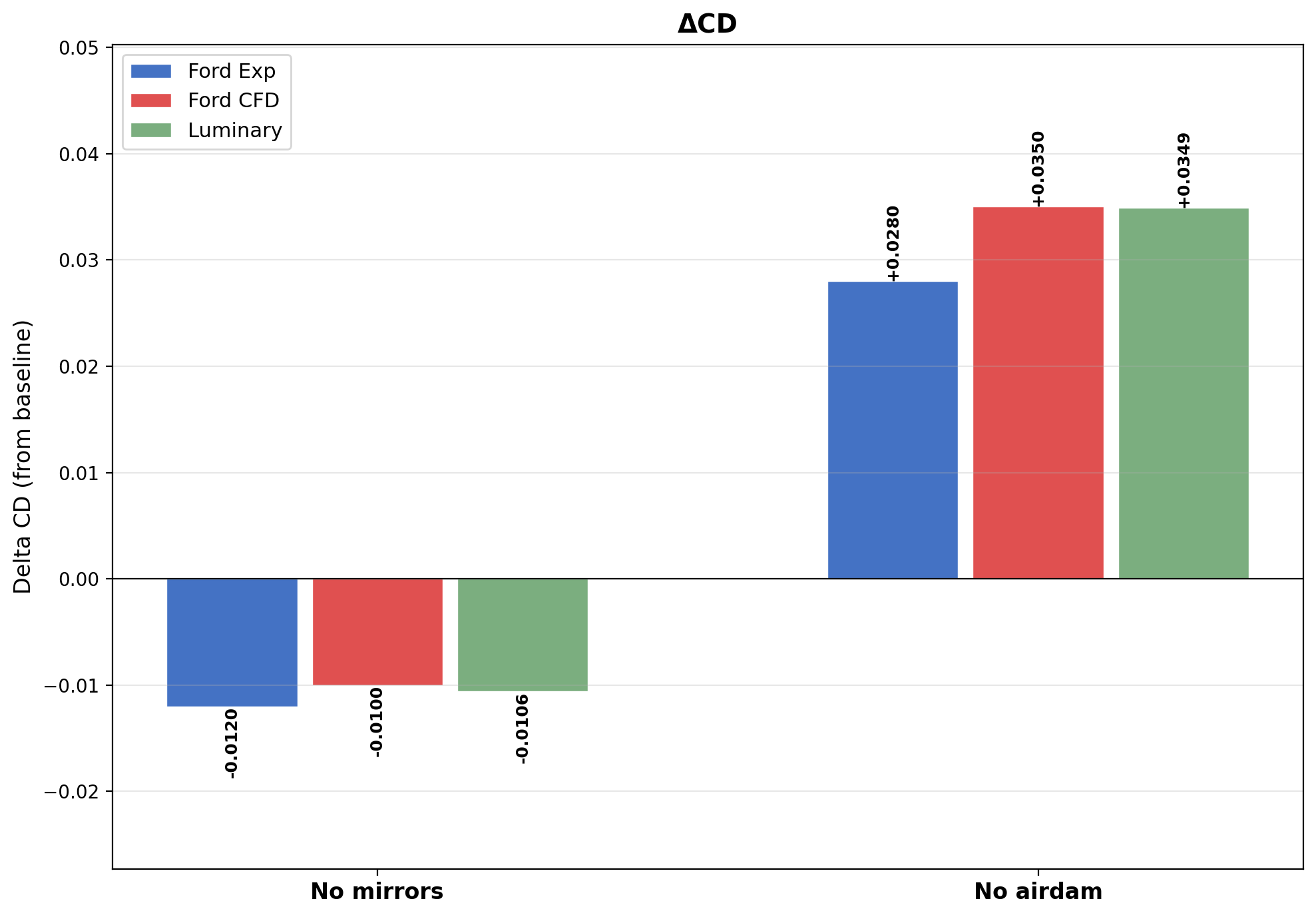
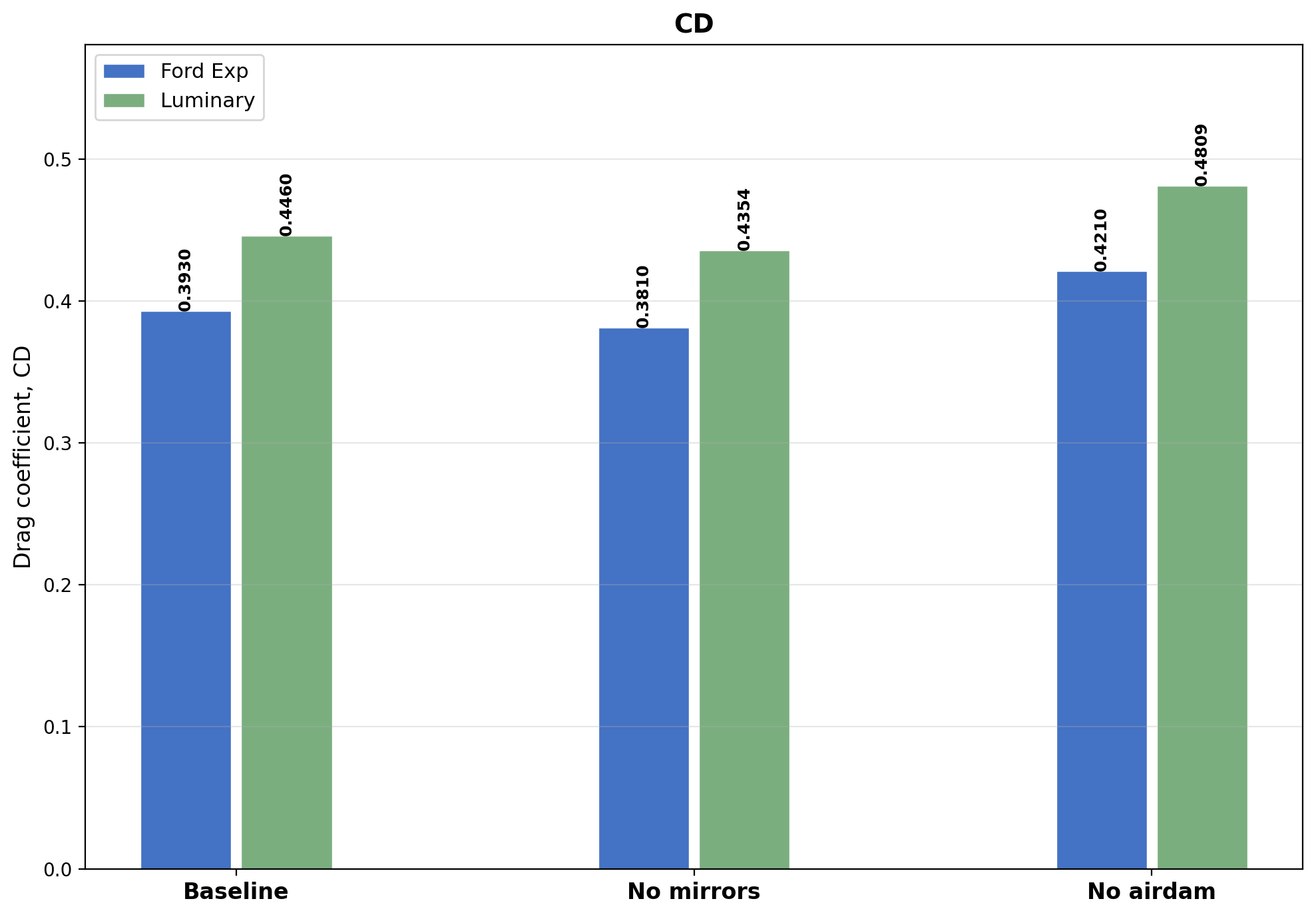
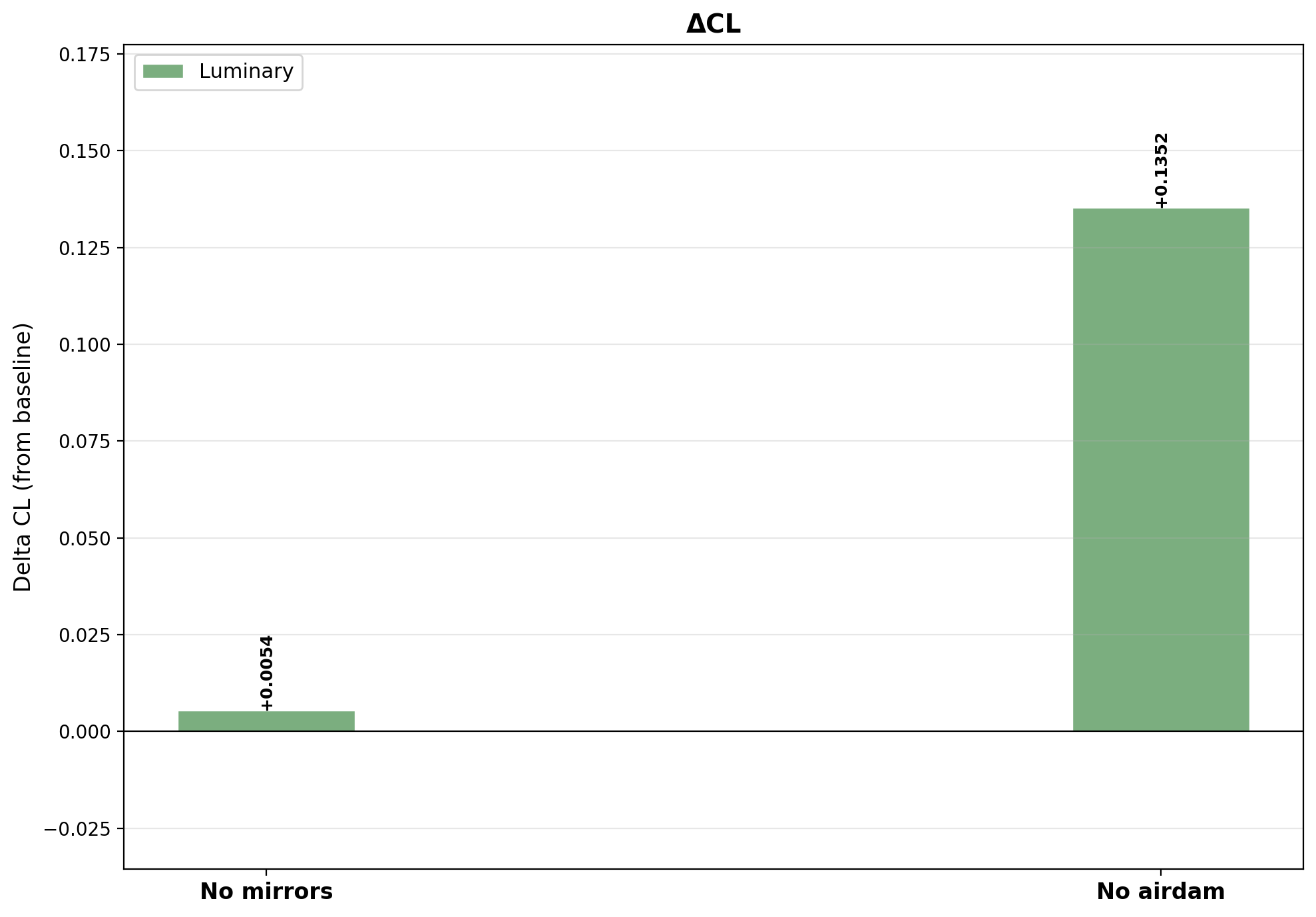
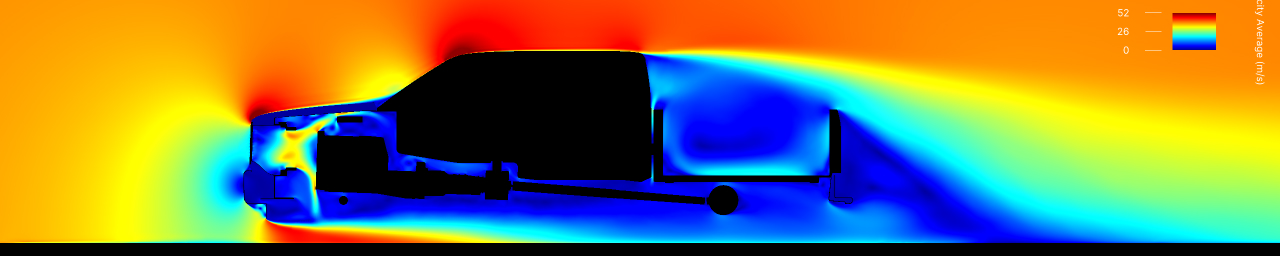
The primary quantities are the time-averaged force coefficients and for each configuration and, as the validation focus, the geometry-induced increments from the 4x2 baseline. For the baseline, Luminary reports and ; the corresponding Ford experimental is 0.3930, so the absolute drag sits about 0.05 above the tunnel value across configurations. Removing the mirrors changes the drag by (Luminary), compared with from Ford CFD and from the Ford experiment. Removing the chin spoiler changes the drag by (Luminary), compared with from Ford CFD and from the Ford experiment. The lift increments from Luminary are for mirror removal and for chin-spoiler removal. Field quantities include the instantaneous and time-averaged velocity-magnitude fields on the vehicle center plane.
Sources
Introduces the Ford Generic Truck Utility (GTU) open generic pickup/SUV model and reports wind-tunnel force coefficients for its configurations.
Open GTU geometry and reference data exchange.
Results
These results are reproduced from Luminary's published workshop submission (see Sources).
Geometry-induced drag increments
| Source | (mirror removal) | (chin-spoiler removal) |
|---|---|---|
| Luminary | -0.0106 | +0.0349 |
| Ford CFD | -0.010 | +0.035 |
| Ford experiment | -0.012 | +0.028 |
Change in time-averaged drag coefficient from the 4x2 baseline for each part removal: Luminary SA-DDES beside the Ford experiment and Ford CFD increments.
Reference: S. Woodiga, K. Howard, P. Norman, N. Lewington, R. Carstairs, B. Hupertz, and K. Chalupa, "The GTU: A New Realistic Generic Pickup Truck and SUV Model," SAE Technical Paper 2020-01-0664, 2020. (geometry-induced drag increments): https://doi.org/10.4271/2020-01-0664
Drag increment by configuration
Reference: S. Woodiga, K. Howard, P. Norman, N. Lewington, R. Carstairs, B. Hupertz, and K. Chalupa, "The GTU: A New Realistic Generic Pickup Truck and SUV Model," SAE Technical Paper 2020-01-0664, 2020. (drag increments): https://doi.org/10.4271/2020-01-0664
Absolute drag coefficient by configuration
Reference: S. Woodiga, K. Howard, P. Norman, N. Lewington, R. Carstairs, B. Hupertz, and K. Chalupa, "The GTU: A New Realistic Generic Pickup Truck and SUV Model," SAE Technical Paper 2020-01-0664, 2020. (absolute drag coefficients per configuration): https://doi.org/10.4271/2020-01-0664
Lift increment by configuration
Reference: S. Woodiga, K. Howard, P. Norman, N. Lewington, R. Carstairs, B. Hupertz, and K. Chalupa, "The GTU: A New Realistic Generic Pickup Truck and SUV Model," SAE Technical Paper 2020-01-0664, 2020. (lift increments): https://doi.org/10.4271/2020-01-0664
Absolute lift coefficient by configuration
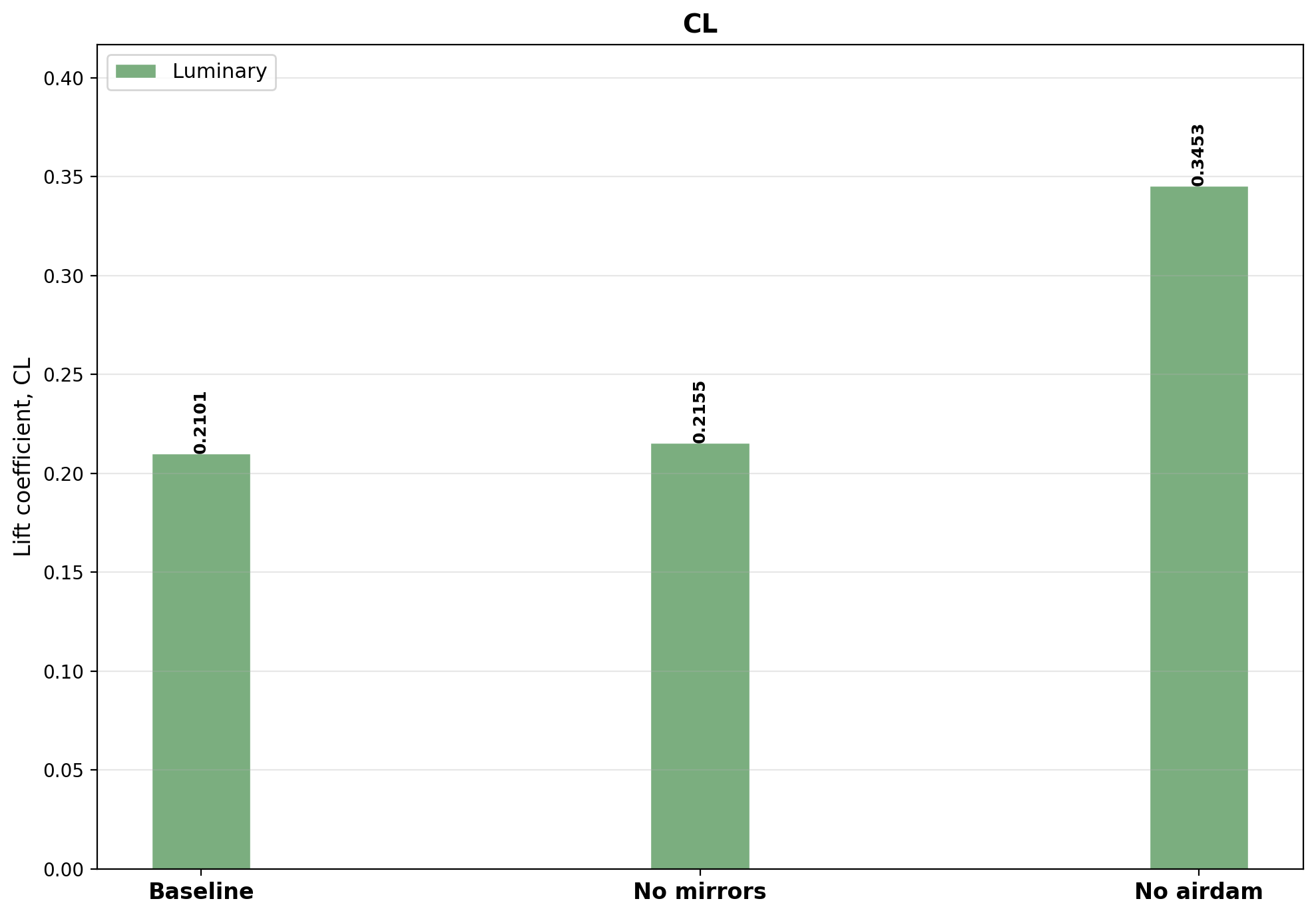
Reference: S. Woodiga, K. Howard, P. Norman, N. Lewington, R. Carstairs, B. Hupertz, and K. Chalupa, "The GTU: A New Realistic Generic Pickup Truck and SUV Model," SAE Technical Paper 2020-01-0664, 2020. (absolute lift coefficients per configuration): https://doi.org/10.4271/2020-01-0664
Time-averaged velocity-magnitude field
Solver configuration
- features exercised
- VerificationValidation3DDES/LESSpalart–AllmarasIdeal gasUnsteadyEnergy equation