
Low-Prandtl Forced Convection over a Flat Plate
verification
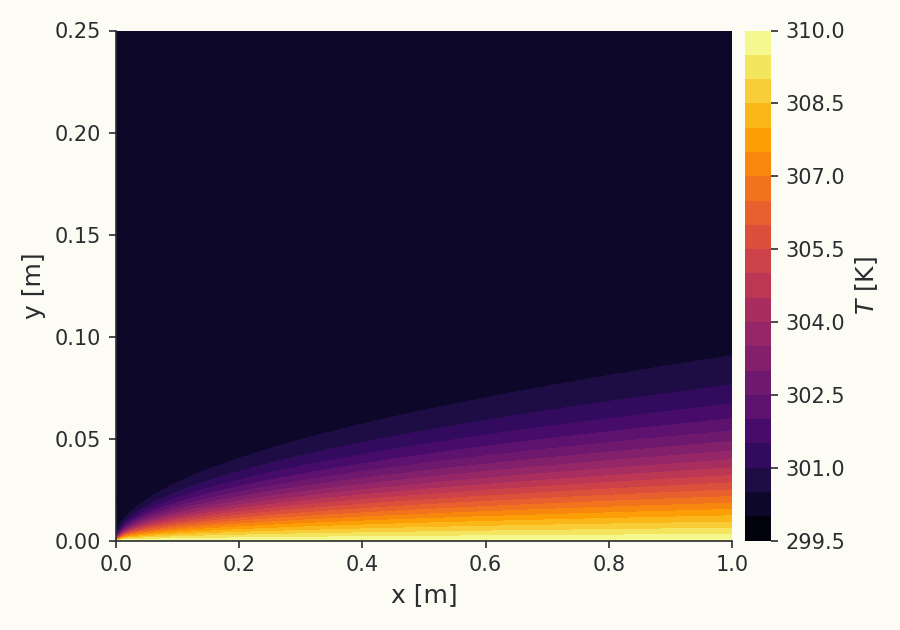
Overview
This case verifies the solver's forced-convection heat transfer prediction for the textbook problem of laminar flow over an isothermal flat plate at a low Prandtl number representative of a liquid metal (). For laminar, constant-property forced convection the local Nusselt number is given for all Prandtl numbers by the Churchill–Ozoe similarity correlation . In the low-Prandtl limit, where the thermal boundary layer is much thicker than the momentum layer, it approaches the compact slug-flow asymptote . Reproducing the local Nusselt-number distribution along the plate exercises the coupled momentum and energy solution for an incompressible, constant-property fluid in the low-Prandtl regime, where the temperature field extends far beyond the velocity field.
Problem Setup
A uniform stream enters at the leading edge of a flat isothermal plate that forms the lower wall of a tall quasi-two-dimensional domain. The plate length is m and the free-stream velocity is m/s; with density kg/m³ and dynamic viscosity Pa·s the plate Reynolds number is , so the boundary layer stays laminar over the whole plate. The fluid is incompressible (constant density) with the energy equation active, a Prandtl number , and constant properties.
The plate is held at a fixed temperature K while the inlet stream is uniform at K, a modest K that keeps the constant-property assumption valid. The inlet imposes the uniform velocity and temperature, the downstream outlet is a static- pressure boundary, and the spanwise faces are symmetry planes. The top boundary is also a static- pressure outlet rather than a symmetry plane, so the flow displaced by the growing boundary layer escapes through the top and the edge velocity stays at (a symmetry top would instead accelerate the free stream by the displacement thickness and bias the comparison). Because the low-Prandtl thermal boundary layer is roughly thicker than the momentum layer, the domain is made tall enough to contain it, and the wall-normal nodes are clustered toward the heated wall to resolve the near-wall temperature gradient that sets the heat flux.
Quantities of Interest
The primary quantity is the local Nusselt number , where the convective coefficient is formed from the local wall heat flux , the imposed wall-to-free-stream temperature difference, and the thermal conductivity . The wall heat flux is read directly from the heated-wall boundary solution, and the resulting is compared with the laminar Churchill–Ozoe similarity solution at . The distribution is sampled away from the singular leading edge; the developed-region mean is reported alongside the similarity value on the grid-converged solution.
Sources
Origin of the laminar flat-plate local-Nusselt-number correlation , valid across all Prandtl numbers; its low-Prandtl (liquid-metal) limit is .
Results
Local Nusselt number
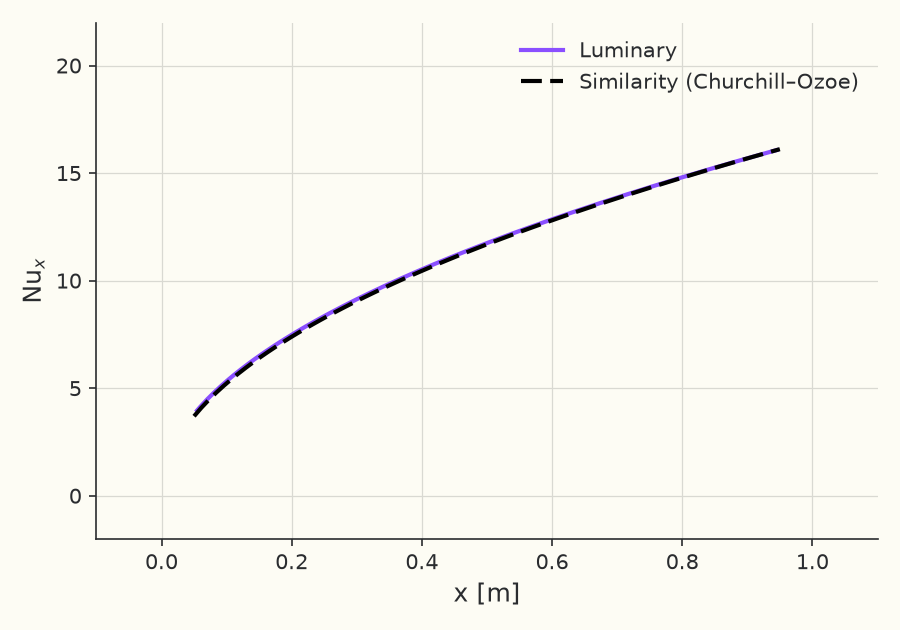
Reference: S. W. Churchill and H. Ozoe, "Correlations for Laminar Forced Convection in Flow Over an Isothermal Flat Plate and in Developing and Fully Developed Flow in an Isothermal Tube," Journal of Heat Transfer, 95(3):416–419, 1973. ( (laminar similarity solution; low-Pr limit )): https://doi.org/10.1115/1.3450078
Mean Nusselt number vs the similarity solution
| Source | |
|---|---|
| Luminary | 14.037 |
| Similarity (Churchill–Ozoe) | 14.007 |
Local Nusselt number averaged over the developed station window ( m) on the finest grid, compared with the laminar Churchill–Ozoe similarity value at .
Solver configuration
- features exercised
- Verification2DLaminarConstant densitySteadyEnergy equation