
DrivAer: AutoCFD4 Case 2 (DDES)
Flagship benchmark showcase
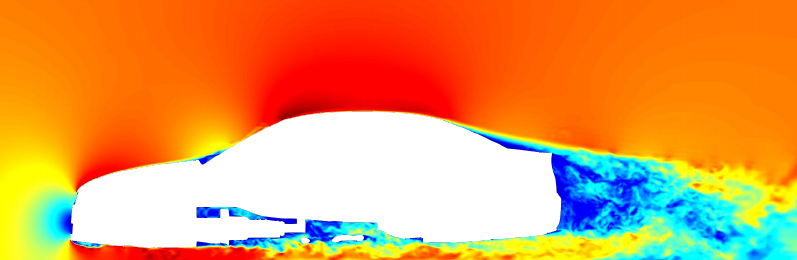
Overview
The Automotive CFD Prediction Workshop series benchmarks CFD predictions of road-vehicle aerodynamics using the DrivAer model, a generic passenger-car geometry with detailed underbody, wheels and mirrors that is widely used as a community reference for automotive external aerodynamics. The fourth workshop (AutoCFD4, 2024) included a scale-resolving test case for the DrivAer notchback in which time-accurate, eddy-resolving methods are compared against wind-tunnel surveys.
This is a flagship benchmark. Luminary entered the workshop with a Delayed Detached Eddy Simulation (DDES). The results reproduced here are taken from Luminary's public AutoCFD4 presentation and resource page; they are not recomputed in this repository. The case is a hybrid RANS-LES transient simulation of a full vehicle.
Problem Setup
The geometry is the DrivAer notchback in two Case 2 configurations: 2a (baseline) and 2b (with a front wheel deflector). The flow is solved with the ideal-gas coupled solver using a second-order finite-volume discretization (arbitrary-polyhedral capable) on the AutoCFD4 committee-supplied 157-million-cell mesh.
Turbulence is treated with Spalart–Allmaras DDES, a hybrid RANS-LES model in which near-wall regions are modeled in RANS mode and detached, separated regions resolve the large turbulent eddies. The formulation adds a shear-layer-adapted length scale and a vortex-tilting measure for grey-area mitigation, a shielding function to protect attached boundary layers from premature switching, and a blended centered/upwind convective scheme to limit dissipation in the LES regions; an SA-QCR2000 variant is also available.
The unsteady simulation is initialized from a steady-state RANS solution. The time step is ramped down through startup and then held fixed at s for 20,000 steps, giving 6.25 s of physical time; forces are time-averaged over the final 3.6 s. The full Case 2a run completed in 93 minutes on 48 NVIDIA A100 GPUs, and in 44 minutes on 64 H100 GPUs.
Quantities of Interest
The primary quantities are the time-averaged aerodynamic force coefficients, drag , lift , and the front and rear lift split and , for both configurations, and the increment from adding the front wheel deflector (the 2b−2a delta) compared against the measured increment. For Case 2a, and ; for Case 2b, and . The DDES increment is −0.0099, compared with a measured increment of −0.0122. Field quantities include the upper-body centerline surface pressure coefficient and underbody and wake velocity-magnitude profiles at a set of survey stations, compared to the Ford wind-tunnel data.
Sources
Luminary's AutoCFD4 presentation: SA-DDES setup, time-averaged forces for Cases 2a/2b, surface and wake velocity profiles vs the Ford experiment, and GPU performance (48 A100s in 93 min; 64 H100s in 44 min).
Summary of the DrivAer Case 2a/2b DDES submission, force coefficients, and GPU-based performance results.
Workshop test-case definitions, the committee-provided DrivAer meshes, and the Ford wind-tunnel reference data.
Results
These results are reproduced from Luminary's published workshop submission (see Sources).
Time-averaged force coefficients and 2b−2a deltas
| Configuration | ||||
|---|---|---|---|---|
| Luminary 2a | 0.2768 | 0.0276 | -0.06948 | 0.097209 |
| Luminary 2b | 0.2669 | 0.0352 | -0.06212 | 0.097355 |
| Luminary Δ (2b−2a) | -0.0099 | +0.0076 | +0.0074 | +0.00015 |
| Experiment Δ (2b−2a) | -0.0122 | -0.0056 | +0.0038 | -0.0094 |
Time-averaged drag, lift and front/rear lift coefficients for the DrivAer Cases 2a and 2b, with the front-wheel-deflector increment (2b−2a) listed beside the measured increment.
Reference: T. D. Economon et al., "Luminary Contribution to the AutoCFD4 Workshop," 4th Automotive CFD Prediction Workshop, 2024 (DrivAer Case 2, SA-DDES). (time-averaged force coefficients and 2b−2a deltas): https://autocfd4.s3.eu-west-1.amazonaws.com/presentations/HPC-Website/Thomas_Economon_Economon-SRS.pdf
Upper-body centerline surface pressure
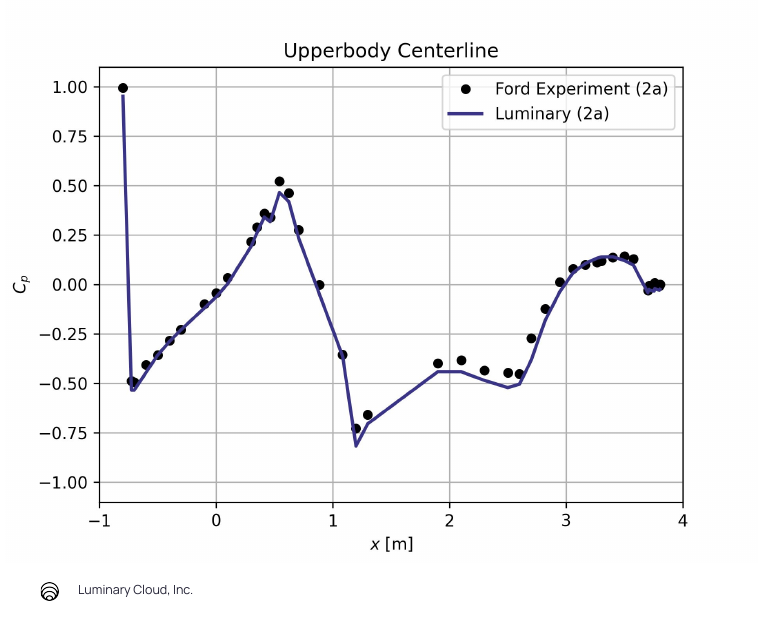
Reference: T. D. Economon et al., "Luminary Contribution to the AutoCFD4 Workshop," 4th Automotive CFD Prediction Workshop, 2024 (DrivAer Case 2, SA-DDES). (upper-body centerline surface ): https://autocfd4.s3.eu-west-1.amazonaws.com/presentations/HPC-Website/Thomas_Economon_Economon-SRS.pdf
Wake velocity profile at station V3
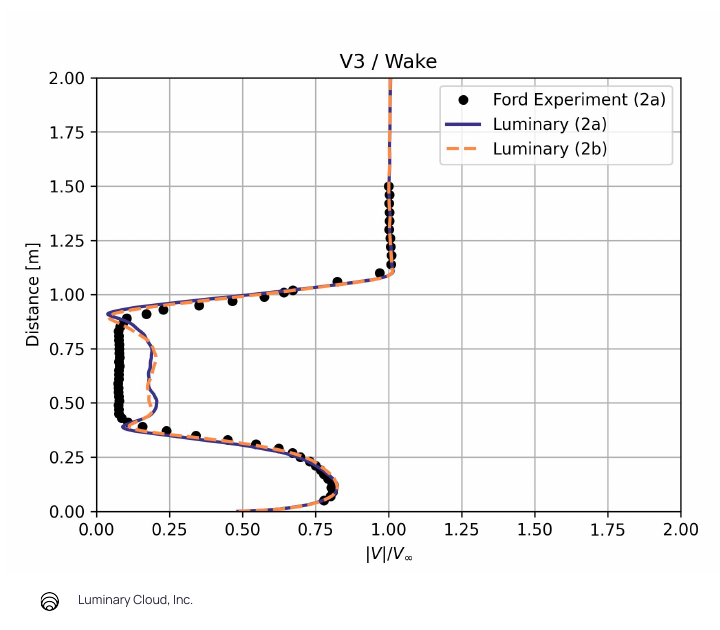
Reference: T. D. Economon et al., "Luminary Contribution to the AutoCFD4 Workshop," 4th Automotive CFD Prediction Workshop, 2024 (DrivAer Case 2, SA-DDES). (wake velocity-magnitude profile at station V3): https://autocfd4.s3.eu-west-1.amazonaws.com/presentations/HPC-Website/Thomas_Economon_Economon-SRS.pdf
Wake velocity profile at station V5
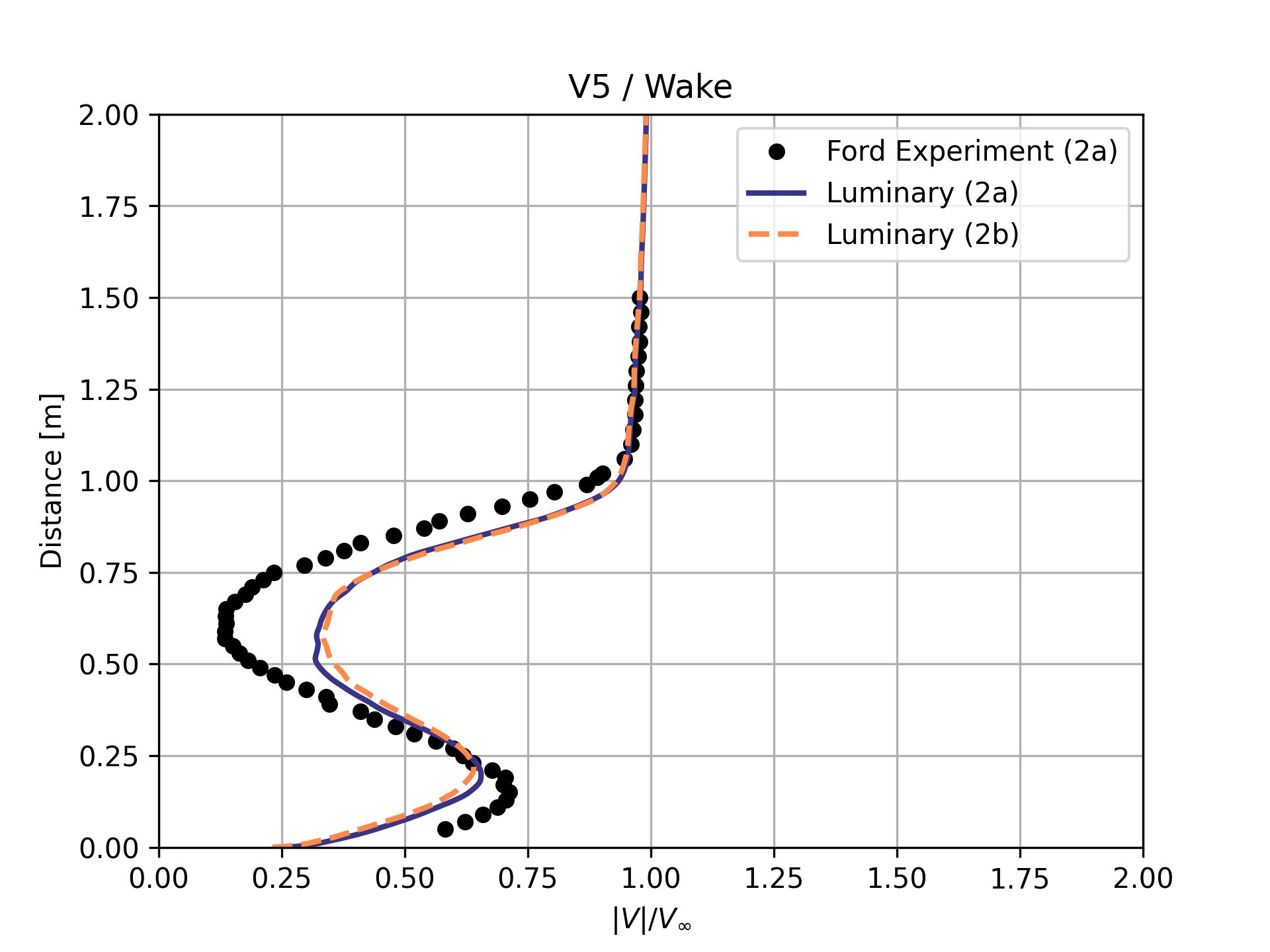
Reference: T. D. Economon et al., "Luminary Contribution to the AutoCFD4 Workshop," 4th Automotive CFD Prediction Workshop, 2024 (DrivAer Case 2, SA-DDES). (wake velocity-magnitude profile at station V5): https://autocfd4.s3.eu-west-1.amazonaws.com/presentations/HPC-Website/Thomas_Economon_Economon-SRS.pdf
Underbody velocity profile at station U2
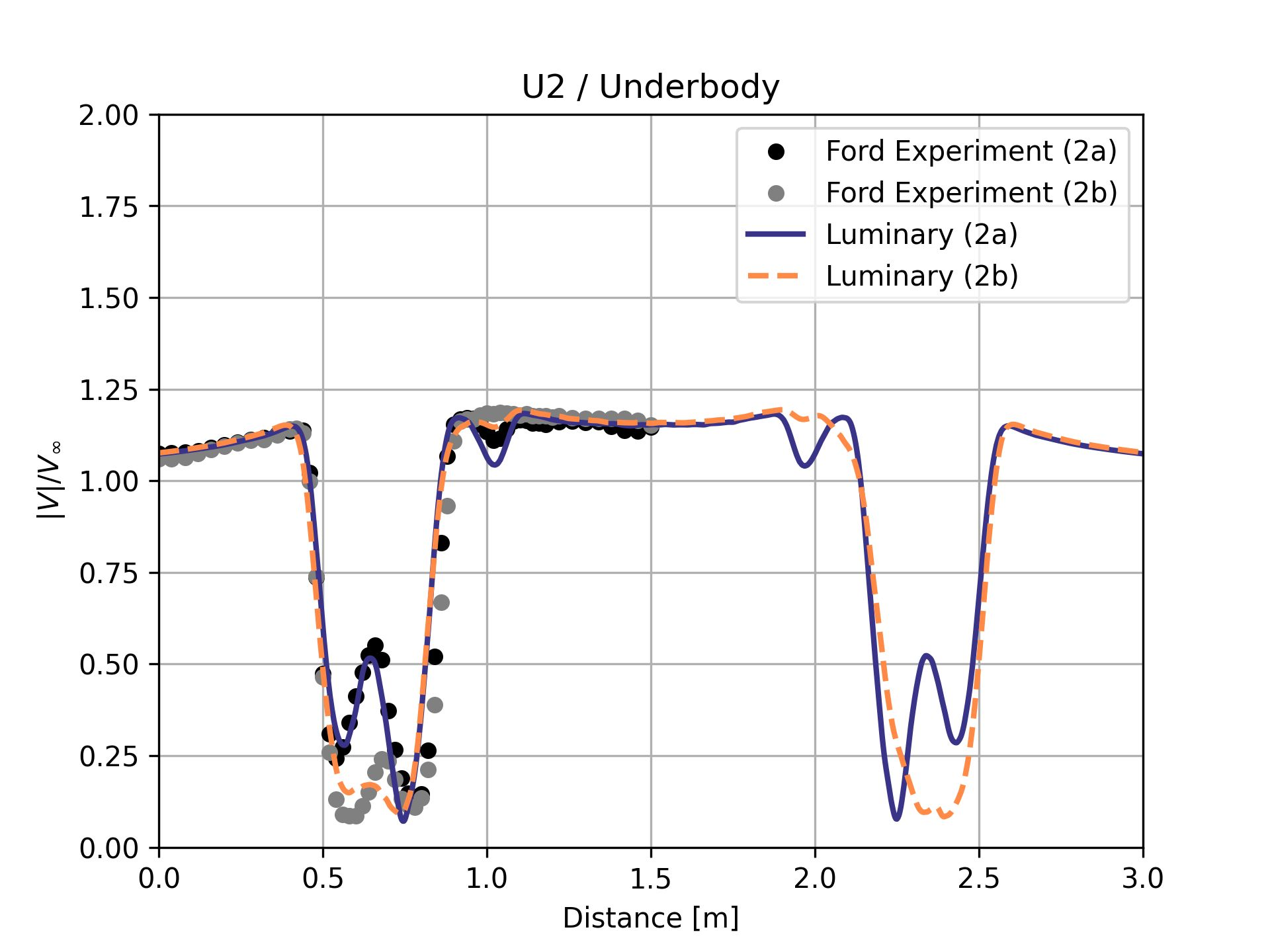
Reference: T. D. Economon et al., "Luminary Contribution to the AutoCFD4 Workshop," 4th Automotive CFD Prediction Workshop, 2024 (DrivAer Case 2, SA-DDES). (underbody velocity-magnitude profile at station U2): https://autocfd4.s3.eu-west-1.amazonaws.com/presentations/HPC-Website/Thomas_Economon_Economon-SRS.pdf
Underbody centerline velocity profile (line L1)
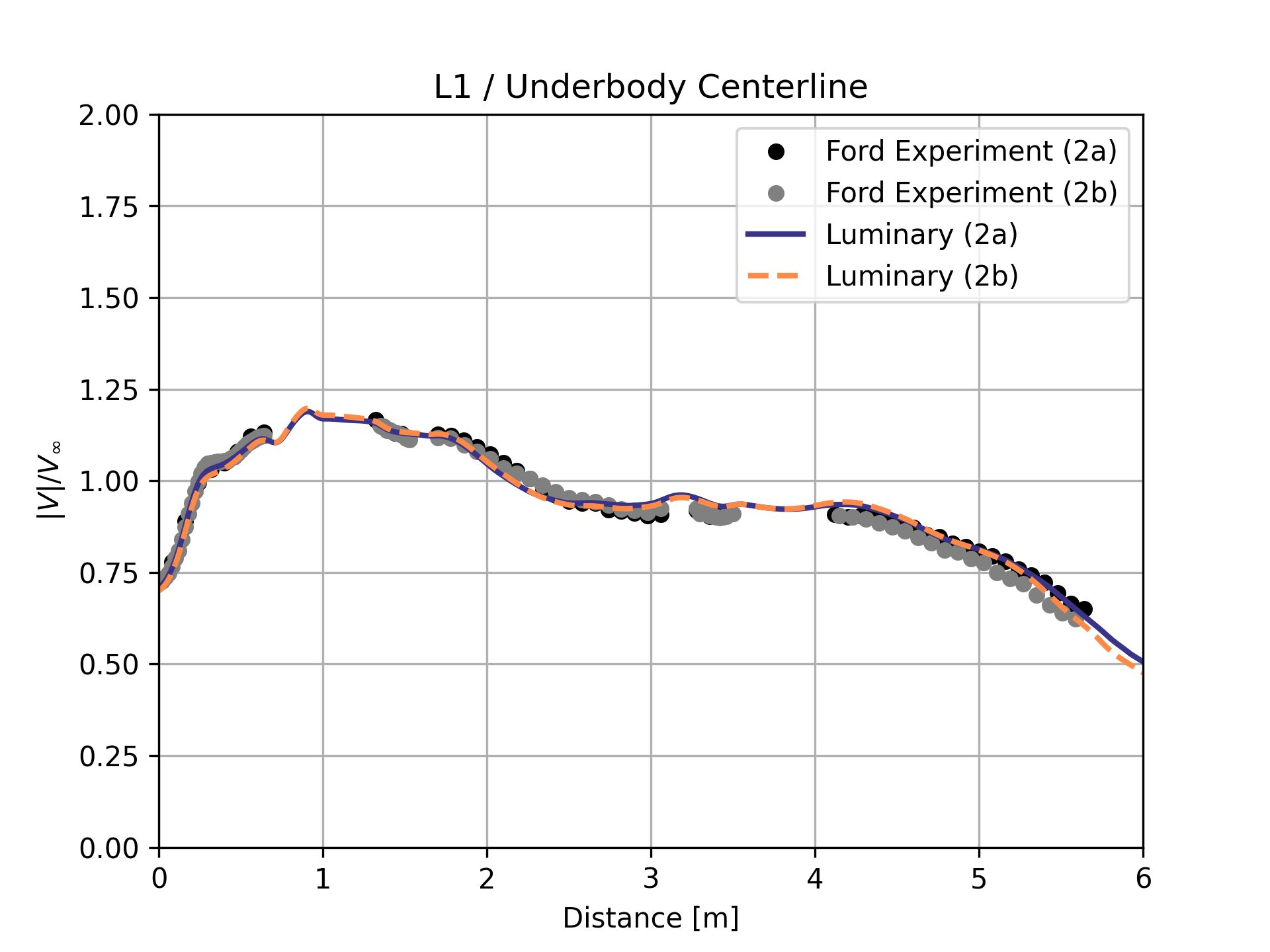
Reference: T. D. Economon et al., "Luminary Contribution to the AutoCFD4 Workshop," 4th Automotive CFD Prediction Workshop, 2024 (DrivAer Case 2, SA-DDES). (underbody centerline velocity-magnitude profile at line L1): https://autocfd4.s3.eu-west-1.amazonaws.com/presentations/HPC-Website/Thomas_Economon_Economon-SRS.pdf
Solver configuration
- features exercised
- VerificationValidation3DDES/LESSpalart–AllmarasIdeal gasUnsteadyEnergy equation