
Laminar Cylinder at Re = 40 (Drag Coefficient)
verification
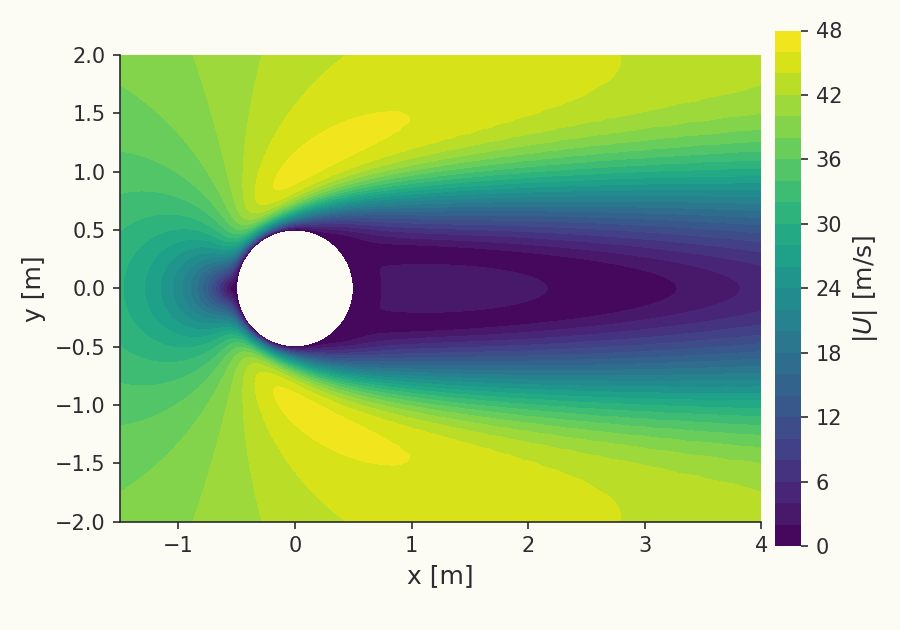
Overview
Steady laminar flow past a circular cylinder is a documented benchmark in incompressible fluid dynamics. At a diameter Reynolds number the flow is steady and two-dimensional, with a symmetric pair of standing vortices in the near wake. The drag coefficient has been computed and measured in independent studies. The case is solved on a family of progressively refined grids, and the drag coefficient is compared with accepted literature values.
Problem Setup
The cylinder has unit diameter and is immersed in a uniform free stream at a diameter-based Reynolds number , with constant density and viscosity. The cylinder surface is a no-slip adiabatic wall, and the outer boundary is a circle placed 50 diameters from the surface that applies free-stream conditions.
The verification is a grid-convergence study over four curvilinear O-grids, from 64 × 49 to 512 × 71 cells. Each grid places equally spaced nodes around the cylinder and extrudes them outward along the radial direction, with the first cell sized to the surface node spacing and a geometric growth ratio of 1.1 out to the far field. The low-dissipation discretization is used, and every grid is converged to its residual floor.
Quantities of Interest
The quantity of interest is the total drag coefficient , the sum of the pressure and friction contributions integrated over the cylinder surface and normalized by the free-stream dynamic pressure and the diameter. It is plotted against the grid spacing and tabulated on the finest grid beside the accepted values of Park et al. () and Sen et al. (). On the finest grid (512 × 71) Luminary computes , within 0.04% of Sen et al. and within 0.03% of Park et al.
Sources
Accepted at Re = 40.
Accepted at Re = 40.
Results
Finest-grid vs literature
| Code | |
|---|---|
| Luminary | 1.5096 |
| Park et al. | 1.51 |
| Sen et al. | 1.509 |
Values on the finest grid (512 × 71).
Reference: J. Park, K. Kwon and H. Choi, "Numerical solutions of flow past a circular cylinder at Reynolds numbers up to 160," KSME Int. J. 12, 1200–1205 (1998).: https://doi.org/10.1007/BF02942594
Grid convergence of
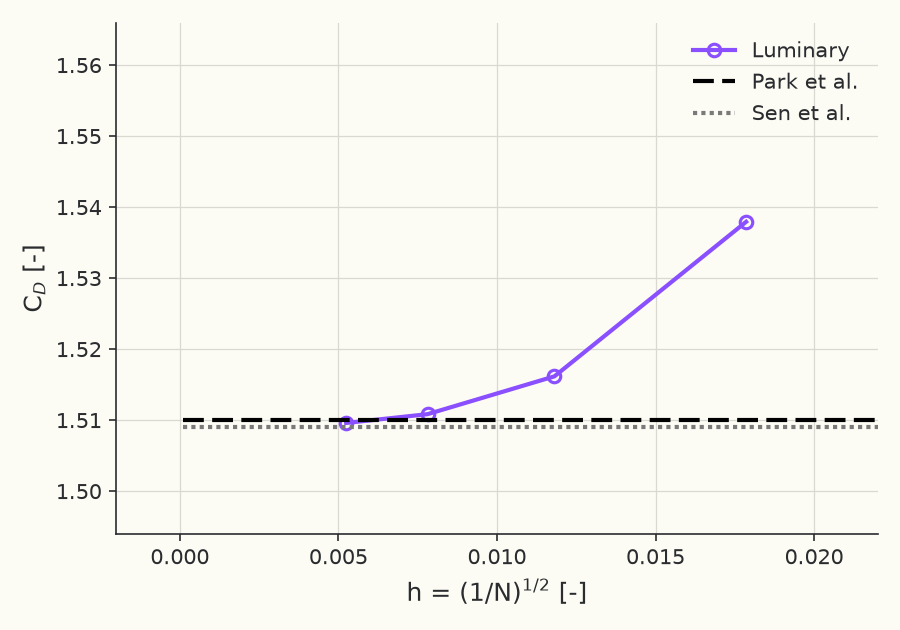
Reference: J. Park, K. Kwon and H. Choi, "Numerical solutions of flow past a circular cylinder at Reynolds numbers up to 160," KSME Int. J. 12, 1200–1205 (1998). (accepted of Park et al. (1.51) and Sen et al. (1.509)): https://doi.org/10.1007/BF02942594
Solver configuration
- features exercised
- Verification2DLaminarConstant densitySteady