
Couette–Poiseuille Flow (Velocity Profiles)
verification
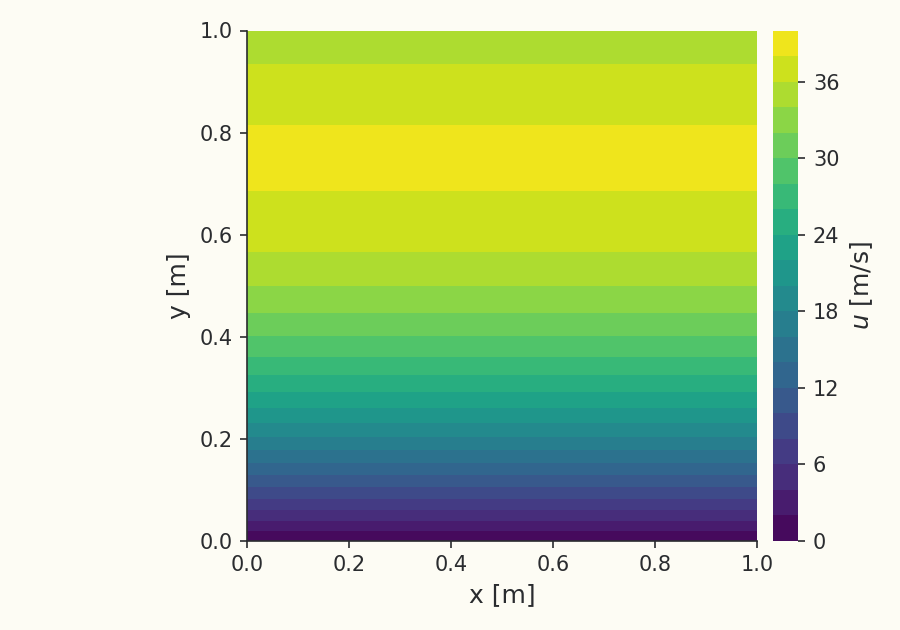
Overview
Couette–Poiseuille flow is the fully-developed laminar flow between two parallel plates driven by both a moving wall and a streamwise pressure gradient. It generalizes plane Couette flow (pure shear, a linear profile) by superimposing the parabolic Poiseuille profile produced by the pressure gradient. Because the governing equation is linear, the exact solution is simply the sum of the two, giving a one-parameter family of profiles controlled by the dimensionless pressure-gradient parameter . It is a standard textbook verification with a closed-form answer and no turbulence, compressibility, or geometric complication.
A favorable gradient () accelerates the fluid and can raise the peak velocity above the lid speed; an adverse gradient () decelerates the near-wall fluid and, if strong enough, drives a region of reversed flow along the stationary wall. The pure-Couette limit recovers the straight-line profile.
Problem Setup
The domain is the same unit-height channel as the plane-Couette case: a quasi-2D box, periodic in the streamwise direction, with the top wall translating at constant speed and the bottom wall stationary. The flow is incompressible (constant density), laminar and steady, with on the channel height .
The streamwise pressure gradient is imposed as a uniform body force through the gravity term, with an x-acceleration chosen to set the target value of . Three cases are run: an adverse gradient , the pure-Couette case , and a favorable gradient .
Quantities of Interest
The verification quantity is the streamwise velocity profile across the channel, sampled on a vertical line and compared point-by-point to the analytic Couette–Poiseuille superposition with . The three values of exercise the favorable, zero and adverse pressure-gradient branches of the solution family, including the near-wall reversed flow at and the above-lid peak velocity at .
Sources
Analytic solution for combined Couette–Poiseuille flow between parallel plates (superposition of the linear shear and parabolic pressure-driven profiles).
Results
Velocity profile,
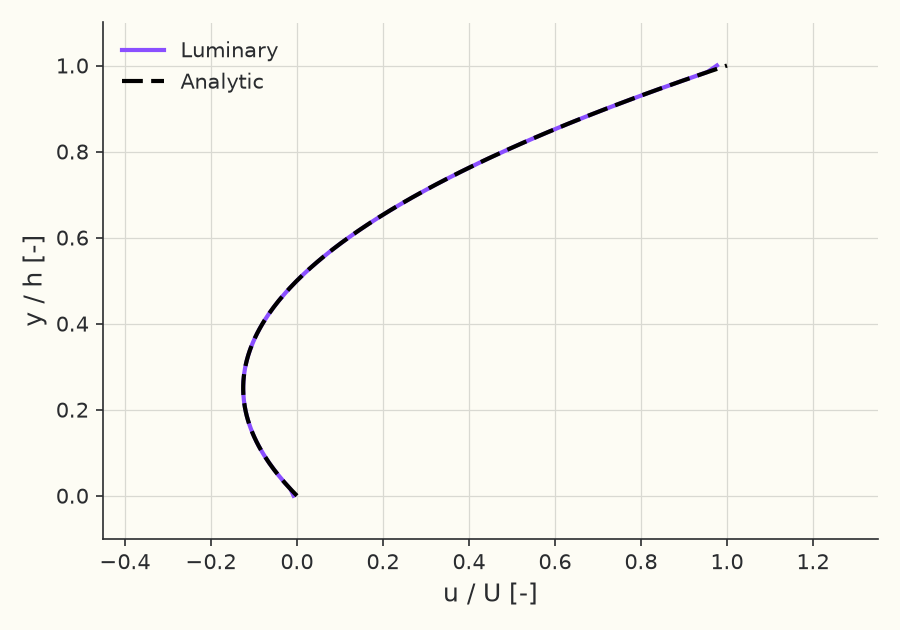
Reference: F. M. White, Fluid Mechanics, 3rd ed., McGraw-Hill, New York, 1994. (combined Couette–Poiseuille profile ): https://www.mheducation.com/highered/product/fluid-mechanics-white/M9780073398273.html
Velocity profile,
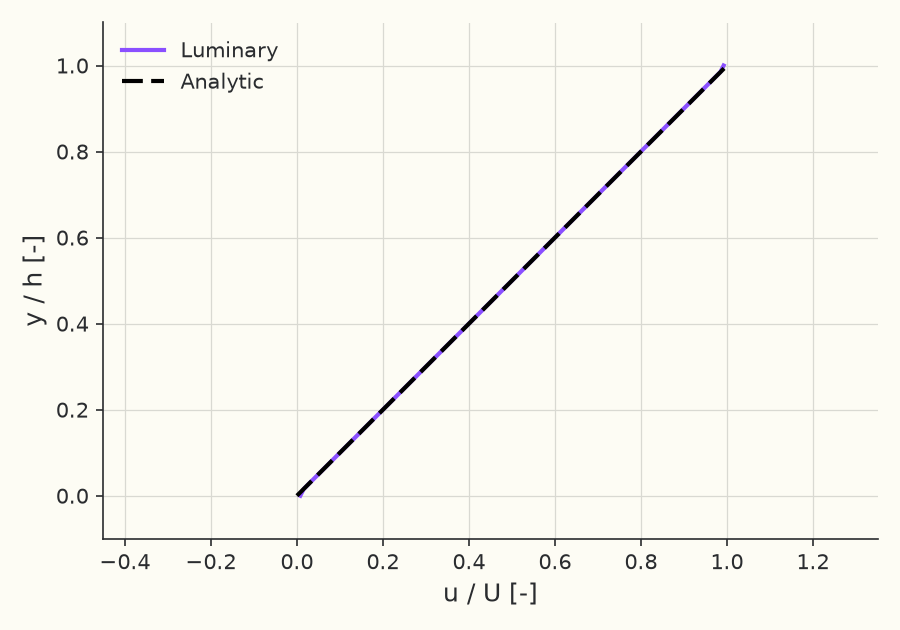
Reference: F. M. White, Fluid Mechanics, 3rd ed., McGraw-Hill, New York, 1994. (combined Couette–Poiseuille profile ): https://www.mheducation.com/highered/product/fluid-mechanics-white/M9780073398273.html
Velocity profile,
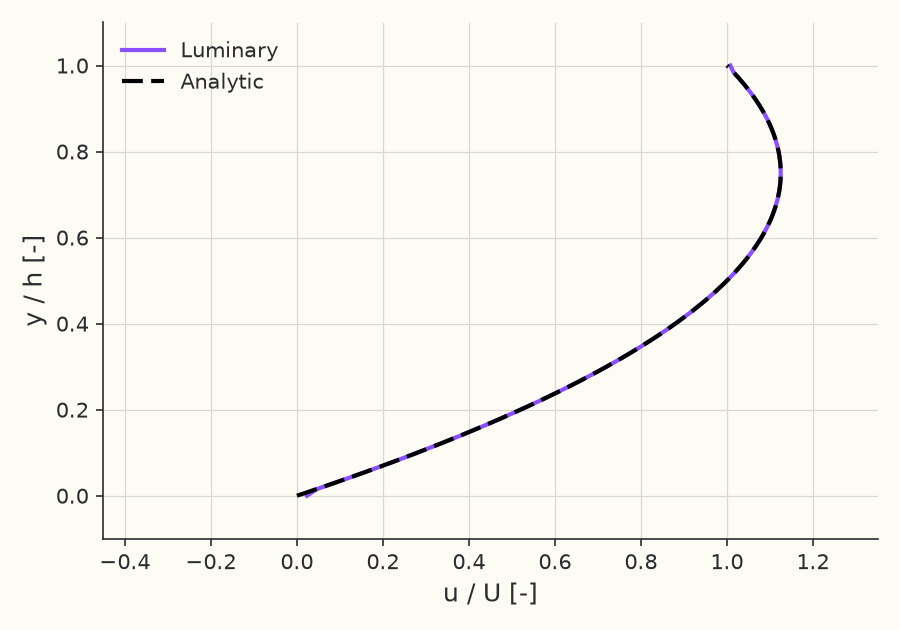
Reference: F. M. White, Fluid Mechanics, 3rd ed., McGraw-Hill, New York, 1994. (combined Couette–Poiseuille profile ): https://www.mheducation.com/highered/product/fluid-mechanics-white/M9780073398273.html
Solver configuration
- features exercised
- Verification2DLaminarConstant densitySteadyBuoyancy / gravity