
Supersonic Flow Over a Cone (Taylor-Maccoll)
verification
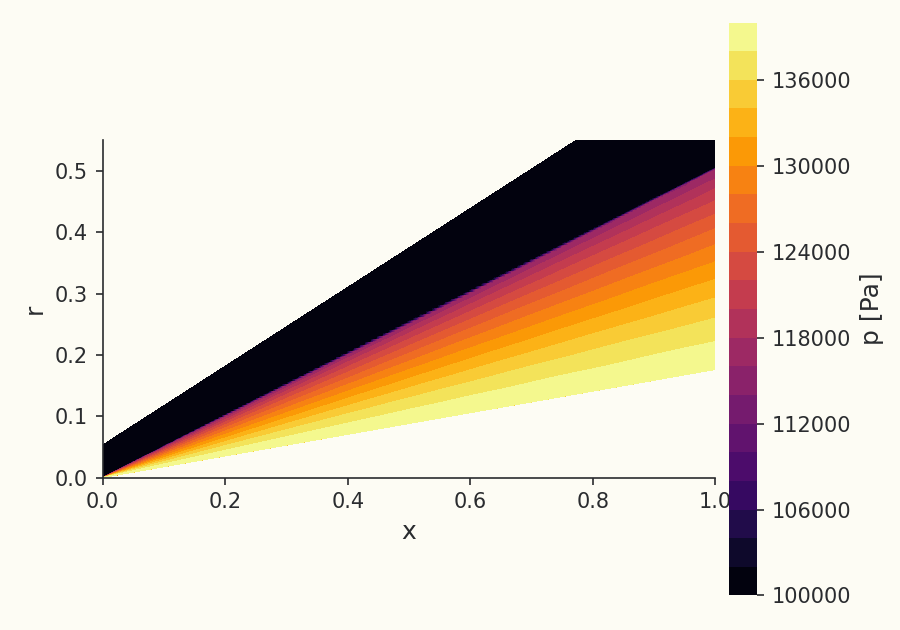
Overview
A sharp cone at zero incidence in a uniform supersonic stream produces an attached conical shock and a flow field that is self-similar along rays from the tip: every flow quantity is constant along a cone of constant half-angle, depending only on the conical angle. This structure admits an exact reduction of the steady Euler equations to a single ordinary differential equation , the Taylor-Maccoll equation, whose solution gives the cone-surface pressure, Mach number and temperature with no empirical input. That makes the case a verification benchmark: the reference is an exact solution of the governing equations, not measured data.
We solve the half-angle cone at free-stream Mach (the NPARC Alliance verification geometry) and compare Luminary's cone-surface state to the Taylor-Maccoll solution. Because the body is axisymmetric and Luminary has no dedicated axisymmetric mode, the cone is modelled as a thin angular wedge sector of the meridional half-plane revolved a few degrees about the axis, with both angular faces treated as symmetry planes, a way to recover an axisymmetric flow on a three-dimensional unstructured solver.
Problem Setup
The geometry is a cone of half-angle aligned with the free stream. A meridional slice (axial coordinate , radial coordinate ) is revolved through a small wedge angle to build a one-cell-thick sector mesh; the two angular faces are symmetry planes, the cone surface is an inviscid (slip) wall, and the outer and upstream boundaries are supersonic free-stream. The sharp cone apex sits exactly on the rotation axis, where the sector cells reduce to standard prism, pyramid and tetrahedral elements.
The flow is inviscid and compressible (ideal gas, ), solved with a density-based formulation using a second-order FDS scheme with the Venkatakrishnan limiter for shock-stable capture of the conical shock. The free stream is . Because the field is fully supersonic, information only propagates downstream and the conical solution establishes almost immediately.
The reference is generated by integrating the Taylor-Maccoll equation for these exact conditions (, cone, ), giving the shock angle and the uniform cone-surface state.
Quantities of Interest
The verification quantity is the cone-surface state, the pressure ratio , the surface Mach number , and the temperature ratio , averaged over the conical region of the surface (away from the apex transient and the downstream boundary). These are compared directly to the Taylor-Maccoll values.
Since the reference is an exact analytic solution rather than a published code-on-grids dataset, the grid is anchored to NASA's own published meridional grid for this geometry and uniformly refined once coarser and once finer. We track the mean cone-surface pressure ratio as a function of grid spacing ; convergence toward the Taylor-Maccoll value confirms the agreement is grid-converged rather than an artifact of a single mesh.
Sources
Defines the cone at ; the reference is the exact Taylor-Maccoll conical-flow solution.
Results
Cone-surface state vs Taylor-Maccoll (finest grid)
| Code | |||
|---|---|---|---|
| Luminary | 1.3718 | 2.1478 | 1.0947 |
| Taylor-Maccoll | 1.3739 | 2.1468 | 1.0951 |
Values on the finest grid (241 × 161).
Cone-surface pressure ratio, Mach number and temperature ratio (averaged over the conical region) against the exact Taylor-Maccoll solution.
Cone-surface pressure ratio
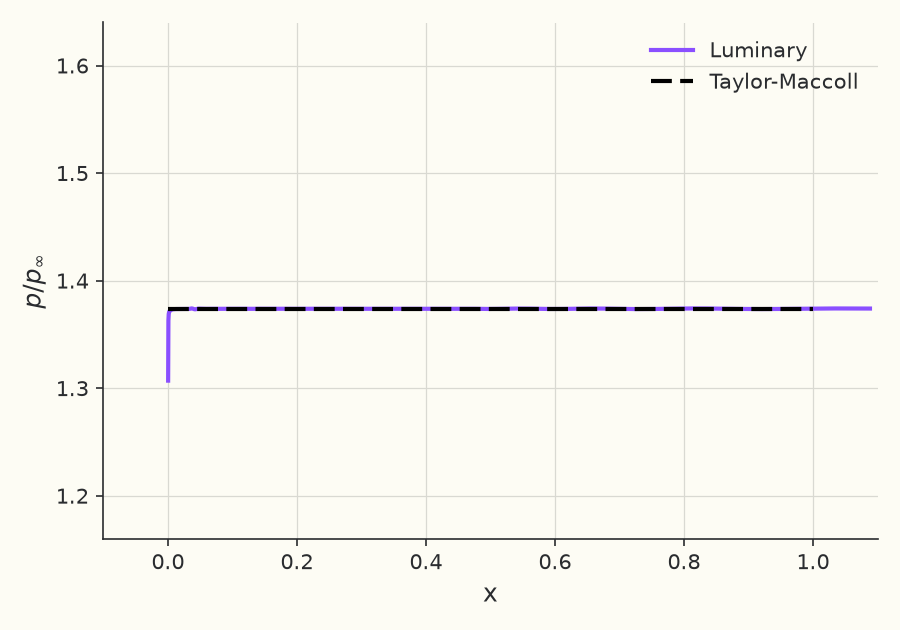
Reference: NPARC Alliance Verification & Validation Archive, "Supersonic Flow Over a Cone," NASA Glenn Research Center. (exact Taylor-Maccoll conical-flow solution ()): https://www.grc.nasa.gov/www/wind/valid/cone10/cone10.html
Solver configuration
- features exercised
- Verification2DInviscidIdeal gasSteadyEnergy equation