
Compressible Couette Flow (Viscous Heating)
verification
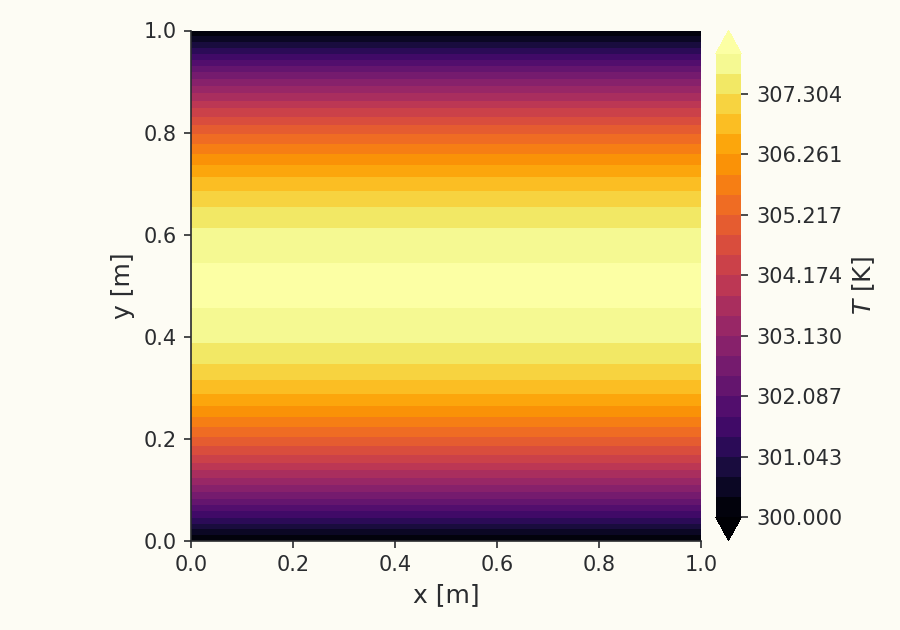
Overview
This case verifies the coupled momentum and energy solution of the compressible laminar solver against an exact result: plane Couette flow in which frictional dissipation heats the fluid. The shearing motion between two plates does work against viscosity, and for a perfect gas with constant transport properties that dissipated energy produces a temperature distribution known in closed form. The velocity field remains the simple linear Couette profile, while the temperature develops a symmetric parabola peaking at mid-gap, so the case checks not only the viscous momentum balance but the dissipation source term and wall thermal boundary conditions in the energy equation.
Problem Setup
Two parallel plates a distance apart are both held at ; the upper plate slides tangentially at () while the lower plate is stationary, with no imposed streamwise pressure gradient. The domain is a unit square discretised as a single spanwise layer of hexahedra, refined in the wall-normal direction to resolve the temperature parabola. The moving wall is driven by a translating reference frame and both walls are no-slip and isothermal; the streamwise faces are a translational periodic pair and the spanwise faces are symmetry planes. The gas is ideal and laminar with constant viscosity and Prandtl number, so the analytic constant-property solution applies exactly.
Quantities of Interest
The verification compares two wall-normal profiles at mid-channel against their exact forms: the streamwise velocity against the linear Couette profile , and the temperature against the viscous-dissipation parabola , whose centreline rise is at these conditions.
Sources
Compressible Couette flow with viscous dissipation: the linear velocity profile and the parabolic temperature rise .
Results
Velocity profile across the gap
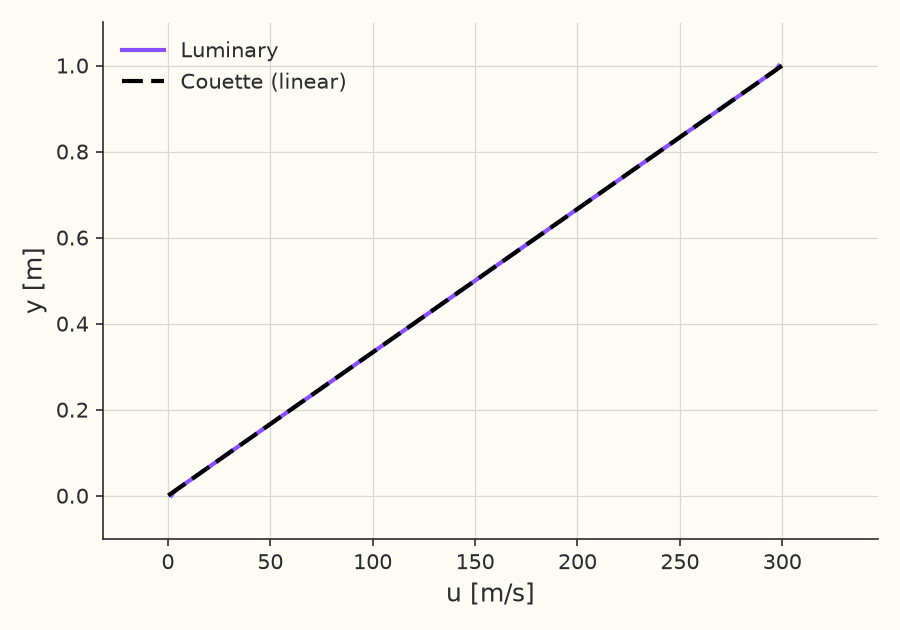
Reference: H. Schlichting and K. Gersten, Boundary-Layer Theory, 8th ed., Springer, Berlin, 2000. (linear profile ): https://link.springer.com/book/10.1007/978-3-662-52919-5
Temperature profile across the gap
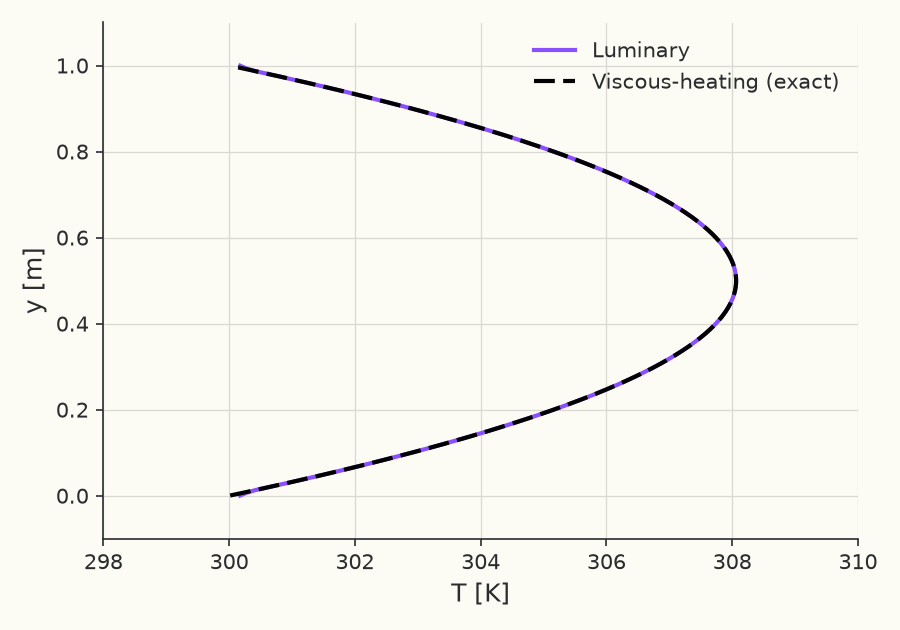
Reference: H. Schlichting and K. Gersten, Boundary-Layer Theory, 8th ed., Springer, Berlin, 2000. (): https://link.springer.com/book/10.1007/978-3-662-52919-5
Solver configuration
- features exercised
- Verification2DLaminarIdeal gasSteadyEnergy equation