
2D Coflowing Jet (Compressible Mixing Layer, SST)
verification
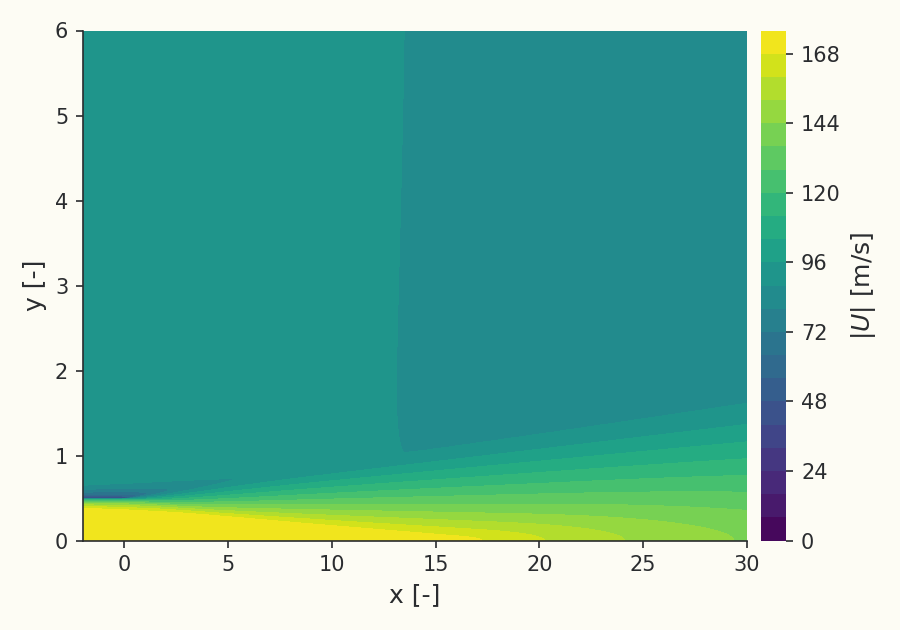
Overview
The 2D coflowing jet is a compressible free-shear verification case: two parallel streams of differing speed meet at the sharp trailing edge of a thin splitter plate and develop into a planar mixing layer downstream. With no wall bounding the shear layer and no separation, the case isolates a turbulence model's behavior in free shear, its spreading rate, its centerline velocity decay, and its eddy viscosity.
This case is the companion of the Spalart–Allmaras coflowing jet, run instead with Luminary's SST model (the Menter SST-2003m variant). The goal is code-to-code verification: to reproduce, on the same grids, the results the NASA Turbulence Modeling Resource (TMR) publishes for its reference codes CFL3D and FUN3D with their SST model. The TMR publishes its SST shear-layer data as the SST-Vm variant (vorticity-based production term); Luminary runs SST-2003m (strain-based). The reference series are labeled "SST-Vm" to name the exact published variant.
This is a grid-convergence study: the case is solved on a family of five successively refined structured grids (each a 2× refinement), and the integrated and profile quantities are tracked as the mesh is refined toward the continuum (grid spacing ).
Problem Setup
The inner stream enters at and the outer (co-flowing) stream at , giving the velocity ratio that drives the mixing layer. The Reynolds number is based on a unit reference length. The two streams are separated, upstream of the trailing edge, by a thin splitter plate modeled as a zero-thickness two-sided adiabatic no-slip wall occupying at ; the mixing layer develops over the downstream region , with the centerline () and the far top boundary treated as symmetry planes.
Each inflow is imposed as a total-pressure (subsonic) inlet with the exact TMR stagnation ratios, the inner stream at , and the outer stream at , , and the downstream boundary as a static back-pressure outlet at . Air is modeled as an ideal gas with a constant molecular viscosity set so that , and turbulence closure is the SST (SST-2003m) model, with the free stream set to the TMR turbulence values () via direct / inflow. Each grid is converged in pseudo-time (continuity residual driven below ) so that the remaining error is spatial.
Quantities of Interest
Velocities are reported as (normalized by the free-stream speed of sound), matching the TMR data convention, so the inner core reads . The verification targets are those published on the NASA TMR SST expected-results page:
- The grid convergence of the splitter drag coefficient , plotted against grid spacing , compared with the CFL3D and FUN3D results across the grid family. On the finest grid Luminary's lies within 0.9% of CFL3D () and within 0.6% of FUN3D ().
- The centerline velocity decay along downstream of the splitter trailing edge.
- The cross-stream velocity profiles versus at the downstream stations , and .
- The eddy-viscosity profile at .
Sources
Reference , centerline , velocity profiles and eddy-viscosity data from the NASA CFL3D and FUN3D codes (SST-Vm variant).
Results
Finest-grid splitter vs CFL3D / FUN3D
| Code | (splitter) |
|---|---|
| Luminary | 0.0056776 |
| CFL3D (SST-Vm) | 0.00573 |
| FUN3D (SST-Vm) | 0.0057092 |
Values on the finest grid (129×257 / 129×257 / 513×513).
Reference: NASA Langley Turbulence Modeling Resource, "2D Coflowing Jet Verification Case" (SST model).: https://tmbwg.github.io/turbmodels/shear_sstv.html
Grid convergence of splitter
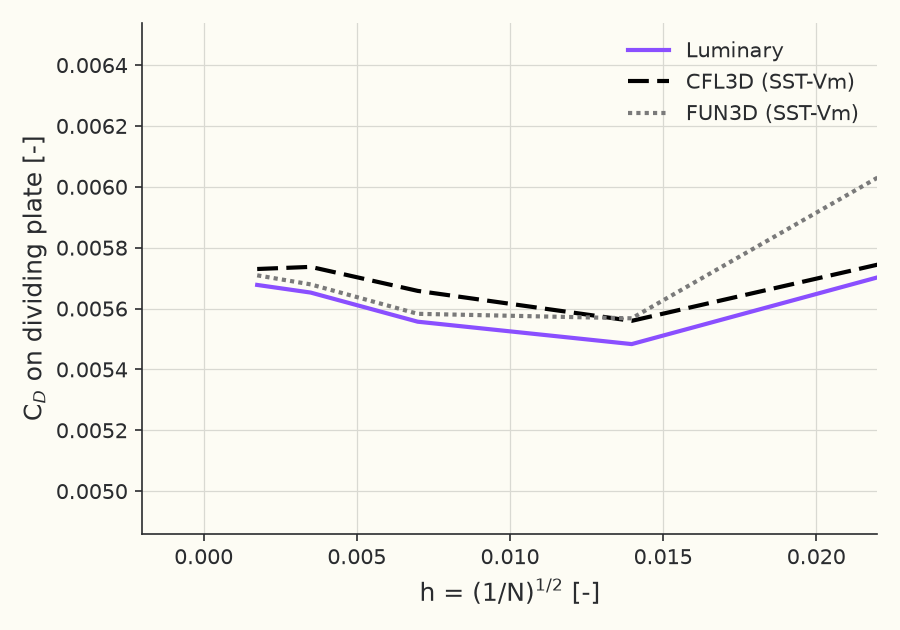
Reference: NASA Langley Turbulence Modeling Resource, "2D Coflowing Jet Verification Case" (SST model). (CFL3D / FUN3D (SST-Vm), grid convergence of splitter ): https://tmbwg.github.io/turbmodels/shear_sstv.html
Centerline velocity decay along
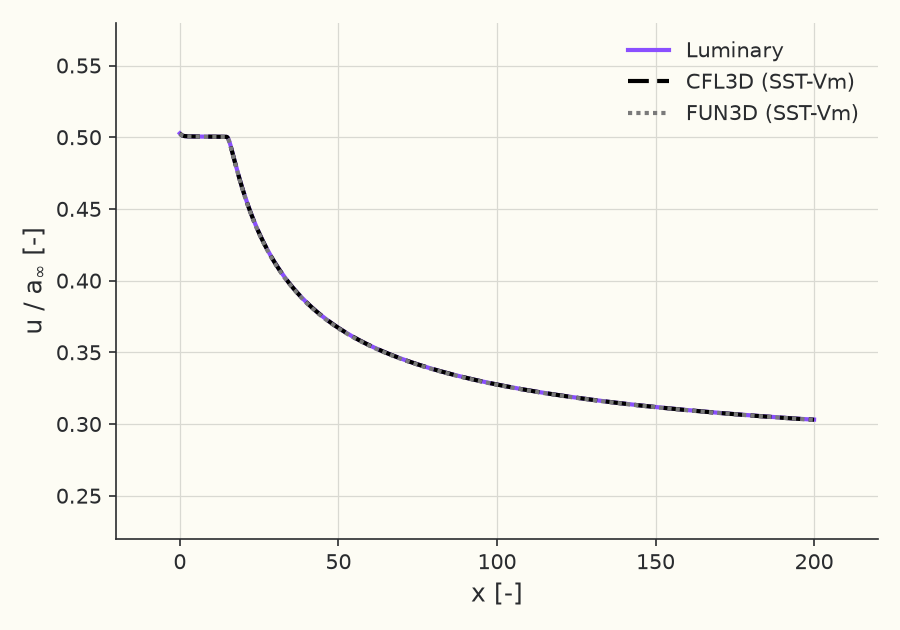
Reference: NASA Langley Turbulence Modeling Resource, "2D Coflowing Jet Verification Case" (SST model). (CFL3D / FUN3D (SST-Vm), centerline vs ): https://tmbwg.github.io/turbmodels/shear_sstv.html
Velocity profile vs at
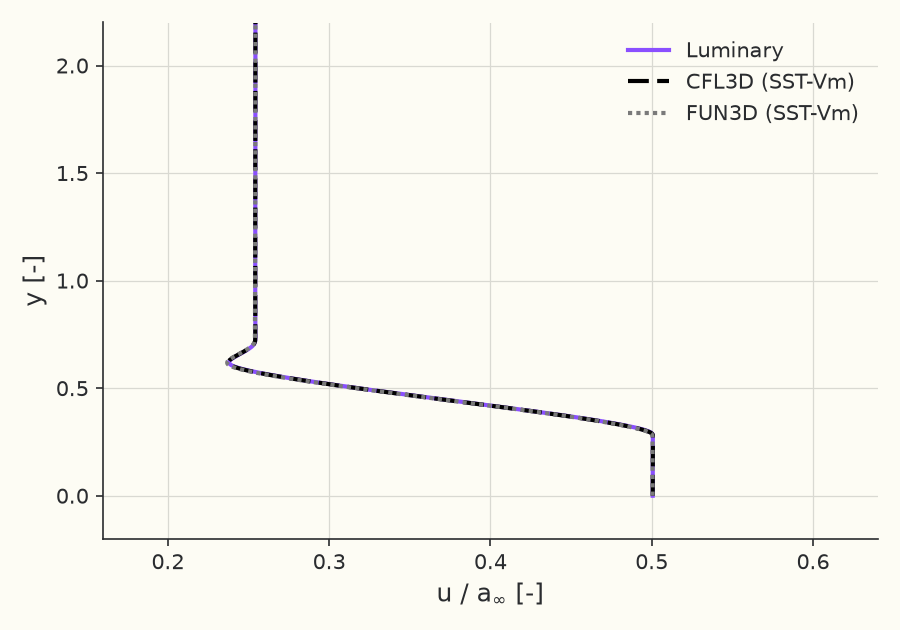
Reference: NASA Langley Turbulence Modeling Resource, "2D Coflowing Jet Verification Case" (SST model). (CFL3D / FUN3D (SST-Vm), vs at ): https://tmbwg.github.io/turbmodels/shear_sstv.html
Velocity profile vs at
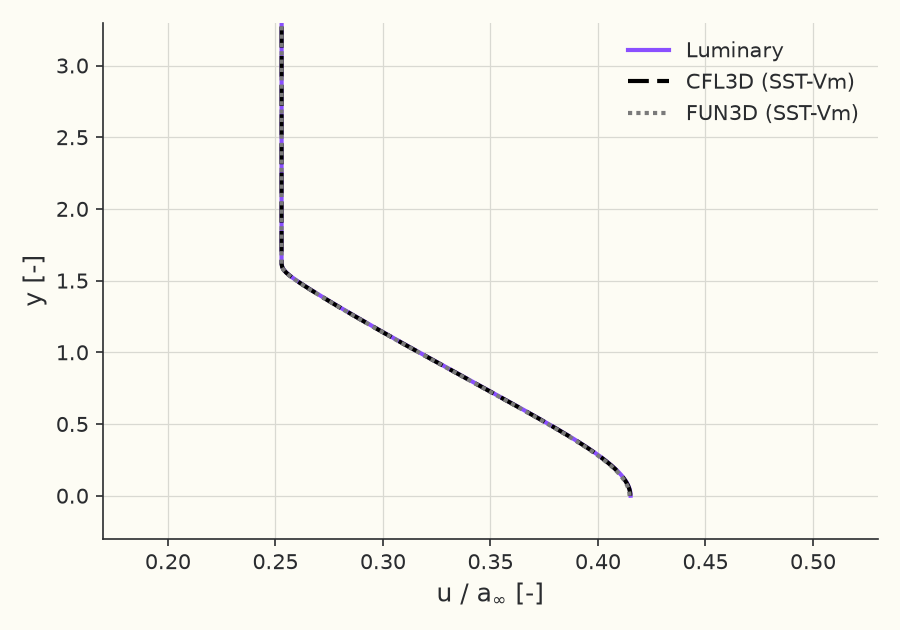
Reference: NASA Langley Turbulence Modeling Resource, "2D Coflowing Jet Verification Case" (SST model). (CFL3D / FUN3D (SST-Vm), vs at ): https://tmbwg.github.io/turbmodels/shear_sstv.html
Velocity profile vs at
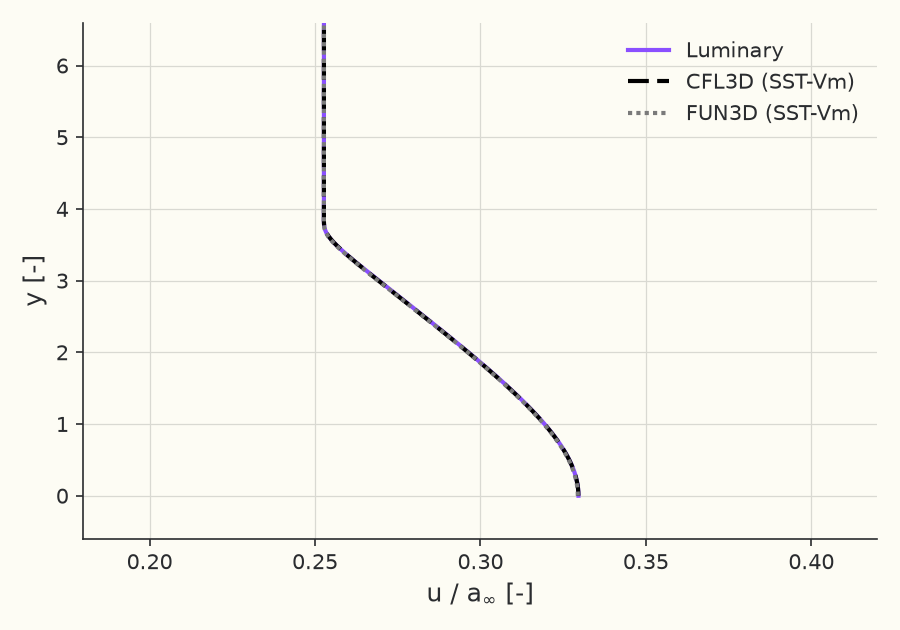
Reference: NASA Langley Turbulence Modeling Resource, "2D Coflowing Jet Verification Case" (SST model). (CFL3D / FUN3D (SST-Vm), vs at ): https://tmbwg.github.io/turbmodels/shear_sstv.html
Eddy-viscosity profile at
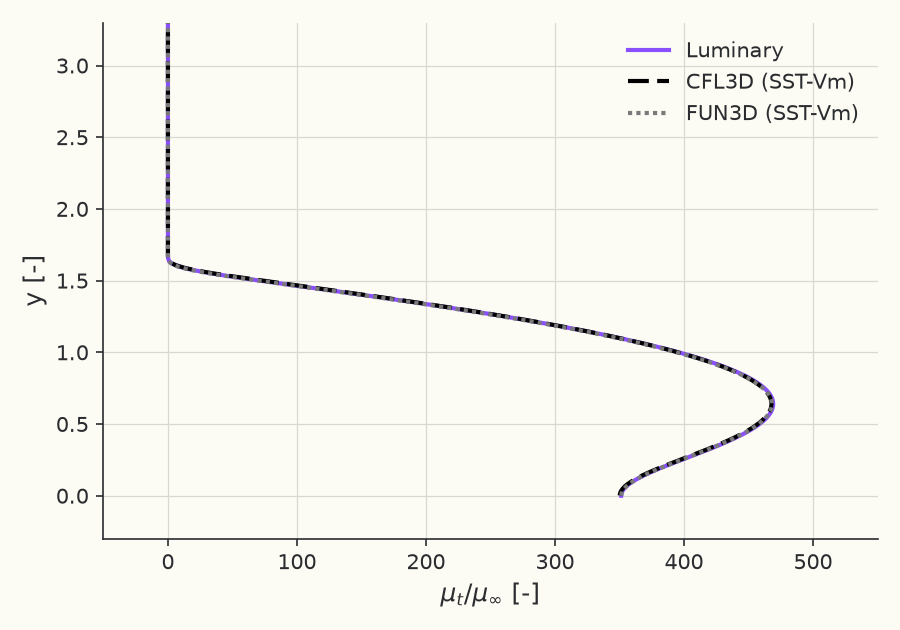
Reference: NASA Langley Turbulence Modeling Resource, "2D Coflowing Jet Verification Case" (SST model). (CFL3D / FUN3D (SST-Vm), vs at ): https://tmbwg.github.io/turbmodels/shear_sstv.html
Solver configuration
- features exercised
- Verification2DRANSk–ω SSTIdeal gasSteadyEnergy equation