
2D Coflowing Jet (Compressible Mixing Layer)
verification
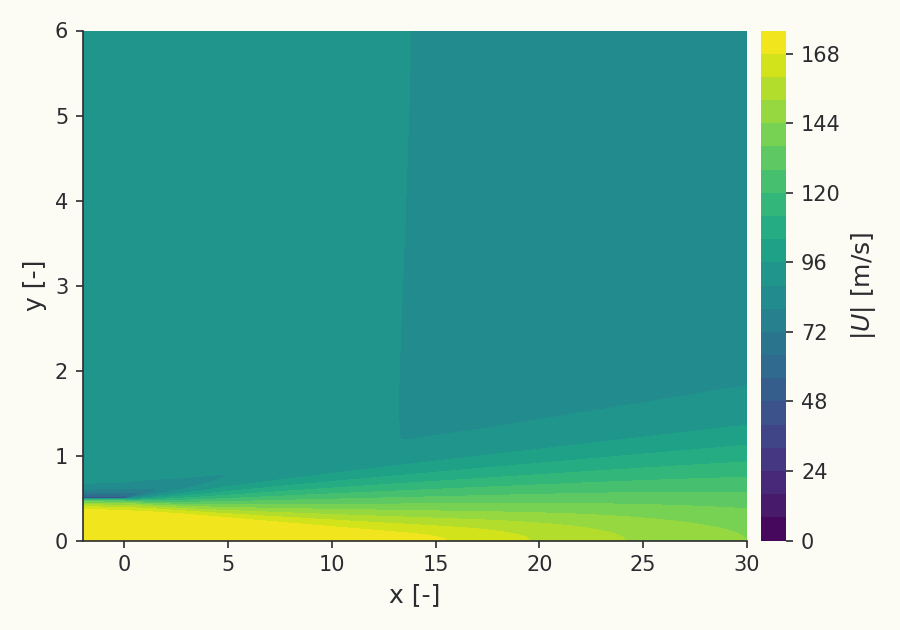
Overview
The 2D coflowing jet is a compressible free-shear verification case: two parallel streams of differing speed meet at the sharp trailing edge of a thin splitter plate and develop into a planar mixing layer downstream. With no wall bounding the shear layer and no separation, the case isolates a turbulence model's behavior in free shear, its spreading rate, its centerline velocity decay, and its eddy viscosity. The goal here is code-to-code verification: to reproduce, on the same grids, the results the NASA Turbulence Modeling Resource (TMR) publishes for its reference codes CFL3D and FUN3D with the Spalart–Allmaras (SA) one-equation model.
This is a grid-convergence study: the case is solved on a family of five successively refined structured grids (each a 2× refinement), and the integrated and profile quantities are tracked as the mesh is refined toward the continuum (grid spacing ).
Problem Setup
The inner stream enters at and the outer (co-flowing) stream at , giving the velocity ratio that drives the mixing layer. The Reynolds number is based on a unit reference length. The two streams are separated, upstream of the trailing edge, by a thin splitter plate modeled as a zero-thickness two-sided adiabatic no-slip wall occupying at ; the mixing layer develops over the downstream region , with the centerline () and the far top boundary treated as symmetry planes.
Each inflow is imposed as a total-pressure (subsonic) inlet with the exact TMR stagnation ratios, the inner stream at , and the outer stream at , , and the downstream boundary as a static back-pressure outlet at . Air is modeled as an ideal gas with a constant molecular viscosity set so that , and turbulence closure is the Spalart–Allmaras model. Each grid is converged deeply in pseudo-time (continuity residual driven below ) so that the remaining error is purely spatial, exactly what a grid-convergence study must isolate.
Quantities of Interest
Velocities are reported as (normalized by the free-stream speed of sound), matching the TMR data convention, so the inner core reads . The verification targets are those published on the NASA TMR "SA expected results" page:
- The grid convergence of the splitter drag coefficient , plotted against grid spacing . On the finest grid the Luminary is within 0.8% of CFL3D () and within 1.0% of FUN3D ().
- The centerline velocity decay along , measuring how the mixing layer erodes the high-speed core downstream of the splitter trailing edge.
- The cross-stream velocity profiles versus at the downstream stations , and , which capture the spreading of the layer.
- The eddy-viscosity profile at .
Sources
Reference , centerline , velocity profiles and eddy-viscosity data from the NASA CFL3D and FUN3D codes.
Results
Finest-grid splitter vs CFL3D / FUN3D
| Code | (splitter) |
|---|---|
| Luminary | 0.0057196 |
| CFL3D | 0.0057658 |
| FUN3D | 0.0056648 |
Values on the finest grid (129×257 / 129×257 / 513×513).
Reference: NASA Langley Turbulence Modeling Resource, "2D Coflowing Jet Verification Case" (SA model).: https://tmbwg.github.io/turbmodels/shear_sa.html
Grid convergence of splitter
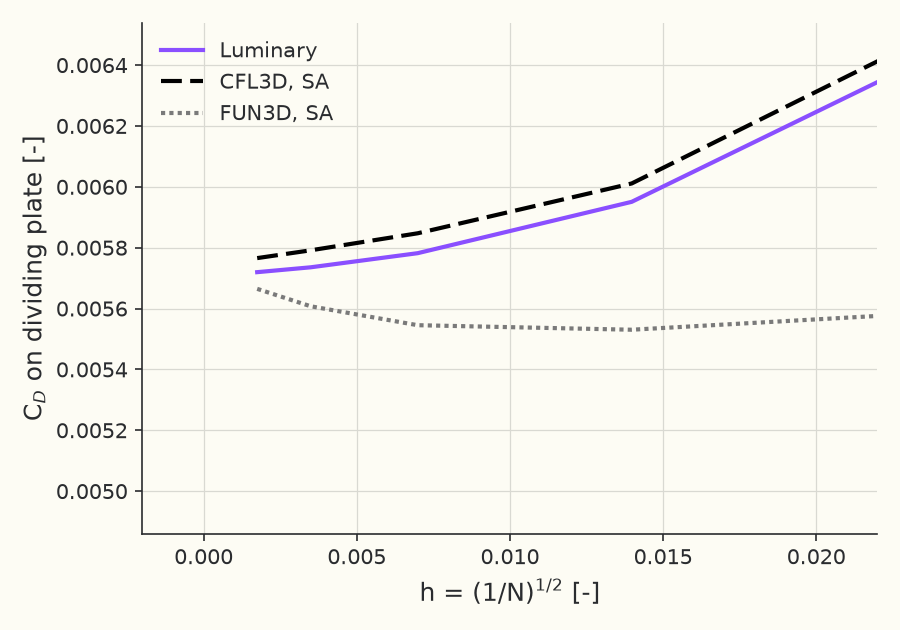
Reference: NASA Langley Turbulence Modeling Resource, "2D Coflowing Jet Verification Case" (SA model). (CFL3D / FUN3D, grid convergence of splitter ): https://tmbwg.github.io/turbmodels/shear_sa.html
Centerline velocity decay along
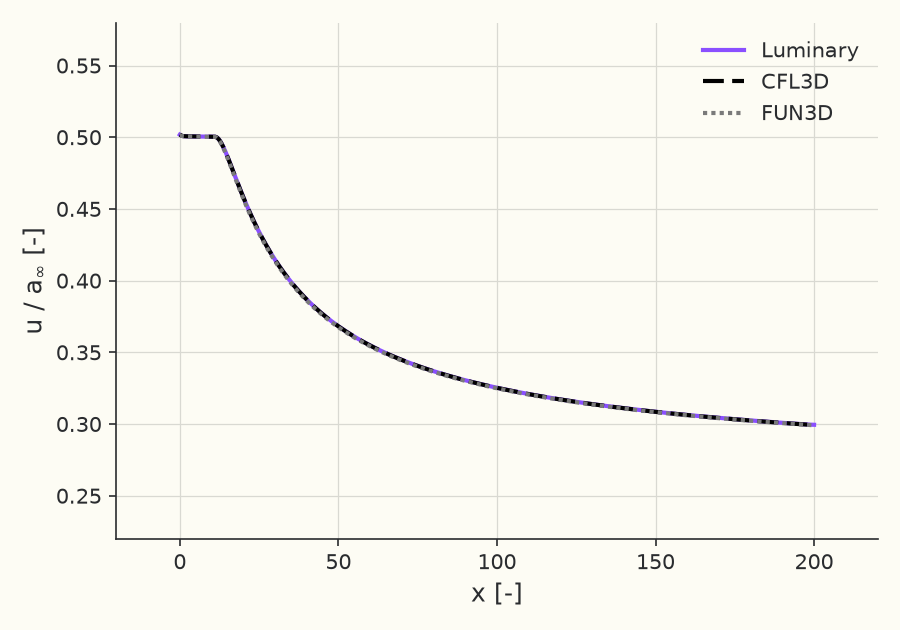
Reference: NASA Langley Turbulence Modeling Resource, "2D Coflowing Jet Verification Case" (SA model). (CFL3D / FUN3D, centerline vs ): https://tmbwg.github.io/turbmodels/shear_sa.html
Velocity profile vs at
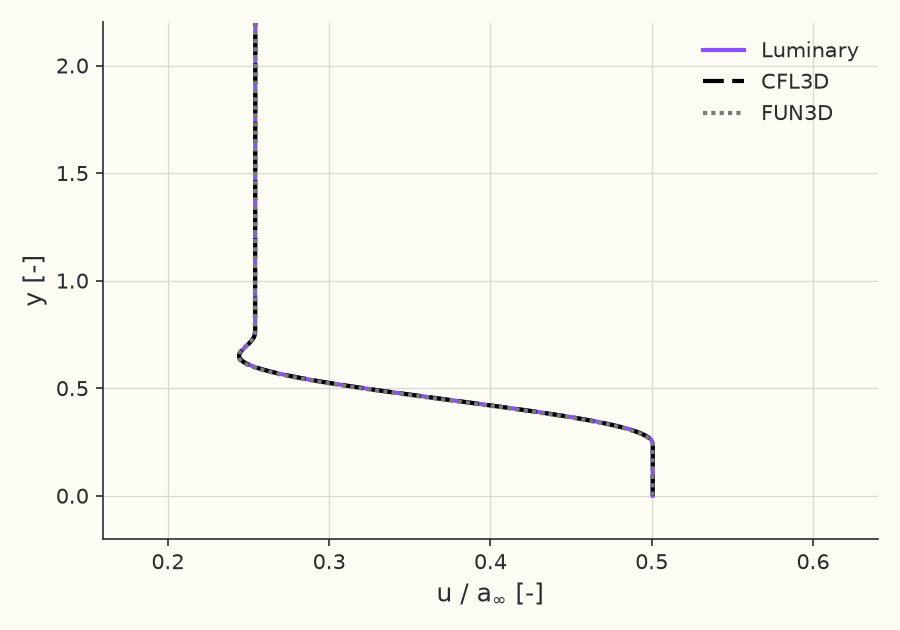
Reference: NASA Langley Turbulence Modeling Resource, "2D Coflowing Jet Verification Case" (SA model). (CFL3D / FUN3D, vs at ): https://tmbwg.github.io/turbmodels/shear_sa.html
Velocity profile vs at
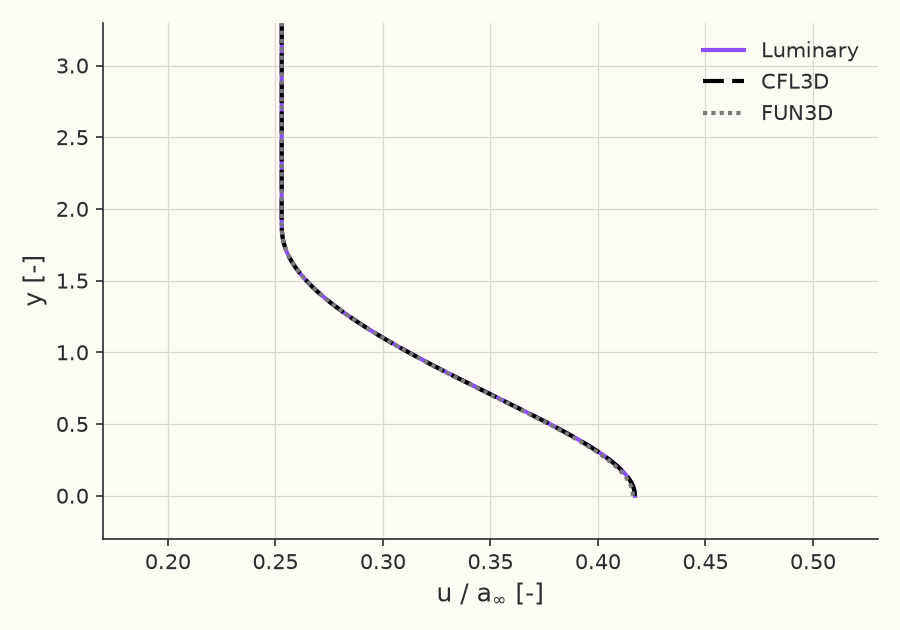
Reference: NASA Langley Turbulence Modeling Resource, "2D Coflowing Jet Verification Case" (SA model). (CFL3D / FUN3D, vs at ): https://tmbwg.github.io/turbmodels/shear_sa.html
Velocity profile vs at
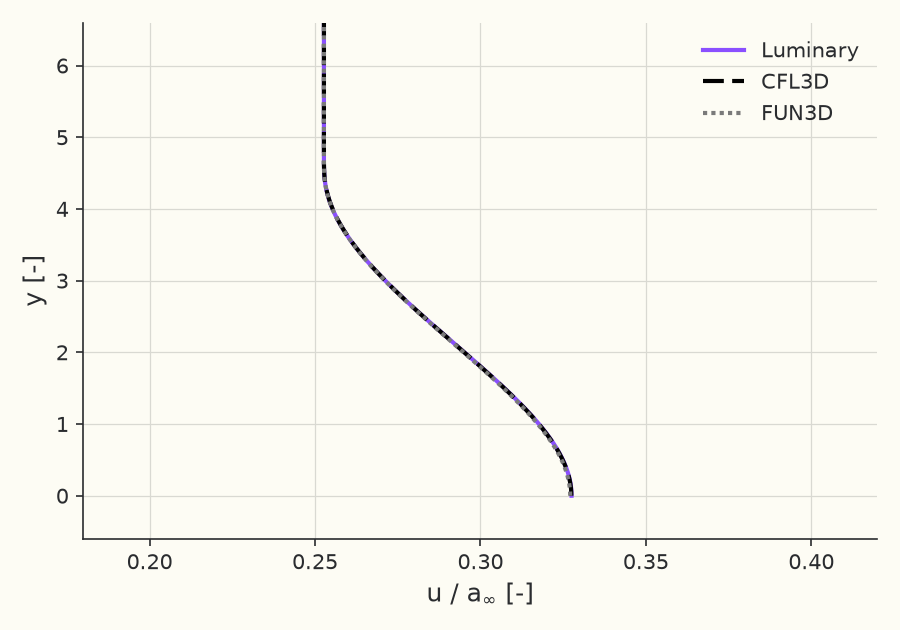
Reference: NASA Langley Turbulence Modeling Resource, "2D Coflowing Jet Verification Case" (SA model). (CFL3D / FUN3D, vs at ): https://tmbwg.github.io/turbmodels/shear_sa.html
Eddy-viscosity profile at
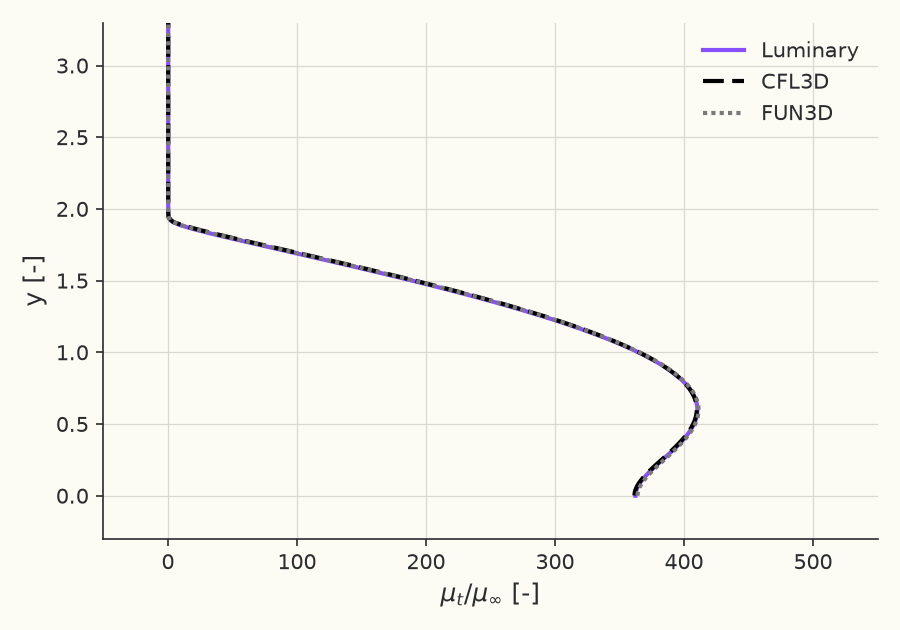
Reference: NASA Langley Turbulence Modeling Resource, "2D Coflowing Jet Verification Case" (SA model). (CFL3D / FUN3D, vs at ): https://tmbwg.github.io/turbmodels/shear_sa.html
Solver configuration
- features exercised
- Verification2DRANSSpalart–AllmarasIdeal gasSteadyEnergy equation