
Converging–Diverging Verification Nozzle
verification
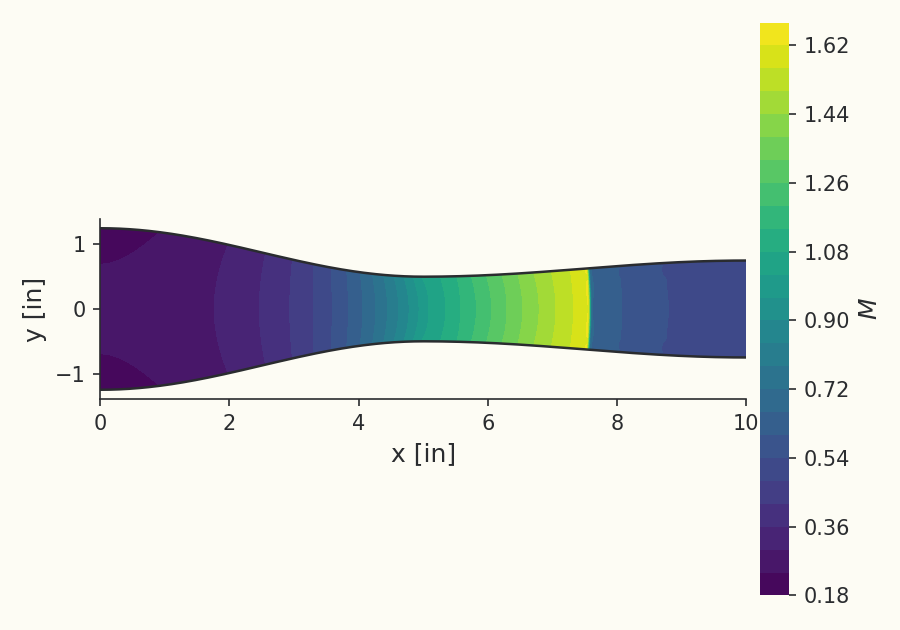
Overview
A converging–diverging nozzle is the canonical setting for compressible internal flow: depending on the ratio of exit back-pressure to inlet stagnation pressure, the same duct produces purely subsonic flow, a choked flow with an embedded normal shock, or a fully supersonic isentropic expansion. Because the steady, inviscid, adiabatic flow of a perfect gas through a slowly-varying duct is governed by the quasi-one-dimensional area–Mach relation, with a Rankine–Hugoniot jump where a shock stands, every one of these regimes has an exact closed-form solution. That makes the geometry a test of a compressible solver's ability to choke a throat, place a normal shock, and compute the downstream state, with no empirical or reference-code input.
This case reproduces the three back-pressure conditions of the NPARC Alliance verification nozzle on a single duct and compares the computed centerline distributions directly against the quasi-1D theory.
Problem Setup
The duct area follows the NPARC cosine law, with an inlet area of 2.5, a throat of 1.0 at the midpoint, and an exit of 1.5 (length units). It is modelled as a symmetric planar duct of unit depth whose half-height traces the area distribution, so the centerline is directly comparable to one-dimensional theory. Both walls are inviscid slip walls and the spanwise faces are symmetry planes.
The flow is driven by a stagnation (total-pressure) inlet at fixed total pressure and temperature; the regime is selected purely by the static pressure imposed at the outlet. Three back-pressure ratios , 0.89, 0.75, and 0.16, are run as a sweep on the same mesh, giving subsonic, normal-shock, and supersonic solutions respectively. The gas is air (); the absolute stagnation values are immaterial to the dimensionless result, so only the area ratios and back-pressure ratios (taken from NPARC) define the cases. The inviscid fluxes use a second-order FDS scheme with a Venkatakrishnan limiter for shock capturing.
Quantities of Interest
The verification quantities are the centerline Mach number and the static-to-total pressure ratio along the nozzle axis. For the subsonic case the Mach number should rise to a subsonic peak at the throat and fall again; for the shock case it should reach a supersonic peak, drop discontinuously across the standing normal shock, and recover; for the supersonic case it should pass smoothly through sonic at the throat and continue to the supersonic design exit. Each is overlaid on the exact quasi-1D solution for the matching regime.
Sources
Defines the cosine area law, the three back-pressure cases, and the comparison against one-dimensional steady inviscid compressible-flow (quasi-1D) theory.
Results
Centerline Mach number: subsonic ()
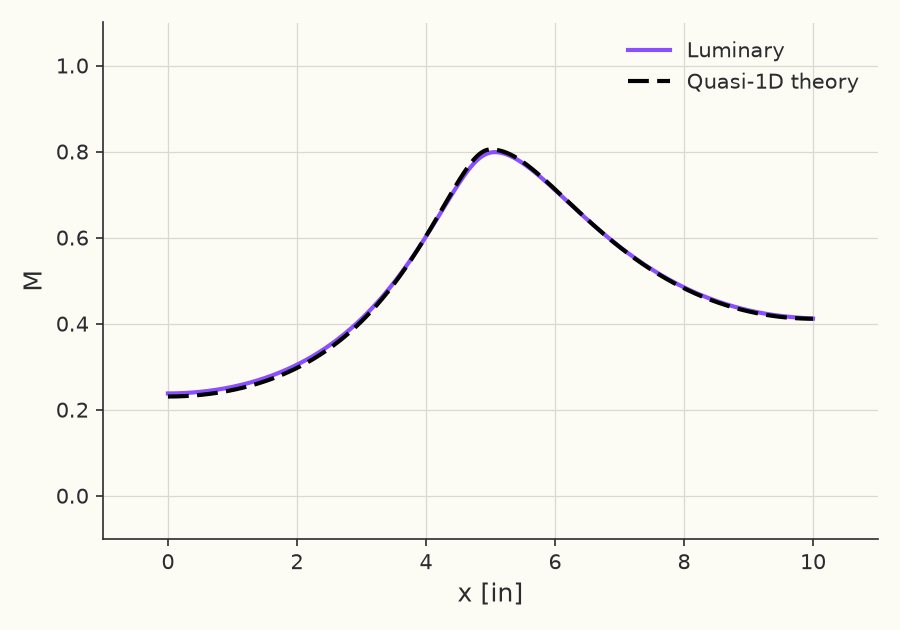
Reference: NPARC Alliance Verification & Validation Archive, "Steady, Inviscid Flow in a Converging-Diverging Verification (CDV) Nozzle," NASA Glenn Research Center. (quasi-1D isentropic area–Mach relation with a normal-shock jump where applicable ()): https://www.grc.nasa.gov/WWW/wind/valid/cdv/cdv.html
Centerline Mach number: normal shock ()
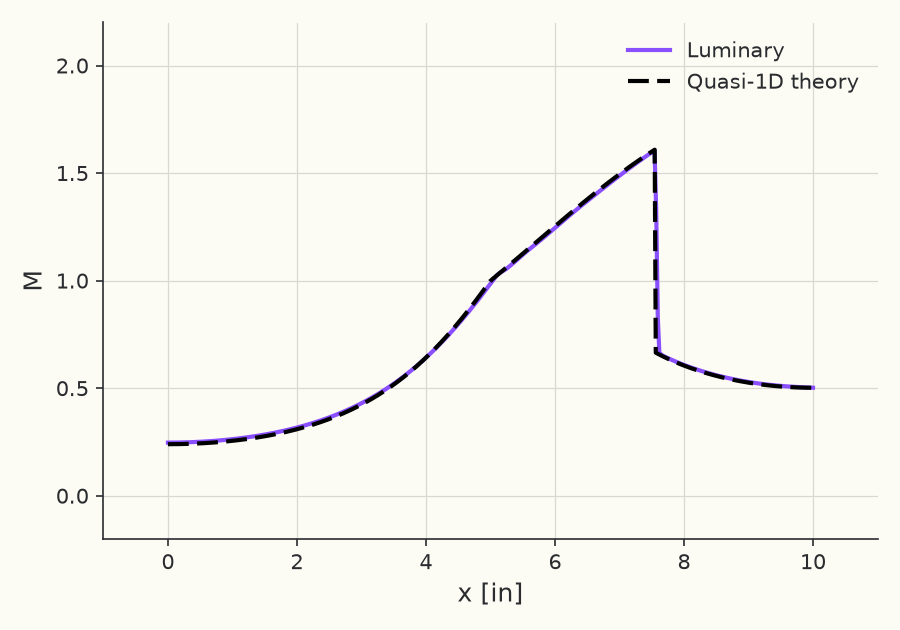
Reference: NPARC Alliance Verification & Validation Archive, "Steady, Inviscid Flow in a Converging-Diverging Verification (CDV) Nozzle," NASA Glenn Research Center. (quasi-1D isentropic area–Mach relation with a normal-shock jump where applicable ()): https://www.grc.nasa.gov/WWW/wind/valid/cdv/cdv.html
Centerline pressure: normal shock ()
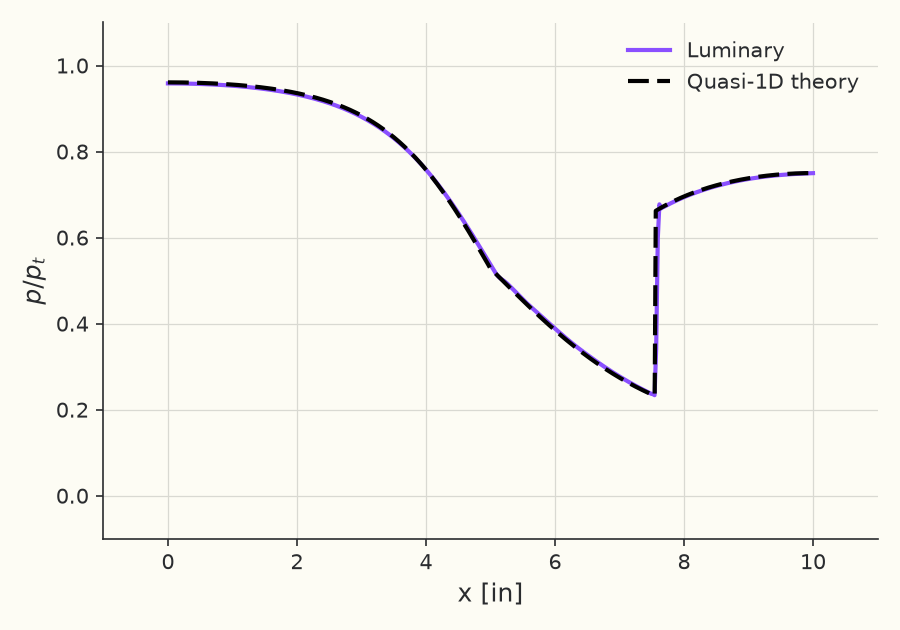
Reference: NPARC Alliance Verification & Validation Archive, "Steady, Inviscid Flow in a Converging-Diverging Verification (CDV) Nozzle," NASA Glenn Research Center. (quasi-1D isentropic area–Mach relation with a normal-shock jump where applicable ()): https://www.grc.nasa.gov/WWW/wind/valid/cdv/cdv.html
Centerline Mach number: supersonic ()
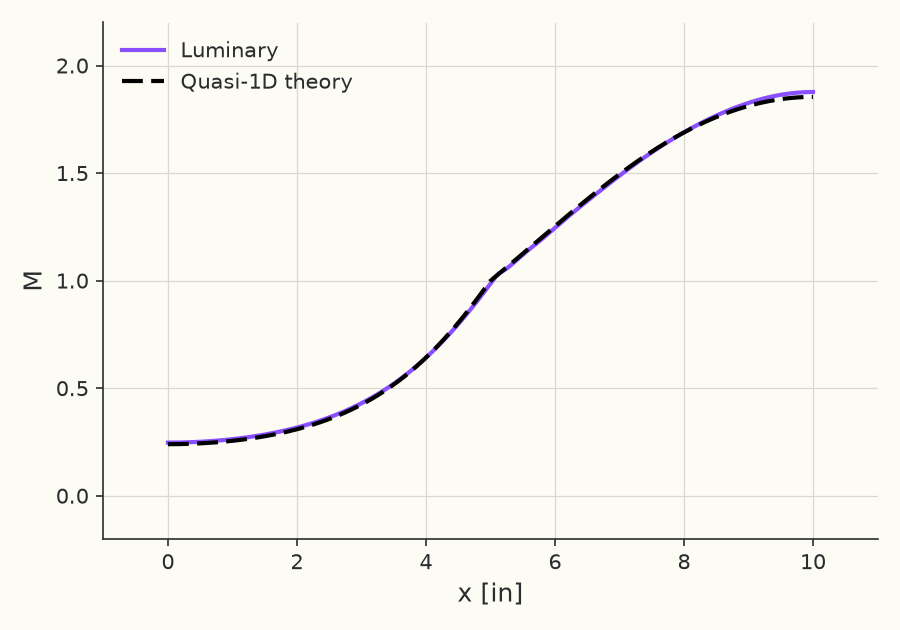
Reference: NPARC Alliance Verification & Validation Archive, "Steady, Inviscid Flow in a Converging-Diverging Verification (CDV) Nozzle," NASA Glenn Research Center. (quasi-1D isentropic area–Mach relation with a normal-shock jump where applicable ()): https://www.grc.nasa.gov/WWW/wind/valid/cdv/cdv.html
Solver configuration
- features exercised
- Verification2DInviscidIdeal gasSteadyEnergy equation