
2D Buoyancy-driven Cavity
verification
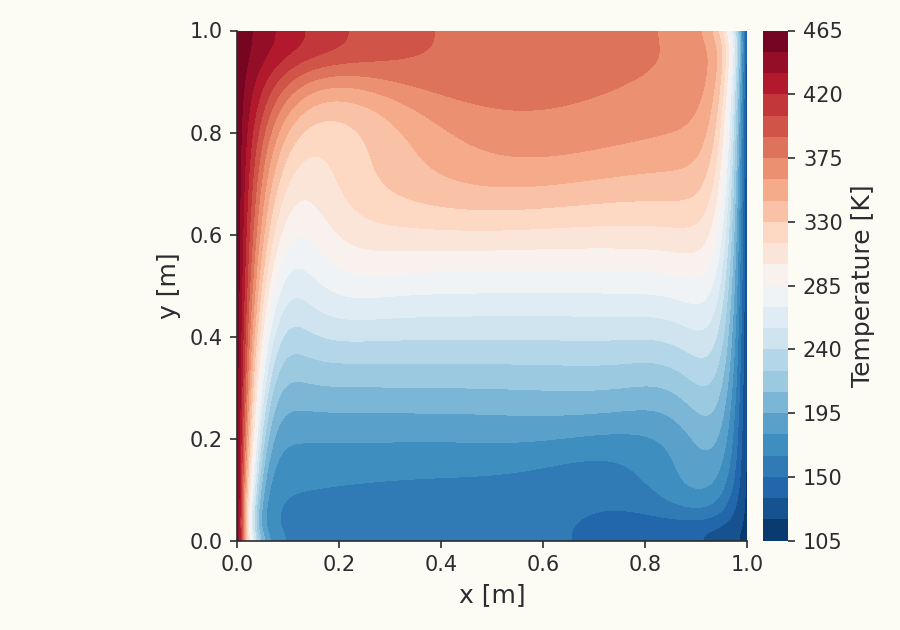
Overview
The 2D buoyancy-driven cavity, a differentially-heated square cavity, is a natural-convection benchmark for incompressible flow solvers with heat transfer. A square cavity of side has a hot left wall and a cold right wall held at fixed temperatures, insulated (adiabatic) top and bottom walls, and gravity acting in the direction. Buoyancy in the variable-density fluid drives a recirculating cell: warm, light fluid rises along the hot wall and cool, dense fluid sinks along the cold wall.
Unlike the small-temperature-difference (Boussinesq) limit, a temperature ratio is imposed here so that the full variable-density capability of the solver is exercised: density is computed from the ideal-gas law and the buoyancy body force is the complete , not a linearized approximation.
Problem Setup
The hot and cold walls are held at and (so ); the top and bottom walls are adiabatic and all four are no-slip. Gravity is in . Air is modeled as an ideal gas with , ; the dynamic viscosity and thermal conductivity are constant, giving a laminar Prandtl number .
The flow is governed by the Rayleigh number,
The Rayleigh number is set by the operating density in the cavity, which fixes the constant thermodynamic pressure through the ideal-gas law; results are reported for . The flow is solved on a uniform structured grid. Velocities are normalized by the reference velocity with Froude number .
Quantities of Interest
The x-velocity profile along the vertical centerline (), versus , is compared to the reference solution of Sockol (2003) for .
Sources
Reference solution for the differentially-heated cavity centerline profiles.
Results
Centerline x-velocity,
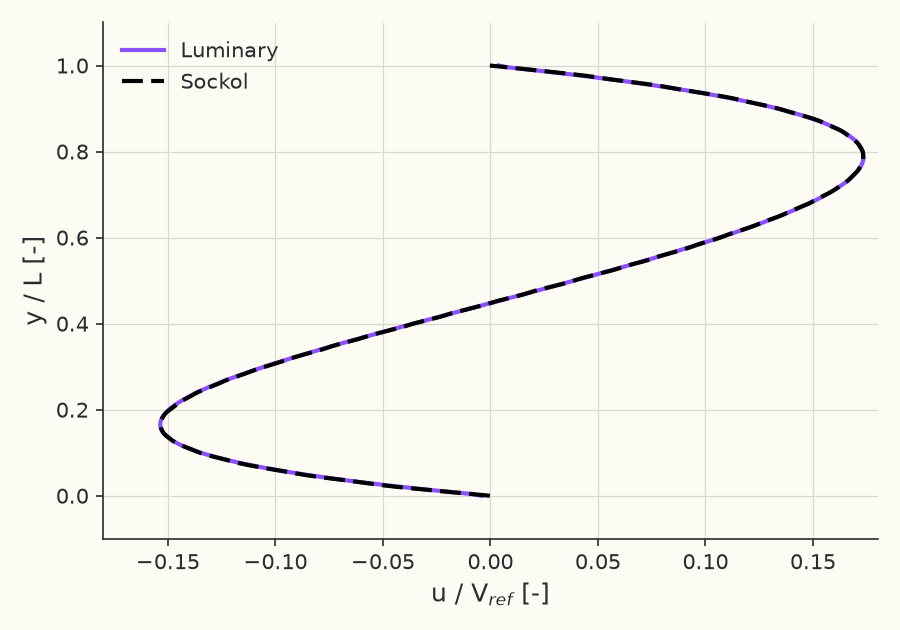
Reference: P. M. Sockol, "Multigrid solution of the Navier–Stokes equations at low speeds with large temperature variations," J. Comput. Phys. 192(2):570–592, 2003. (digitized from Fig. 1(a)): https://doi.org/10.1016/j.jcp.2003.07.033
Centerline x-velocity,
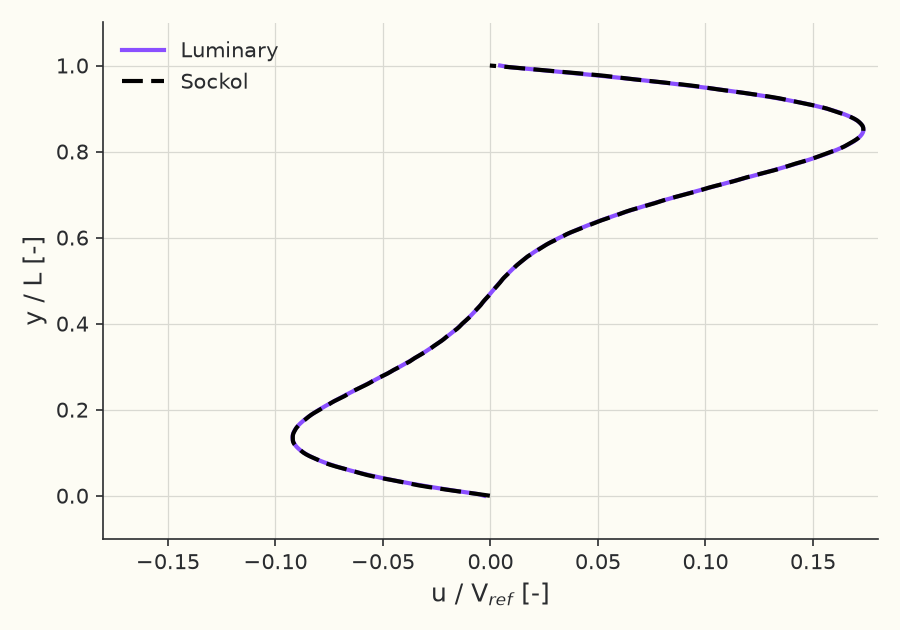
Reference: P. M. Sockol, "Multigrid solution of the Navier–Stokes equations at low speeds with large temperature variations," J. Comput. Phys. 192(2):570–592, 2003. (digitized from Fig. 1(b)): https://doi.org/10.1016/j.jcp.2003.07.033
Centerline x-velocity,
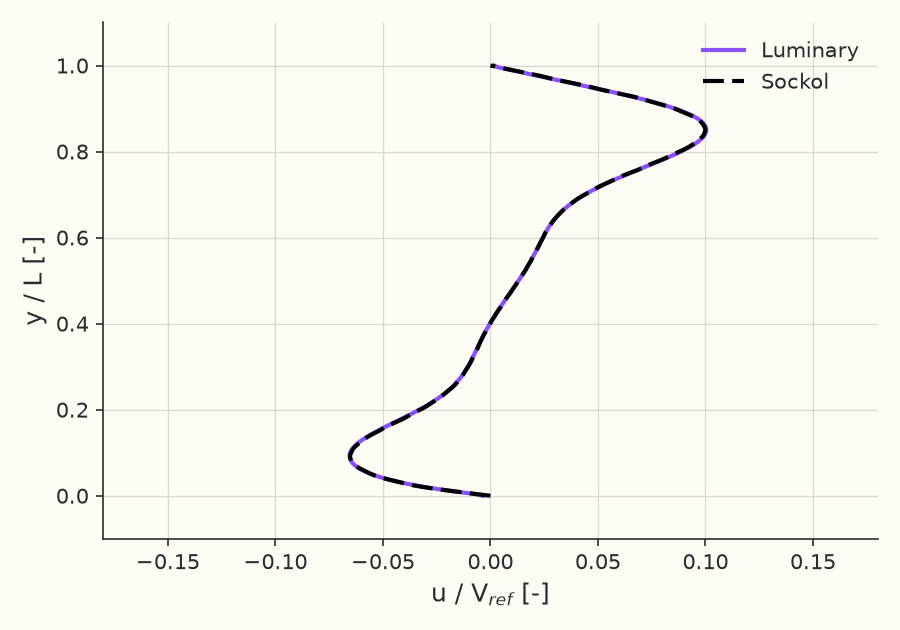
Reference: P. M. Sockol, "Multigrid solution of the Navier–Stokes equations at low speeds with large temperature variations," J. Comput. Phys. 192(2):570–592, 2003. (digitized from Fig. 1(c)): https://doi.org/10.1016/j.jcp.2003.07.033
Solver configuration
- features exercised
- Verification2DLaminarIdeal gasSteadyEnergy equationBuoyancy / gravity