2D Bump-in-channel (Turbulent Boundary Layer, SST)
verification
Overview
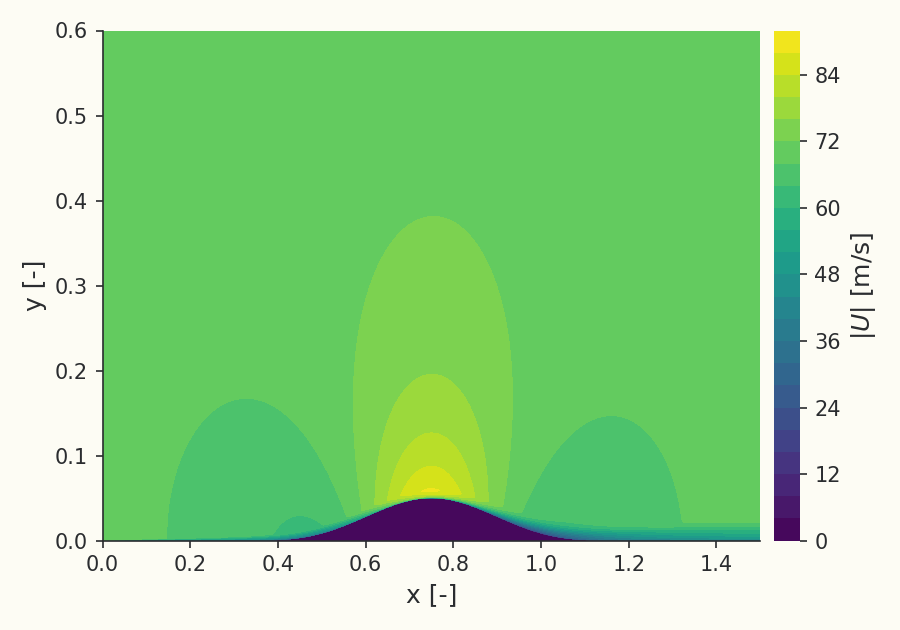
The 2D bump-in-channel is a standard verification case for Reynolds-averaged Navier–Stokes (RANS) turbulence models, one step up in complexity from the zero-pressure-gradient flat plate. A turbulent boundary layer develops along the lower wall of a channel as the flow passes over a shallow, smoothly-contoured bump. The bump accelerates the flow over its windward face and decelerates it over the lee face, imposing a favorable-then-adverse streamwise pressure gradient on the boundary layer, so, unlike the flat plate, the wall experiences both a viscous (skin-friction) and a pressure (form) drag, while the geometry stays smooth enough that the flow remains attached.
This case is the companion of the Spalart–Allmaras bump, run instead with Luminary's SST model (the Menter SST-2003m variant). The goal is code-to-code verification of the turbulence model under a streamwise pressure gradient: to reproduce, on the same grids, the results the NASA Turbulence Modeling Resource publishes for its reference codes CFL3D and FUN3D using the matching SST-2003m model.
This is a grid-convergence study: the case is solved on a family of five successively refined structured grids (89×41, 177×81, 353×161, 705×321, 1409×641, each a 2× refinement), and the key integrated quantities are tracked as the mesh is refined toward the continuum ().
Problem Setup
The free-stream Mach number is and the Reynolds number is based on the reference length , matching the NASA TMR specification. The channel spans and . The lower wall is a no-slip viscous wall over ; the bump itself rises over with the profile , reaching its crest at . Upstream () and downstream () of the plate the lower wall and the channel top () are symmetry planes, and the far upstream/downstream boundaries use a characteristic free-stream (Riemann) condition. The mesh is one cell thick in with symmetry on the spanwise planes; the reference area is (plate length × unit span).
Air is modeled as an ideal gas with Sutherland's law for the dynamic viscosity and a laminar Prandtl number . Turbulence closure is the SST (SST-2003m) model, with the free stream set to the TMR turbulence values () via direct / inflow. Each grid is converged in pseudo-time so that the remaining error is spatial, what a grid-convergence study isolates.
Quantities of Interest
The verification targets are those published on the NASA TMR SST expected-results page:
- The grid convergence of the integrated force coefficients, lift , total drag , and its pressure (form) and viscous (friction) parts and , and of the skin-friction coefficient at the bump crest , each plotted against the grid spacing . On the finest grid (1409×641), every reported coefficient, lift, total drag, its pressure and viscous parts, and at the crest, agrees with both reference codes to within 0.30%; the largest Luminary–reference difference is comparable to the CFL3D-to-FUN3D spread on the same quantity.
- The surface distributions on the finest grid: the skin-friction coefficient and the pressure coefficient along the bump, which show the favorable/adverse pressure-gradient structure the boundary layer is subjected to.
- The eddy-viscosity profile at , probing the turbulence model's behavior at the bump crest. The peak (about ninety) and the wall-normal height at which it occurs coincide with the CFL3D and FUN3D SST-2003m profiles, and the profile decays to the same channel-interior level.
Sources
Reference , , and eddy-viscosity data from the NASA CFL3D and FUN3D codes (SST-2003m variant).
Results
Finest-grid force coefficients and vs CFL3D / FUN3D
| Code | (total) | (pressure) | (friction) | at | |
|---|---|---|---|---|---|
| Luminary | 0.025088 | 0.0035815 | 0.00040046 | 0.003181 | 0.0059412 |
| CFL3D (SST-2003m) | 0.025042 | 0.0035821 | 0.00040024 | 0.0031819 | 0.0059333 |
| FUN3D (SST-2003m) | 0.025066 | 0.0035731 | 0.00039928 | 0.0031738 | 0.0059506 |
Values on the finest grid (1409 × 641).
Reference: NASA Langley Turbulence Modeling Resource, "2D Bump-in-channel Verification Case" (SST model).: https://tmbwg.github.io/turbmodels/bump_sst2003.html
Grid convergence of total
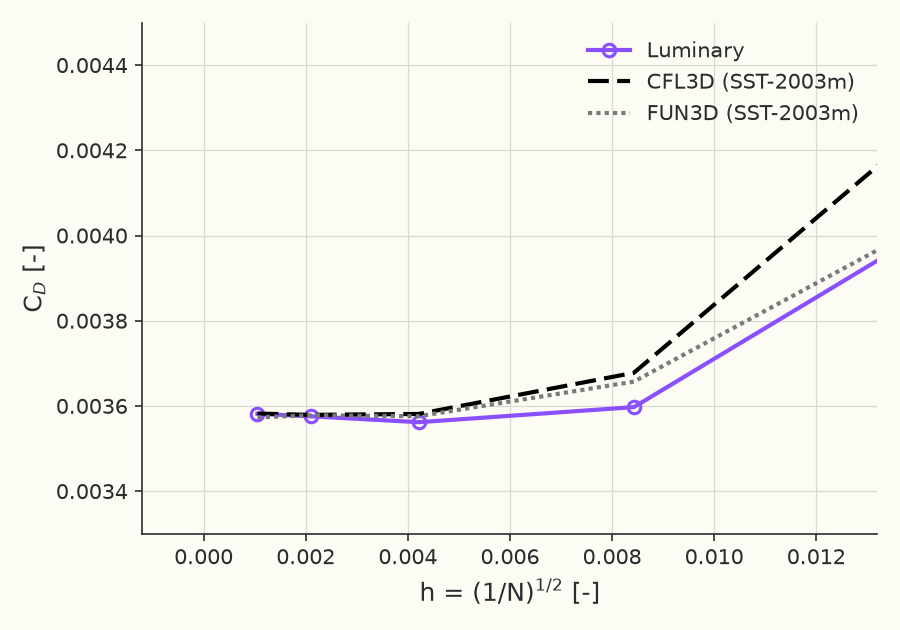
Reference: NASA Langley Turbulence Modeling Resource, "2D Bump-in-channel Verification Case" (SST model). (CFL3D / FUN3D (SST-2003m), grid convergence of total ): https://tmbwg.github.io/turbmodels/bump_sst2003.html
Grid convergence of
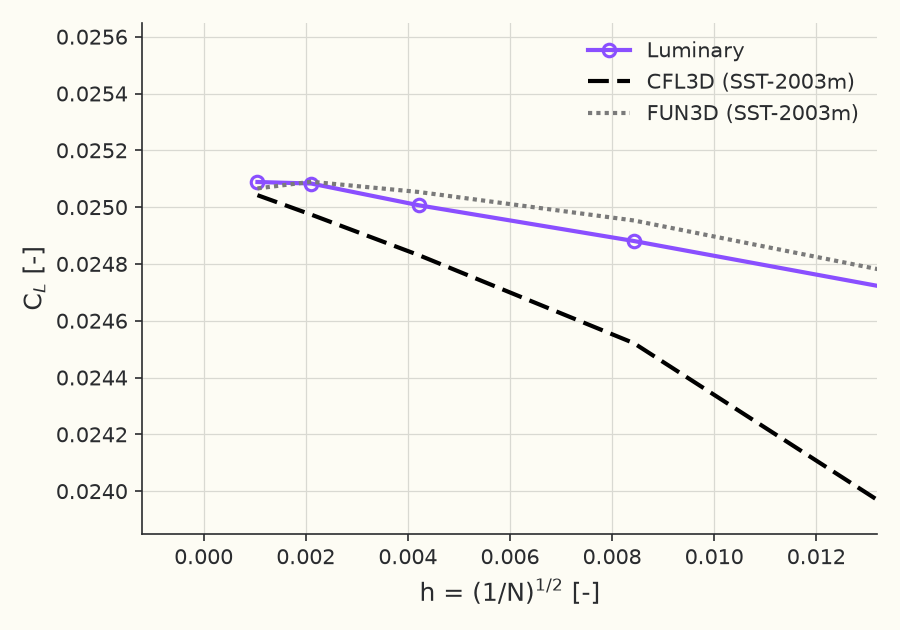
Reference: NASA Langley Turbulence Modeling Resource, "2D Bump-in-channel Verification Case" (SST model). (CFL3D / FUN3D (SST-2003m), grid convergence of total ): https://tmbwg.github.io/turbmodels/bump_sst2003.html
Grid convergence of pressure drag
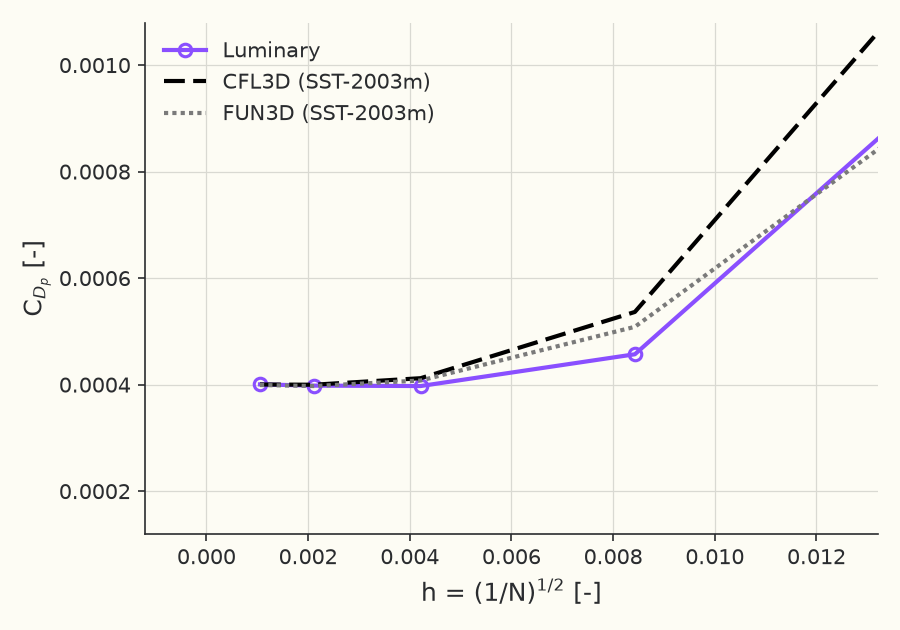
Reference: NASA Langley Turbulence Modeling Resource, "2D Bump-in-channel Verification Case" (SST model). (CFL3D / FUN3D (SST-2003m), grid convergence of total ): https://tmbwg.github.io/turbmodels/bump_sst2003.html
Grid convergence of viscous drag
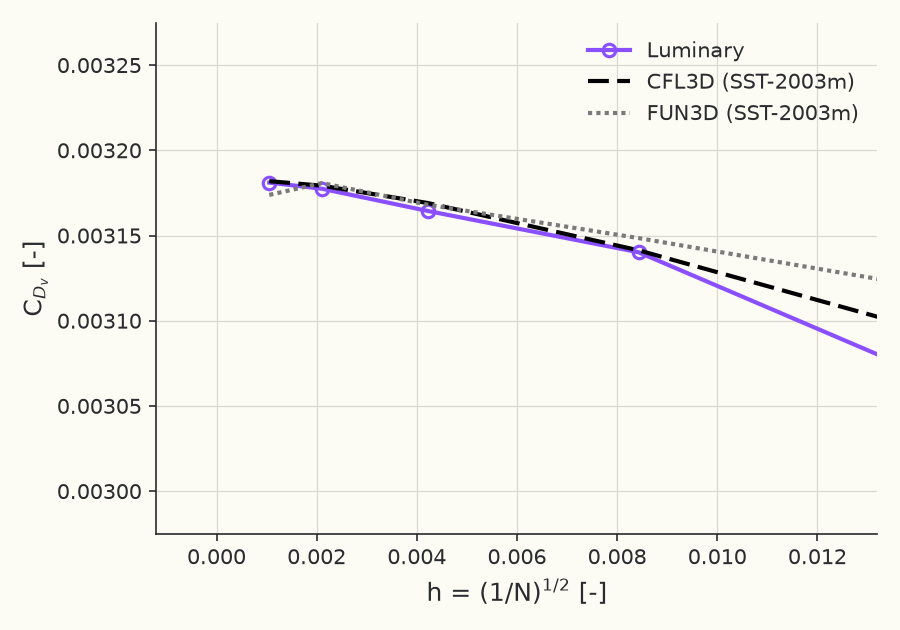
Reference: NASA Langley Turbulence Modeling Resource, "2D Bump-in-channel Verification Case" (SST model). (CFL3D / FUN3D (SST-2003m), grid convergence of total ): https://tmbwg.github.io/turbmodels/bump_sst2003.html
Grid convergence of at
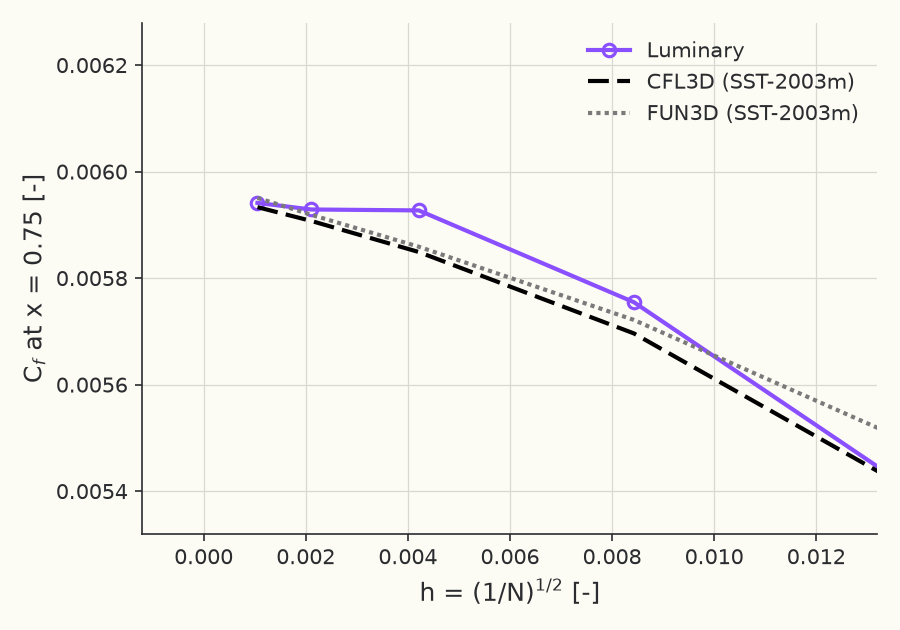
Reference: NASA Langley Turbulence Modeling Resource, "2D Bump-in-channel Verification Case" (SST model). (CFL3D / FUN3D (SST-2003m), grid convergence of at ): https://tmbwg.github.io/turbmodels/bump_sst2003.html
Skin-friction coefficient on the bump
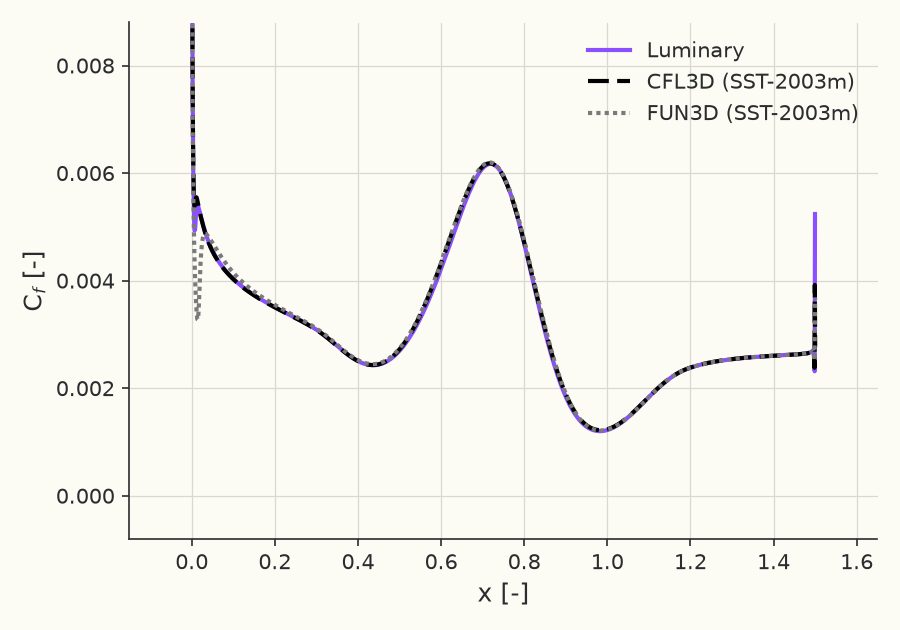
Reference: NASA Langley Turbulence Modeling Resource, "2D Bump-in-channel Verification Case" (SST model). (CFL3D / FUN3D (SST-2003m), on the finest grid): https://tmbwg.github.io/turbmodels/bump_sst2003.html
Surface pressure coefficient on the bump
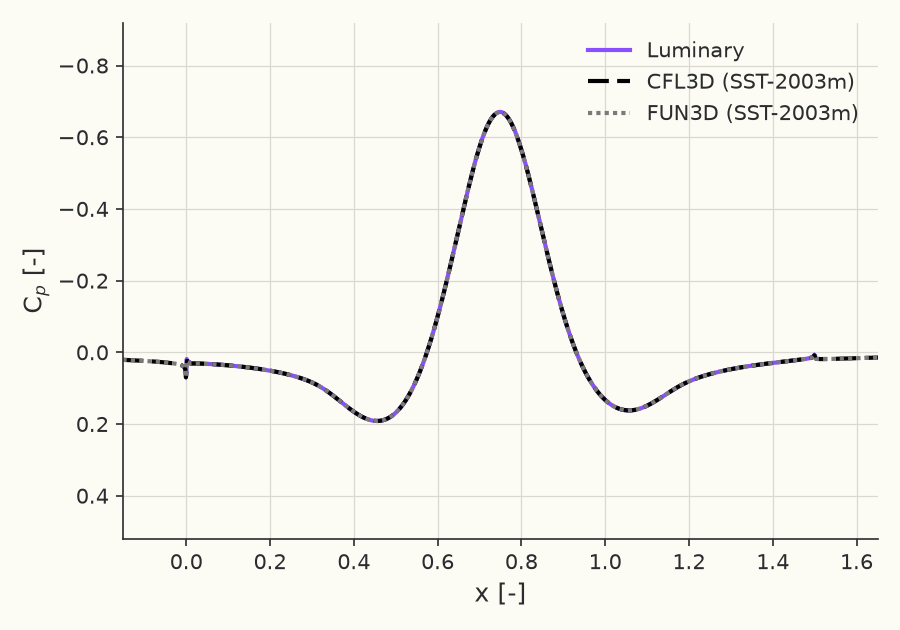
Reference: NASA Langley Turbulence Modeling Resource, "2D Bump-in-channel Verification Case" (SST model). (CFL3D / FUN3D (SST-2003m), on the finest grid): https://tmbwg.github.io/turbmodels/bump_sst2003.html
Eddy-viscosity profile at
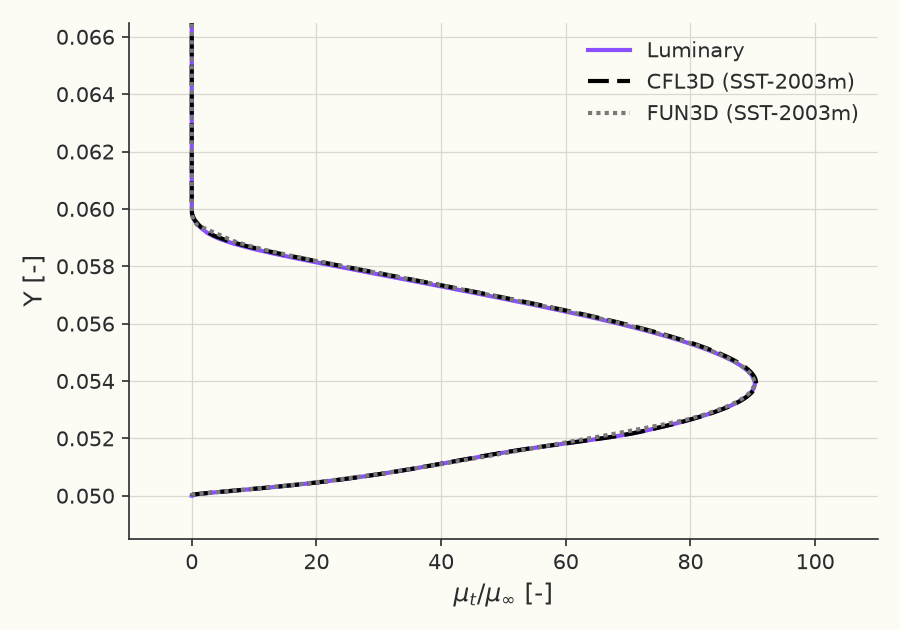
Reference: NASA Langley Turbulence Modeling Resource, "2D Bump-in-channel Verification Case" (SST model). (CFL3D / FUN3D (SST-2003m), at ): https://tmbwg.github.io/turbmodels/bump_sst2003.html
Solver configuration
- features exercised
- Verification2DRANSk–ω SSTIdeal gasSteadyEnergy equation