3D Bump-in-channel (Turbulent Boundary Layer)
verification
Overview
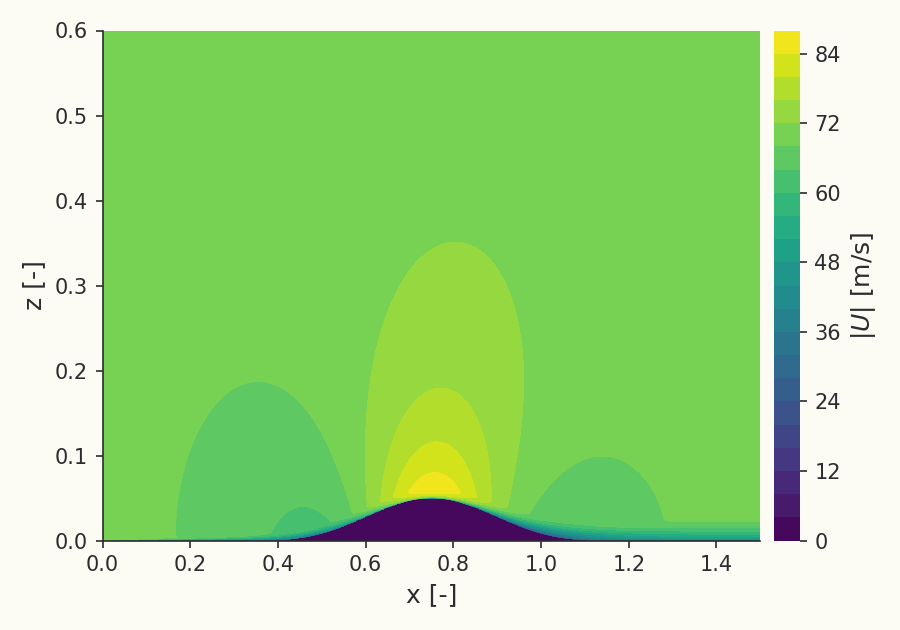
The 3D bump-in-channel is a three-dimensional turbulence-model verification case: a shallow bump on the lower wall of a channel, whose height varies in the spanwise direction so the flow develops a three-dimensional turbulent boundary layer with both favorable and adverse streamwise pressure gradients. Because the wall is curved in two directions, the drag splits into a viscous (friction) part and a pressure (form) part. With no analytic solution, verification here means demonstrating that the solver's Spalart–Allmaras (SA) result converges, under grid refinement over the NASA grid family from 3,520 up to 14.4 million cells, toward the results of the NASA reference codes CFL3D and FUN3D in lift and in each drag component.
This case exercises the solver's three-dimensional RANS path on the same physics as the 2D bump, at and .
Problem Setup
The bump is defined by for along the spanwise centre, swept across the span. The channel extends roughly 25 grid units upstream and downstream of the bump and to above it; the spanwise extent is one unit. The flow is compressible (ideal-gas air, Sutherland viscosity) at free-stream Mach number and Reynolds number based on the unit reference length, with a reference area of 1.5. Turbulence is modeled with Spalart–Allmaras.
Boundary conditions follow the NASA tunnel specification: a subsonic total-pressure inflow (total pressure and total temperature held at the free-stream stagnation state) on the upstream end and a static back-pressure outlet on the downstream end, which pins the absolute pressure datum. The bump is an adiabatic no-slip wall, and symmetry planes close the channel top, the spanwise sides, and the lower wall upstream and downstream of the bump. The grids are NASA's structured hexahedral family, used here as published so the comparison to CFL3D and FUN3D is grid-for-grid.
Quantities of Interest
The verification quantities are the integrated lift and drag on the bump and their convergence under grid refinement: the lift coefficient , the total drag coefficient , and its pressure () and viscous () components, each plotted against the grid-spacing measure and compared to the CFL3D and FUN3D reference values at the same grids. A table reports the Luminary coefficients numerically beside the two reference codes at the finest grid.
The drag is predominantly viscous: at the finest grid the friction component is about 89% of the total. On the finest grid Luminary's coefficients agree with CFL3D and FUN3D to within 0.25% in , 0.20% in , 0.38% in , and 1.4% in . The , , , and curves are shown converging under grid refinement toward the reference values as .
Sources
Reference , , and grid-convergence data from the NASA CFL3D and FUN3D codes.
Results
Finest-grid force coefficients vs CFL3D / FUN3D
| Code | (total) | (pressure) | (viscous) | |
|---|---|---|---|---|
| Luminary | 0.024996 | 0.0035808 | 0.00037865 | 0.0032021 |
| CFL3D | 0.025006 | 0.0035897 | 0.000384 | 0.0032057 |
| FUN3D | 0.025046 | 0.0035741 | 0.00038407 | 0.0031901 |
Values on the finest grid (65 × 705 × 321).
Reference: NASA Langley Turbulence Modeling Resource, "3D Bump-in-channel Verification Case" (SA model).: https://tmbwg.github.io/turbmodels/bump3d_sa.html
Grid convergence of total
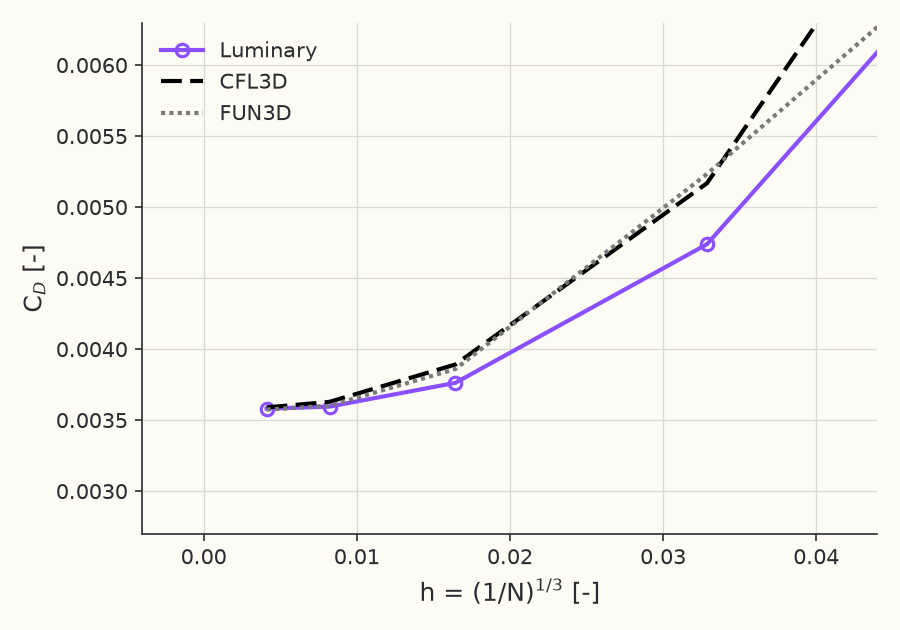
Reference: NASA Langley Turbulence Modeling Resource, "3D Bump-in-channel Verification Case" (SA model). (CFL3D / FUN3D, grid convergence of the force coefficients): https://tmbwg.github.io/turbmodels/bump3d_sa.html
Grid convergence of
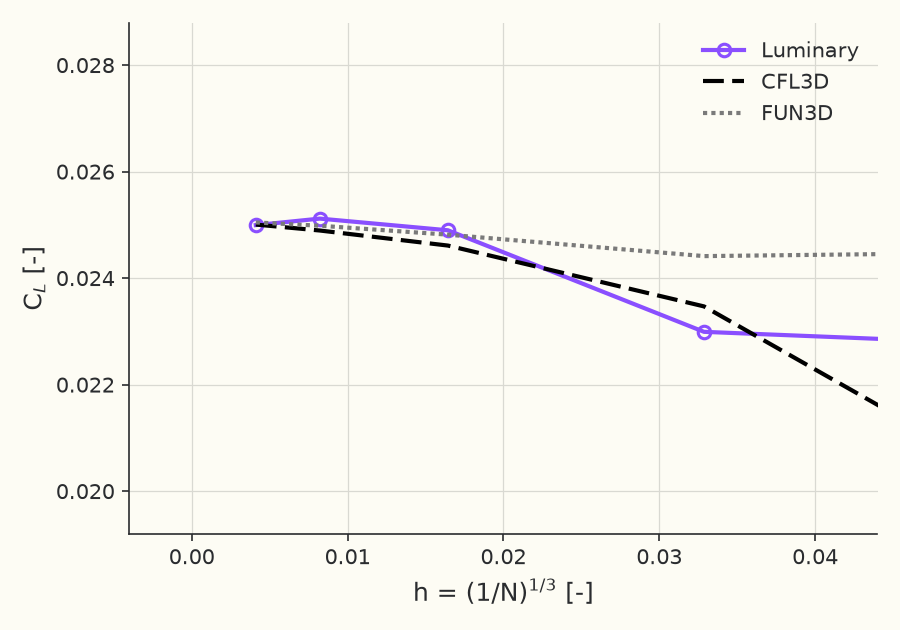
Reference: NASA Langley Turbulence Modeling Resource, "3D Bump-in-channel Verification Case" (SA model). (CFL3D / FUN3D, grid convergence of the force coefficients): https://tmbwg.github.io/turbmodels/bump3d_sa.html
Grid convergence of pressure drag
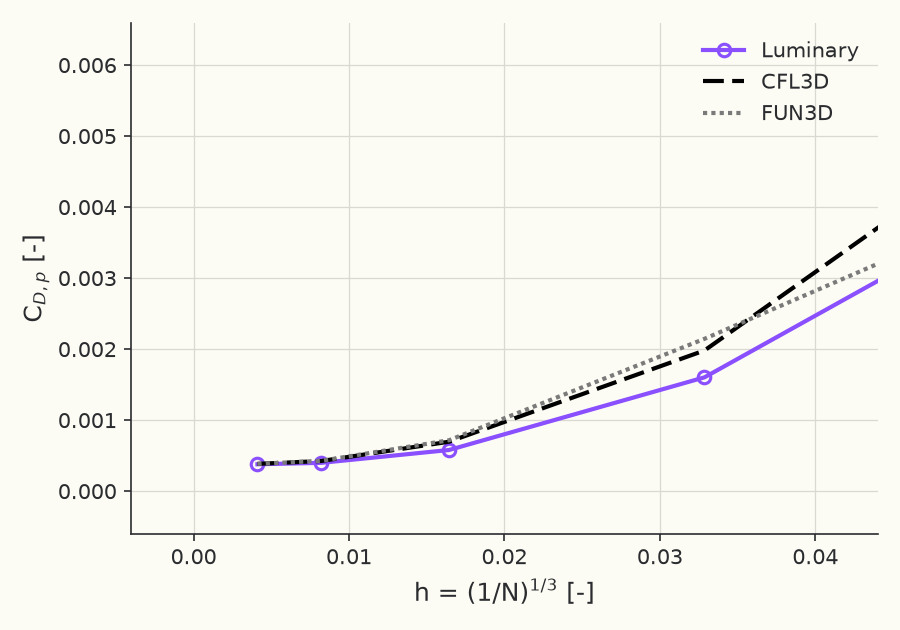
Reference: NASA Langley Turbulence Modeling Resource, "3D Bump-in-channel Verification Case" (SA model). (CFL3D / FUN3D, grid convergence of the force coefficients): https://tmbwg.github.io/turbmodels/bump3d_sa.html
Grid convergence of viscous drag
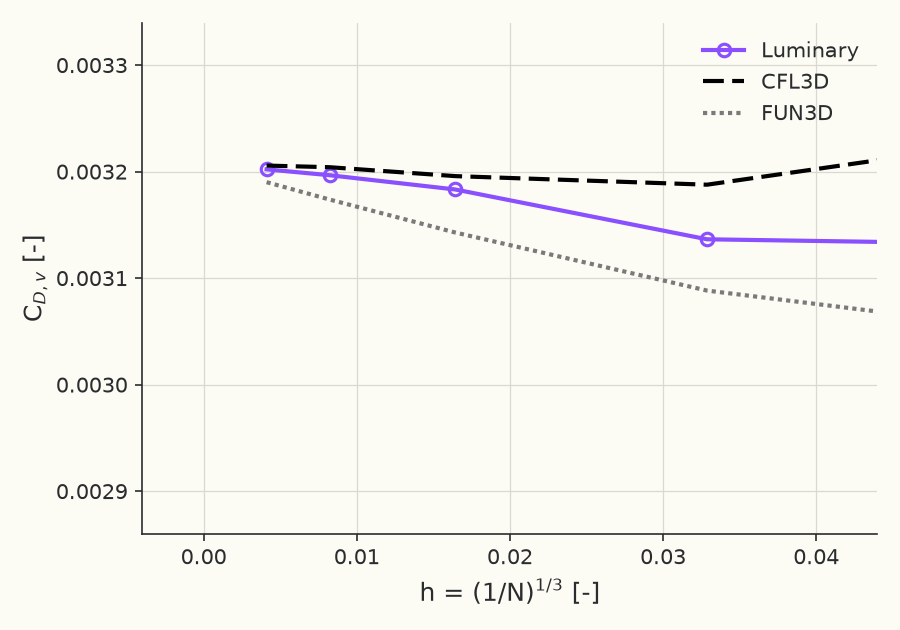
Reference: NASA Langley Turbulence Modeling Resource, "3D Bump-in-channel Verification Case" (SA model). (CFL3D / FUN3D, grid convergence of the force coefficients): https://tmbwg.github.io/turbmodels/bump3d_sa.html
Solver configuration
- features exercised
- Verification3DRANSSpalart–AllmarasIdeal gasSteadyEnergy equation