2D Bump-in-channel (Turbulent Boundary Layer)
verification
Overview
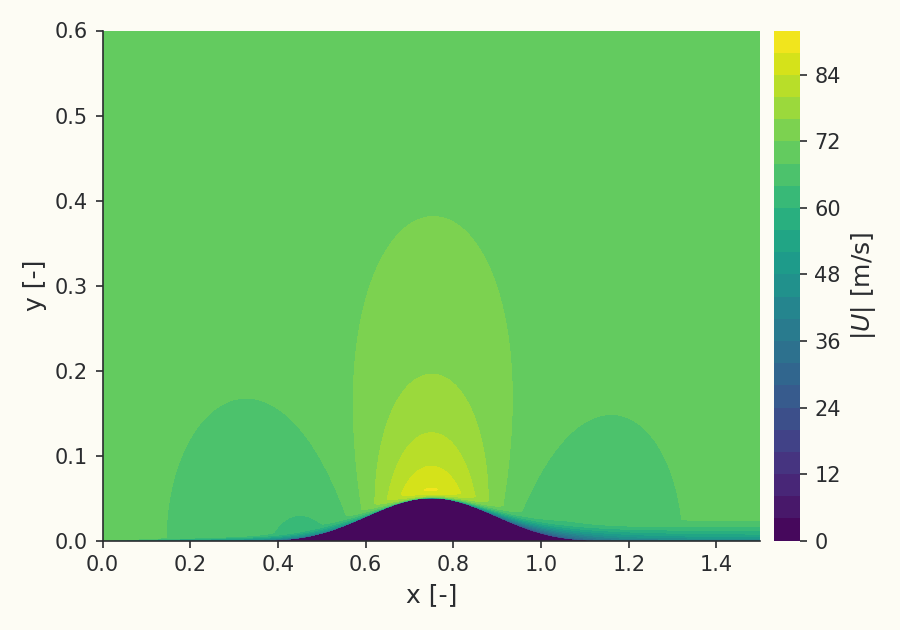
The 2D bump-in-channel is a verification case for Reynolds-averaged Navier–Stokes (RANS) turbulence models, a step up in complexity from the zero-pressure-gradient flat plate. A turbulent boundary layer develops along the lower wall of a channel as the flow passes over a shallow, smoothly contoured bump. The bump accelerates the flow over its windward face and decelerates it over the lee face, imposing a favorable-then-adverse streamwise pressure gradient on the boundary layer, so the wall carries both a viscous (skin-friction) and a pressure (form) drag while the flow remains attached. The case is a code-to-code verification of the turbulence model under a pressure gradient: the goal is to reproduce, on the same grids, the results the NASA Turbulence Modeling Resource publishes for its reference codes CFL3D and FUN3D using the Spalart–Allmaras (SA) one-equation model.
This is a grid-convergence study: the case is solved on a family of five successively refined structured grids (89×41, 177×81, 353×161, 705×321, 1409×641, each a 2× refinement), and the integrated quantities are tracked as the mesh is refined toward the continuum ().
Problem Setup
The free-stream Mach number is and the Reynolds number is based on the reference length , matching the NASA TMR specification. The channel spans and . The lower wall is a no-slip viscous wall over ; the bump rises over with the profile , reaching its crest at . Upstream () and downstream () of the plate the lower wall and the channel top () are symmetry planes, and the far upstream/downstream boundaries use a characteristic free-stream (Riemann) condition. The mesh is one cell thick in with symmetry on the spanwise planes; the reference area is (plate length × unit span).
Air is modeled as an ideal gas with Sutherland's law for the dynamic viscosity and a laminar Prandtl number . Turbulence closure is the Spalart–Allmaras model. On each grid the density residual is driven to so that the remaining error is spatial, which is what a grid-convergence study isolates.
Quantities of Interest
The verification targets are those published on the NASA TMR SA expected-results page:
- The grid convergence of the integrated force coefficients, lift , total drag , and its pressure (form) and viscous (friction) parts and , and of the skin-friction coefficient at the bump crest , each plotted against the grid spacing , compared with CFL3D and FUN3D.
- The surface distributions on the finest grid: the skin-friction coefficient and the pressure coefficient along the bump.
- The eddy-viscosity profile at .
Sources
Reference , , and eddy-viscosity data from the NASA CFL3D and FUN3D codes.
Results
Finest-grid force coefficients and vs CFL3D / FUN3D
| Code | (total) | (pressure) | (friction) | at | |
|---|---|---|---|---|---|
| Luminary | 0.024959 | 0.0035728 | 0.00038133 | 0.0031915 | 0.0061499 |
| CFL3D | 0.0249 | 0.0035724 | 0.0003817 | 0.0031907 | 0.0061494 |
| FUN3D | 0.024942 | 0.0035611 | 0.00038231 | 0.0031787 | 0.0061514 |
Values on the finest grid (1409 × 641).
Reference: NASA Langley Turbulence Modeling Resource, "2D Bump-in-channel Verification Case" (SA model).: https://tmbwg.github.io/turbmodels/bump_sa.html
Grid convergence of total
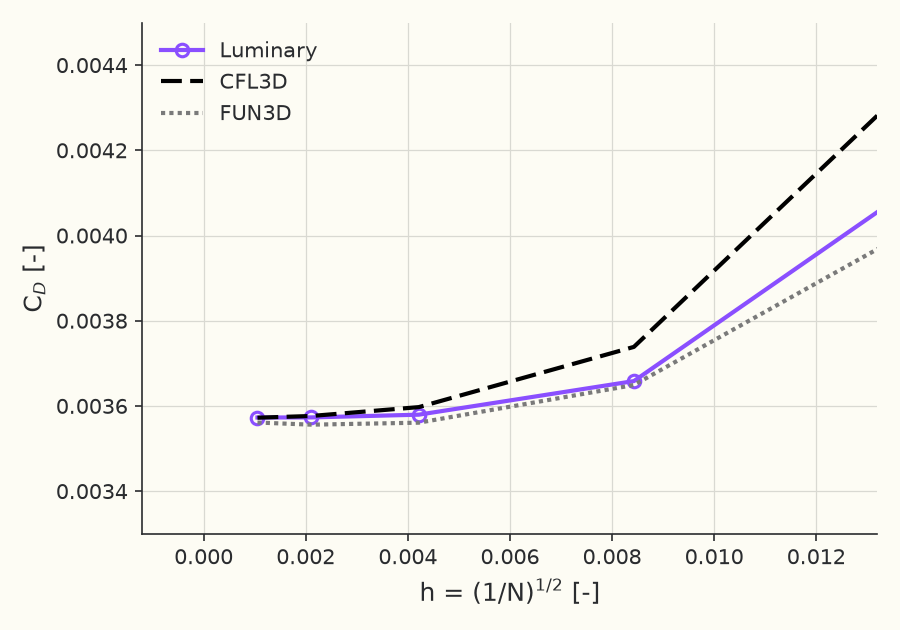
Reference: NASA Langley Turbulence Modeling Resource, "2D Bump-in-channel Verification Case" (SA model). (CFL3D / FUN3D, grid convergence of total ): https://tmbwg.github.io/turbmodels/bump_sa.html
Grid convergence of
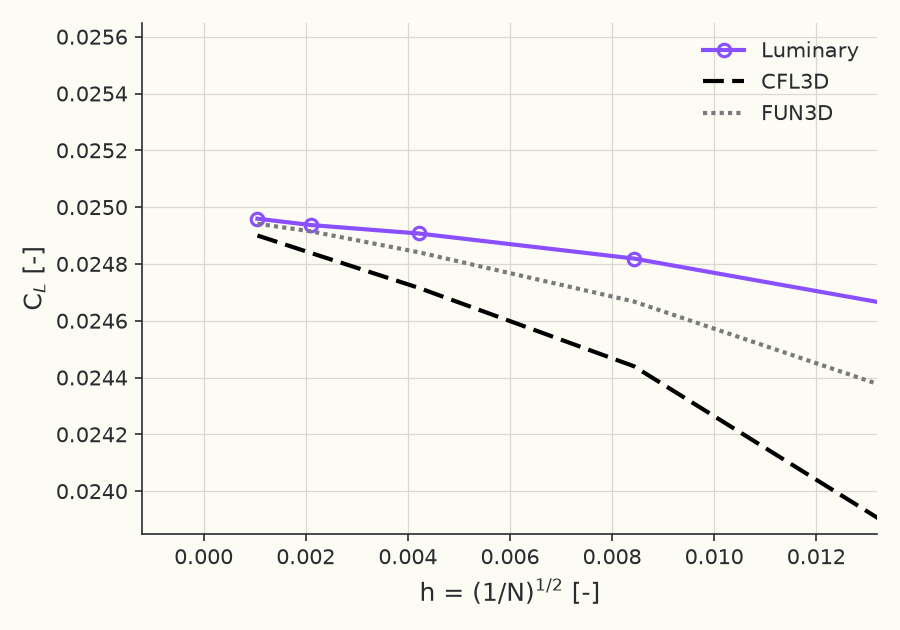
Reference: NASA Langley Turbulence Modeling Resource, "2D Bump-in-channel Verification Case" (SA model). (CFL3D / FUN3D, grid convergence of total ): https://tmbwg.github.io/turbmodels/bump_sa.html
Grid convergence of pressure drag
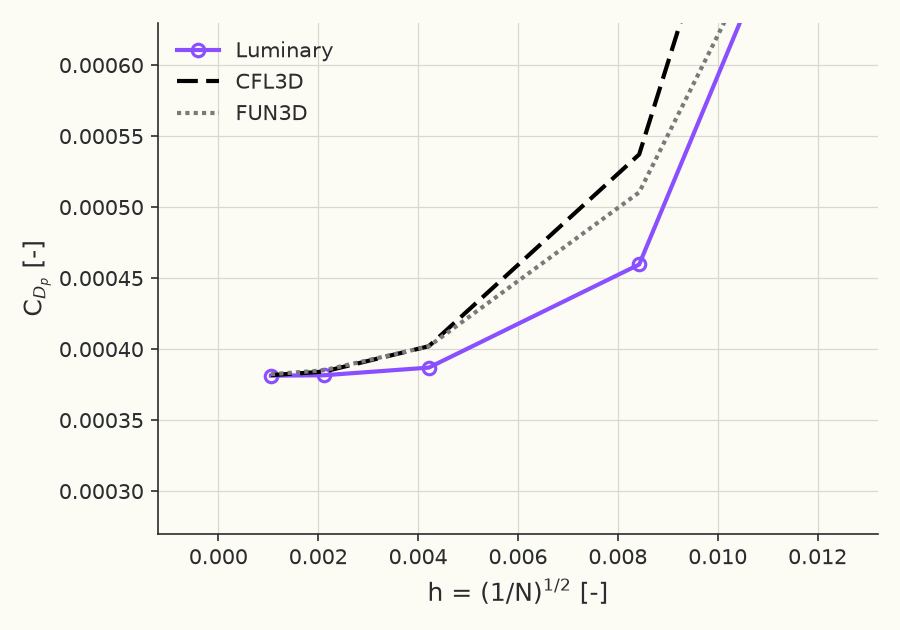
Reference: NASA Langley Turbulence Modeling Resource, "2D Bump-in-channel Verification Case" (SA model). (CFL3D / FUN3D, grid convergence of total ): https://tmbwg.github.io/turbmodels/bump_sa.html
Grid convergence of viscous drag
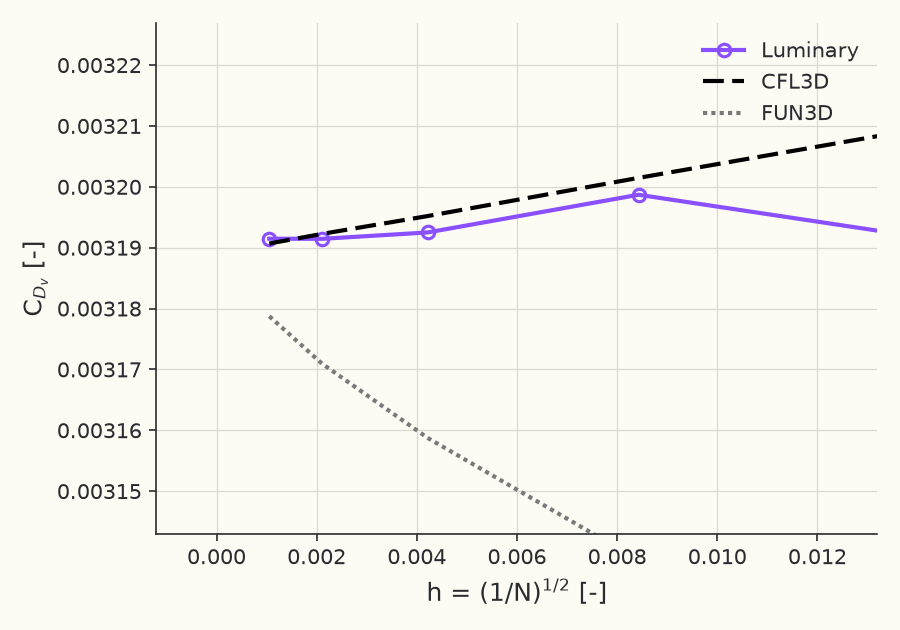
Reference: NASA Langley Turbulence Modeling Resource, "2D Bump-in-channel Verification Case" (SA model). (CFL3D / FUN3D, grid convergence of total ): https://tmbwg.github.io/turbmodels/bump_sa.html
Grid convergence of at
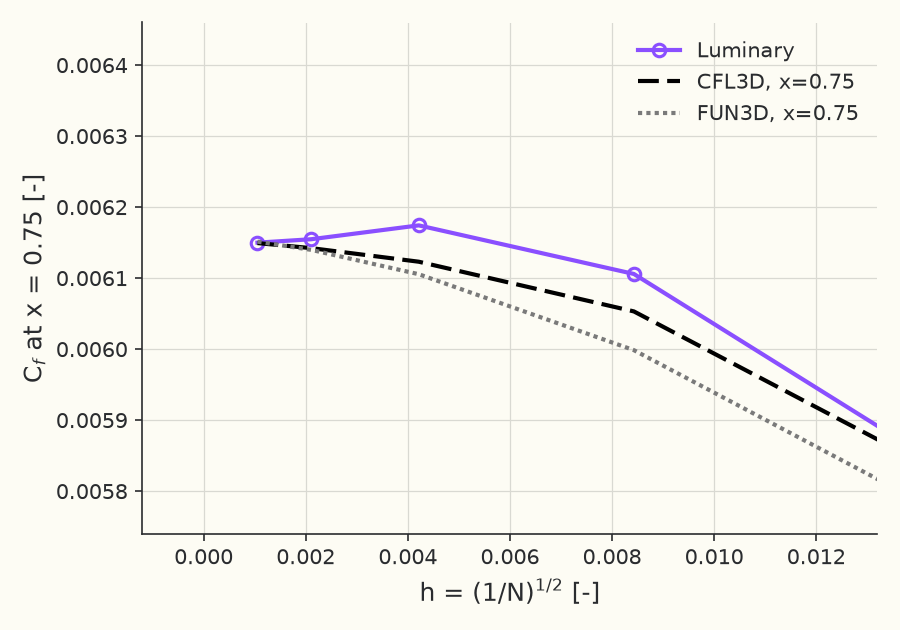
Reference: NASA Langley Turbulence Modeling Resource, "2D Bump-in-channel Verification Case" (SA model). (CFL3D / FUN3D, grid convergence of at ): https://tmbwg.github.io/turbmodels/bump_sa.html
Skin-friction coefficient on the bump
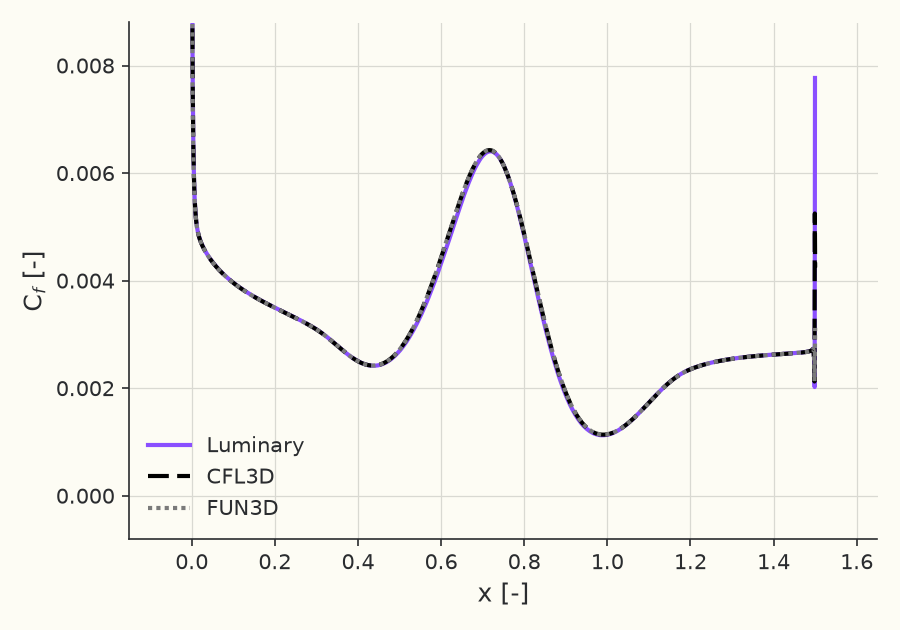
Reference: NASA Langley Turbulence Modeling Resource, "2D Bump-in-channel Verification Case" (SA model). (CFL3D / FUN3D, on the finest grid): https://tmbwg.github.io/turbmodels/bump_sa.html
Surface pressure coefficient on the bump
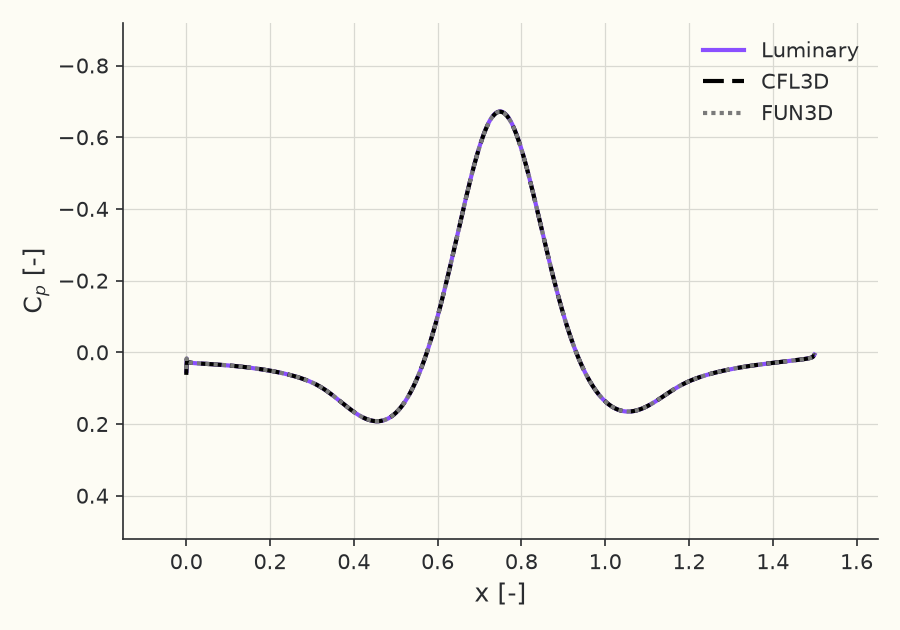
Reference: NASA Langley Turbulence Modeling Resource, "2D Bump-in-channel Verification Case" (SA model). (CFL3D / FUN3D, on the finest grid): https://tmbwg.github.io/turbmodels/bump_sa.html
Eddy-viscosity profile at
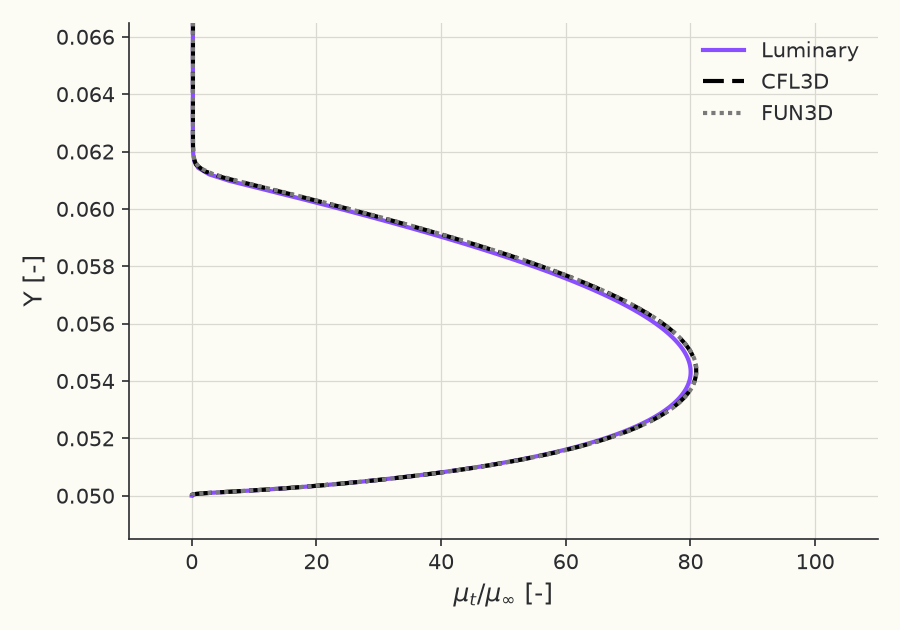
Reference: NASA Langley Turbulence Modeling Resource, "2D Bump-in-channel Verification Case" (SA model). (CFL3D / FUN3D, at ): https://tmbwg.github.io/turbmodels/bump_sa.html
Solver configuration
- features exercised
- Verification2DRANSSpalart–AllmarasIdeal gasSteadyEnergy equation