
Backward-Facing Step: DDES (Vogel-Eaton)
validation
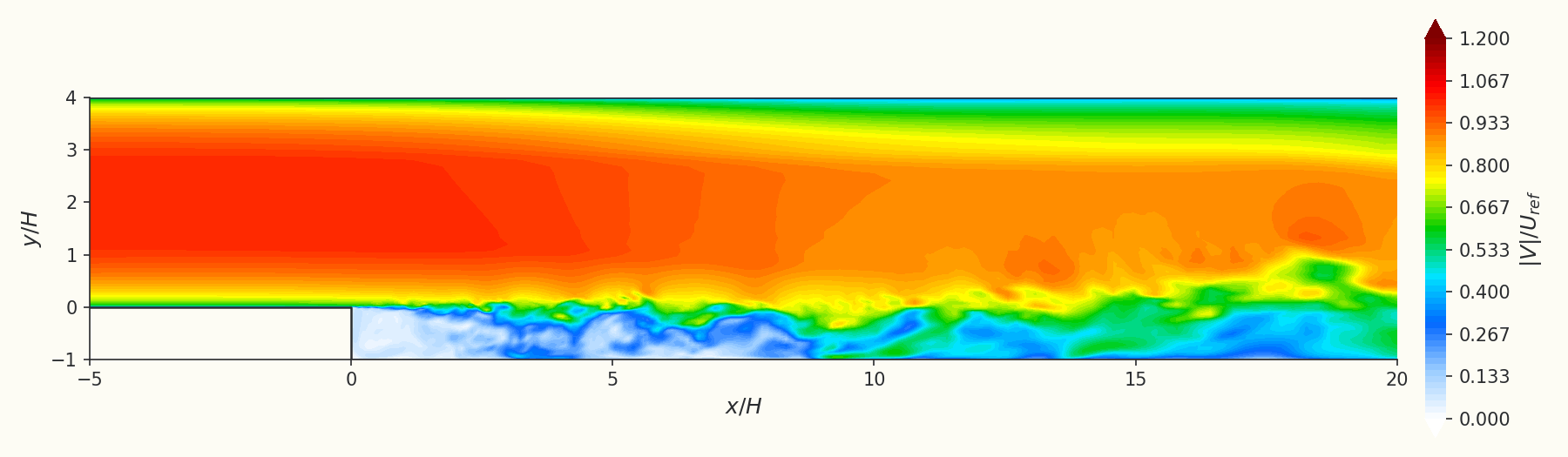
Overview
The backward-facing step is a separated-flow benchmark: a turbulent boundary layer detaches at a sharp step, forms a recirculation bubble, and reattaches on the wall downstream. The reattachment length and the recovery of the wall shear stress are sensitive measures of how well a turbulence treatment represents the separated shear layer and its reattachment.
This case computes the Vogel & Eaton (1985) step at with Spalart-Allmaras Delayed Detached Eddy Simulation (DDES), a scale-resolving hybrid RANS-LES method that runs RANS in the attached boundary layer and resolves the turbulent eddies of the separated shear layer and wake. The result is compared two ways: against the Vogel-Eaton experiment, and against the enhanced-DDES simulation of Shur et al. (2015), which used the same vortex-tilting-measure length scale on this configuration.
Problem Setup
The geometry is a backward-facing step of height mm with a 5:4 channel expansion ratio. The domain is three-dimensional and spanwise-periodic over a width of . The inflow develops along an upstream section (a slip-wall startup region followed by a no-slip wall long enough to establish at the step edge), then expands over the step into a downstream channel of length . The mesh is a structured-hexahedral grid of about 3.92 million cells with near-wall spacing giving on the resolved walls.
The fluid is treated as an ideal gas with Sutherland's-law viscosity. The boundary conditions are a total-pressure inlet ( Pa, K), a static-pressure outlet, no-slip adiabatic walls on the step-side and opposite channel walls, slip walls on the upstream startup section, and a translational periodic pair across the span.
Turbulence is modeled with Spalart-Allmaras DDES using the 2015 vortex-tilting-measure length scale and an shielding function, with . The convective scheme is a low-dissipation variant of FDS that blends upwind and centered contributions. Time integration is second-order implicit (BDF2) at a fixed step s; the simulation is first advanced until the flow is statistically stationary, after which time- and spanwise-averaged statistics are accumulated.
Quantities of Interest
The primary quantities are the skin-friction coefficient along the step-side (lower) wall, whose zero crossing locates the mean reattachment point, measured at , and the mean streamwise velocity profiles at four downstream stations, . Both are compared against the Vogel-Eaton experiment and the Shur et al. (2015) DDES.
Sources
Backward-facing step experiment at , expansion ratio 5:4; skin friction and reattachment on the step-side wall.
Enhanced DDES with the vortex-tilting-measure length scale; the backward-facing step is one of its validation cases (Figs. 33-35), giving the code-to-code reference and velocity profiles.
Results
Lower-wall skin friction
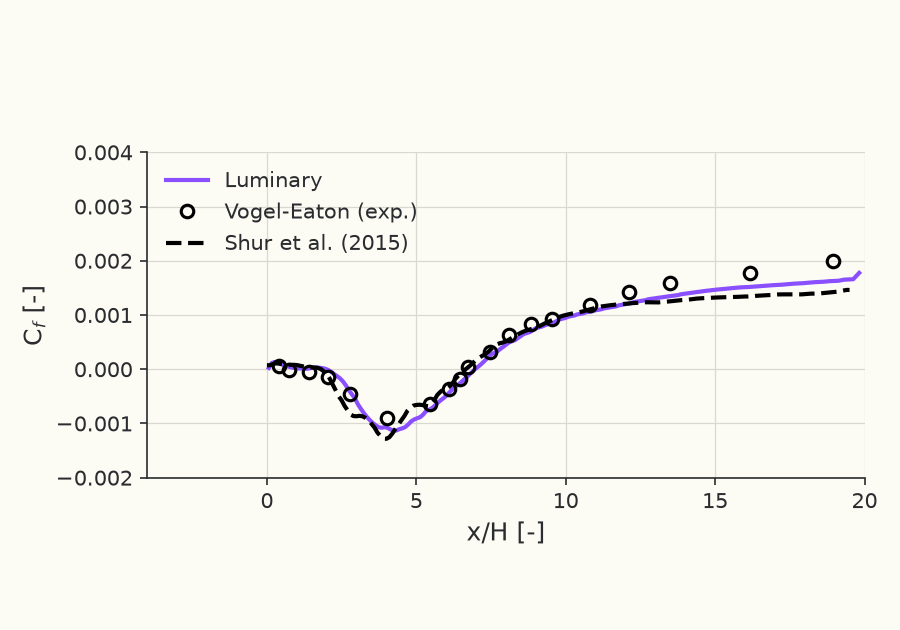
Reference: J. C. Vogel and J. K. Eaton, "Combined Heat Transfer and Fluid Dynamic Measurements Downstream of a Backward-Facing Step," Journal of Heat Transfer 107(4):922-929, 1985. (digitized from Shur et al. (2015), Figs. 33a, 35): https://doi.org/10.1115/1.3247522
Reattachment (C_f zero crossing): x_r/H = 6.97.
Mean streamwise velocity profiles
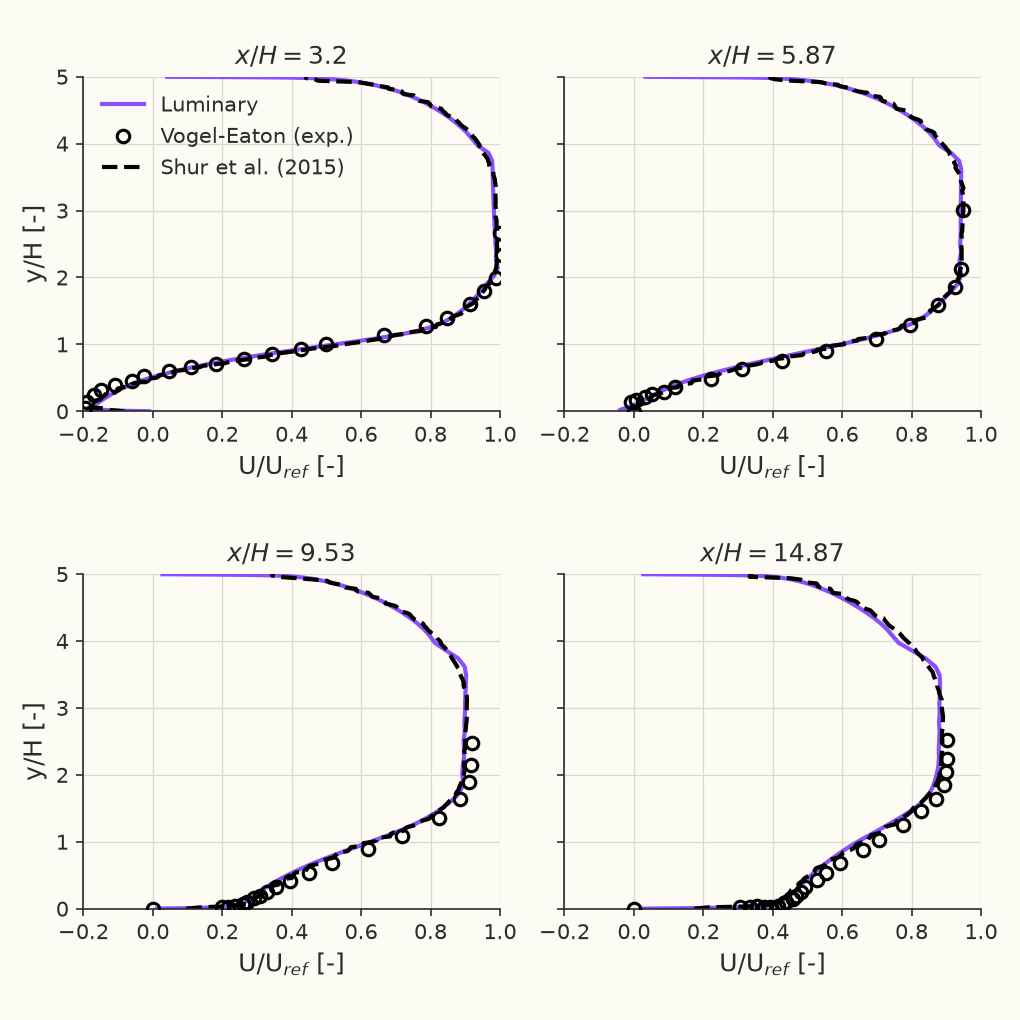
Reference: J. C. Vogel and J. K. Eaton, "Combined Heat Transfer and Fluid Dynamic Measurements Downstream of a Backward-Facing Step," Journal of Heat Transfer 107(4):922-929, 1985. (digitized from Shur et al. (2015), Fig. 34): https://doi.org/10.1115/1.3247522
Solver configuration
- features exercised
- VerificationValidation3DDES/LESSpalart–AllmarasIdeal gasUnsteadyEnergy equation