
Laminar Backward-Facing Step at Re = 800
verification
Overview
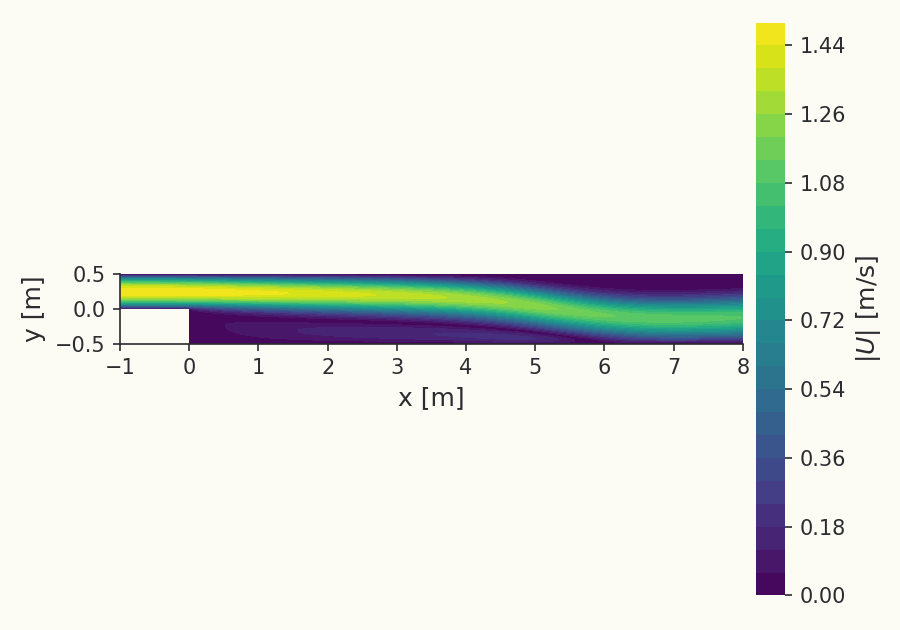
The backward-facing step is the canonical test of a solver's ability to capture laminar flow separation and reattachment. At a Reynolds number of 800 the flow is steady and two-dimensional: the shear layer leaving the step encloses a primary recirculation bubble in the step corner, and the displacement of the core flow drives a second, weaker separation bubble on the opposite wall further downstream. Gartling (1990) computed this configuration with a finite-element method on an extended channel, and the resulting solution is used here as a numerical benchmark.
This is a code-to-code verification: Luminary's solution is compared directly against Gartling's benchmark finite-element numerical solution at the same Reynolds number. The verified quantities are the horizontal-velocity profiles across the channel at two streamwise stations downstream of the step.
Problem Setup
The geometry is a sudden symmetric expansion of ratio two: the inlet channel has height equal to the step height , and the downstream channel height is . The step face sits at and lengths are reported relative to the channel height (Gartling's convention), measured from the step. Rather than prescribing the parabolic channel profile directly at the inlet, a long upstream channel (about 1.25 times the laminar hydrodynamic entry length) precedes the step, so a uniform inflow develops into the fully-developed profile on its own before reaching the expansion.
The fluid is treated as constant-density with constant viscosity, and the viscosity is chosen so that the Reynolds number based on the downstream channel height and the mean inlet velocity is . The inlet is a uniform velocity inlet, the outlet a fixed-pressure boundary placed downstream of the reattachment region, and all channel walls are no-slip. The solve uses a second-order scheme with no limiter and is run to a steady-state density-residual target of .
Quantities of Interest
The quantity of interest is the horizontal-velocity profile across the channel, examined at two streamwise stations: (through the shear layer and the primary recirculation bubble) and (where the flow is recovering after reattachment). At each station Luminary's profile is compared against Gartling's benchmark numerical solution. The velocity-magnitude field shows the primary step-corner recirculation bubble and the secondary bubble on the opposite wall.
Sources
Benchmark finite-element solution of the laminar backward-facing step at ; tabulated horizontal-velocity profiles at and (measured from the step).
Results
Horizontal velocity at
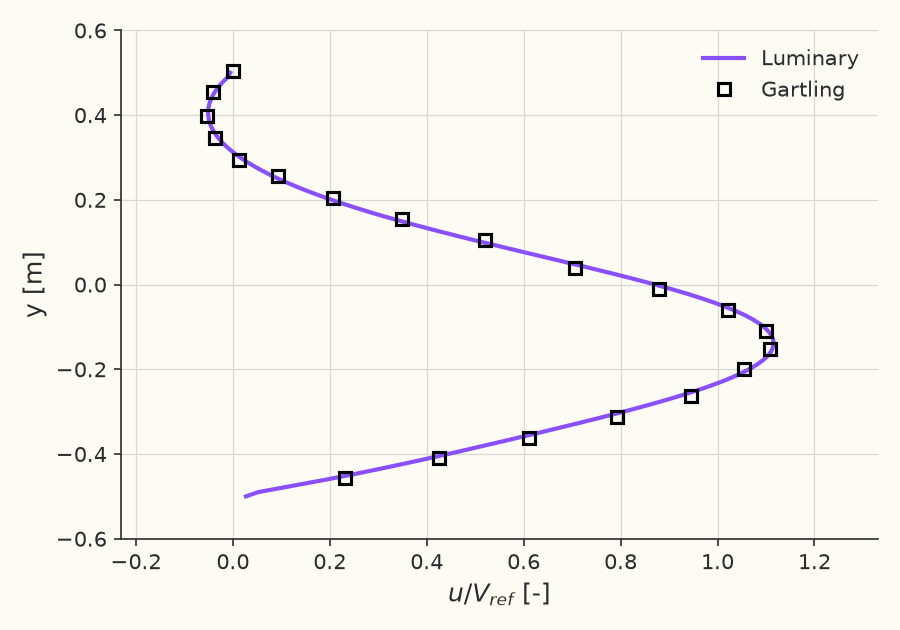
Reference: D. K. Gartling, "A test problem for outflow boundary conditions: flow over a backward-facing step," International Journal for Numerical Methods in Fluids 11(7), 953–967 (1990). ( profile at ): https://doi.org/10.1002/fld.1650110704
Horizontal velocity at
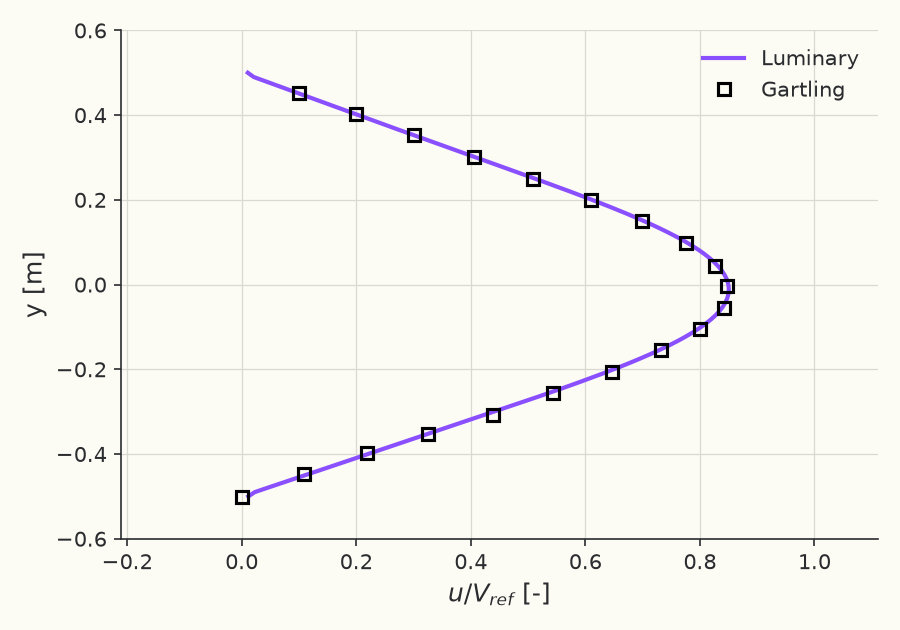
Reference: D. K. Gartling, "A test problem for outflow boundary conditions: flow over a backward-facing step," International Journal for Numerical Methods in Fluids 11(7), 953–967 (1990). ( profile at ): https://doi.org/10.1002/fld.1650110704
Solver configuration
- features exercised
- Verification2DLaminarConstant densitySteadyEnergy equation